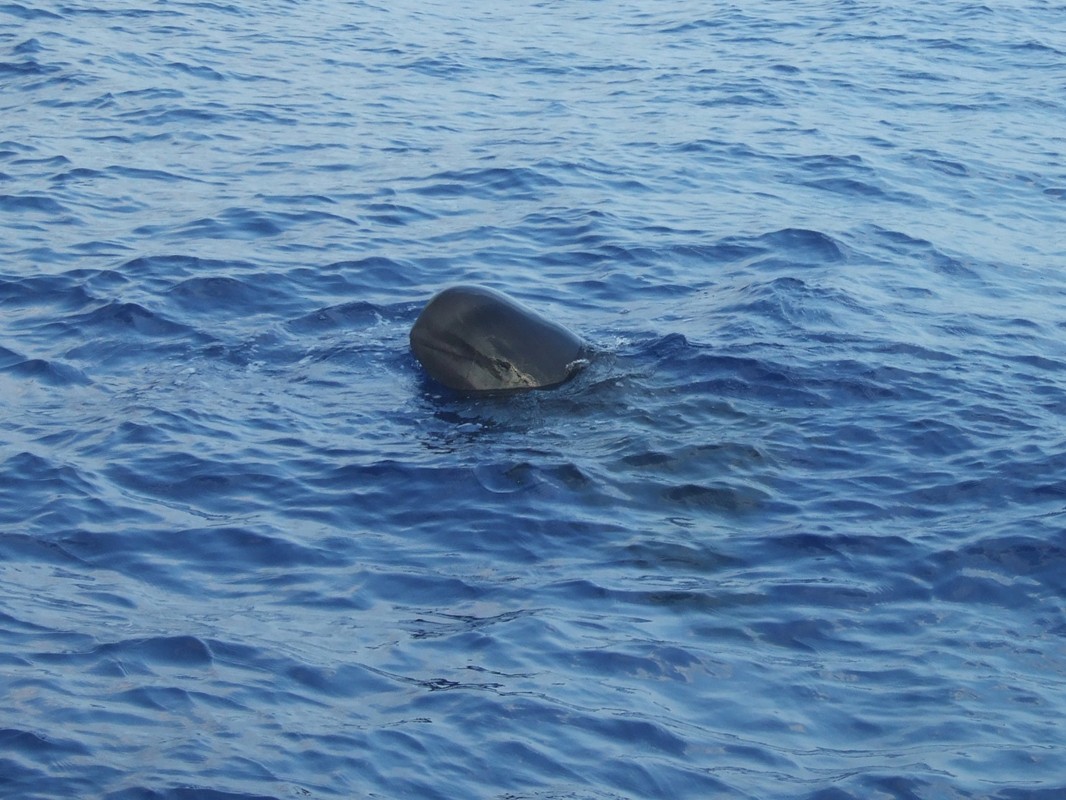
Short-finned pilot whales
Hawaii
(The Big Island):March 6-16
Day 7, Pilot Whales
Short-finned pilot whales
The next morning we didn’t get to enjoy our new
lanai, as we
had an early tour planned. Needing to be at Honokohau Harbor (north of
Kailua)
at 7:00 a.m., we left the room when it was still dark at 6:10. The tour
boats
there are easy to find, as they are moored right along the inside edge
of the
harbor and each has a big sign behind their boat. We stopped by the
restroom
just as Captain Tom was stepping out and he immediately guessed who we
were. We
grabbed our gear and headed down to the boat which was tied by the
stern to the
small dock along the edge of the harbor and from the bow by a mooring
buoy. Tom
gave us a brief overview and we were on our way. For a six-pack, the
boat was
spacious. The back deck had plenty of room, somewhat interrupted by the
fishing
seat bolted to the middle. There was a cushioned seat to either side of
the
boat amidships, and a few steps between them led to a small salon with
bench
seats and a table and a small head. The wheelhouse was built above the
salon,
which made it a bit hard to hear Tom when he talked to us while we were
underway, but it seemed like a good setup.
In researching whale watching in Hawaii, I quickly
saw that
whale watching boats don’t limit themselves to humpback season, but
offer trips
all year, targeting small toothed whales in the summer (e.g.,
short-finned
pilot whales, false killer whales, beaked whales, dolphins). Intrigued,
I’d
picked Tom more or less at random and emailed him from Juneau to ask if
those
whales were also seasonal or whether they might be around in the
winter. He
responded right away that they were
there all winter but he never had demand to see them when humpbacks are
around—and to let him know if I wanted a private charter. After some
internal
debates (I could rent my own boat for cheaper) Chris and I decided to
go ahead
with the charter. After all, I wouldn’t know where to begin to find
them.
Tom knew where to begin. We headed straight out
from the
harbor until we hit 1,000 fathoms (6,000 feet). Like most of the
toothed whales
(spinner dolphins being the exception), pilot whales (which was the
most likely
whale we’d encounter) spend all day in deep water, feeding on squid and
such at
night and resting at the surface during the day. Once we hit 6,000
feet, we
turned south and drove along at that depth, keeping a look out for
black bodies
on the surface. I had no idea what to expect. At that time of year, Tom
doesn’t
have a lot of intel to use, and he encouraged us to point out anything
we saw.
Not far into the trip I got excited when I saw splashes toward the
island
which,  though
they weren’t the black bodies Tom said to look for,
seemed
promising. I soon realized with some embarrassment that I was seeing
surf
hitting the shore in the distance. One thing Tom mentioned was that
fishing
boats can sometimes give away pilot whale pods, as boats will circle
them in
the hope that game fish are hanging out with them. It was as I was
gazing
toward a fishing boat to the west with that in mind that I saw the
black
bodies. I waited half a second for another look at which point I saw
dorsal
fins and called it out. Chris saw them immediately, but it took Tom a
couple of
minutes to spot them (partly because I was not very good at describing
where
they were). They were probably a couple of hundred feet out and, once
Tom saw
them, he exclaimed that they were pilot whales, and we turned toward
them. We
were just under one hour from stepping on the boat.
though
they weren’t the black bodies Tom said to look for,
seemed
promising. I soon realized with some embarrassment that I was seeing
surf
hitting the shore in the distance. One thing Tom mentioned was that
fishing
boats can sometimes give away pilot whale pods, as boats will circle
them in
the hope that game fish are hanging out with them. It was as I was
gazing
toward a fishing boat to the west with that in mind that I saw the
black
bodies. I waited half a second for another look at which point I saw
dorsal
fins and called it out. Chris saw them immediately, but it took Tom a
couple of
minutes to spot them (partly because I was not very good at describing
where
they were). They were probably a couple of hundred feet out and, once
Tom saw
them, he exclaimed that they were pilot whales, and we turned toward
them. We
were just under one hour from stepping on the boat.
The
first thing Tom noticed was that it was a
small group.
Apparently he usually sees groups of about 17 and, in the end, I was
pretty
confident of eight. There was a group of four or five younger animals
who wound
up in a cluster off the starboard stern, a couple others more widely
spaced off
the stern and port stern, and one larger female (the leader of that
sub-group)
farther to port. The dorsal fin is a tell of age and, at some point,
gender,
with mature male fins being very large with big hooks on the end of
them. The
groups are matrilineal and females form lifelong bonds; unlike their
cousins
the orcas, however, males don’t necessarily (or possibly ever?) stay
with their
mother’s pod, and we saw no mature males among them.
So we slowed to a standstill and, while we bobbed
on the
back deck, the ocean was alive with spyhopping pilot whales! The fellow
behind
the boat might have been the most active, raising his head high above
the water
over and over. The group to starboard, who were closest, also spyhopped
repeatedly, and we got occasional looks from port as well. It was a
total
delight, and Tom said he’d never seen so much spyhopping activity.
Pilot whales
are, I have to confess, adorable, with their round heads and small
mouths. They
looked as delighted to check us out as we were to see them. Perhaps the
rarity
of winter fans made them more interested than usual. Tom kept an eye on
the
dominant female, warning us that when she decided it was time, the rest
of the
group would follow her underwater. But every time she made a feint
toward
diving deep, she came up again. When she  finally
did shut it down, it
was after
a very, very slow pass with the whole pod across the stern of the boat.
We
could see their dark shapes under the water and, when they surfaced, we
could
see what looked to be nicks and/or barnacles on their fins. We had one
more
long, rolling, spyhopping encounter as they passed the starboard side
and then
they dove deeper and disappeared. Pilot whales don’t normally fluke,
but I did
see the tail of one individual as a wave from behind him pushed his
flukes into
view; the edges of them were curled (which I gather is normal).
finally
did shut it down, it
was after
a very, very slow pass with the whole pod across the stern of the boat.
We
could see their dark shapes under the water and, when they surfaced, we
could
see what looked to be nicks and/or barnacles on their fins. We had one
more
long, rolling, spyhopping encounter as they passed the starboard side
and then
they dove deeper and disappeared. Pilot whales don’t normally fluke,
but I did
see the tail of one individual as a wave from behind him pushed his
flukes into
view; the edges of them were curled (which I gather is normal).
Feeling
a little giddy at our luck, we moved our
way south and kept a lookout. Twelve
minutes later we caught up with another group of pilot whales, likely
the rest
of the pod we’d seen earlier. We passed a nursery group with four or
five
calves and a female to starboard; some distance from the others, there
were
three more individuals including two obvious (but not large) males. We
watched
the former for a few minutes, then the original group came up to port.
We ended
the encounter by passing alongside the trio that included the larger
males (who
tend to be the least interested in boats) and then, extremely grateful
for the
encounter, we let them be.
From there we continued south as far as time would
allow,
moving closer inshore and then traveling north again back to the
harbor. The
idea was to look for humpback whales on the return trip. Surprisingly,
despite
humpbacks being the major motivation for going to Hawaii for years,
they were
pretty low on the priority list once I learned all there was to do on
the Big
Island. We’d seen quite a bit of activity from shore already, and
seeing them
up close on the water was not nearly as interesting as, for example,
seeing
pilot whales. That’s just as well because conditions were not good for
humpback
watching. Strong winds had buffeted the northern half of the island
most of the
week, which had prevented Tom from taking passengers north into the
whale
sanctuary where most of the action off the Big Island takes place (and
where
we’d seen everything so far from shore). This day was no different,
which was
why we’d headed south instead of north where we certainly would have
seen
humpbacks if we’d failed to see pilot whales.
By the time we turned north again, Chris and I
were drowsy
from the early morning and the vibrations of the Spinner’s twin
diesels. We
passed a sport fishing boat that looked to be pulling in a marlin and
stopped
to observe, but missed the action. Perhaps half way back to the harbor,
Tom
stopped again, this time in the vicinity of two tourist boats. He’d
seen them
stopped when we were heading south and interpreted their behavior as
whale
watching. A group of dolphins came up between them and one of the boats
dropped
a bunch of people in the water—one of the snorkel with dolphin tours
that Tom
despised (because they relentlessly pursue the dolphins and do not let
them
rest). A juvenile whale came up among the dolphins, which made the
action
clearly illegal. As we sat offshore the other boats, the whale fluked
and the
dolphins all turned in our direction; Tom expected them to dive under
the boat,
but the dolphins turned off our port side when they were pretty close
(allowing
Tom to identify them as bottlenosed dolphins by their sickle-shaped
fins) and
the whale followed underwater out of sight. Although we never got a
good look
at the whale, it was neat to see the dolphins associating with him,
something
I’d read about but is apparently not very common to see (Tom said he
sees if
four or five times a year). The tour boats rushed past us to the
dolphins and
flanked them; even if they could claim they weren’t harassing the
dolphins,
they can’t have been ignorant of the humpback beneath them and were
therefore
clearly violated the 100 yards law. The whale came up briefly beyond
them and
we left the area.
Chris had seen a blow behind us as we left the
harbor and we
looked through that area thoroughly (bypassing the harbor the first
time to eat
up the rest of our four hours), but saw nothing. I did notice some
long, sandy
beaches near the entrance to the harbor, though, and wondered why they
were
devoid of people.
We parted ways with Tom in the harbor and drove
back into
Kailua for lunch at the Ultimate Burger again. As I was paying, Jordan
(the
assistant manager) walked out and, apparently recognizing us as repeat
customers, mumbled “20% discount” and continued on his way! I hadn’t
even
caught what was going on until Chris filled me in, but the cost of our
lunch had
dramatically dropped in price!
 We watch whales pass the stern (Captain Tom's photo) |
 Pilot whale! |
 Pair of pilot whales |
 Chris and a whale look at each other |
 A male pilot whale |
 Spy hop! |
 The pod together |
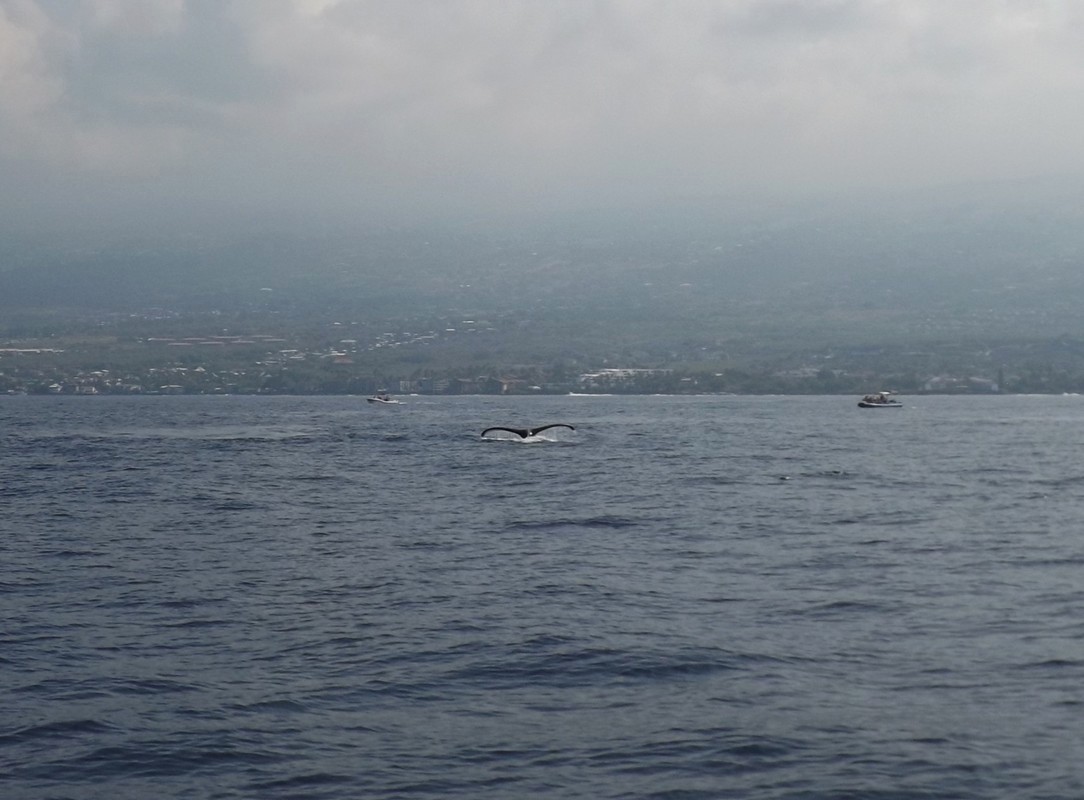 Humpback whale |
 On the back deck |
 wanted
to visit.
Unfortunately, the beach was closed that day for maintenance, a
frustrating discovery
after the long drive to get there. But, since we were there, we walked
around
the heiaus; the older one is falling apart and was once used by King
Kamehameha
I as a platform for canons. The other one—heiau on Whale Hill—was built
by the
king before he set out to conquer the rest of the Hawaiian islands; it
is
apparently built, at least in part, by round lava rocks that had been
moved
hand-to-hand across the island from Pololu Valley (I read that any
stone
dropped to the ground was left there, and can still be seen straddling
the
island). We weren’t supposed to get close to the huge stone walls,
though, so I
couldn’t discern the round rocks from below. It was an impressive site,
crowning the hill. A multi-tiered wooded platform below it held
offerings from
Hawaiians who still honor the site.
wanted
to visit.
Unfortunately, the beach was closed that day for maintenance, a
frustrating discovery
after the long drive to get there. But, since we were there, we walked
around
the heiaus; the older one is falling apart and was once used by King
Kamehameha
I as a platform for canons. The other one—heiau on Whale Hill—was built
by the
king before he set out to conquer the rest of the Hawaiian islands; it
is
apparently built, at least in part, by round lava rocks that had been
moved
hand-to-hand across the island from Pololu Valley (I read that any
stone
dropped to the ground was left there, and can still be seen straddling
the
island). We weren’t supposed to get close to the huge stone walls,
though, so I
couldn’t discern the round rocks from below. It was an impressive site,
crowning the hill. A multi-tiered wooded platform below it held
offerings from
Hawaiians who still honor the site.Consulting the cheat sheet, we decided to check
out Waikoloa
Beach, a little farther south, which is surrounded by a resort
community.
Viewed from the highway, it seemed to be artificially constructed on a
lava field,
rather than being built on more accessible land like most of the rest
of the
island’s communities seemed to be. In fact, the location was quite
bizarre with
the obvious exception of the beach itself. We drove down a road with
barren,
a’a lava to either side, and then into a shameful cluster of small
shopping
centers. Passing through those, we wound up in the beach’s parking lot,
a
rectangle scraped away from the desolation around it.
And from there a short park to the narrow
strip of paradise on the beach.
 And
it was a lovely beach, with stone, open air
bathrooms
and attractive vegetation growing among clumps of lava in the sand at
the back
of the beach. To the north was a long arc of white sand and palm trees
that
separated the ocean from a very large fish pond. We chose the south end
instead, sitting on a salt and pepper beach (part black sand from lava
rocks,
part coral) and found a comfy place beneath a tree to relax. We were at
first
surprised to find a breeze blowing from shore, bending the palm trees
to the
ocean, since the winds we’d avoided that morning were curving around
the island
form the northwest and coming inshore. After about half an hour, the
wind
abruptly changed direction and roared in from the ocean, driving all
but the
hardy folks from the water. Although it surely would have been pleasant
to swim
(and it appeared to be a good place to snorkel), I didn’t think getting
out of
the water and into the wind would be very fun, and neither of us did. I
wandered
around a little and read some interpretive signs, one of which talked
about the
large fish pond which was managed for use by the king and nobles
passing by.
So, Hawaiians must have lived there along the shore taking advantage of
the
fresh water spring that fed the brackish pond, but nothing like the
resort town
that lies there now.
And
it was a lovely beach, with stone, open air
bathrooms
and attractive vegetation growing among clumps of lava in the sand at
the back
of the beach. To the north was a long arc of white sand and palm trees
that
separated the ocean from a very large fish pond. We chose the south end
instead, sitting on a salt and pepper beach (part black sand from lava
rocks,
part coral) and found a comfy place beneath a tree to relax. We were at
first
surprised to find a breeze blowing from shore, bending the palm trees
to the
ocean, since the winds we’d avoided that morning were curving around
the island
form the northwest and coming inshore. After about half an hour, the
wind
abruptly changed direction and roared in from the ocean, driving all
but the
hardy folks from the water. Although it surely would have been pleasant
to swim
(and it appeared to be a good place to snorkel), I didn’t think getting
out of
the water and into the wind would be very fun, and neither of us did. I
wandered
around a little and read some interpretive signs, one of which talked
about the
large fish pond which was managed for use by the king and nobles
passing by.
So, Hawaiians must have lived there along the shore taking advantage of
the
fresh water spring that fed the brackish pond, but nothing like the
resort town
that lies there now.
And so we spent a very pleasant time on a popular,
touristy
beach. On the way out we were surprised to see many cats resting on the
rocks
near the entrance in what appeared to be a cat paradise (signs
indicated that
the cats were well cared for). On the way back to the rental, we
stopped by a
pizza place Chris had found nearby and picked up a pizza for dinner. We
drank
lambics, ate popcorn, and watched a movie after dinner.
 Heiau on Whale Hill |
 The older heiau is in the foreground |
 Offering platform |
 Waikoloa Beach |
 Waikoloa Beach |
 Is this an old konane board? |
 Waikoloa Beach looking toward the resort and fish pond |
 Pacific golden plover |
 Cat paradise |