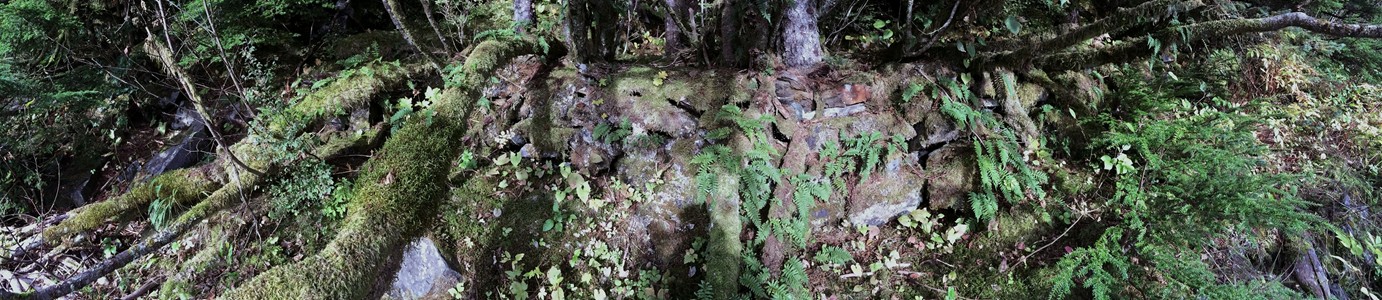
The rock retaining wall on Fanny Island
Snettisham
2014 - 8: The Way it Should Be, Days 5-7
September 9-22
The rock retaining wall on Fanny Island
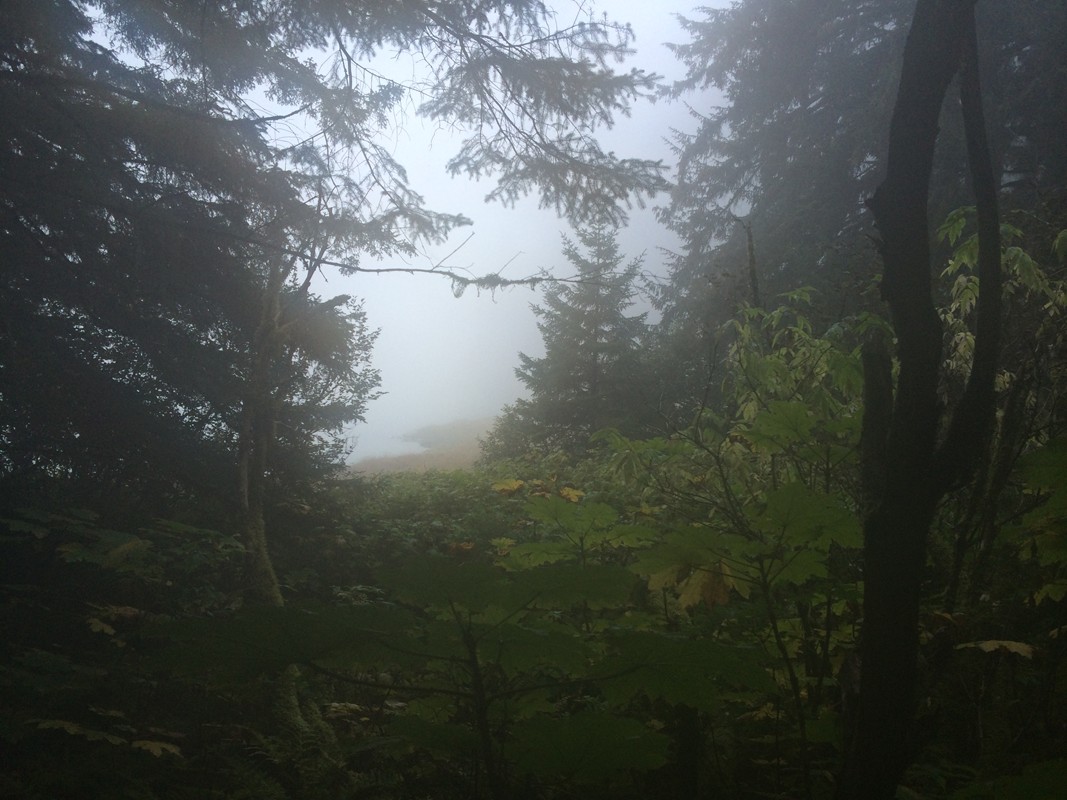 Having
hit it pretty hard the day before, I
allowed myself a
day of guiltless leisure. It helped that I managed to sleep through the
night—no boat lapping or other noise woke me until the sudden explosion
of the
first pinecone hitting the roof of the lodge after light (the resident
red
squirrel(s) has been freeing the spruce trees of their cones since the
last
time I was here, three weeks ago, sometimes releasing amusing torrents
of
banging cones on the lodge and surroundings). It was a good sign that I
felt
fully rested at 7:30, though I lounged in bed enjoying the brightness
of
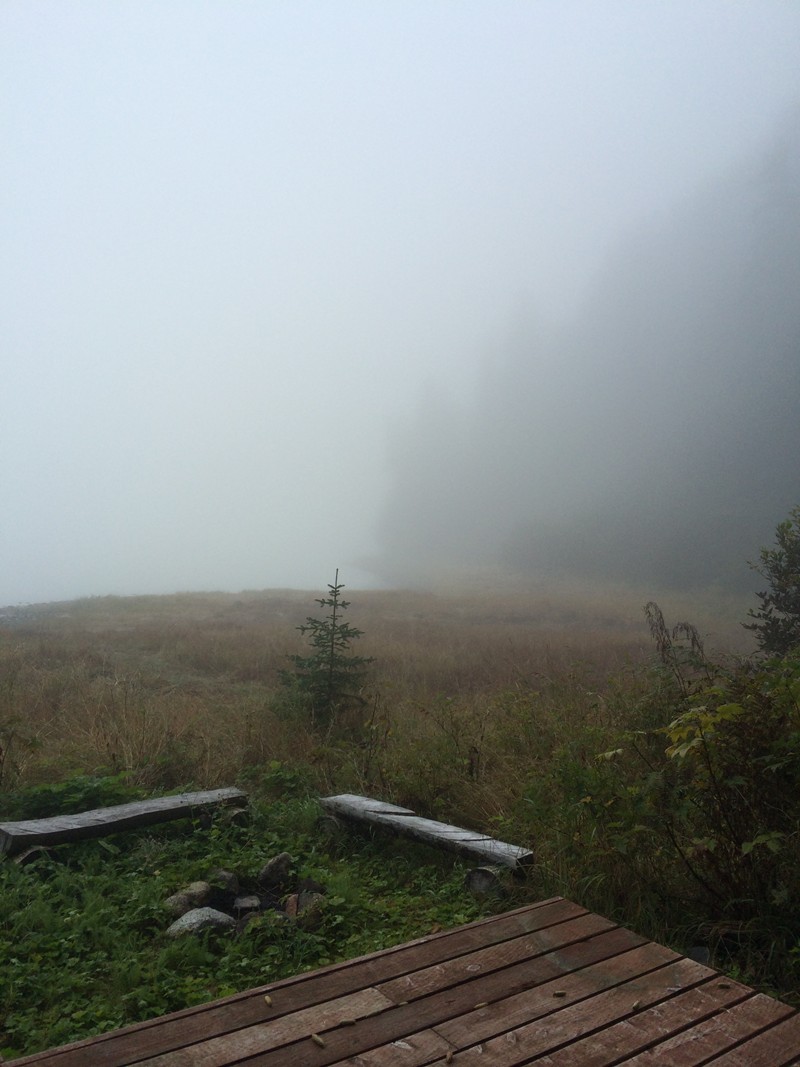
Cottonwood Cabin for another 45 minutes. Well, brightness is a relative
term. I
could see from inside that we were in a dense fog layer and, after I
got up, I
could barely make out faint shadows of the boats at anchor from the
lodge and
the eagle nest point was hazy. Nothing was visible beyond. The inlet
was
absolutely still.
Having
hit it pretty hard the day before, I
allowed myself a
day of guiltless leisure. It helped that I managed to sleep through the
night—no boat lapping or other noise woke me until the sudden explosion
of the
first pinecone hitting the roof of the lodge after light (the resident
red
squirrel(s) has been freeing the spruce trees of their cones since the
last
time I was here, three weeks ago, sometimes releasing amusing torrents
of
banging cones on the lodge and surroundings). It was a good sign that I
felt
fully rested at 7:30, though I lounged in bed enjoying the brightness
of
Cottonwood Cabin for another 45 minutes. Well, brightness is a relative
term. I
could see from inside that we were in a dense fog layer and, after I
got up, I
could barely make out faint shadows of the boats at anchor from the
lodge and
the eagle nest point was hazy. Nothing was visible beyond. The inlet
was
absolutely still.
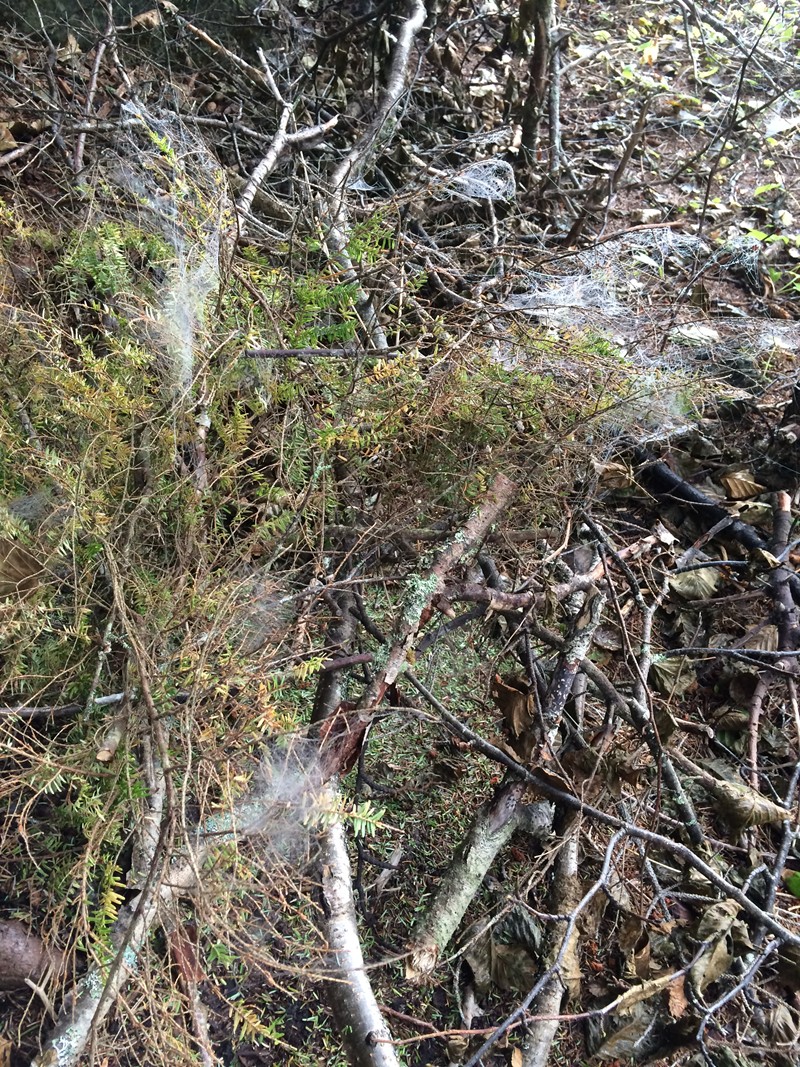
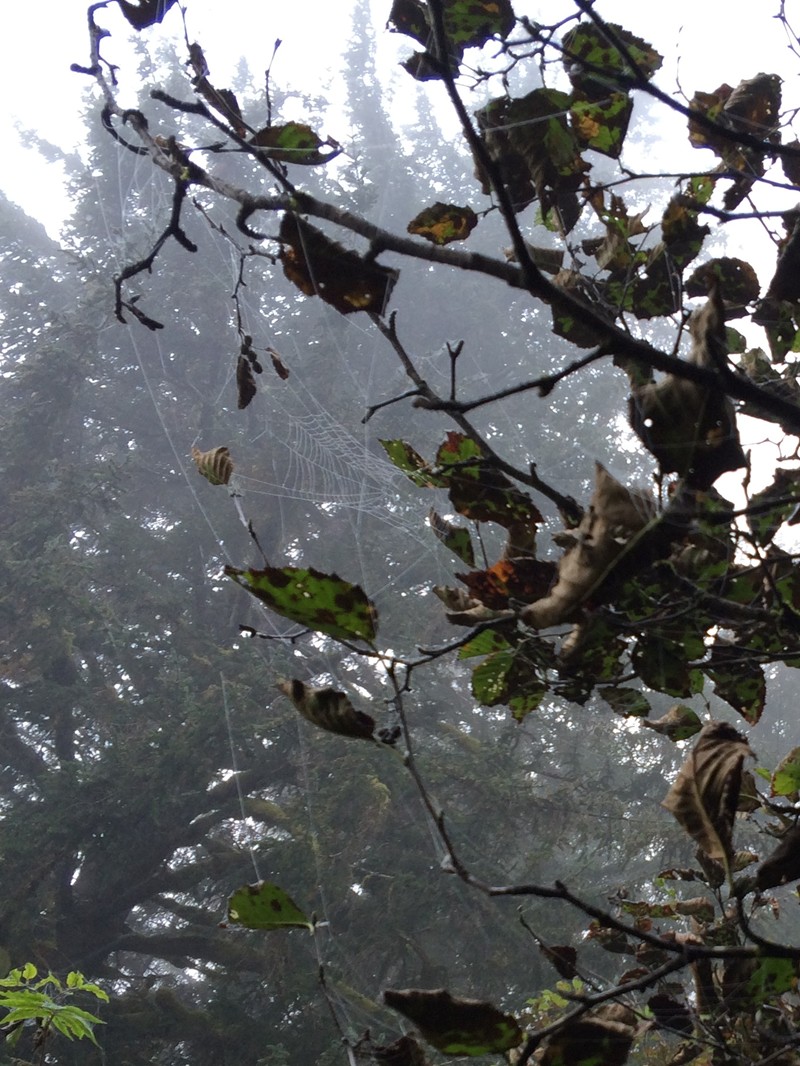
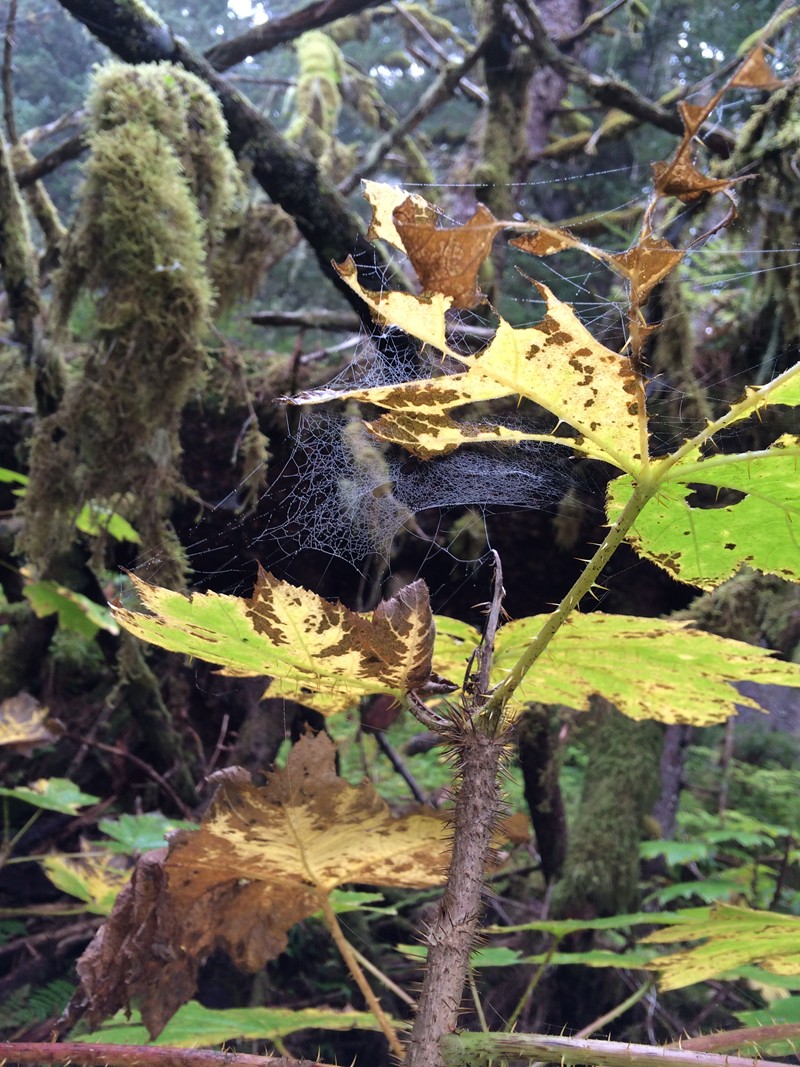
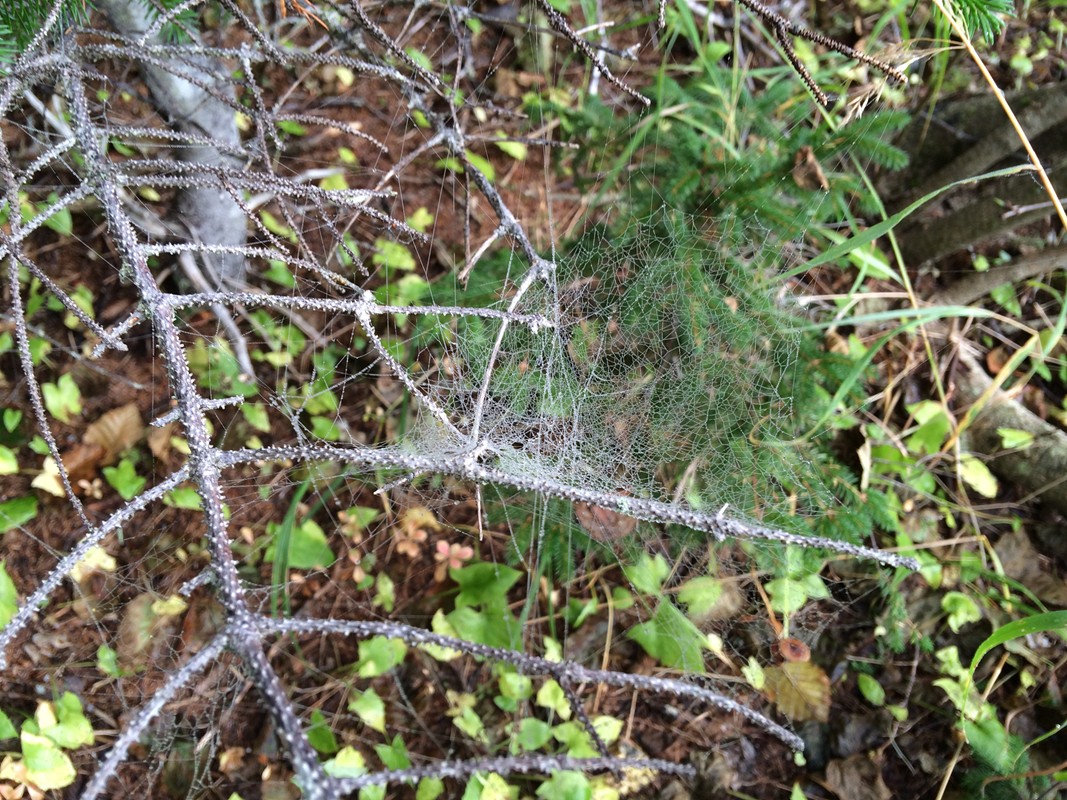
On the way to the lodge, I noticed that one of the
elderberry bushes by the path was overgrown with silver cobwebs.
Looking closer, it appeared that the entire plant was covered in
strands of spider silk and clusters or web were around almost every
barren berry bundle (see photo to right, whcih doesn't really do it
justice). I looked around and to my astonishment I saw spider webs
everywhere--and I mean everywhere. There was hardly a square foot of
vegetation that was not crossed by a strand or many strangs of silk;
classic webs were built between twigs and what 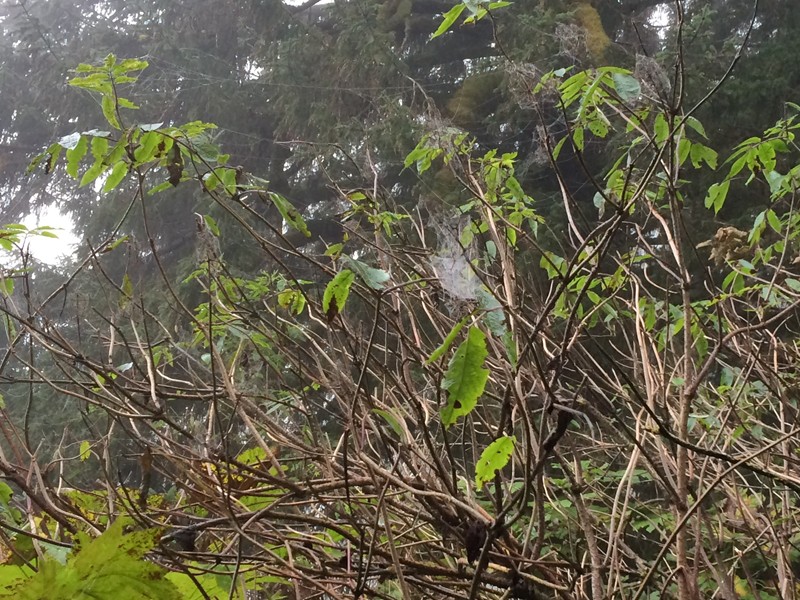 looked
like silk hammoks hung from branches. It was all a little eerie. Either
a billion spiders had suddenly spun webs all over the property
overnight or the light filtering through the fog exposed them in a way
we almost never see. If the latter, then the world is alive with an
alarming number of arachnids! Or is there a middle ground? All morning
I was met with endless cobwebs glittering in all directions.
looked
like silk hammoks hung from branches. It was all a little eerie. Either
a billion spiders had suddenly spun webs all over the property
overnight or the light filtering through the fog exposed them in a way
we almost never see. If the latter, then the world is alive with an
alarming number of arachnids! Or is there a middle ground? All morning
I was met with endless cobwebs glittering in all directions.
Thankfully, I am not especially averse to spiders,
and the still morning was a lovely environment in which to finish my
book. I
had some
hot chocolate and read for an hour, the stillness broken only by
distant fog
horns from cruise ships, two on and off for a while (one might have
been in
Tracy Arm based on the direction it was coming from, the other
definitely in
Stephen’s Passage), the occasional squirrel scold, and for several
wonderful
minutes, a raven. Sitting in a tree just upriver, he called
continuously,
gulping hiccups in long series interrupted by a variety of other
sounds. The
calls echoed off the cliffs downriver. It was wonderful. During the
week I
noticed many ravens around the homestead, which is not common, but no
crows,
which are very common there. I did see large flocks of crows in other
areas of
Snettisham when I was out and about, though, so perhaps they are
already
grouping up for winter and have better hunting grounds.
 As
the tide dropped and the fog began to diminish,
I moved
to the rocky point so I could peer upriver periodically as the sandbars
emerged
in case any wildlife came by, and because that point is a nice place to
read.
It was chilly, so I’d added long underwear to my t-shirt, fleece, and
vest, as
well as my rain jacket, and was grateful for them when the wind began
to pick
up. By 11:00 I was too hungry to continue, so I came back and had a
snack lunch
on the porch before returning to the point to actually finish the book
(I am
becoming a true Isaac Asimov fan). After enjoying the ending for a
while, I
decided to start a task I’ve been dreaming about for years:
inventorying the
flora on the homestead. I thought that picking one area at a time would
be a
reasonable way to approach this herculean task, and the point seemed
like a fun
one with its unusual species. Each one I looked up in my plant guide
and wrote
down the common and scientific names and tried to learn something about
each
one of them. Identification of a few I wasn’t as familiar with was
difficult
with seeds (and dying leaves) instead of flowers. A couple remain
mysteries and
I stopped before I’d documented all obvious species.
As
the tide dropped and the fog began to diminish,
I moved
to the rocky point so I could peer upriver periodically as the sandbars
emerged
in case any wildlife came by, and because that point is a nice place to
read.
It was chilly, so I’d added long underwear to my t-shirt, fleece, and
vest, as
well as my rain jacket, and was grateful for them when the wind began
to pick
up. By 11:00 I was too hungry to continue, so I came back and had a
snack lunch
on the porch before returning to the point to actually finish the book
(I am
becoming a true Isaac Asimov fan). After enjoying the ending for a
while, I
decided to start a task I’ve been dreaming about for years:
inventorying the
flora on the homestead. I thought that picking one area at a time would
be a
reasonable way to approach this herculean task, and the point seemed
like a fun
one with its unusual species. Each one I looked up in my plant guide
and wrote
down the common and scientific names and tried to learn something about
each
one of them. Identification of a few I wasn’t as familiar with was
difficult
with seeds (and dying leaves) instead of flowers. A couple remain
mysteries and
I stopped before I’d documented all obvious species.
By that time it was after 1:00 and I was ready for a change. But not ready to get down to work or anything, though I did manage to accomplish one chore: transferring the remains of the spare jerry jug of gas into the jerry jug I was using to fuel the generator. The former had been bitten through in two places by a naughty bear (perhaps the same one that rubbed my bridge apart) and will have to be scrapped. After that I grabbed a small piece of plywood from the shed and opened a puzzle I bought for myself last year. It’s what I often daydream about—having the free time to do a puzzle! Why not? The only problem with puzzles is the back pain. I tried to ameliorate it by raising its support board on pillows but after a couple of hours I had to quit. I finally decided that I’d look into working on something, so I took a tape measure to Hermit Thrush, removed the plywood covering the broken uphill window, and carefully measured the dimensions of the Plexiglas inside. Then I brought the sheet of Plexiglas I’d bought in town to the lodge deck and marked the dimensions I’d taken with a sharpie. Now, would I be able to cut it? I’d apparently neglected to bring down a utility knife as I was intending, and the only one I could find had a broken blade, though it seemed functional. I wasn’t sure if it would work, but I scoured away at the plastic using my level to help guide the blade. I’d laid a blanket underneath to protect it and awkwardly squatted over it, avoiding putting pressure on the plastic itself. I scoured and scored and scoured, unsure whether I could make it through. At one point I tried cutting with large scissors and tin snips, but both broke the Plexiglas in pieces. In the end, it only took 20 minutes or so to cut through the shorter side. First the blade penetrated one small area and then I expanded that cut to surrounding areas with more scouring, then eventually was able to break the remaining section off. The other side was longer and more labor intensive, but after less than an hour of work I had what I hoped would be a new window.
With that success under my belt I brought up the
survey of
the property on my laptop to get a distance and bearing form the corner
in the
creek to the corner on the point. This would be a little more difficult
to pin
down, as the distance was 214 feet through some rugged terrain. I used
a twisty
tie to secure the end of the tape to the marker in the creek, than
awkwardly
ran it toward the last tree on the point that matched up with the
bearing from
the survey (corrected 20 degrees, which was the difference between the
bearing
I read on my compass at the first site and the bearing where the marker
actually was). It seemed to match up pretty well with the line on the
marker
itself. When I reached the end of the line, having clambered down steep
drops,
over a tributary creek, through tangled brush and under alder branches,
the
line was in no way straight. I wedged the tape housing under a rock and
returned to release the tape from the marker and coil it up as I
returned. Then
I tied the end to an alder tree and bouldered awkwardly around the
rocks and
onto the edge of the first shelf of the rocky point. This time when I
ran out
of tape I returned the same way, coiling the tape up as I bouldered my
way
back. From there it was just 16 feet (give or take), which put me in
the
vicinity of the highest rocks leading up to the pinnacle where the
eagles and
otters like to eat. I poked around there, under low spruces and alders,
but
didn’t find anything other than a handful of old cut stumps. I’ll have
to ask
my dad if he ever cut any there; if not, that could be a clue as to
where the
marker is if the surveyor did it. More cut trees headed across the
point toward
the lodge, but that could be coincidence.
Finally I headed back to the lodge for dessert
with a
grateful dog who clearly was hoping for a snack and a nap.
 Spider webs |
 Fog in the inlet |
 Spider webs |
 Spider webs |
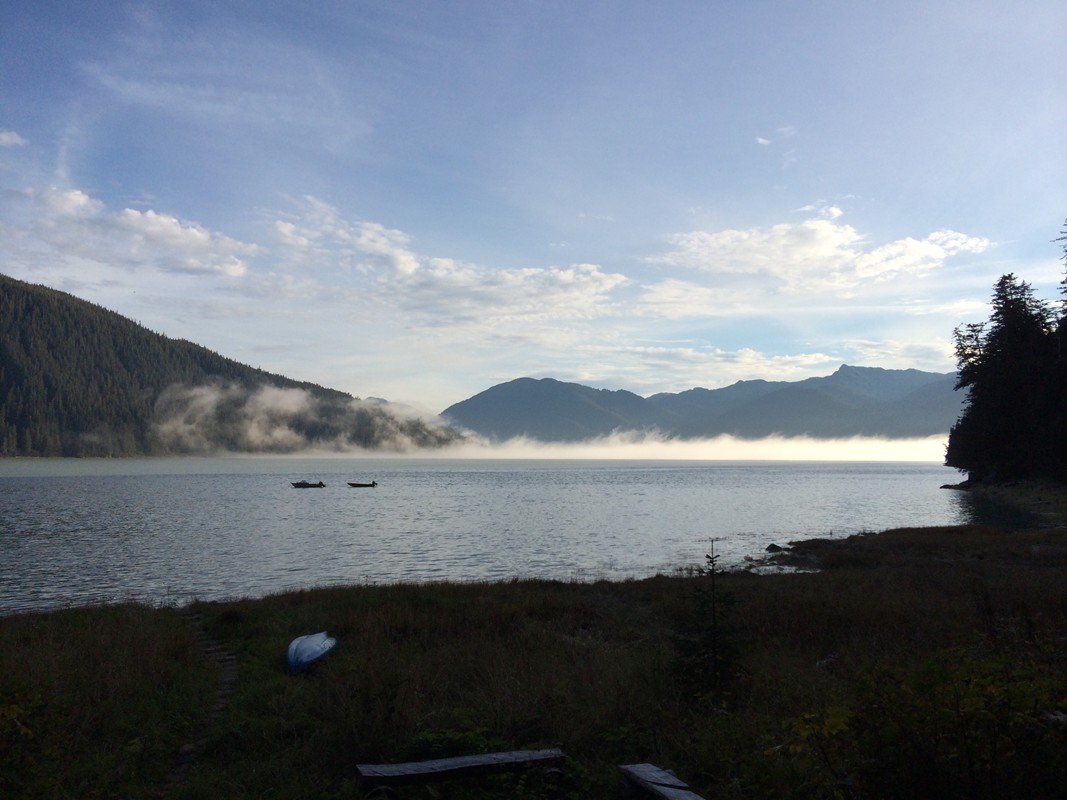 The inlet clears |
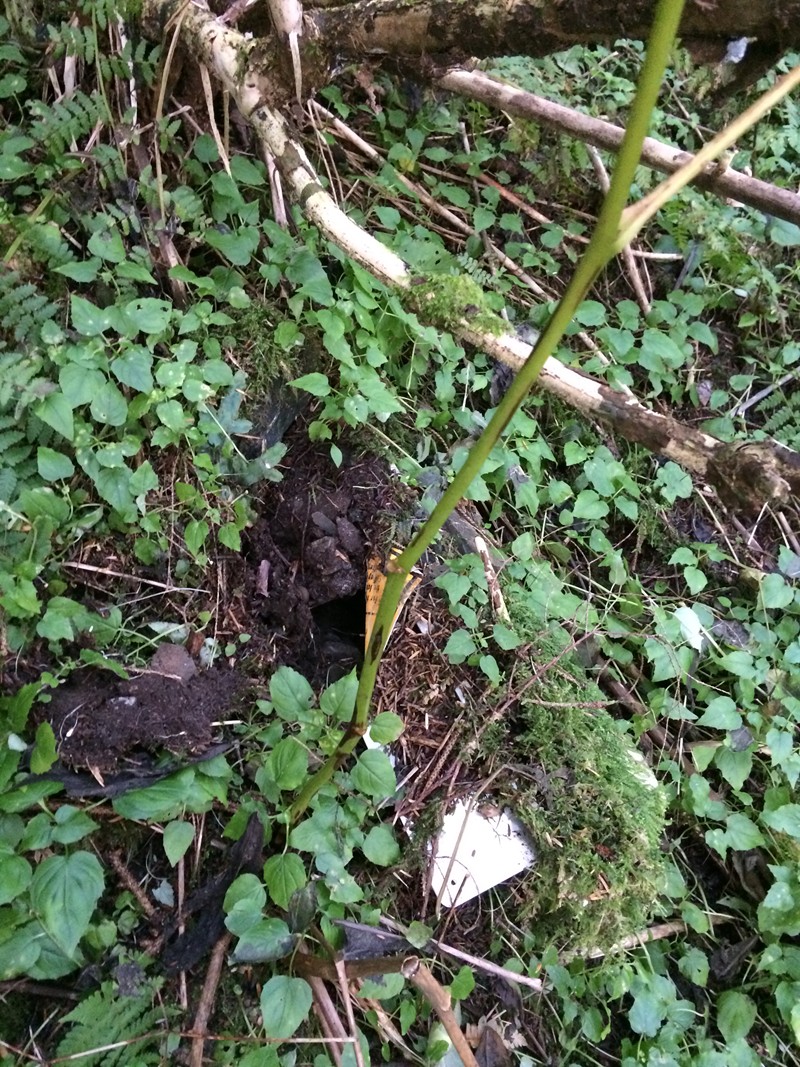 The USFS boundary marker |
With that done, I rewarded myself with the cup of
coffee I
had daydreamed about having the morning that I camped. After a few
minutes more
on the porch I carried the window pieces over to Cottonwood to try them
against
a window there just to make sure they would work before I got too
excited. What
I’d forgotten was that the side pieces would need to be shorter than
the actual
height of the pane, since the top and bottom pieces were overlapping. I
carried
them back and cut off an inch and a half (I’d settled on a ¾”
overlap instead
of a full inch), not even very much annoyed that I’d already put Joanie
and the
extension cord away. I cut the frames in front of the shed to spare
myself
setting up the latter.
The next step was to remove the existing pane of
Plexiglas,
which was fully intact except for one missing pieces thanks to the blue
plastic
protective cover that held the shattered pieces together. Armed with a
hammer,
gloves, and eye protection, I began bashing it outward. It was
surprising
tough, and surprisingly prone to breaking in sharp pieces like glass. I
was
afraid that cleaning up the edges and making sure all shards were gone
from the
existing frame would be difficult, but when I was about three quarters
of the
way through breaking out the main pieces, the whole frame began to
slide out of
its grooves between the two halves of the window and came out clean and
intact!
Then I fetched the new pane of Plexiglas to see if it fit. It was
pretty darn
close, nice and snug, but just a little too wide on one side. A closer
inspection revealed that a section about an inch and a half long hadn’t
quite
broken off at the line I’d carved in and was protruding a quarter inch.
I
carefully chipped and scoured it away with my utility knife, but the
corner
below was still too wide, and I could see the original scour mark just
a
millimeter or two below the current edge. I scraped away at that and
sanded the
edge down until at last it fit nearly perfectly. Then I lightly sanded
and
cleaned up the frame pieces I’d cut, started two screws in each one
until they
barely protruded out the back, marked their positions on the window,
and
screwed them all in.
I have to say it looked beautiful! The final step was unscrewing the cross piece on the inside of the Plexiglas (which makes the window look like it has six panes but is really just in insert behind the pane) so I could press it against the new outside frame with the Plexiglas in the middle. Two screws came out easily, the other two were the original screws which have square heads. Did I have a screwdriver that would fit? The answer turned out to be no, even searching through all my boxes of miscellaneous tools (I found perhaps a dozen or more screwdrivers, but all flat or Phillips). Of course I had the right driver for my maquita, but it had stopped running earlier in the summer. But it was my only option, so I grabbed the three square drivers I’d found and the drill itself and headed back to Hermit Thrush. Wouldn’t you know I was able to use the drill as a screwdriver? Securing the driver in the drill, I then held the top of the driver in place to prevent it from spinning and rotated the whole drill. Both screws came out easily. I pressed the new pane against its outside frame and screwed the cross piece securely against it. It looked fantastic!
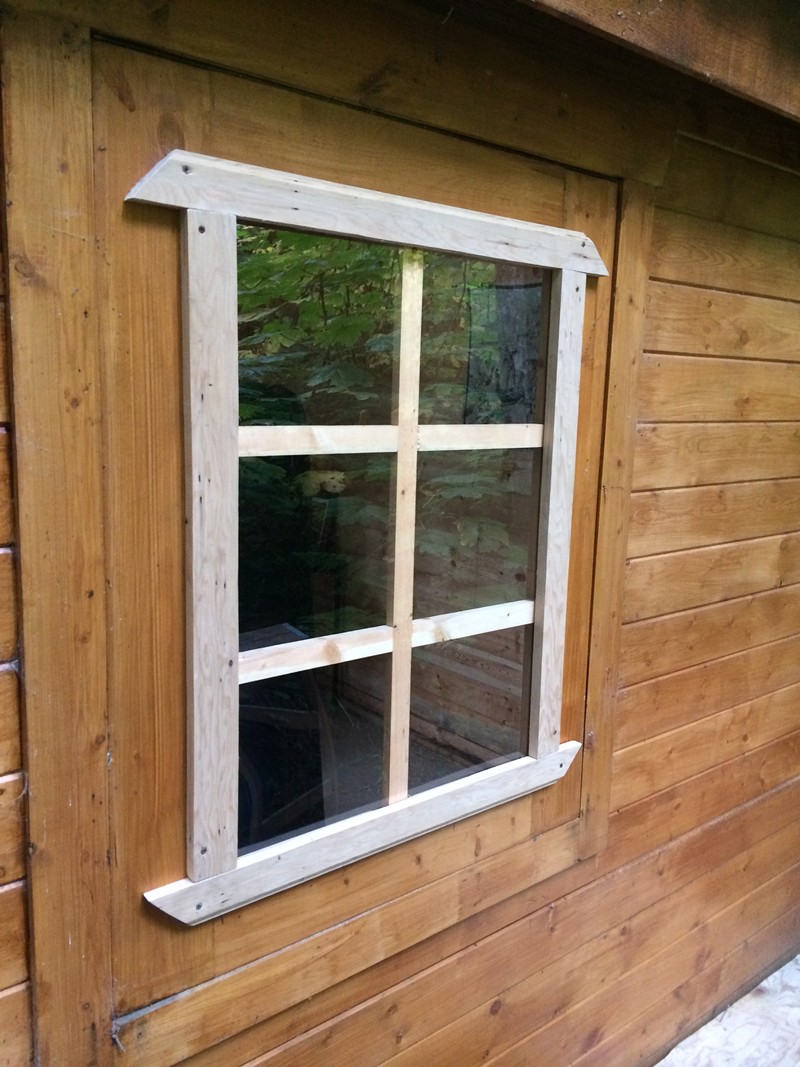 That
was a project I am
particularly proud of—well executed,
beautiful, and it will make a huge difference in the livability of the
cabin.
I’m very pleased to be finally working on Hermit Thrush which has long
been a
concern with its mildew smell, broken window, etc. After a lunch of
quesadillas
and a cerveza, I continued working there, sweeping up inside, laying
the box
spring completely upside down to facilitate additional drying, and then
redigging a trench along the back side under the water filters. This
latter
task is the result of a slow migration of dirt down the mountain and
against
the 2x8 stringer, which was close to ground level on that side to begin
with—it’s even possible that it was excavated at that time. I used a
pick and
hoe to scrape a hoe-width gully along the 2x8 until it was fully
exposed with a
gap under it and pushed back the dirt on the other side of it as well
as I
could with my fingers. Hopefully that will help protect the wood and
will be
easier to maintain.
That
was a project I am
particularly proud of—well executed,
beautiful, and it will make a huge difference in the livability of the
cabin.
I’m very pleased to be finally working on Hermit Thrush which has long
been a
concern with its mildew smell, broken window, etc. After a lunch of
quesadillas
and a cerveza, I continued working there, sweeping up inside, laying
the box
spring completely upside down to facilitate additional drying, and then
redigging a trench along the back side under the water filters. This
latter
task is the result of a slow migration of dirt down the mountain and
against
the 2x8 stringer, which was close to ground level on that side to begin
with—it’s even possible that it was excavated at that time. I used a
pick and
hoe to scrape a hoe-width gully along the 2x8 until it was fully
exposed with a
gap under it and pushed back the dirt on the other side of it as well
as I
could with my fingers. Hopefully that will help protect the wood and
will be
easier to maintain.
I took a Russian tea break and read a few chapters
of a new
book on the porch. There had been a few sprinkles during the night, and
it
rained for a few minutes while I was cutting the boards in the morning,
but
otherwise the day was overcast and mild. The eagles were very active on
and
off, drying their wings on their point downriver, chickadees chattered,
and a
Pacific wren spent quite a bit of time chipping and bopping around in
the
meadow, but there was little other bird activity that I saw.
After my break I tackled a more tedious task,
another one
that I’ve been meaning to do for a long time but always put off until I
have a
more leisurely trip; it was directly inspired by the satisfaction I
felt in
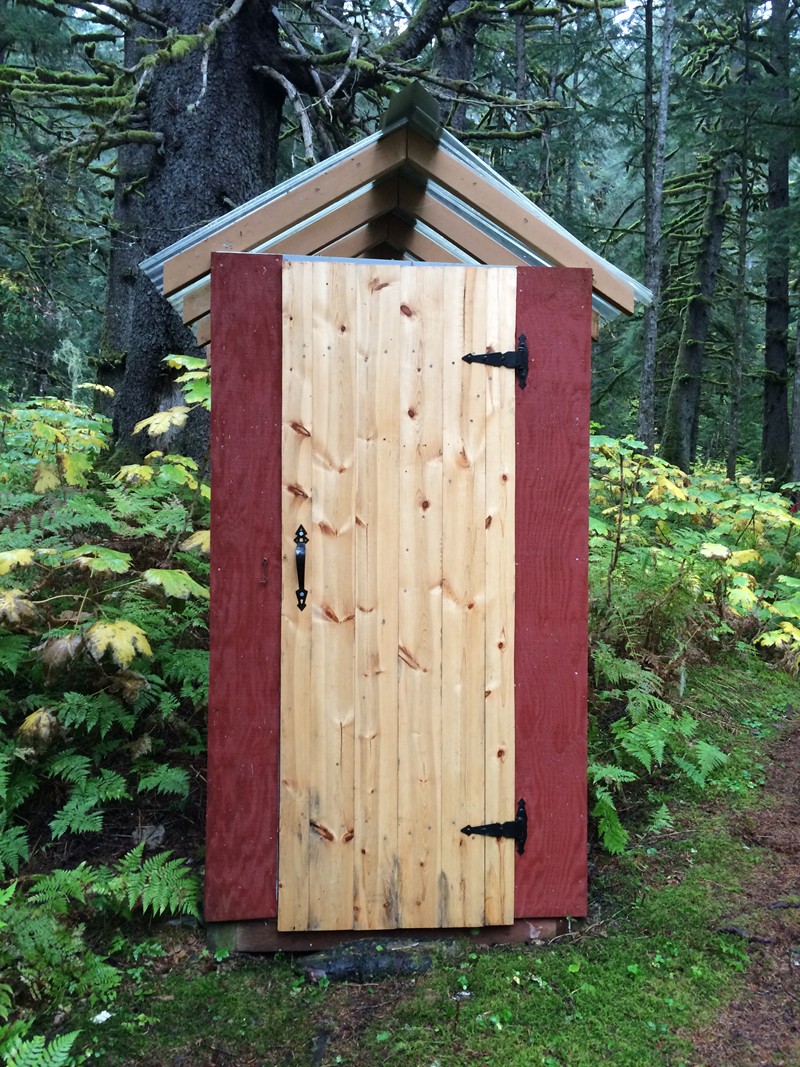
cleaning up Hermit Thrush. What I had in mind was scrubbing, starting
with the
cabin outhouse which has a light patina of mildew on the walls inside
and years
of mud splatter on the door and siding outside, not to mention the
algae and
pine needles on the roof. I heated up a kettle of hot water and mixed
it in a
bucket with cold water from the tap, gloved up in rubber gloves, and
rubbed all
the walls and joists and other surfaces inside with a rag. The water
was so
filthy by the end that I rinsed the rag and refilled the bucket at the
valve behind
Cottonwood and rinsed it all off again. Then I worked on the door, the
bottom
of the side of the outhouse you see from the new set of stairs, and
finally
both sides of the roof. I also ripped out the mosquito netting on
either side
of the gable ends of the roof which was covered in algae spots and
trapping
spider webs and pine needles behind. It was an unpleasant, messy task
but the
outhouse looks great.
From there I scrubbed the lower log on the two
sides of
Hermit Thrush and Harbor Seal that need to be protected from rain in
order to
prevent the moisture getting inside, and then the top rail and top
baluster of
the bridge, also grown green with algae. By that time a front moved in
and it
started raining hard (and I was ready to quit) so I closed the door to
Hermit
Thrush (which had been open to air it out) and packed all my gear back
to the
lodge. Although I desperately wanted to quit, I decided I’d better take
care of
the riverboat again, which was back on the other side of the Ronquil.
Cailey
and I kayaked out; she jumped onto the riverboat and from there onto
the bow of
the Ronquil while I pushed the former around to its proper side and
tied
another line to it, this time from the other side in the hopes that it
would
prevent it from going around the bow. While I was working, I noticed
two seals
nearby watching me intently. On the way back to shore, I turned around
to see
if any seals were in sight and saw one just 20 feet away or so, calmly
watching. I dropped Cailey off on shore and paddled back out a little
ways and
exchanged gazes with this lovely young seal quite a few times. She
seemed very
at ease, not particularly anxious no matter how close she surfaced to
me, once
staying about 15 feet from the bow for quite some time. Once I saw a
series of
three footprints about five feet to the side of me—she did a pass
underwater!
Eventually I took my phone out and accidentally photographed her while
taking a
picture of the boats. I took a second photo when she turned to look at
me, but
that was the end of our interactions. I waited a while longer, then
slowly
paddled back to shore, a little sad that it wasn’t more convenient to
spend
more time with them (on Cailey’s account). Maybe later this week!
It was still light enough then to work on the
puzzle, so I
moved the table closer to the window and spent about an hour on that
while a
fire warmed up the lodge and dried out a few damp items, before I made
some
chili for dinner and worked on this. I was surprised to find that it
was fairly
dark around 7:30. Rain came in as I was writing this, but seems to have
died
down again.
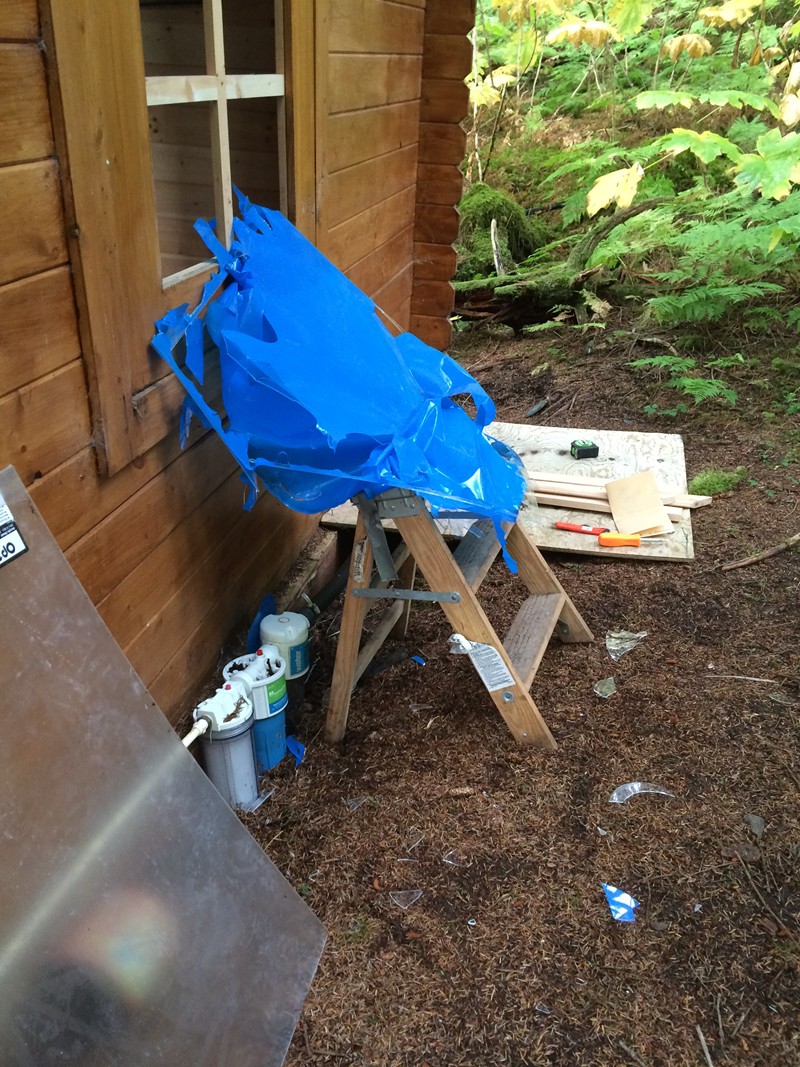 Pulling out the broken window |
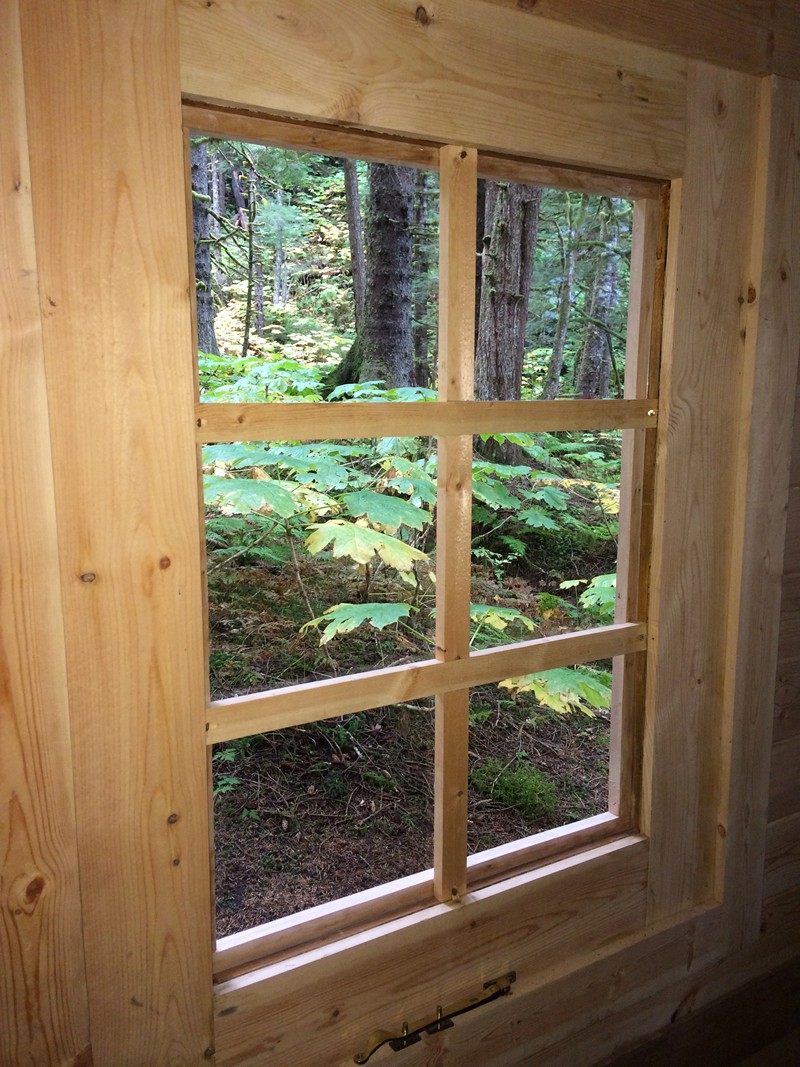 New window from inside |
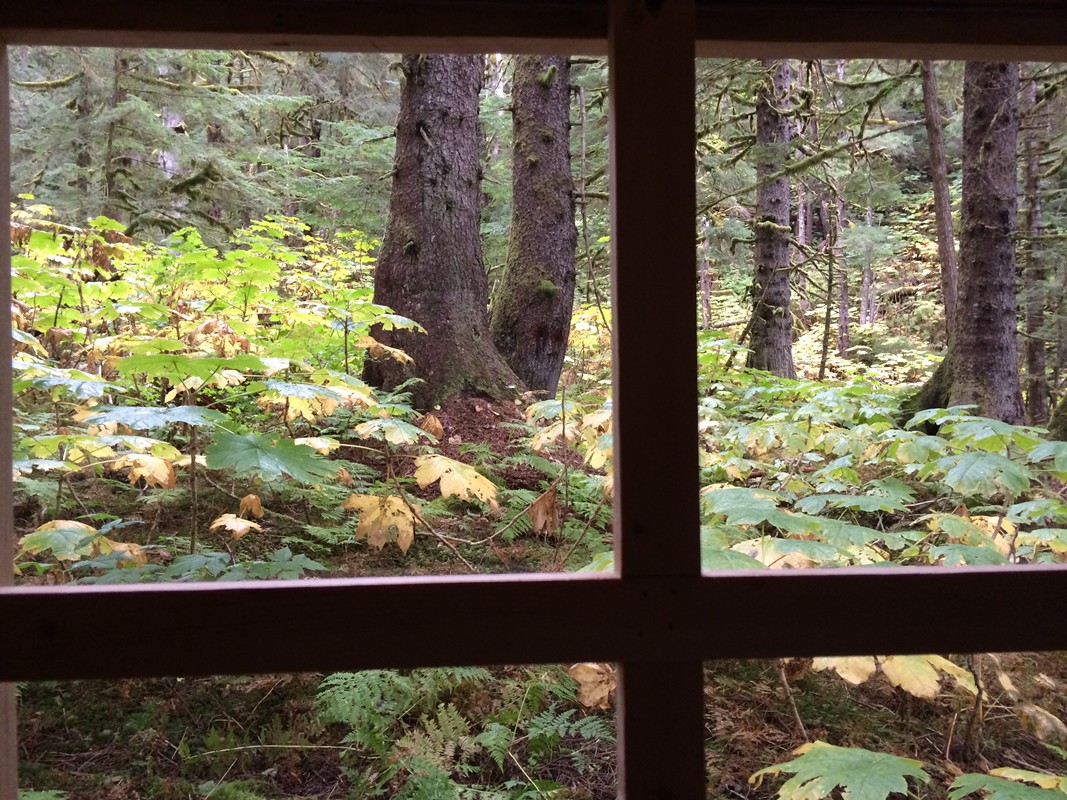 Looking out the new window |
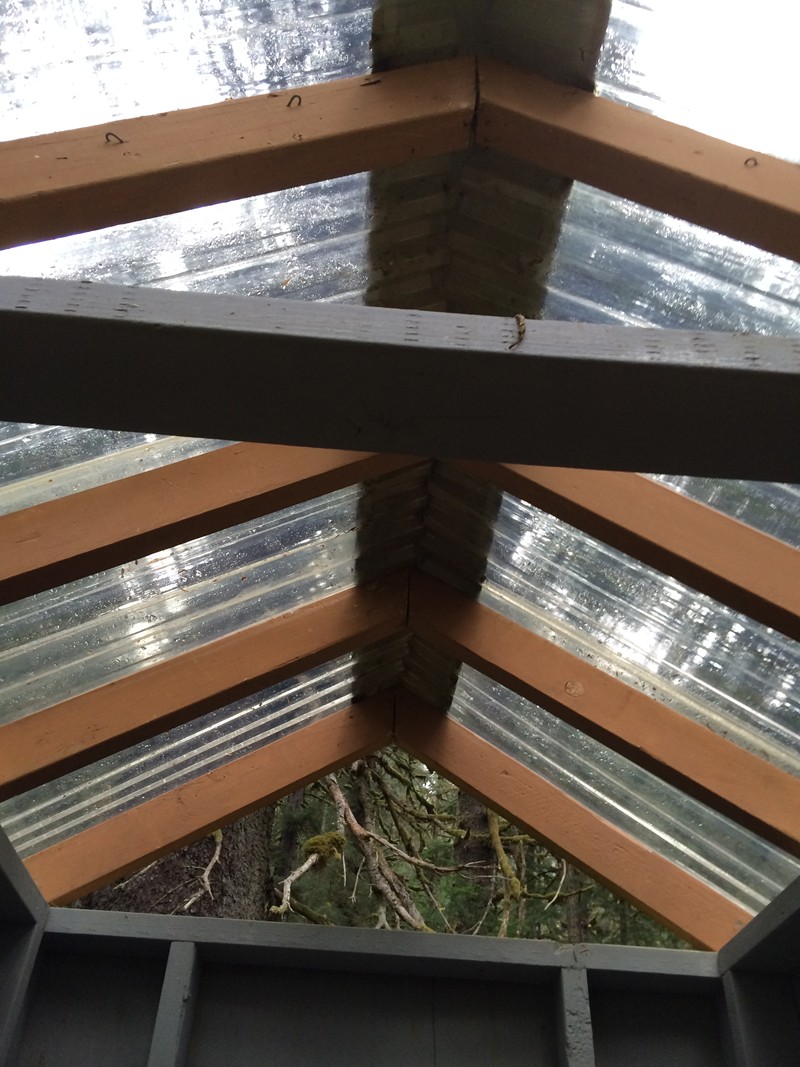 Clean roof of outhouse |
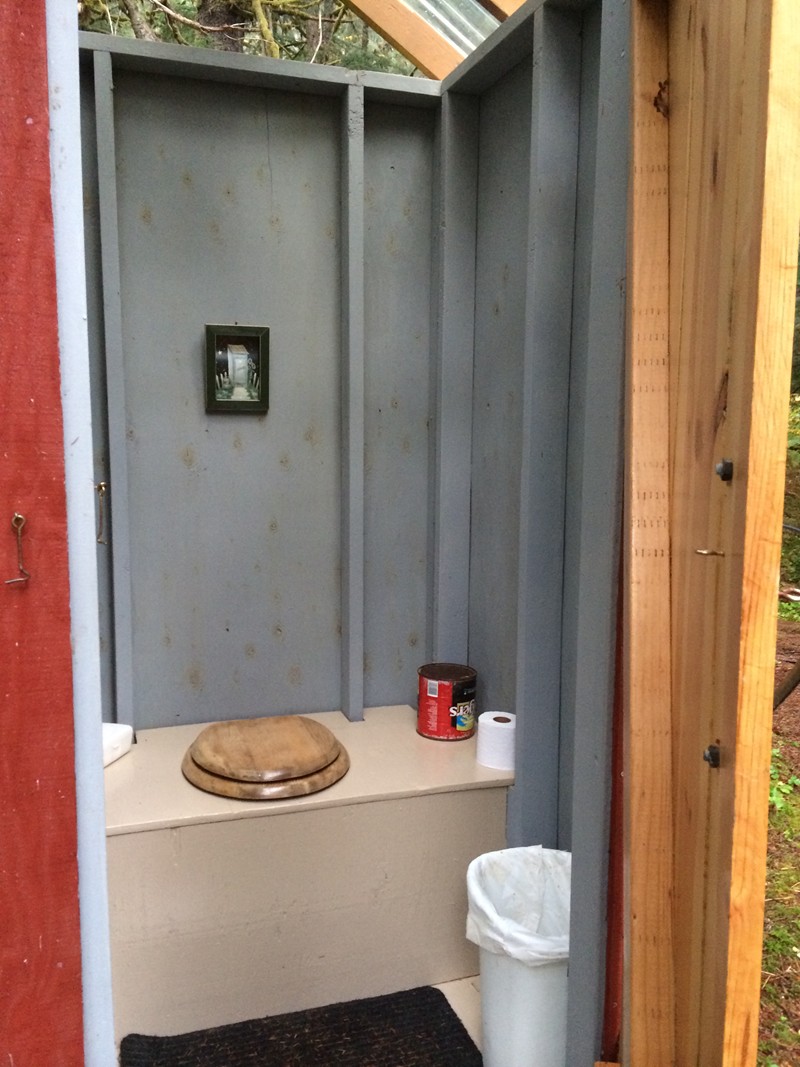 Clean outhouse! |
 Clean outhouse |
 After
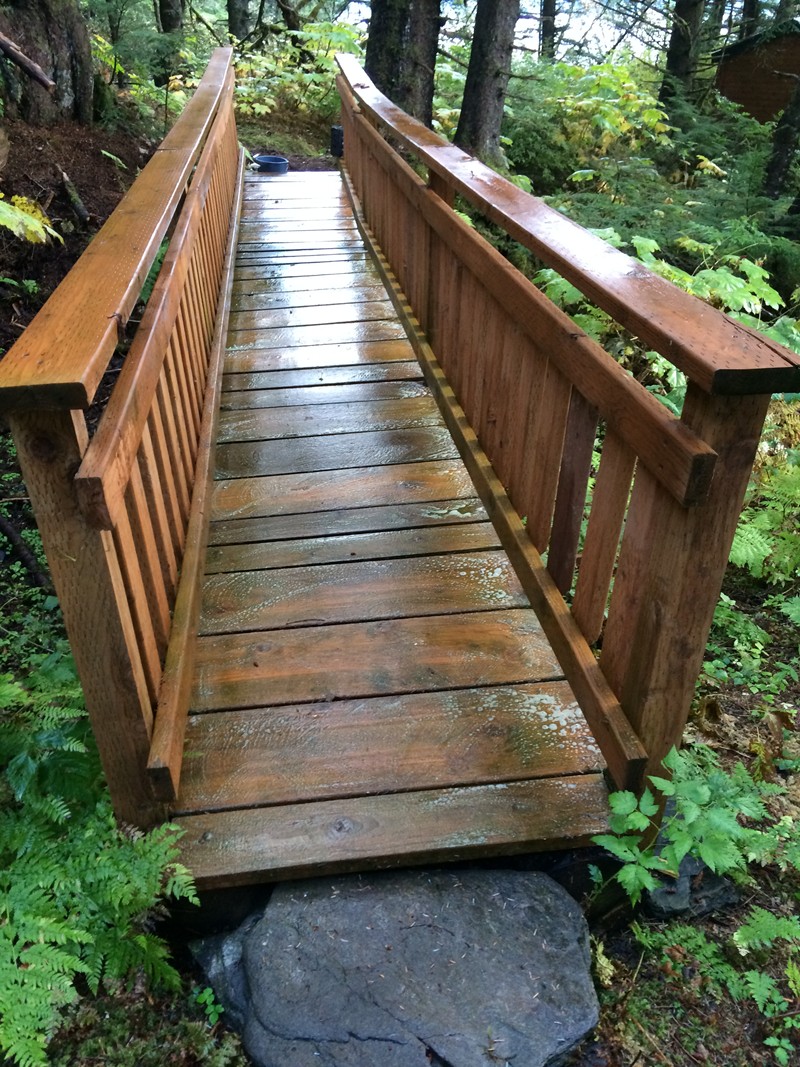
that was done I turned to the bridge and
finished
scrubbing it (the treads and the lower baluster), making several trips
to the
hose behind Mink to fill up buckets to rinse it off afterwards. That
was
actually more pleasant and quicker than the outhouse. As a trial, I
also
scrubbed the porch and steps of Cottonwood. The black algae/grime
didn’t all
come off with my minimal scrubbing, but it was an improvement. Having
finished
the wet and messy part of the day, I finished my spit bath and changed
clothes,
feeling much improved. I ate top ramen with relish on the porch and
rested a
little before another scrounging up a handful of small screws and
heading back
to Hermit Thrush. I put a few extra screws on the new window frame,
having
forgotten to do that the day before, then went to repair the loose
balusters on
the bridge. There were a few I knew of that were loose on one side, the
result
of a few tiny screws mixed in unnoticed with longer screws. When I went
around
the bridge and tested them, though, I found quite a number on the
downhill side
that had simply broken off, including the two that had fallen off
entirely
since I’d last been here. Did they pop loose when those large branches
hit them
last winter? Has a bear been rubbing along that whole side of the
bridge,
popping them out as I’m sure happened to the two on the ground? It will
remain
a mystery. I had just enough screws to repair all the damage and now my
bridge
looks ship shape again.
After
that was done I turned to the bridge and
finished
scrubbing it (the treads and the lower baluster), making several trips
to the
hose behind Mink to fill up buckets to rinse it off afterwards. That
was
actually more pleasant and quicker than the outhouse. As a trial, I
also
scrubbed the porch and steps of Cottonwood. The black algae/grime
didn’t all
come off with my minimal scrubbing, but it was an improvement. Having
finished
the wet and messy part of the day, I finished my spit bath and changed
clothes,
feeling much improved. I ate top ramen with relish on the porch and
rested a
little before another scrounging up a handful of small screws and
heading back
to Hermit Thrush. I put a few extra screws on the new window frame,
having
forgotten to do that the day before, then went to repair the loose
balusters on
the bridge. There were a few I knew of that were loose on one side, the
result
of a few tiny screws mixed in unnoticed with longer screws. When I went
around
the bridge and tested them, though, I found quite a number on the
downhill side
that had simply broken off, including the two that had fallen off
entirely
since I’d last been here. Did they pop loose when those large branches
hit them
last winter? Has a bear been rubbing along that whole side of the
bridge,
popping them out as I’m sure happened to the two on the ground? It will
remain
a mystery. I had just enough screws to repair all the damage and now my
bridge
looks ship shape again.
And so I returned to the porch for a cup of
Russian tea. It
had rained lightly all night, but had by begun to clear up by the time
I got up.
I’m amazed at how dry the weather has been this week—it has only
rained/sprinkled a few hours during daylight and most of the rest of
the time
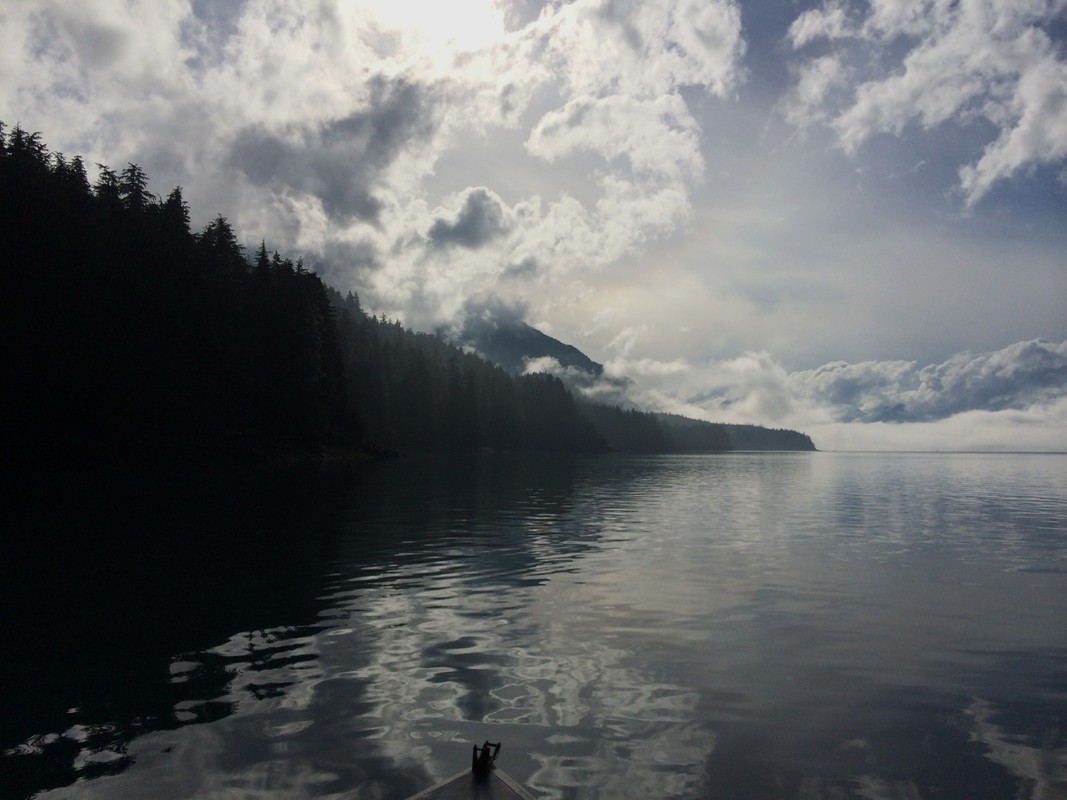
it’s been partly cloudy or clear. As the sun broke through and warmed
everything I looked out on the calm inlet and decided it would be a
fine day
for a boat ride. That desire took precedent over a nap I could feel
creeping up
on me. It was likely to be my last off-shore adventure for the week and
it was
such a lovely afternoon. Around 2:00 Cailey and I paddled out to the
boats,
 snugged
them up together, fueled the Ronquil, and moved the anchor line
over to
the riverboat. That proved to be a little more tricky than I’d
anticipated, as
it required transferring the entirely line (most of the 300 feet of
which was
bundled in the bow) and because as soon as I untied the Ronquil, it
began to
drift with the wind which made tying the anchor to the riverboat
awkward. So it
was half past when we headed out, floating over the calm water in the
sunshine as
we broke out in to the wider port. I was amply bundled up, so I stayed
standing
as we crossed Gilbert Bay and returned to old Snettisham town, the site
of the
Friday Mine mill. I left Cailey on board and scoured the beach for the
bag of
substrate I’d picked up, much relieved to find it settled comfortably
on a flat
rock after much looking lower on the beach. While I was there, I filled
another
ziplock I’d brought along (in case I couldn’t find the others) with
sand from
the creek as it trickled down the intertidal zone. There were plenty of
micas
there, for what that was worth.
snugged
them up together, fueled the Ronquil, and moved the anchor line
over to
the riverboat. That proved to be a little more tricky than I’d
anticipated, as
it required transferring the entirely line (most of the 300 feet of
which was
bundled in the bow) and because as soon as I untied the Ronquil, it
began to
drift with the wind which made tying the anchor to the riverboat
awkward. So it
was half past when we headed out, floating over the calm water in the
sunshine as
we broke out in to the wider port. I was amply bundled up, so I stayed
standing
as we crossed Gilbert Bay and returned to old Snettisham town, the site
of the
Friday Mine mill. I left Cailey on board and scoured the beach for the
bag of
substrate I’d picked up, much relieved to find it settled comfortably
on a flat
rock after much looking lower on the beach. While I was there, I filled
another
ziplock I’d brought along (in case I couldn’t find the others) with
sand from
the creek as it trickled down the intertidal zone. There were plenty of
micas
there, for what that was worth.
As we pushed away from the beach I was startled by
a snort
and s splash and looked up to see a huge sea lion about 20 yards away
glance my
way and dive—I think we may have startled him as well. He came up a
couple more
times, possibly the first fall sea lion I’ve seen in the port! I’ll
have to
check out the haulout on the way out to see if any more are gathering.
There
were two other boats in the entrance with me—a fishing boat and a
Nordic tug,
both coming in. It was foggy toward Stephen’s Passage which dissuaded
me from
looking for whales at the entrance. One small whale was in the middle
working
its way out, which was nice to see as they had stopped coming into the
river
inlet after the first few days.
I headed for Speel Arm, beginning a detailed
scouring of the
left shoreline starting right at the point across from (west of)
Sentinel. My
goal was to find the big round rock in the photo of an early Speel
cabin I had.
I’d failed to find it while cruising the opposite shoreline when going
to and
from the pulp mill site earlier this summer, so decided this time I’d
try the
other side. I was over half way down the arm when I looked at the photo
again,
propped up under the windshield, and realized that there was grass in
front of
the cabin and next to the rock. Grass. A little intertidal grassy patch
perhaps. That didn’t fit the description of any of the landscape I was
passing!
Why hadn’t that dawned on me before? The only sites I could think of
that fit
the bill was Mallard Cove (which I’d glanced into as we passed), the
pulp mill
site, which I knew didn’t have any rocks of that type, and Anchor Cove,
around
the corner from the power plant and at the edge of deep water. With a
small
following sea behind us that I didn’t relish the idea of fighting on
the way
back, we zoomed over to the inlet, slowing down and turning on the
fathometer
to make sure we didn’t get into any shallow water. I glassed Anchor
Cove and
the grassy shoreline on the opposite side of the inlet beyond the steep
cliffs
and found no matching rocks. I now suspect that the cabins were on the
Speel
River itself.
I headed across the inlet toward the pulp mill
site with the
idea of grabbing a new GPS waypoint in case I couldn’t find the one I
got
earlier, but saw a skiff in that area and turned back toward the
entrance
instead of risking interaction (and I didn’t want to bother then at
whatever
they were up to). On the way out I passed the Nordic tug coming in and
waved.
Thankfully, the seas weren’t as bad as I imagined and died down
completely by
the time Fanny Island was in sight. It was my next destination, a
return to the
house site for a waypoint and to look for this nice rockwork my parents
kept
mentioning that I hadn’t noticed at all the first time I’d been there.
I
skirted around the southern point where harbor seals were sunning
themselves on
reefs and pulled up in front of the house site. Before I made it
through the
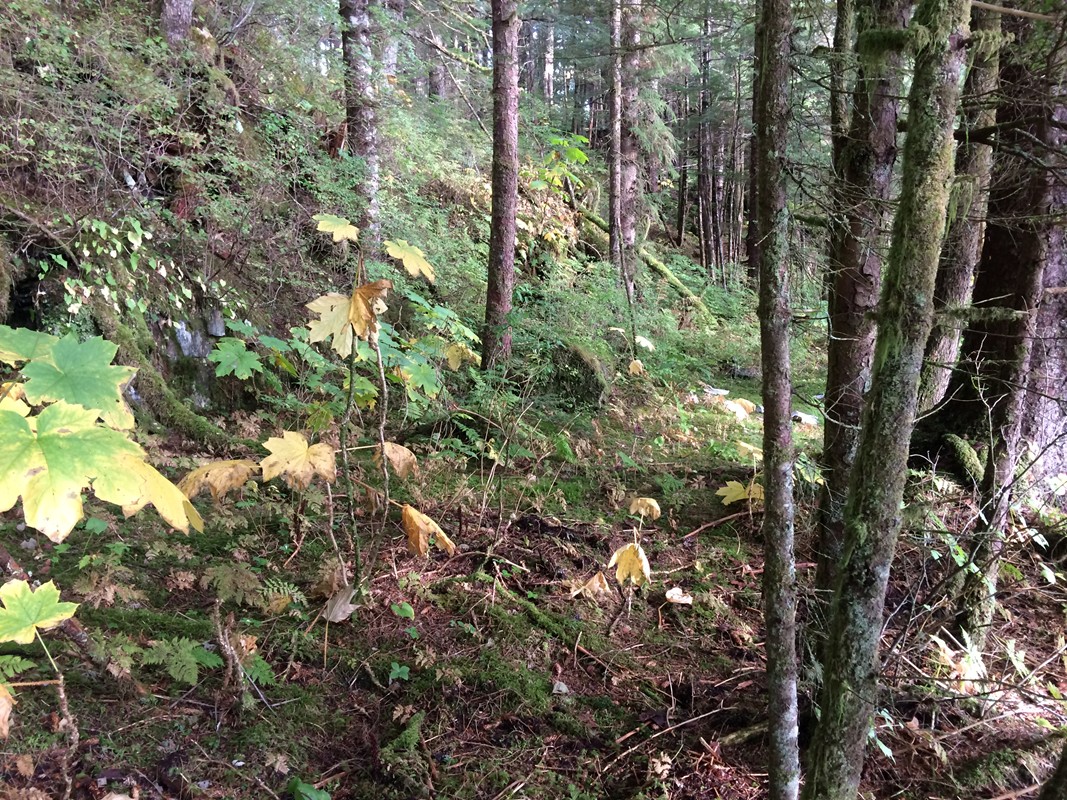
alders I saw what my parents were talking about. All along the top of
the beach
beyond the high tide line was a rock wall two or three feet high, maybe
spanning 75 yards of beach. Beyond the wall was the narrow shelf of
flat land
so 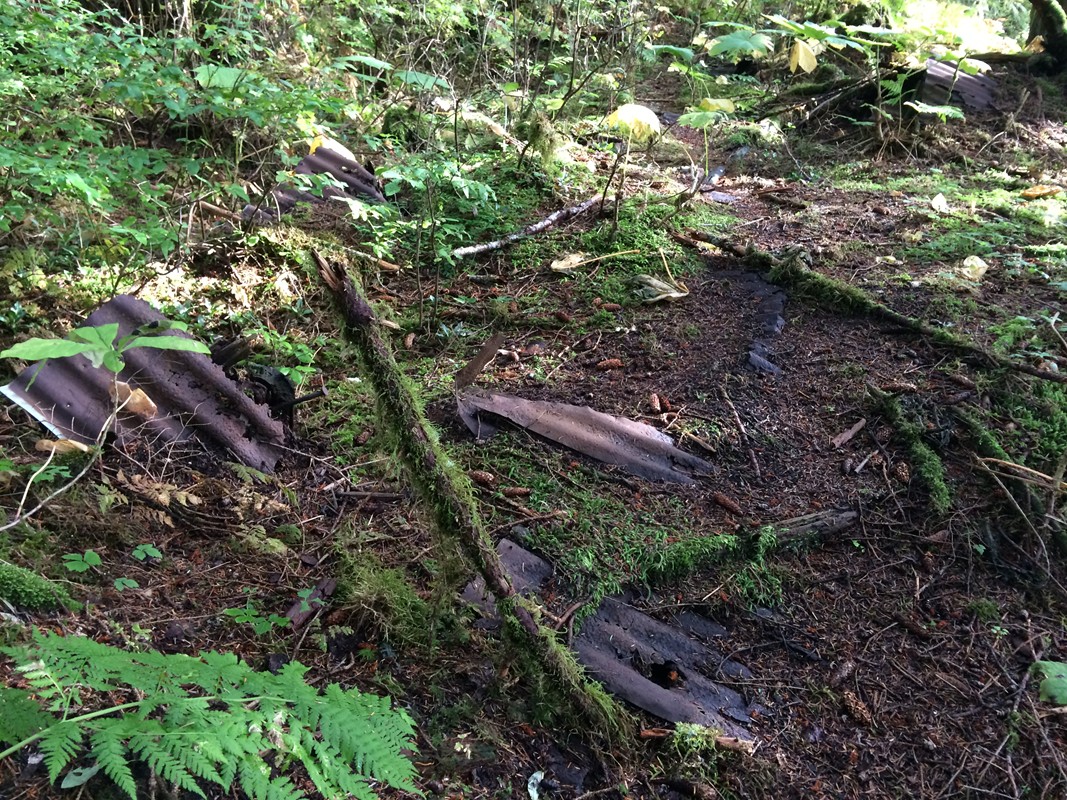 typical
in Southeast, most of it backed by a vertical slope of
bedrock or
nearly vertical slope of the forest floor. I believe they made the wall
to help
level the ground, or expand the width of the level area. It certainly
was a
beautiful corridor between the rock wall/alder fringe on one edge and
the steep
wall behind, most of it probably no more than 20-25 feet wide. I walked
back
along this hallway, picking up the chewed and shattered remains of a
white
bucket that a bear had destroyed, to the site of the house at the other
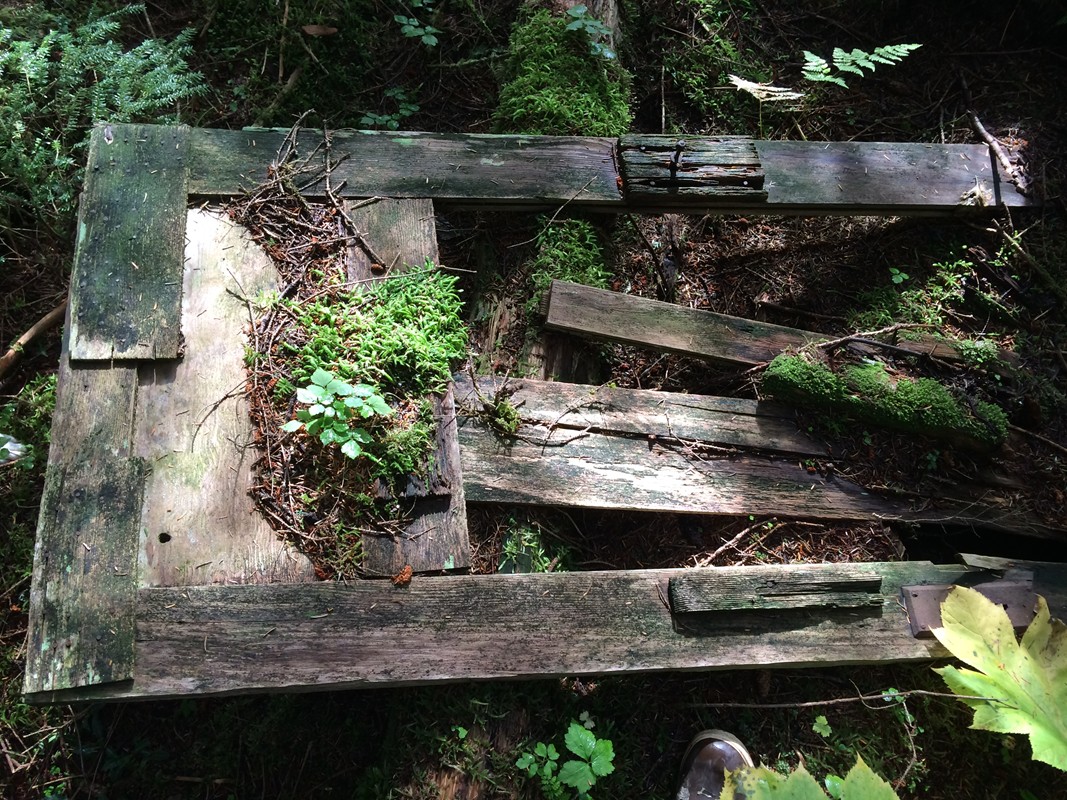
end. It
looked much as it had before—three large logs at more or less right
angles
(probably the foundation) and a decaying door. There was some metal
roofing
nearby and I also noticed metal roofing above the house on the next
shelf up. A
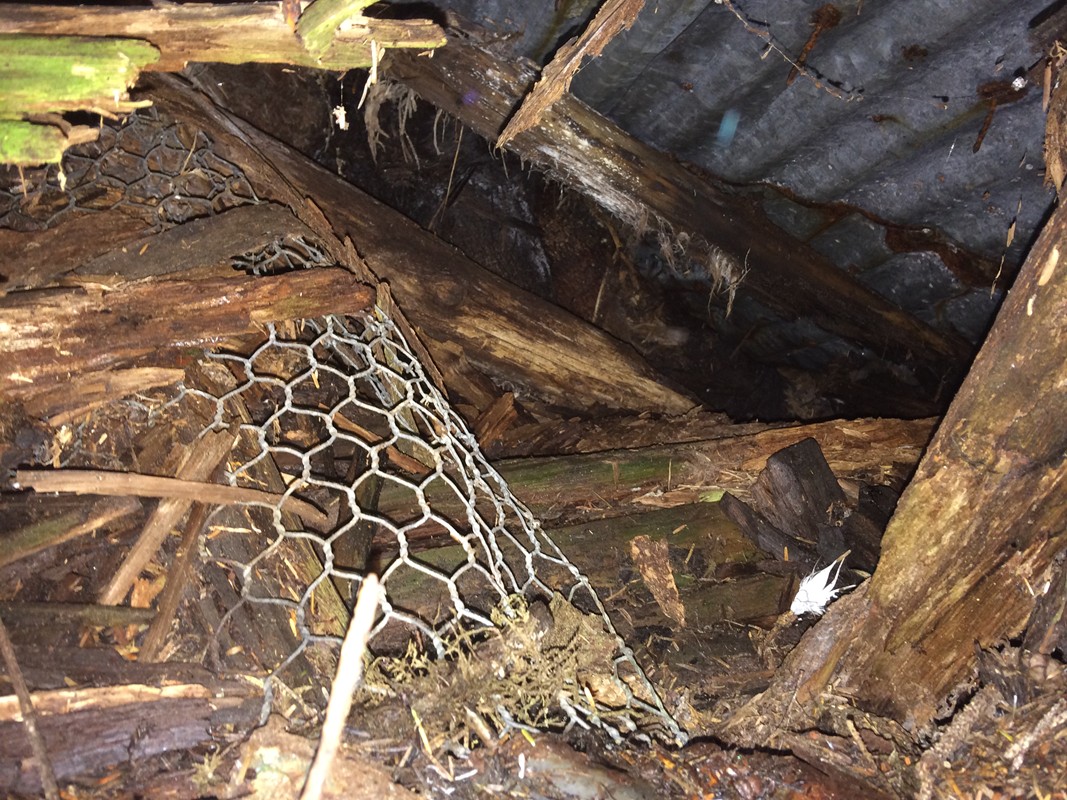
well worn game trail ran through that area with a lot of metal roofing
and
small logs with nails and the like sticking out. Some of the metal
roofing was
gable shaped with some small round logs underneath and some chicken
wire and a
little hollow—could these have been fox pens? It seemed likely.
typical
in Southeast, most of it backed by a vertical slope of
bedrock or
nearly vertical slope of the forest floor. I believe they made the wall
to help
level the ground, or expand the width of the level area. It certainly
was a
beautiful corridor between the rock wall/alder fringe on one edge and
the steep
wall behind, most of it probably no more than 20-25 feet wide. I walked
back
along this hallway, picking up the chewed and shattered remains of a
white
bucket that a bear had destroyed, to the site of the house at the other
end. It
looked much as it had before—three large logs at more or less right
angles
(probably the foundation) and a decaying door. There was some metal
roofing
nearby and I also noticed metal roofing above the house on the next
shelf up. A
well worn game trail ran through that area with a lot of metal roofing
and
small logs with nails and the like sticking out. Some of the metal
roofing was
gable shaped with some small round logs underneath and some chicken
wire and a
little hollow—could these have been fox pens? It seemed likely.
From there Cailey and I followed the well
maintained trail past several flat
topped stumps toward the southern point through a cathedral like forest
of
mighty trees, widely spaced with blueberry bushes beneath. They were
stunning
in a way that seemed non-Southeast—maybe it was the lack of devil’s
club or
other larger undergrowth. There were just enormous trees and
blueberries. The
trail died out before we reached the beach (or we lost it). I spied on
the
seals from behind the fringe of alders and got wonderful looks at them.
It was
interested to see them perk up when Cailey emerged and romped around on
the
beach, but when she ran over to the east side of the point she busted
the seals
there and the ones I was watching slowly followed suit (I regretted
disturbing
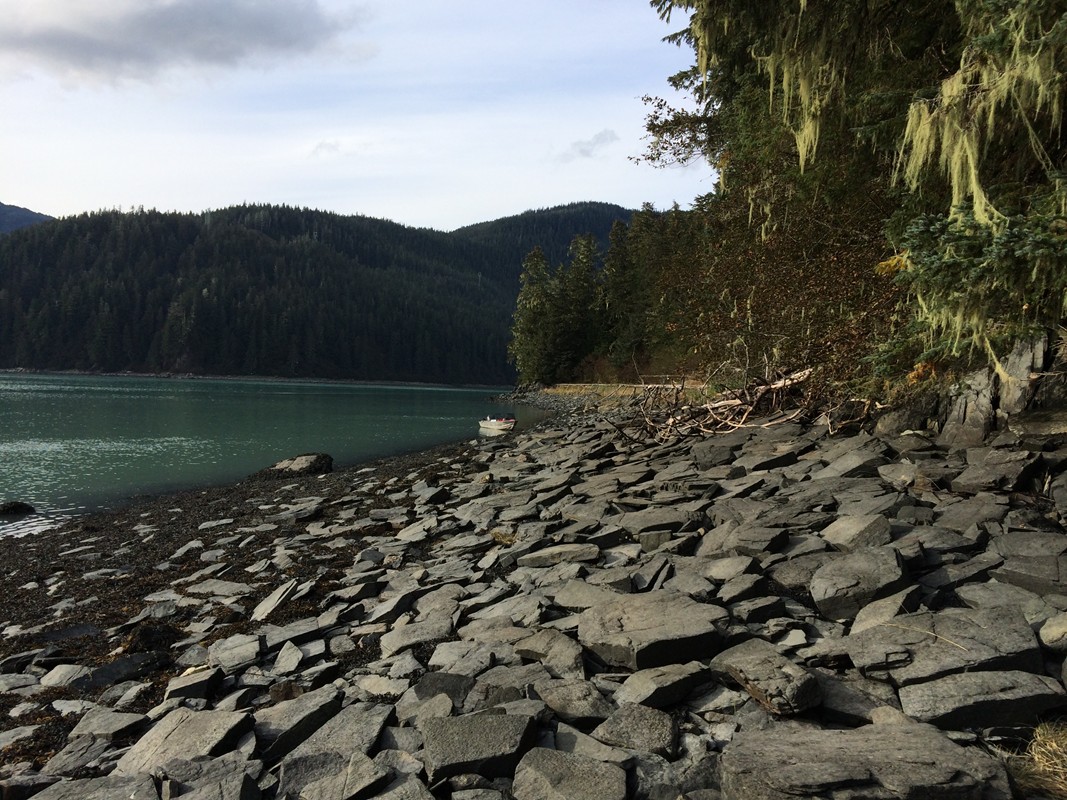
them). We walked back to the boat via the beach and I had a wonderful
look at a
sparrow perched on the side of a large boulder and gazing out over the
serene
bay while I waited for my phone to pick up a GPS signal. It looked like
a song
sparrow, maybe a migrant. When a seal splashed behind my boat it took
off in a
hurry and flew by me only a few feet away.
It took quite a long time to pick up a signal, and
then I
hastily took waypoints and we were on our way back to the homestead on
a glassy
calm ocean in the late sunshine. I swung by the entrance again just in
case
there were any tantalizing blows to be seen and saw that Stephen’s
Passage
still had a layer of fog over it. I wonder what it’s been like in
Juneau? I
found the fishing boat at anchor in the river when we returned. I
refueled the
Ronquil, tied up the riverboat, returned the anchor to the other, and
then
Cailey and I headed in. I felt satisfied with the day enough to enjoy
my puzzle
for an hour before making some dinner (Bob’s Mill biscuits and roasted
red
pepper tomato bisque soup from a box) and writing this.
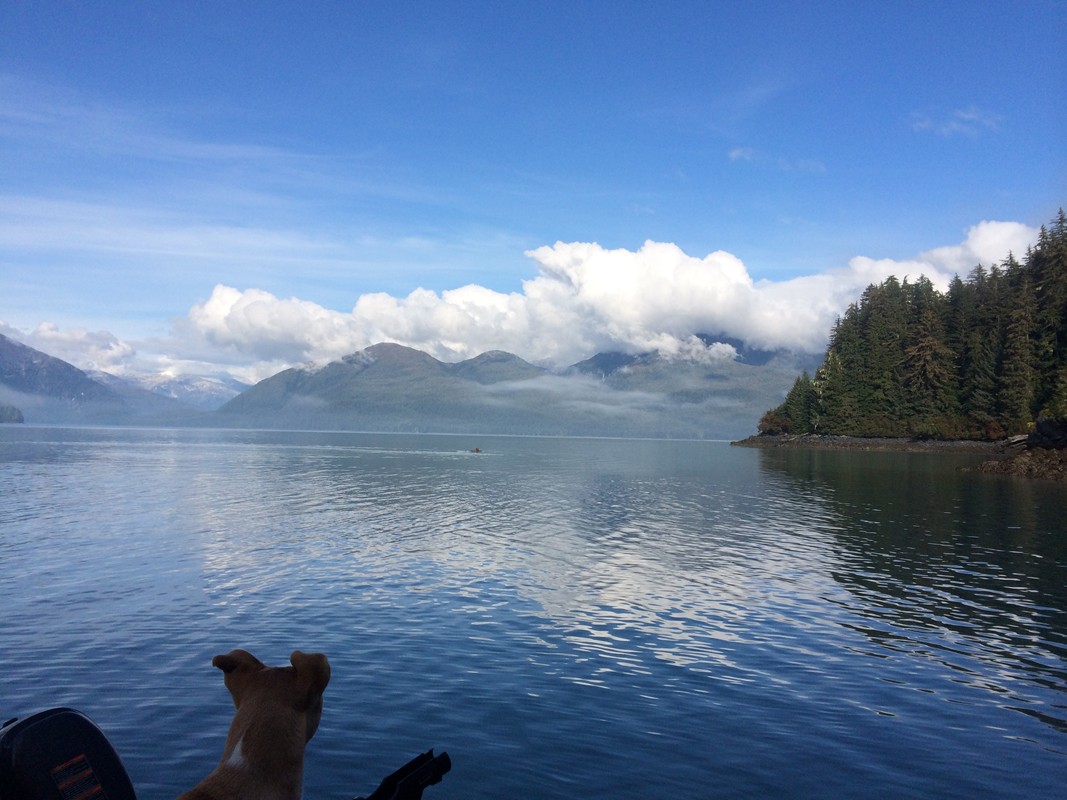 Cailey and a sea lion eye each other |
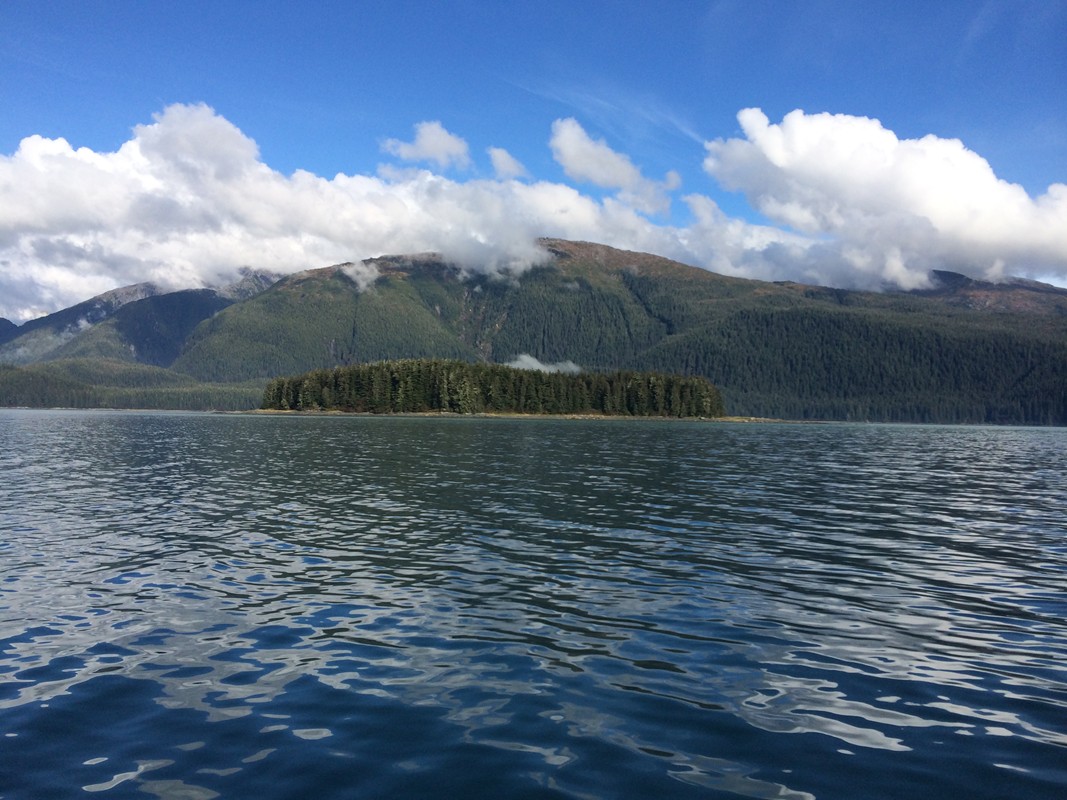 Fanny Island |
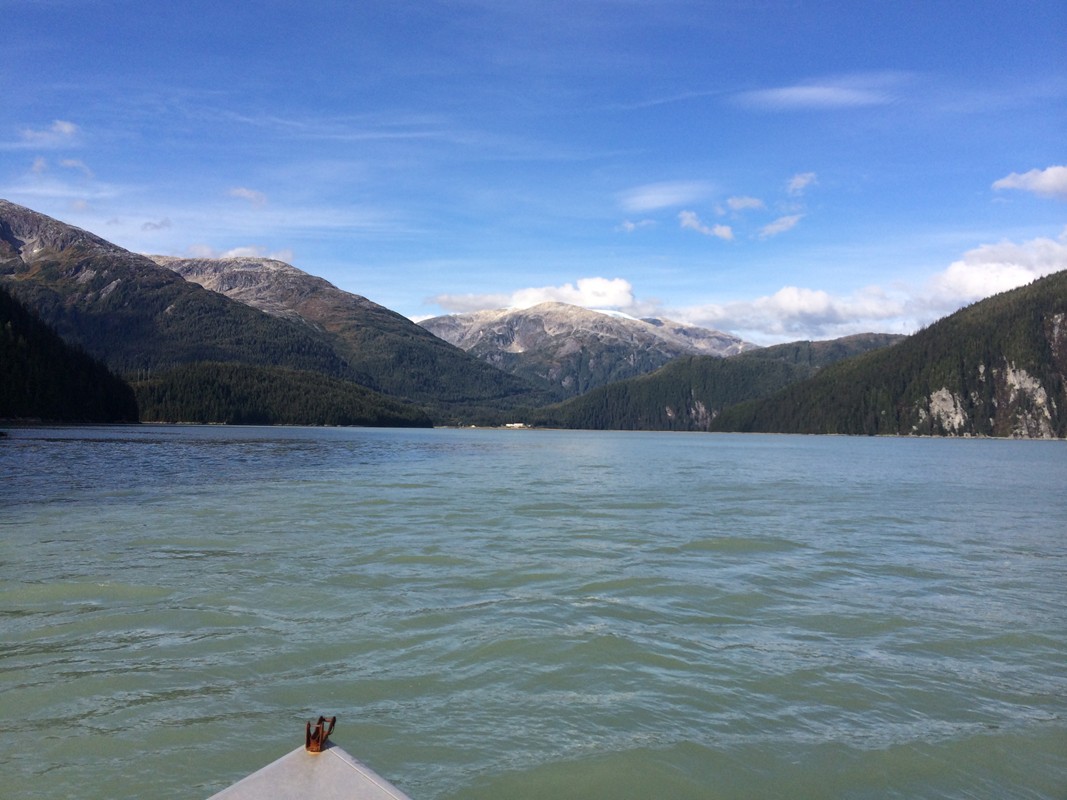 Speel Arm |
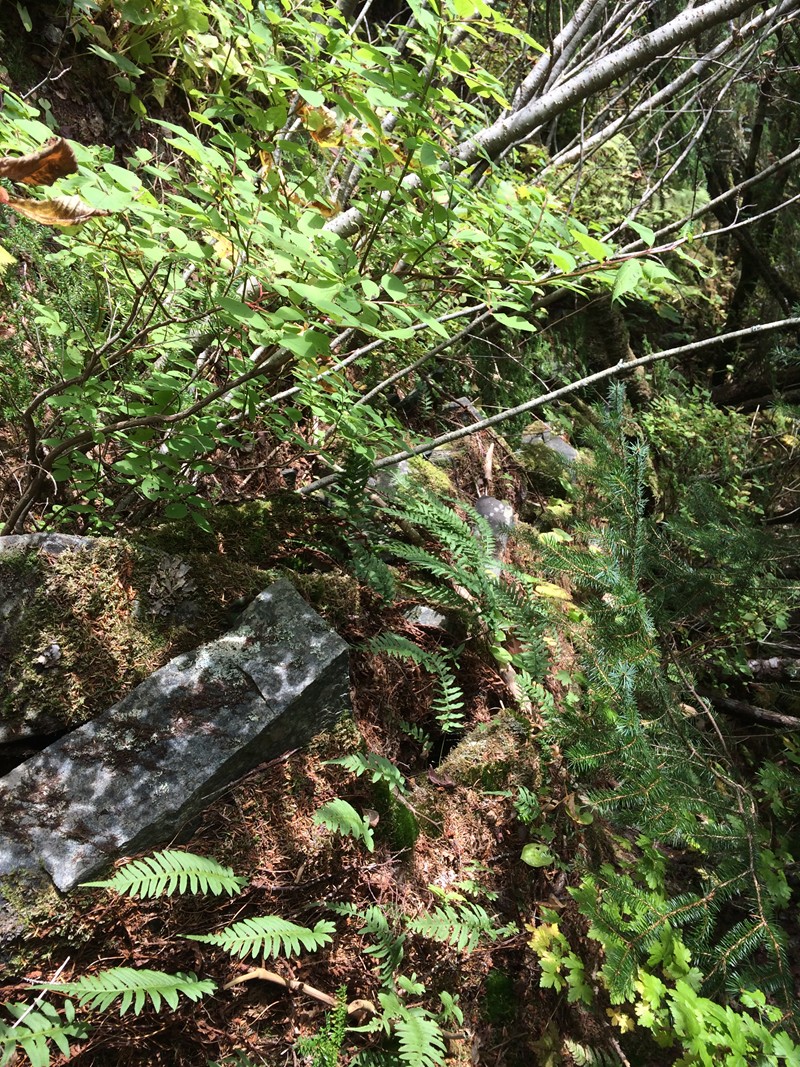 Retaining wall on Fanny Island |
 Shelf between retaining wall and cliff |
Old cabin site on Fanny Island |
 Fanny Island cabin door |
 Fox house? |
 Ronquil at Fanny Island |
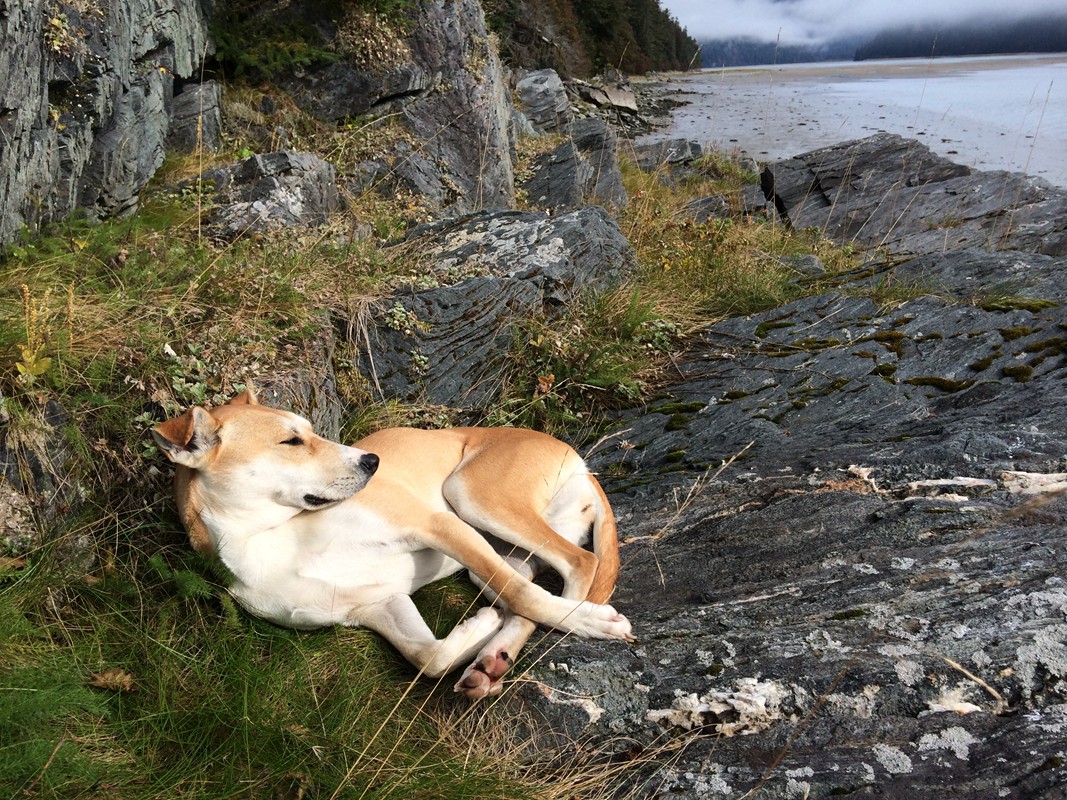
Cailey owns the point