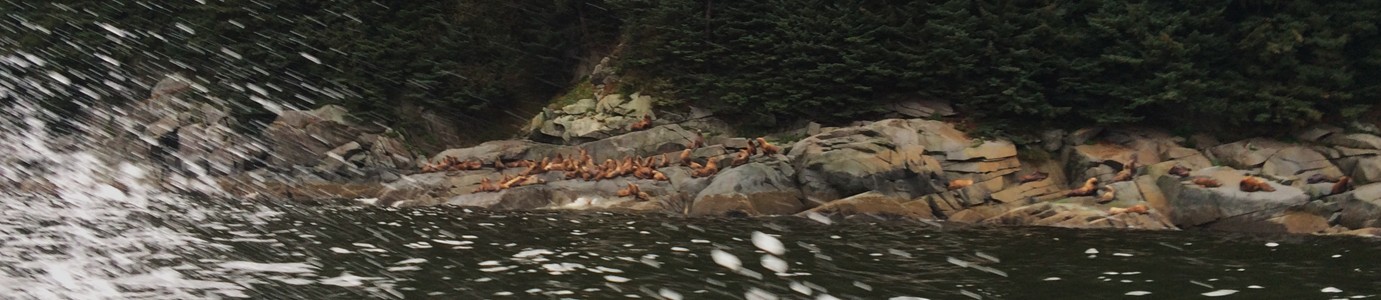
Sea lions at Circle Point
Snettisham
2014 - 8: The Way it Should Be, Days 8-12
September 9-22
Sea lions at Circle Point
There was some rain during the night and a few
sprinkles
greeted me in the morning, soon to diminish into an overcast day. I was
hoping
that my mother would show up at some point, and there were a few things
I
wanted to do before she arrived, so I quickly got to work. I’d
also
decided
that I’d better take advantage of the meager 13’ tide
to bring the
riverboat up
on shore, but the tide wasn’t until 10:30 so I tackled a few
other
tasks while
I waited for it to rise. In general, my goal was to knock out those
close up
tasks that wouldn’t inconvenience us for the last couple of
days. First
up:
waterproof Hermit Thrush. Several years ago I smeared the small lip of
flooring
projecting on the back wall of the cabin with plumber’s putty
and
hadn’t had an
issue again with water getting into the cabin until this year (at
least, not
that I’ve noticed). Perhaps it was because the putty was
crumbling off,
or
perhaps it was because the summer was rainy, but this year water was
saturating
the 2x2 cedar strip below the walls and pooling up around the screws,
soaking
the box spring and the floor underneath. It was time to do something
more
permanent.
Thankfully, I seemed to have the right supplies
for a first
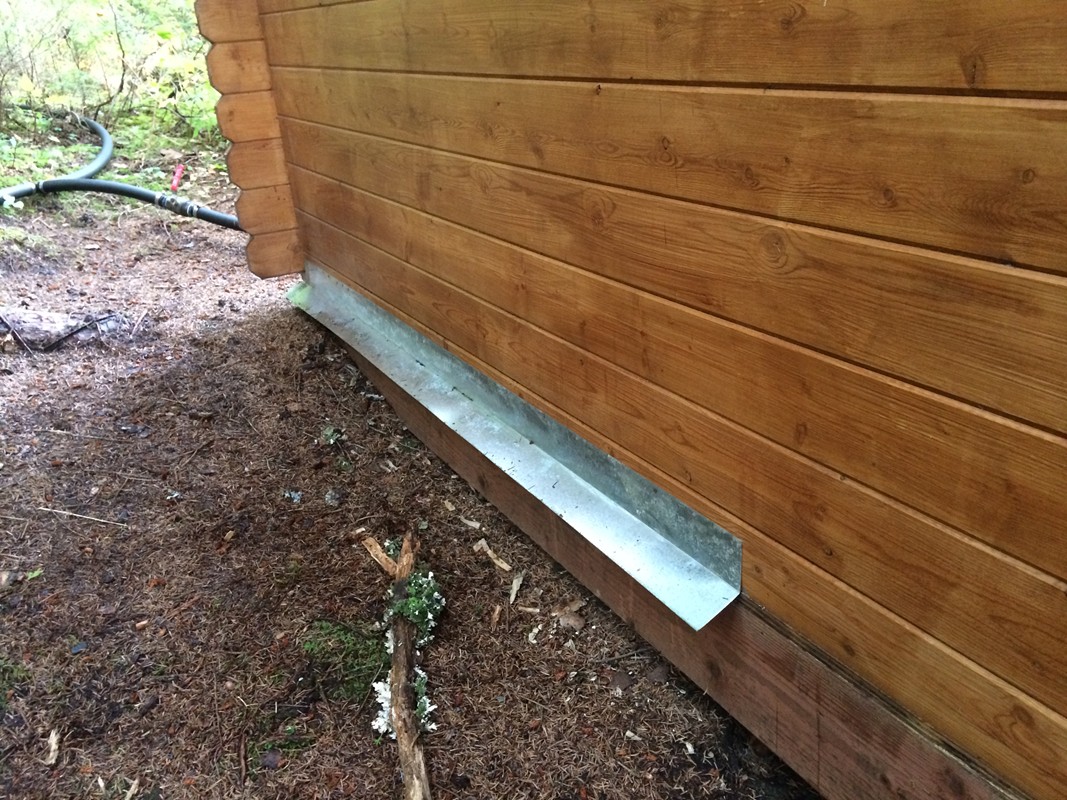
crack at it. What the 90 degree metal flashing was originally meant for
I have
no idea (probably something on the lodge), but it looked more or less
ideal. I
cut a piece to run along most of the back wall (all along the exposed
lip of
floor) and set it on the lip so the vertical side lay against the 2x2
and the
first log above it and the horizontal piece lay on the plywood. I
tacked that
piece in, then put a full piece and a partial piece all along the
exposed
plywood on the wall facing the mountain, which was more even and much
wider. On
either end I cut a notch in the vertical side to fit under the extended
log and
protect the wall to the end. There was plenty of flashing leftover, so
I tacked
in pieces on two walls of Harbor Seal as well. I didn’t finish
because
I
wanted to get my mother’s advice before securing them any
further.
Then I decided that there was no sense in leaving
the water
systems functional for the two cabins that wouldn’t get use. I
cleaned
the sink
and vanity in Hermit Thrush with scrubbing bubbles, then shut off the
water,
removed the filter housings, drained the system (being careful to try
to drain
all the water out of the sink hose), and wrapped the exposed filter
heads in
tinfoil. I repeated the process for Harbor Seal, carrying the housings
back to
the lodge to be cleaned and moving the blanket I’d put on the
bed in
Harbor
Seal for my mom up to Mink cabin (I’d decided to put her in
Mink since
it is
closer to the lodge and Cottonwood).
By that time it was high tide, so I kayaked out to
the boats
with Cailey and brought the riverboat to shore, tying it to the line
still
secured to the chain in the woods. I was just finished and back at the
lodge at
11:00 when I heard the drone of an airplane and within seconds a Ward
Air 206
was landing straight at the beach, no circling or anything to give me
time to
run to the outhouse! Instead I threw on my waders as quickly as I could
and
barely made it to shore as he was taxiing in. Generously, my dad had
offered to
fly my mother down to help me close up. As we unloaded my
mother’s
gear, we
chatted with the pilot about his experience flying up the Whiting
River, which
apparently is a good route to Canada due to a low pass (3,000’)
over
Whiting
Lake. He reported never seeing moose up the river, much to his surprise.
After carrying my mother’s few bags to the
porch
and
replenishing the cooler with a fresh bag of ice she’d
thoughtfully
brought
(there were only a couple of small pieces left from the original ice),
I gave
her a tour of the property (the first time she’d seen the
bridge or
stairs)
while she told me about closing up the Taku cabin the week before. Then
we ate
quesadillas for lunch and spent the afternoon in the lodge chatting and
working
on the puzzle. That evening we ate an amazing butternut squash risotto
dish my
mother brought and exquisite “everything†pie featuring
Taku
blueberries and
nagoonberries. After dinner we managed to finish the puzzle, struggling
to the
end with the dappled, painted leaves, and chatted until bed at 10:30.
That
night I slept better than I had all week, Cailey snuggled up as usual
next to
me; it rained all night.
In the morning I managed to beat my mom to the
lodge with
enough time to do the dishes and clean/lubricate the o-rings on the six
filters. Then I opened up the shed and found a wren fluttering against
the
upriver window. He or she was gently captured with only a little effort
and I
released him in front of my mother who’d just stepped off the
boardwalk. The
little guy flew away, apparently with no harm. Those guys bob around
the ground
so much that he must have found his way through the crack in the door
even
though it was closed. We drank coffee on the porch with biscuits and
looked out
at another lovely overcast day. Little did we know what a long
day’s
work we
had ahead of us!
 The
first thing I did was replace the trailer
ratchet on the
chain in the woods with the come-along, but the tide wasn’t for
another
couple
of hours and would give us another foot up the beach, so we left that
task and
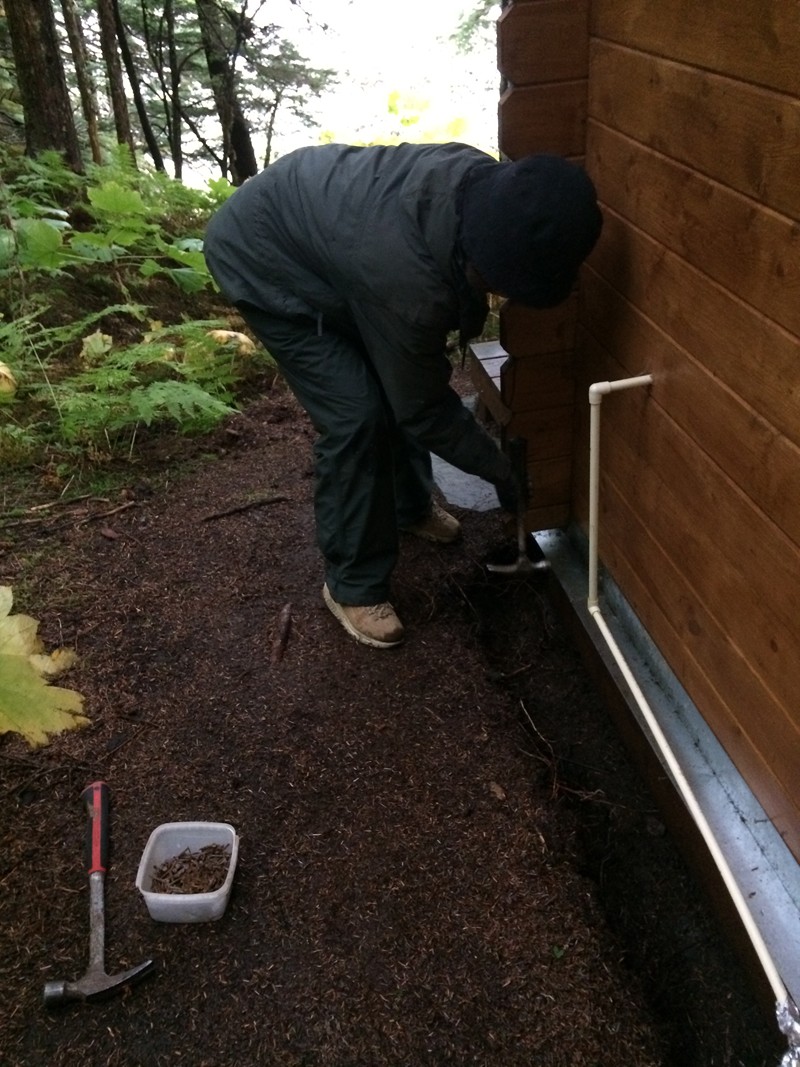
went to work on the flashing. My mother agreed with my strategy, so we
set to
work nailing the back of the flashing to the wall, spacing the short
roofing
nails at a distance that held the flashing flush to the wall (sometimes
only a
few inches apart). After nailing them in on Hermit Thrush, we
experimented with
bending the bottom part down to better shed the water; on the
mountainside wall
we bent it at a sharp 90 degree angle and hammered it against the top
of the
2x8 to protect it from rain splatter, but on the other wall we just
bent it at
a gentle angle.
The
first thing I did was replace the trailer
ratchet on the
chain in the woods with the come-along, but the tide wasn’t for
another
couple
of hours and would give us another foot up the beach, so we left that
task and
went to work on the flashing. My mother agreed with my strategy, so we
set to
work nailing the back of the flashing to the wall, spacing the short
roofing
nails at a distance that held the flashing flush to the wall (sometimes
only a
few inches apart). After nailing them in on Hermit Thrush, we
experimented with
bending the bottom part down to better shed the water; on the
mountainside wall
we bent it at a sharp 90 degree angle and hammered it against the top
of the
2x8 to protect it from rain splatter, but on the other wall we just
bent it at
a gentle angle.
By that time it was after 11:00 and high tide, so
we pulled
the boat up as far as it would go and then began bringing it up by
come-along.
This turned out to be a very slow process, as there was only a six foot
reach
of cable and a lot of that was used taking up the slack in the line.
Each time
we reset, we had to tie a new loop in the line which made the painfully
slow
process all the more apparent. I sat in the woods cranking while my
mother
watched the boat and helped pull it the two or three times the boat
moved a few
inches for each length of six feet. Then she came back to where I was
and
helped release the line, pull out the cable again, and secure it to a
new loop
in the line. It looked like we were bringing it up about two feet per
session,
tediously slow. I did soon improve management of the come-along,
though, and
would already have the cable pulled out by the time my mother got there
to
stretch the line out and find where the next loop would need to be. By
a little
after noon I was worn out and badly in need of food, so we took a lunch
break.
The boat seemed hardly to have moved, still somewhere in the middle of
the
steep slope adjacent to the log. We ate quesadillas and drank beer,
then
decided to remove the engine before we continued moving the boat. I
unhitched
the chain from around the tree in the woods and we carried it, the
come-along,
and my new tripod to the boat. In order to line it up correctly above
the
engine, I removed the engine hood, surprised to find most of a package
of
noodles stowed against the back! As we cleaned it out, chuckling about
how I’d
run the engine all summer with a bunch of noodles in it, we saw that
there was
oatmeal and rice underneath all the pasta. The amazing thing is that I
recognized all the stashed materials; two springs ago I’d
opened up the
lodge
to find that a mouse had made its way inside and had stashed the same
pasta,
oatmeal, and rice in various places in the lodge. At first I thought
he’d also
carried a considerable amount (it must have been a hundred loads) all
the way
to the shed and under the engine hood, but Chris later pointed out that
the
engine had overwintered in the lodge that first winter and no doubt was
filled
up at that time. We scooped it out as well as we could and stashed it
on the
boat, though I think Cailey had eaten all of it by the time the day was
over.
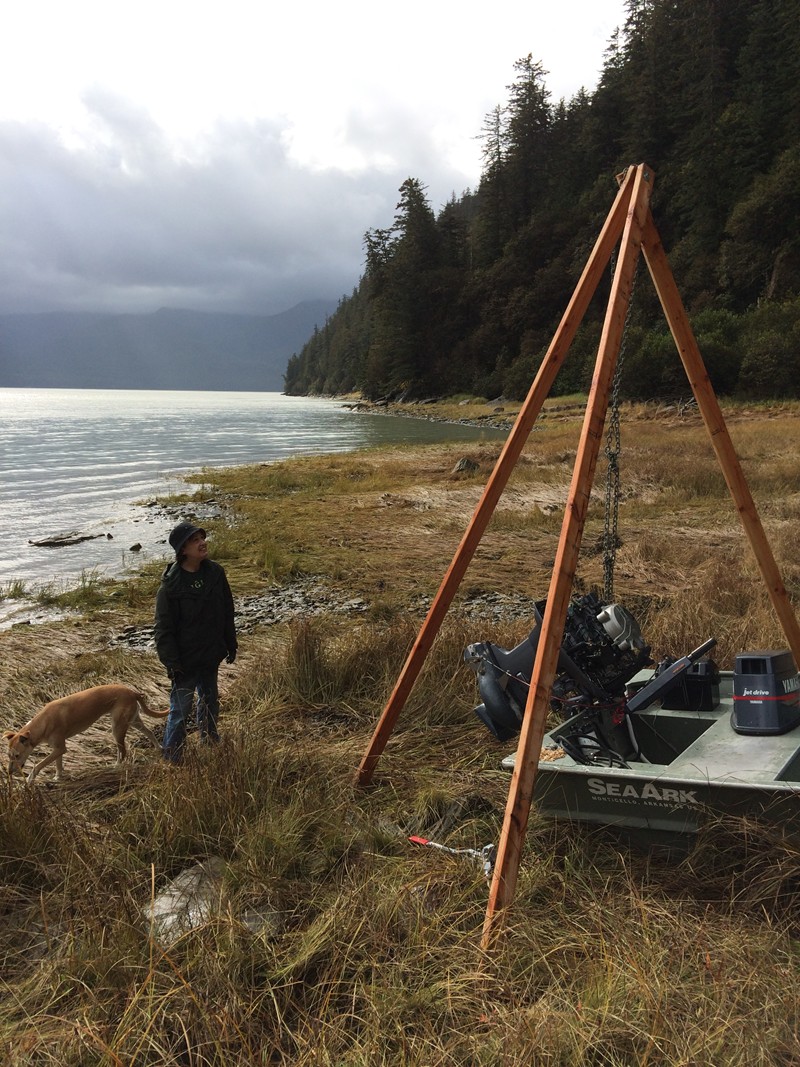 Once
the hood was off we could arrange the tripod.
After
throwing the chain over the top of the 2x4s, we spread the tripod
behind and to
either side of the engine, making small adjustments until it looked to
be
directly over the engine loop. I was concerned about how to connect the
come-along
to the chain, as the shackle pin I had is too thick to fit through two
links in
the middle of the chain, but my mother solved that problem by tying a
knot in
the chain which worked beautifully. We clipped on the come-along and
were ready
to pull. Before we did that, though, I brought some cedar shims down
and filled
the gap between the bottom of the engine and the top of the transom
(the jet
engine’s bracket does not rest on the boat, which makes it
difficult to
bolt
in). Once it was all shimmed up, I duct taped the shims together, we
unscrewed
the bolts with socket and wrench, released the clamps, and had the
engine up in
no time. With only a little extra maneuvering, we lowered the engine
down onto
a dolly and tied it securely in place.
Once
the hood was off we could arrange the tripod.
After
throwing the chain over the top of the 2x4s, we spread the tripod
behind and to
either side of the engine, making small adjustments until it looked to
be
directly over the engine loop. I was concerned about how to connect the
come-along
to the chain, as the shackle pin I had is too thick to fit through two
links in
the middle of the chain, but my mother solved that problem by tying a
knot in
the chain which worked beautifully. We clipped on the come-along and
were ready
to pull. Before we did that, though, I brought some cedar shims down
and filled
the gap between the bottom of the engine and the top of the transom
(the jet
engine’s bracket does not rest on the boat, which makes it
difficult to
bolt
in). Once it was all shimmed up, I duct taped the shims together, we
unscrewed
the bolts with socket and wrench, released the clamps, and had the
engine up in
no time. With only a little extra maneuvering, we lowered the engine
down onto
a dolly and tied it securely in place.
The boat was blocking the best path up to the
lodge, though,
so we left it there and repurposed the chain and come-along back in the
woods
for the boat and removed all the remaining gear off the boat (battery,
bilge
pump system, etc.). We pulled the boat up another few feet that way
until it
was on the relatively flat meadow above the lodge, then jointly pulled
the
engine up to the shed. The only really awkward part was getting it
along the
edge of the porch where the gray currents are thick; my mother
heroically
fought them back with her body while I lugged the engine past.
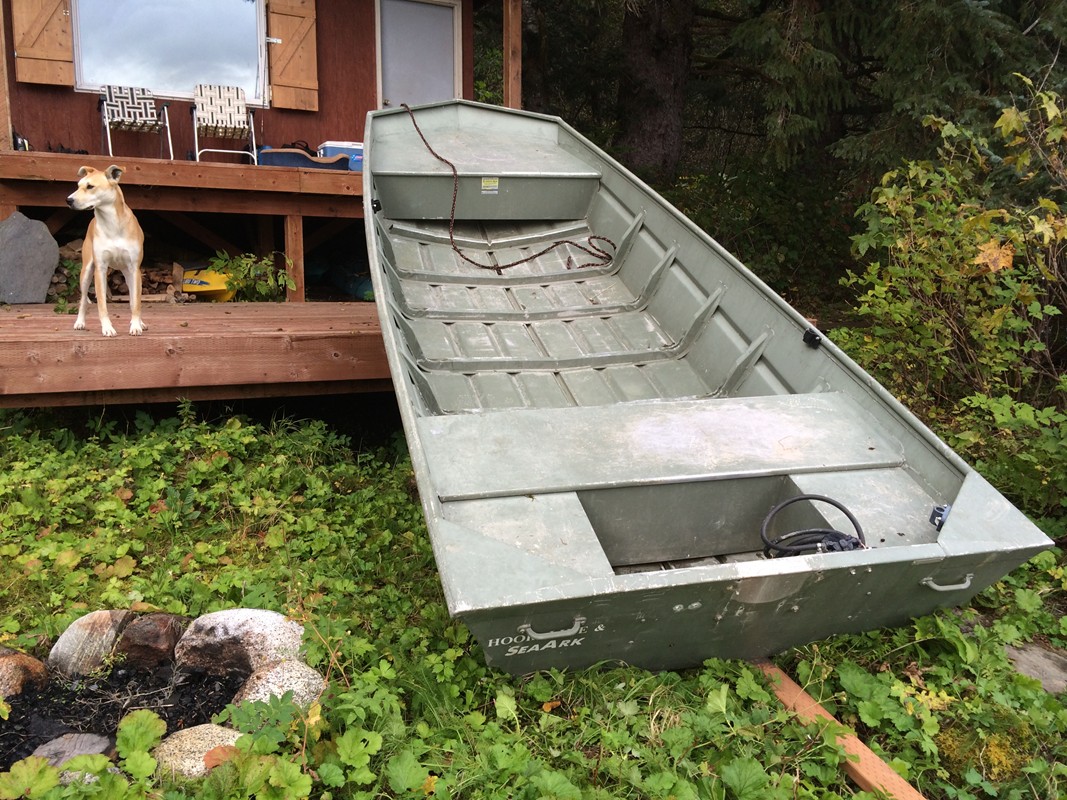 After
that we hung tarps around both outhouses
(not yet
securing them with line) and finished the flashing project at Harbor
Seal. Back
at the lodge, we stowed the lumber I had staged on the deck under the
lodge for
the winter, then decided to move the boat “two feetâ€
before we took a
much
desired break. By that time we’d decided to try pushing it
ourselves as
a
faster and more efficient method of moving it. We quickly got into a
routine
with my mother pushing a 2x4 under the stern and raising the boat up
while I
lifted and pulled on the bow, sliding it forward inches to a foot each
time.
Some of the time there was enough of a gap back there that she could
insert the
2x4 without help, other times I had to go back and lift up one side. It
was
hard work, but so much faster than the come-along! By the time we quit
we had
moved it considerably farther than two feet, nosing the boat into the
tall grass behind the fire pit. We finally did take a break, drinking
an
orange san
pellegrino (Mom) and a diet coke (me). Then we manhandled the boat the
rest of
the way to the porch (moving one of the benches out of the way
temporarily),
heaved it up on top, scooted it across, then dropped it down on the
other side
before turning it over as gently as we could. We propped it up well
with lumber
scraps I’d left out, then quit for the day, well and truly worn
out.
After
that we hung tarps around both outhouses
(not yet
securing them with line) and finished the flashing project at Harbor
Seal. Back
at the lodge, we stowed the lumber I had staged on the deck under the
lodge for
the winter, then decided to move the boat “two feetâ€
before we took a
much
desired break. By that time we’d decided to try pushing it
ourselves as
a
faster and more efficient method of moving it. We quickly got into a
routine
with my mother pushing a 2x4 under the stern and raising the boat up
while I
lifted and pulled on the bow, sliding it forward inches to a foot each
time.
Some of the time there was enough of a gap back there that she could
insert the
2x4 without help, other times I had to go back and lift up one side. It
was
hard work, but so much faster than the come-along! By the time we quit
we had
moved it considerably farther than two feet, nosing the boat into the
tall grass behind the fire pit. We finally did take a break, drinking
an
orange san
pellegrino (Mom) and a diet coke (me). Then we manhandled the boat the
rest of
the way to the porch (moving one of the benches out of the way
temporarily),
heaved it up on top, scooted it across, then dropped it down on the
other side
before turning it over as gently as we could. We propped it up well
with lumber
scraps I’d left out, then quit for the day, well and truly worn
out.
That night we ate the same amazing meal
we’d had
the night
before. While it was cooking I cleaned and lubricated the rest of the
water
filters we’d taken off the cabins and got the motion sensor
camera all
ready to
go for winter with fresh batteries and a strap extension so it could go
around
a larger tree. It had been windy in the morning, but we were thankful
that it
only rained briefly here and there while we worked. I’d wanted
to set
the
halibut line that day so we could pull it before we left the next day,
but we
were so tired by the time we quit (around 5:00) and there was a brisk
chop
coming in off Gilbert Bay that I elected to forgo halibut fishing. I
just
wasn’t up to kayaking out to the boat and fighting myself
across to
Gilbert Bay
at that point in the day! The wind did die down during dinner, though.
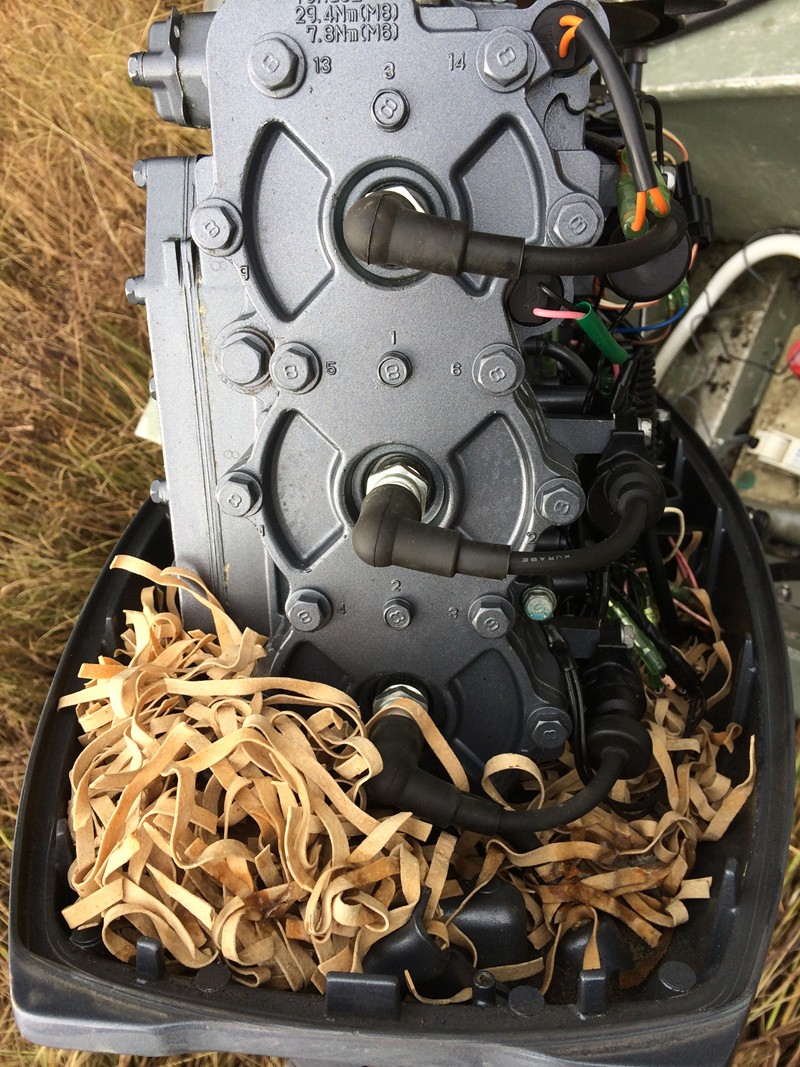 Mouse noodle stash in my engine! |
 Mom pushes the riverboat |
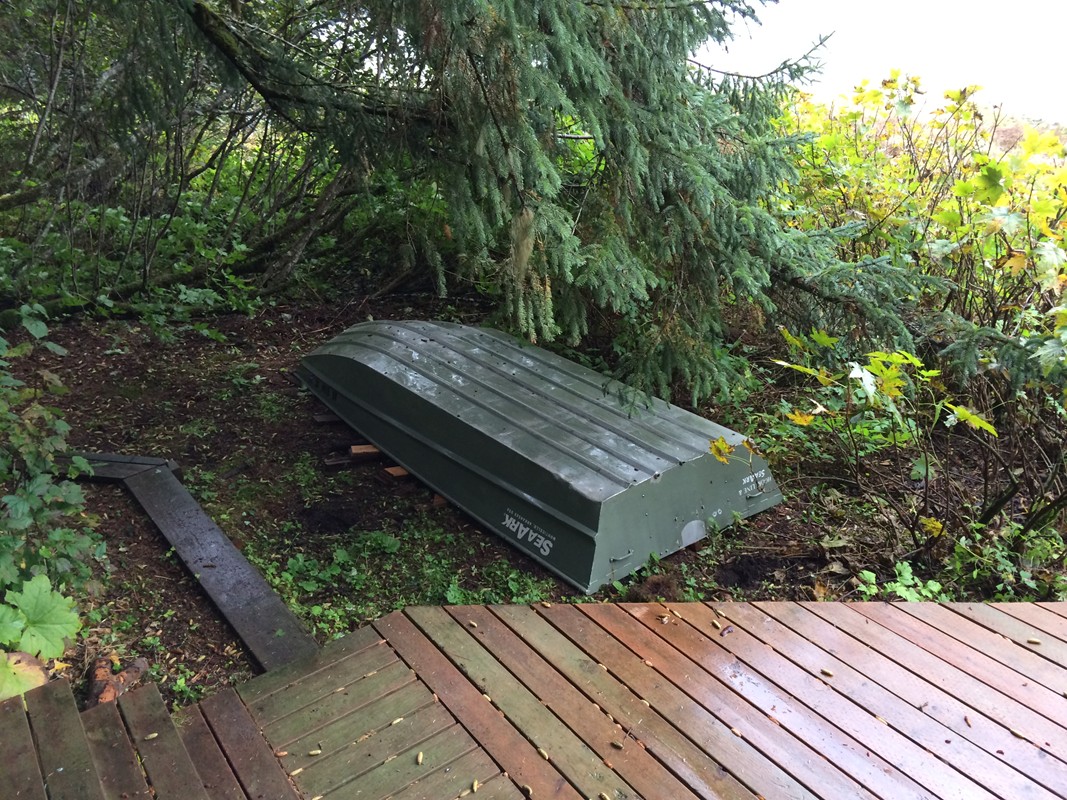 All set for winter |
Then I cleaned my cabin, tied the tarp around the
cabin
outhouse, tidied up the shed (a lot of items had accumulated outside it
and I
needed to rearrange the interior to fit the engine back in its corner),
re-secured
the tarps over the main lumber pile (which I’d disturbed to
find a
piece of
hemlock siding for the window repair), began packing up the lodge, and
finally
put the gray water system away. This last is a most unpleasant task,
which involves
cutting away the filter bag through which all the gray water flows on
its way
into the tank (which was clogged enough to be full of water and hard to
handle)
and then dumping the remains of the barrel on the ground and removing
the lower
filter bag. I bagged up the filters and covered the ground where the
barrel had
dumped its contents with branches and moss and twigs to discourage
Cailey from
digging around there. At that point we were nearly ready to go with the
exception of winterizing the rest of the water system, which involves
removing
the olive barrel from the creek, the filters from the lodge, draining
the hoses
and valves, and wrapping the valves in tinfoil. But we didn’t
want to
be
without water until we knew we were going and we’d woken that
morning
to
another northerly whipping down the Whiting enough to cause waves. We
were
again puzzled by the incongruity of the weather, as rain had poured all
morning
(which is usually indicative of a southeasterly system). We were
finished with
our chores by 10:00 and decided to wait on the water system until the
weather
lay down in case we would be overnighting again (neither of us wanted
to see
what Taku Inlet was like if there were northerly waves on the Whiting,
quite
rare in summer). We had a picnic lunch and rested for a while. All our
gear was
ready for departure.
Around noon the wind began laying down, so we
hiked up to
the olive barrel and struggled to wrangle it out of the creek.
I’d
noticed a
few days before when using the unfiltered valves to fill buckets for
scrubbing
the bridge that the water coming out was deep brown and full of
sediment (a
testament to how well the filters work that the water came clear out of
all the
taps). When I finally pulled the barrel out far enough to remove the
lid and
look inside, I found a lot of fine sediment that was weighing it down.
I
scooped most of it out and stashed the barrel off the side of the
creek. After
that we drained all the valves, trying to be careful to raise the hoses
and get
all the water out, and wrapped tinfoil around all of them. I took the
time to
visit the two valves off the main line to try to drain any remaining
water out
of them as well in an effort to avoid having to replace any next
spring. After
that I finished packing inside and moved everything out to the porch
while my
mom swept and covered the windows in newspapers. We filled the wood box
and,
finally, removed the smoke stack and covered the opening with plywood
(which
took longer than usual as I dropped my first hammer and lost it
somewhere under
the lodge).
Finally we hauled everything down to the water,
placing some
of it on a tarp to help keep it dry. The water was calm right against
the
shoreline, but by the time I was 50 feet out I was feeling the rollers.
It
wasn’t the worst I’ve seen it there at Snettisham, but
the swell was
strong and
significant and I knew from experience (well, as well as one can know
without
actually going out to check) that the port would be seeing heavy seas
and there
was no way we wanted to be in Stephen’s Passage. I bopped
around the
boat a
little while making the decision; on the one hand, we were ready and
wanted to
head out and we really didn’t know what it was like out there.
On the
other
hand, I had a pretty good idea we’d be coming back and that
would mean
reanchoring the boat, unloading gear, etc. I called it, kayaking back
to shore
to explain the situation. Since the tide was dropping, we left
everything where
it was and went back to the lodge to wait out the weather. I figured
that 4:30
would be the latest we’d want to leave, as it usually takes two
hours
to get
back in decent weather and that would give us an hour to be slow or
deal with
any situations before it got dark around 7:30. We had a beer on the
porch, then
retreated inside, ever watching the water. It did seem to diminish a
little,
but we called it at 4:00 and decided to stay, sending a SPOT message
later to
let the people at home know we hadn’t left. When we retrieved
our gear,
the
wind was strong and swirly, vindicating our decision to stay. Right
afterwards,
however, the southeasterly swell did die down and was replaced by a
light
northerly again. Earlier we’d lit a candle and a kerosene
lantern in
the hopes
that it was help warm the place up; now that we’d decided to
stay and
the light
was dimming, we lit three of the propane lights as well as the pilots
on the
stove. We didn’t light a fire, but were comfortable all
evening. We ate
butternut squash soup, bread, biscuits, and chocolate for dinner.
I’d
already
packed away my sheets, so I used a blanket and the comforter as a big
sleeping
bag and was comfortable all night. It rained intensely and was very
cozy.
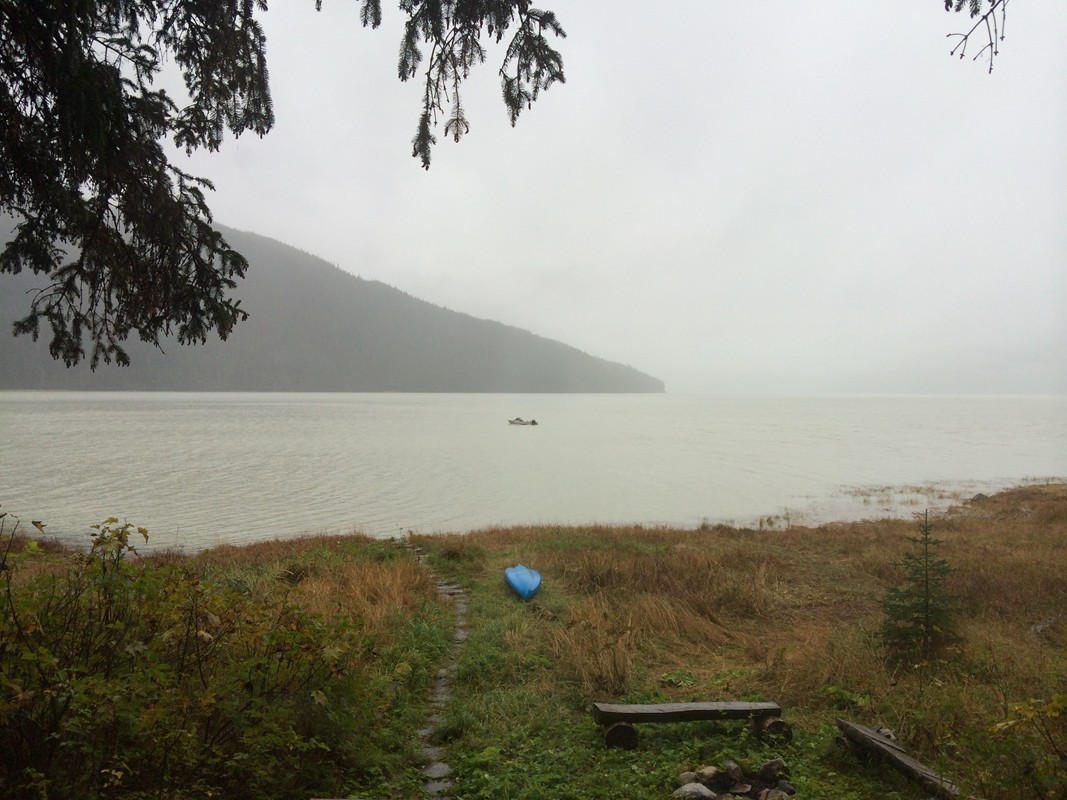 You can see the seas coming down the river |
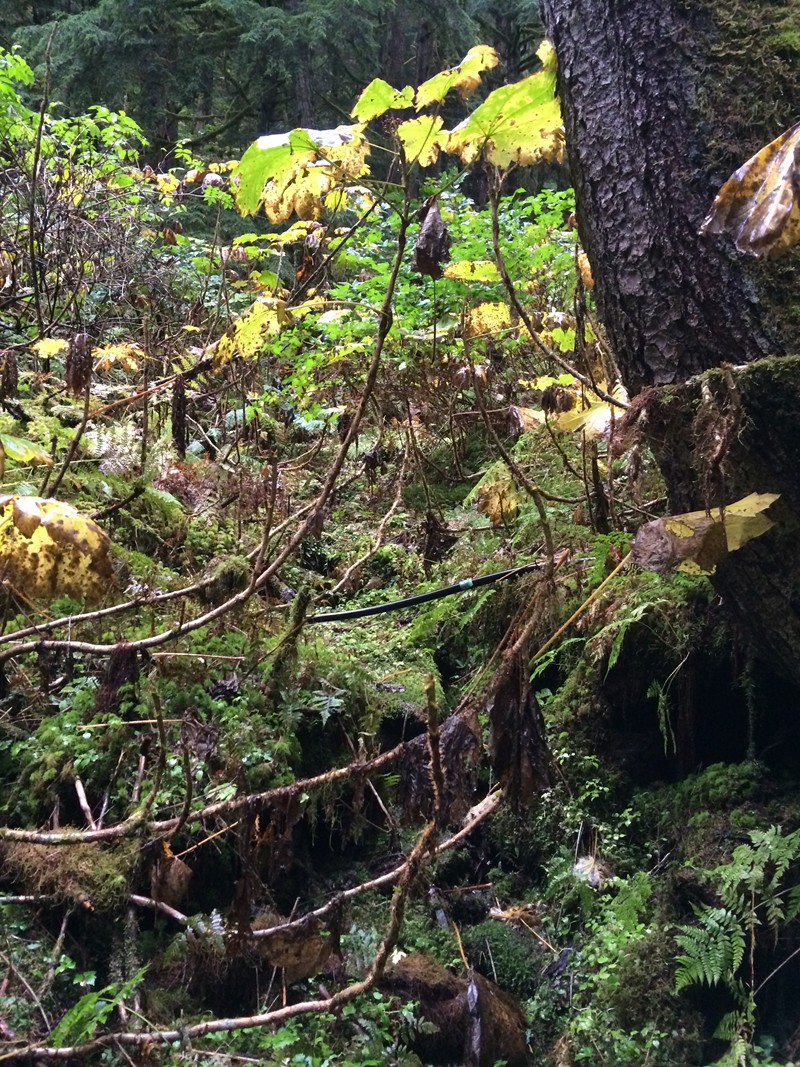 Soggy route to the water source |
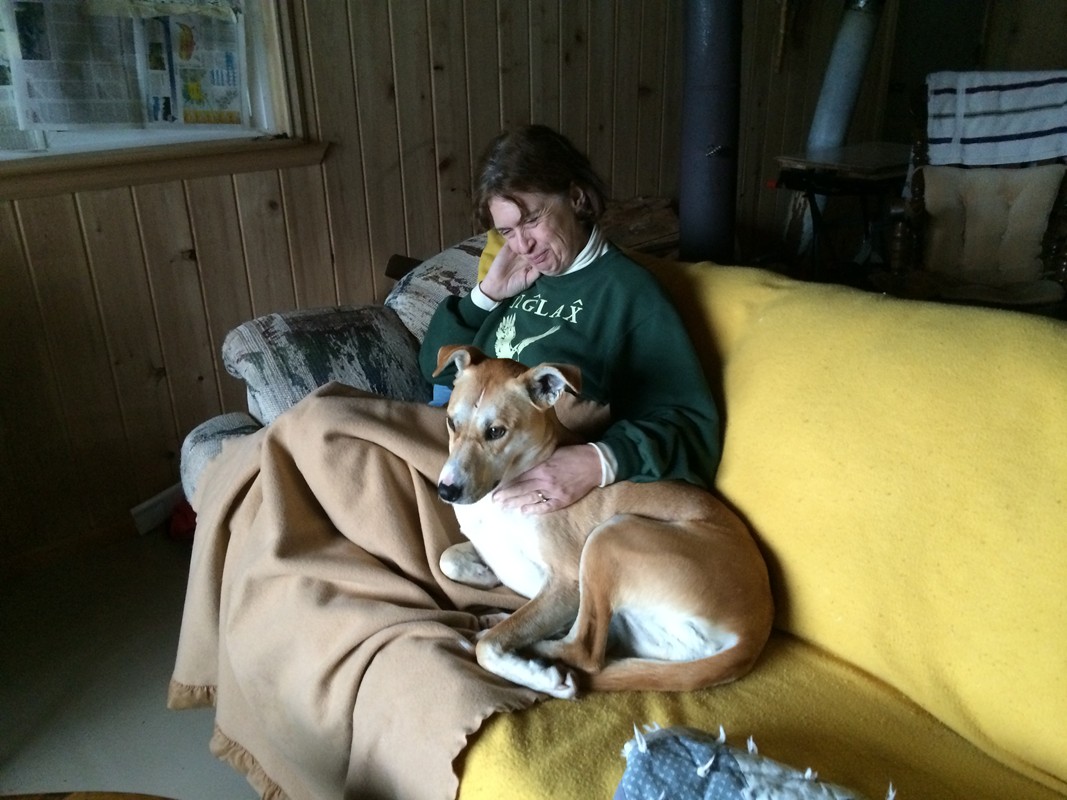 We settle back in for the night |
I couldn’t help but notice a howling
northerly
coming down
the river, though it left the shallow water at low tide undisturbed. I
anchored
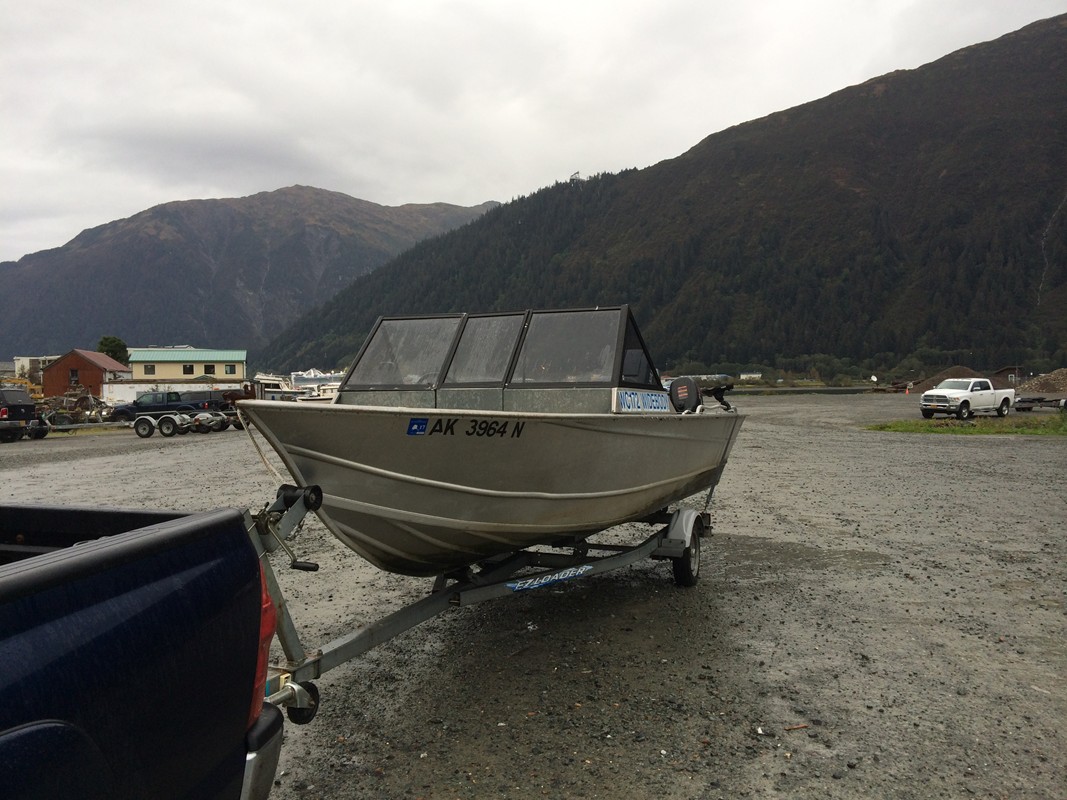
the boat in the mud and we slogged our gear to the boat in many trips.
We
pulled anchor and drifted downriver while we got the boat ship shape,
then took
off enjoying a following sea out of the port. Around the corner in
Stephen’s
Passage we started to encounter smooth swells coming down, but nothing
that slowed
us down very much. We paused below Grave Point, then headed back out,
passing a
sea lion that leaped out of the water on the way. The seas built as we
headed
up toward Taku Inlet until they began to get ugly off the tip of Grand
Island.
I plunged between a couple of waves and took a lot of green water over
the bow
before I sat up on top of my folded seat so I could see over the top of
the
windshield. The day was fair and bright, and there were even patches of
blue
sky here or there, but the salt spray made it impossible to see in
those
conditions. We pushed on a little farther, but it was getting
increasingly
unpleasant, the wind whipped seas building to three feet and requiring
concerted effort to maneuver safely and comfortably and avoid scooping
too much
water out of the ocean. Poor Cailey had moved down the narrow isle as
far back
in the boat as she could go and we moved her blankets back there for
her to lay
miserably on. My mom suggested we try making it to Doty Cove and
finding some
shelter there, but a few seconds in the trough of those waves on the
way and I
vetoed that idea. The fact that Doty Cove was full of whale blows
should tell
you that the attempt was very unpleasant!
Then my mom mentioned that my dad used to go up
the south
side of Taku Inlet and cross farther up, so we thought we’d
give that a
try. We
turned and made our way across Stephen’s Passage and cruised up
along
shore at
Circle Point, delighted to see about 75 sea lions including several
large bulls
on the rocks. A little farther along the shore I got a cell phone
signal and we
managed to call my dad to tell him what we were doing; he was very glad
to hear
from us. The going close to shore was a little slow, but fairly
comfortable and
we kept an eye out for sheltered areas to retreat into. We worked our
way just
past the cove where the power lines cross Taku Inlet, then headed out
to see
what it was like. It didn’t take long before I turned around.
My dad
had said a
big southeasterly storm was coming in and that we should hurry home
before it
did, so we were hoping the northerly would die down. To that end, we
retreated
to the most shelter we could find (the beach Chris and I explored
earlier this
summer), but it wasn’t sheltered enough to protect the boat,
which was
banging
on the rocks. Cailey got a couple of minutes ashore and then we pushed
off and
anchored about 15 feet off to wait. We ate cheese and crackers and
waited about
40 minutes before decided that we should probably just call it off. It
was so deceptive
looking at it from that perspective—it really didn’t
look bad out there
at all.
When we finally pulled anchor I insisted on giving it one more try, if
only to
stop myself mulling all night over how I might have made it. At first,
it was
promising. For maybe 25 feet at a time we could head straight across
the inlet
toward Bishop Point before we’d have to turn and face the
larger set of
oncoming waves. I felt we were making decent progress and would be able
to eek
our way across eventually. But about ¼ mile from shore we
got
into the teeth of
the wind, which whipped over our heads and blew the seas into tight
three and
possibly four footers that there was no escape from. Although we could
manage
them, we had to face every one of them, which meant that we could make
no
progress across the inlet. Not only that, but riding up the wild seas
and
smashing into the next on was causing a near constant slosh of water
onto my
face (necessarily peering above the streaming windshield) so that I
couldn’t
see anything significant most of the time anyway. Although the day was
dry, my
backpack got wet and I discovered that the crotch and thigh areas of my
mustang
suit are apparently not waterproof. Trying to ride the trough in that
situation
was out of the question.
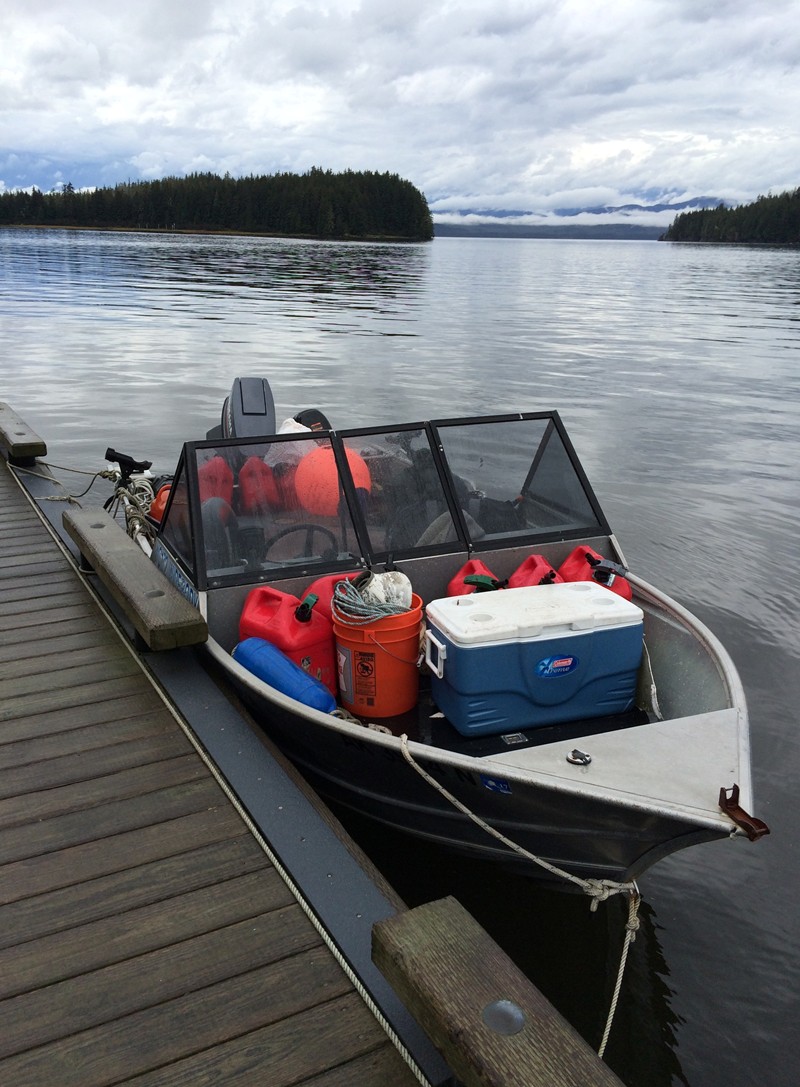 And
so we turned back to Taku Harbor for the
night,
something I’ve long said I could do if I ever needed to. We
hadn’t seen
any
boats in there on the way up and it was a Sunday night in late
September, so we
hoped the cabin would be free. On the way down we called my dad again
to let
him know our plan; he said then that the weather man had told him that
the
northerly might not die down even when the southeasterly hit. I tried
to call
Chris without success but did manage to send off a quick text. We also
saw a
boat at Point Arden come across the inlet in our direction before
turning south
and following us into Taku Harbor. It was a great relief to get beyond
Grave
Point and into the calm. We tied up at the end of the dock and filled a
harbor
cart with gear and my mother drug it all the way to the cabin (which is
not far
from the dock as the crow flies, but is a somewhat longer walk down the
dock,
up the ramp, and back to the cabin along a gravel trail). We cautiously
dropped
our gear off, then went to look for wood—me to make spoons for
dinner
(we only
had a plastic fork and my leatherman for utensils) and my mother to
gather wood
for the fire. We wound up sitting on the bench outside the cabin
whittling; my
red alder spoons struggled into clunky existence while my
mother’s chop
sticks
(ramen was on the menu) took quick and effective shape. We broke for a
cup of
jasmine tea, r
And
so we turned back to Taku Harbor for the
night,
something I’ve long said I could do if I ever needed to. We
hadn’t seen
any
boats in there on the way up and it was a Sunday night in late
September, so we
hoped the cabin would be free. On the way down we called my dad again
to let
him know our plan; he said then that the weather man had told him that
the
northerly might not die down even when the southeasterly hit. I tried
to call
Chris without success but did manage to send off a quick text. We also
saw a
boat at Point Arden come across the inlet in our direction before
turning south
and following us into Taku Harbor. It was a great relief to get beyond
Grave
Point and into the calm. We tied up at the end of the dock and filled a
harbor
cart with gear and my mother drug it all the way to the cabin (which is
not far
from the dock as the crow flies, but is a somewhat longer walk down the
dock,
up the ramp, and back to the cabin along a gravel trail). We cautiously
dropped
our gear off, then went to look for wood—me to make spoons for
dinner
(we only
had a plastic fork and my leatherman for utensils) and my mother to
gather wood
for the fire. We wound up sitting on the bench outside the cabin
whittling; my
red alder spoons struggled into clunky existence while my
mother’s chop
sticks
(ramen was on the menu) took quick and effective shape. We broke for a
cup of
jasmine tea, r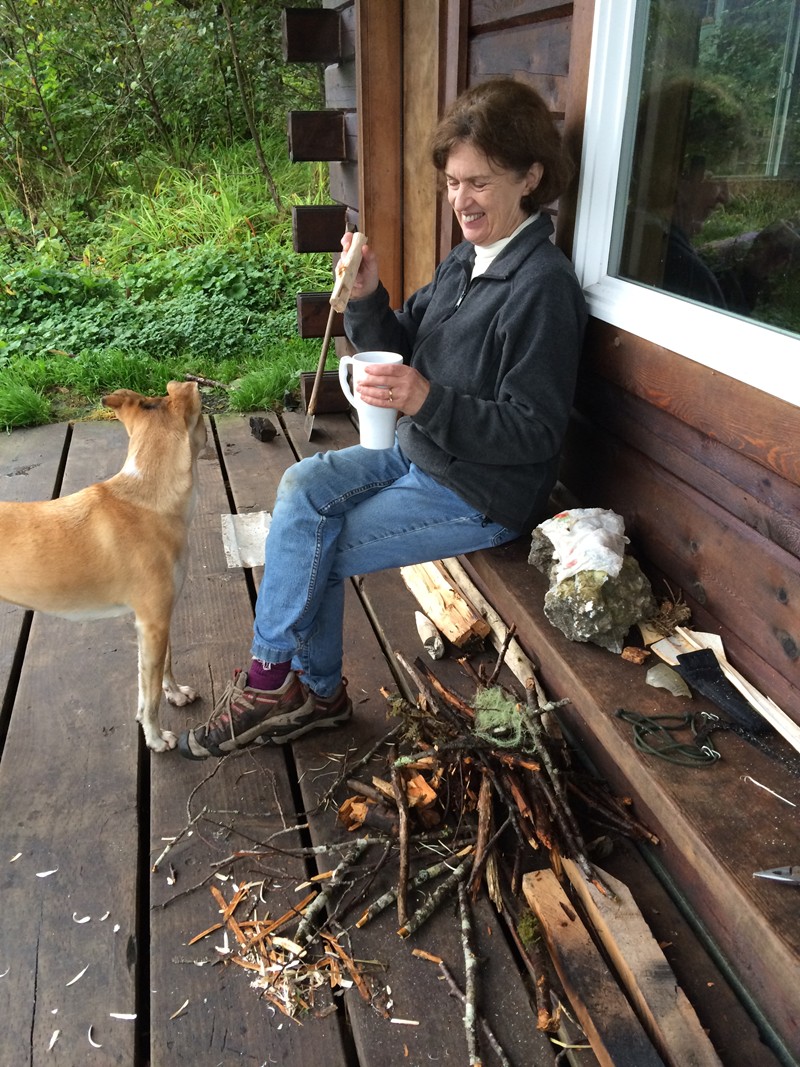 egrettably
unsweetened. Quite luckily for this trip, I
was
bringing back the camping gear I’d packed for my potential
overnight
trip up
the river or to Gilbert Creek, which meant I had a camp stove, pot, and
cup.
For my mother we salvaged a slightly moldy plastic mug we found in the
cabin,
amply rinsed and washed with my camp soap. We were also lucky in that I
was
bringing back extra food from the cabin, so we had tea, ramen, chips,
soup, and
lots of snacks on top of the dehydrated food from my boat emergency kit.
egrettably
unsweetened. Quite luckily for this trip, I
was
bringing back the camping gear I’d packed for my potential
overnight
trip up
the river or to Gilbert Creek, which meant I had a camp stove, pot, and
cup.
For my mother we salvaged a slightly moldy plastic mug we found in the
cabin,
amply rinsed and washed with my camp soap. We were also lucky in that I
was
bringing back extra food from the cabin, so we had tea, ramen, chips,
soup, and
lots of snacks on top of the dehydrated food from my boat emergency kit.
While we were finishing our bitter tea (I tried to
sweeten
it with pear juice from a can of pears, unsuccessfully), the promised
storm
began to blow into Taku Harbor. My mom and I were both surprised to see
that it
blew so directly inside the harbor, having both assumed it was
sheltered from
both the north and the south. We watched the waves build and begin to
jostle
the Ronquil, whose stern was facing the wind. I considered whether to
turn it
around to face the wind or move it inside the float where the other
boat was,
protected from the wind entirely by the T of the floating ramp. I
didn’t feel
much like moving the boat and it seemed to be riding pretty well there.
That lasted about ten minutes. The wind built
swiftly until
the trees were bent sideways and swells were rocking the boat and
splashing
over the transom. It happened so suddenly and dramatically that by the
time I
put my jacket on, I ran down to the boat in my haste to save it from
the ferocity
of the storm. The wind practically buffeted me off the ramp on the way
down and
the boat was jockeying to and fro. I threw on my rain pants which
I’d
left in
the glove box and helped my mom untie the lines, an awkward task as the
wind
pulled the boat from the dock and waves splashed over the back. My mom
wound up
holding the line on the dock as I puttered forward, following me along
until I
pulled back close enough for her to throw the line on board. While
Cailey
nervously rocketed around the dock, I brought the boat inside the float
and
tied up right inside the floating connection to the ramp. It was dead
calm in
there (on the water anyway) but we tied extra lines on (making use of
the
second 50’ line on the bow), adjusted the fenders, and made
sure that
everything was covered by both tarps and secure from the wind.
Back at the cabin we enjoyed security from the
now-raging
storm. The gentleman who owned the other boat had come out to help us
on the
dock, saying that he was going to come get us about the boat if we
hadn’t come
when we did, and mentioned that the storm was a gale. I don’t
think
I’ve ever
been out of Juneau in such a storm. The young cottonwoods outside the
cabin bent
sideways in the wind, gusts whitened the water across the harbor, and
even
little whirlwinds of salt spray sprung up. My mother tried to get the
diesel
stove to work with what remnants of fuel were in the tank, but never
succeeded.
The small emergency wood stove had some kindling inside and my mom
gathered a
bunch of sticks and twigs to supplement that, but everything was
absolutely
soaking wet from a day and two nights of heavy rain. My mom worked
valiantly
all night burning twigs, cardboard, and paper in an effort to warm the
cabin a
little and perhaps dry a few items of important clothing, but it never
really
got going, not even with a few of my special egg carton/wax fire
starters,
though I’m sure it did take the chill off and help dry some of
the
clothing. My
backpack had gotten very wet with the nonstop saltwater sloshing over
the side
of the boat on our last attempt, so I was glad that it dried out a
little close
to the stove.
All in all, though, it was quite cozy. We tried
the two cold
water dehydrated entrees from my emergency pack and decided that the
couscous
left much to be desired (it didn’t taste like much except bland
garlic
and peppers)
but the potato salad (which had a lot of cheese in it) was tolerable.
The best
part of dinner was the package of ramen that we split and the half a
glass each
of wine we managed to squeeze from two nearly empty bladders. We had an
excess
of food available, but I did wish that I’d brought the rest of
the
Russian tea
and another package of ramen!
So we were lucky to have food and the ability to
cook, but
it didn’t stop there. We were to spend the night, and Cailey
couldn’t
keep us
both warm! But with my camping gear I had a sleeping bag and we had two
remarkably dry yellow blankets from Snettisham I was bringing back to
town to
launder. All this we’d packed up to the cabin in the cart. In
sorting
through
my backpack and perusing the many items stashed there for emergencies,
I pulled
out my fancy bivy sac, the superior alternative to the emergency
blanket, made
of similar material but shaped like a sleeping bag. Ever adventurous,
my mom
chose to try it and left me my sleeping bag. There was no need to
determine who
got my camping pad, as the cabin was equipped with four enormous, soft
foam
pads which we put together in a long row on the bottom bunk (as big as
a couple
of king sized beds). I checked the boat again before it was fully dark
and
found it weathering the storm with serenity on the small square of calm
water
inside the float. The gear under the tarp was nice and dry and I
grabbed my
long underwear to sleep in and a magazine for my mom to read. Shortly
thereafter, my mother went to use the outhouse at dusk and came back to
tell me
about an encounter with a small owl. He had flown into the tree in
front of the
outhouse and looked at her curiously for some time, making little
noises. He
flew away, only to return to a tree behind the outhouse and observe my
mother
again. A rare encounter!
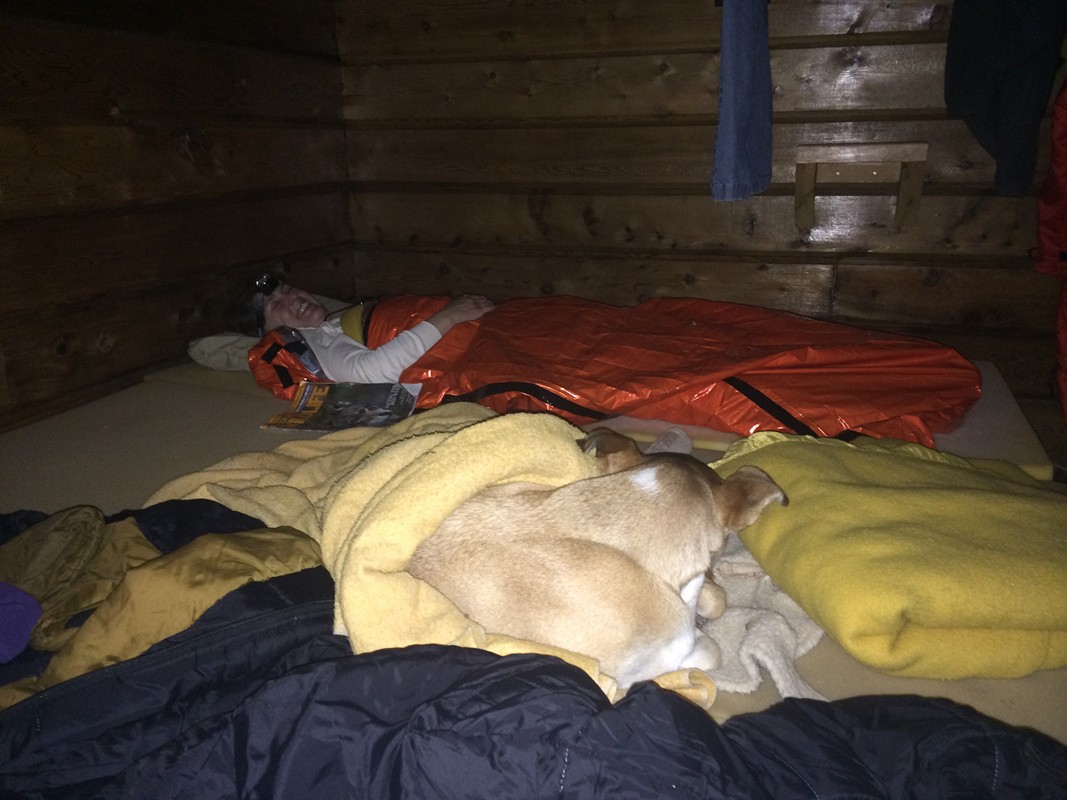 We
turned in rather early, Cailey next to me on
her fleece
jacket and the drier of her two boat blankets.
We
turned in rather early, Cailey next to me on
her fleece
jacket and the drier of her two boat blankets.
We discovered two issues with using the bivy sac
as a
makeshift sleeping bag. For one thing, it is very noisy! This is easily
enough
overcome, but the other issue would give me pause about trying this
again
without a good reason. Sometime in the night my mother discovered that
there
was a small pool of water in the bottom of the sack. More water dripped
on her
when she rearranged the bag around her shoulders. Unlike conventional
sleeping
bags, those sacs are apparently waterproof and moisture was condensing
inside
with no escape! Nevertheless, we slept well enough given the
circumstances.
Early in the morning an animal was scampering vigorously across the
roof
repeatedly until I was forced to get up, if only to scare him off. I
didn’t see
any sign of him, but I was able to return to sleep afterwards.
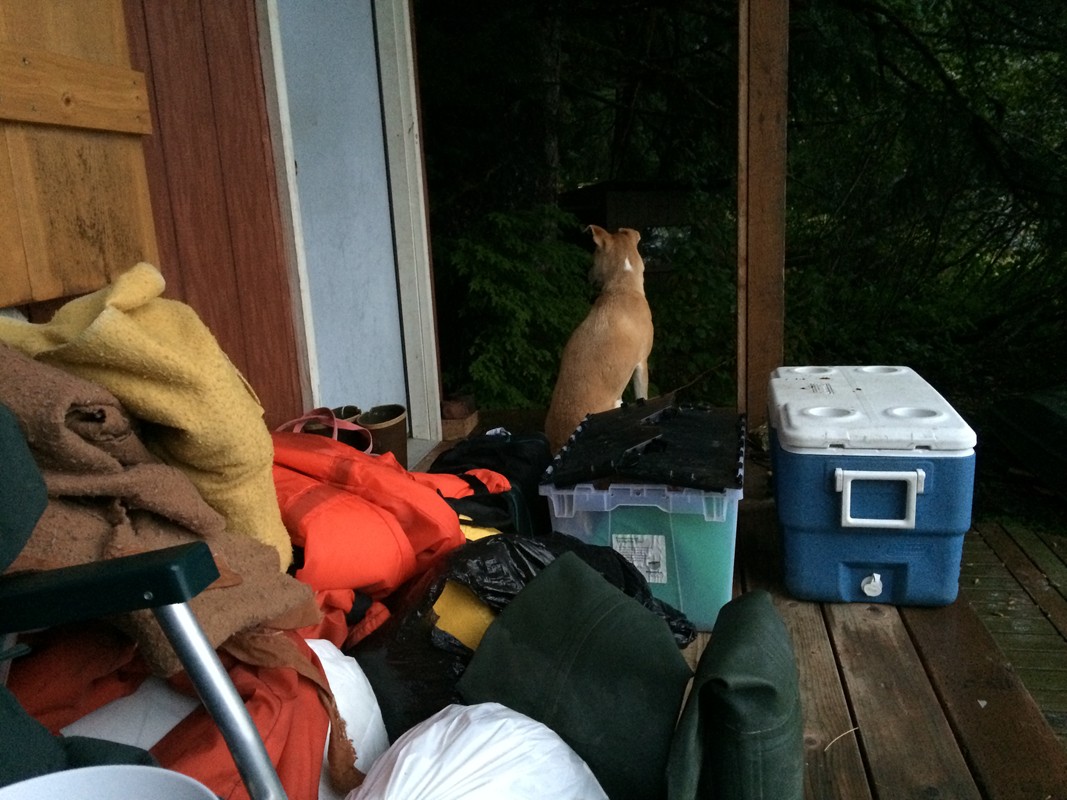 Gear on the porch, ready for loading |
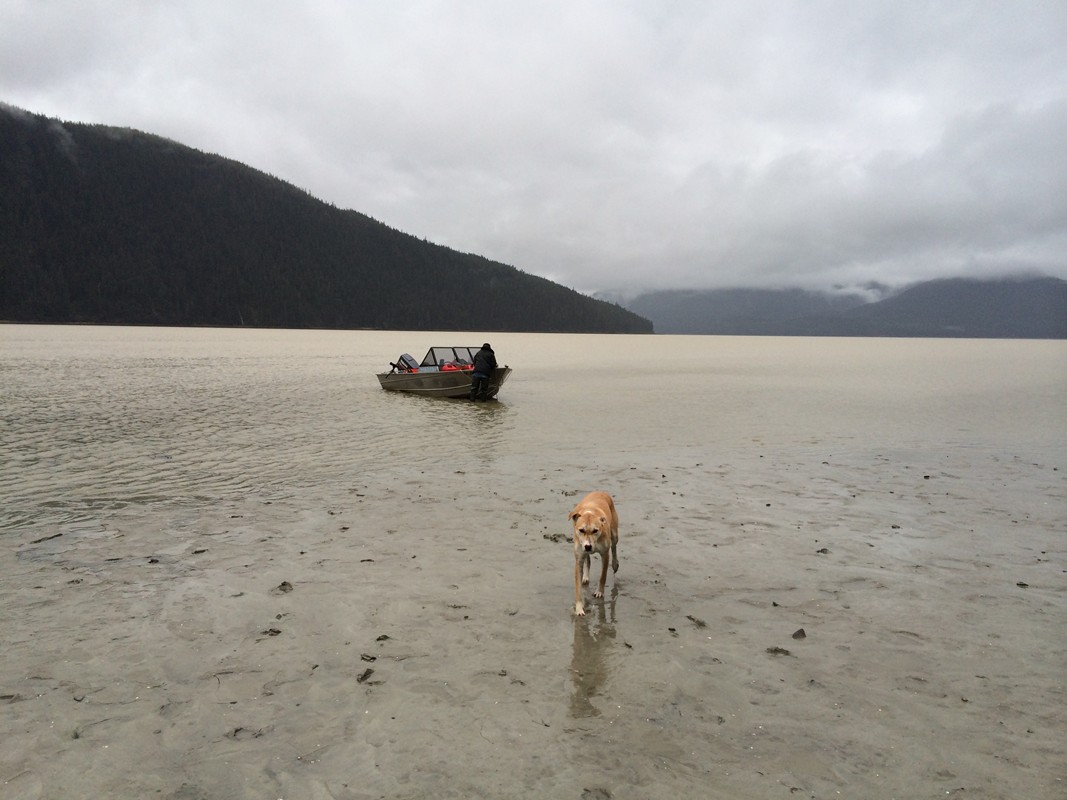 Slogging through a low tide departure |
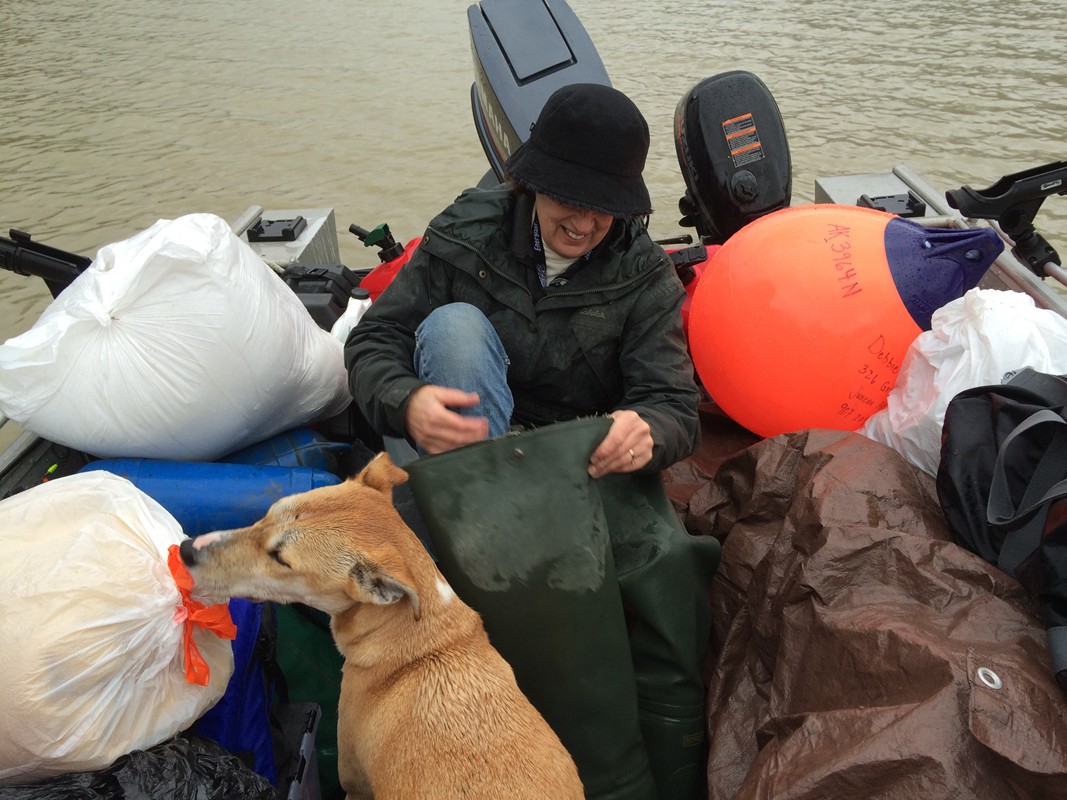 Getting dressed and ship shape |
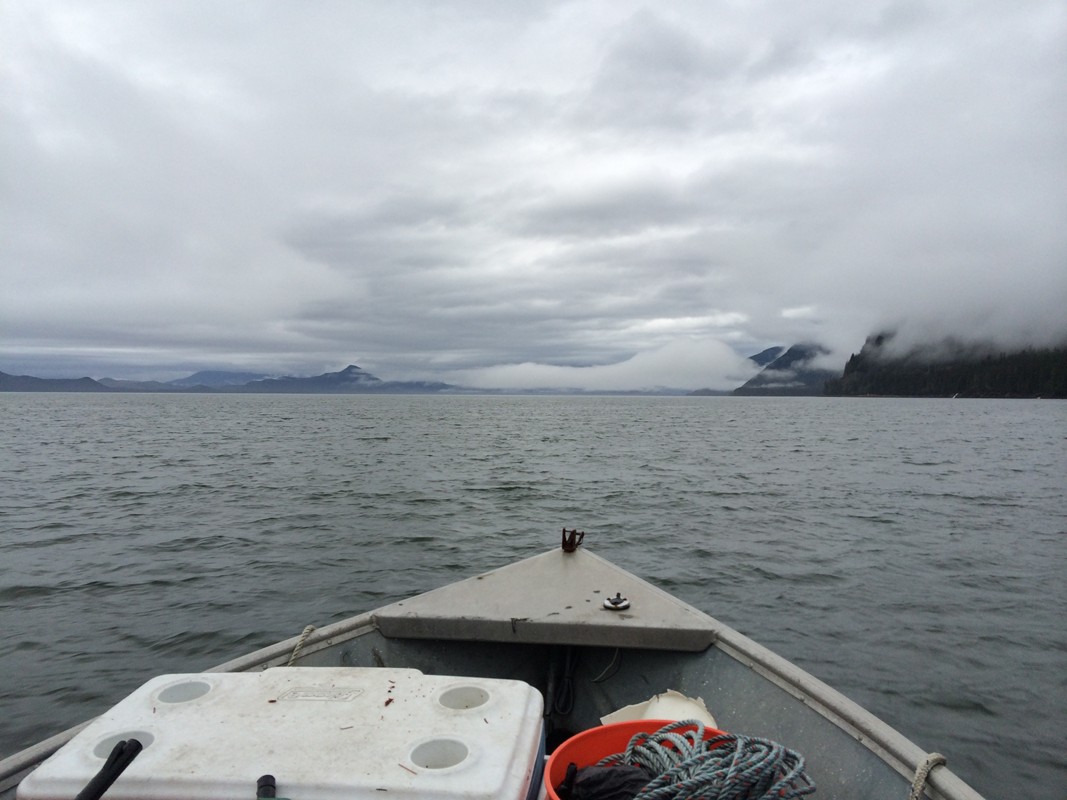 Those seas don't look bad so far |
Drinking tea and whittling at Taku Harbor |
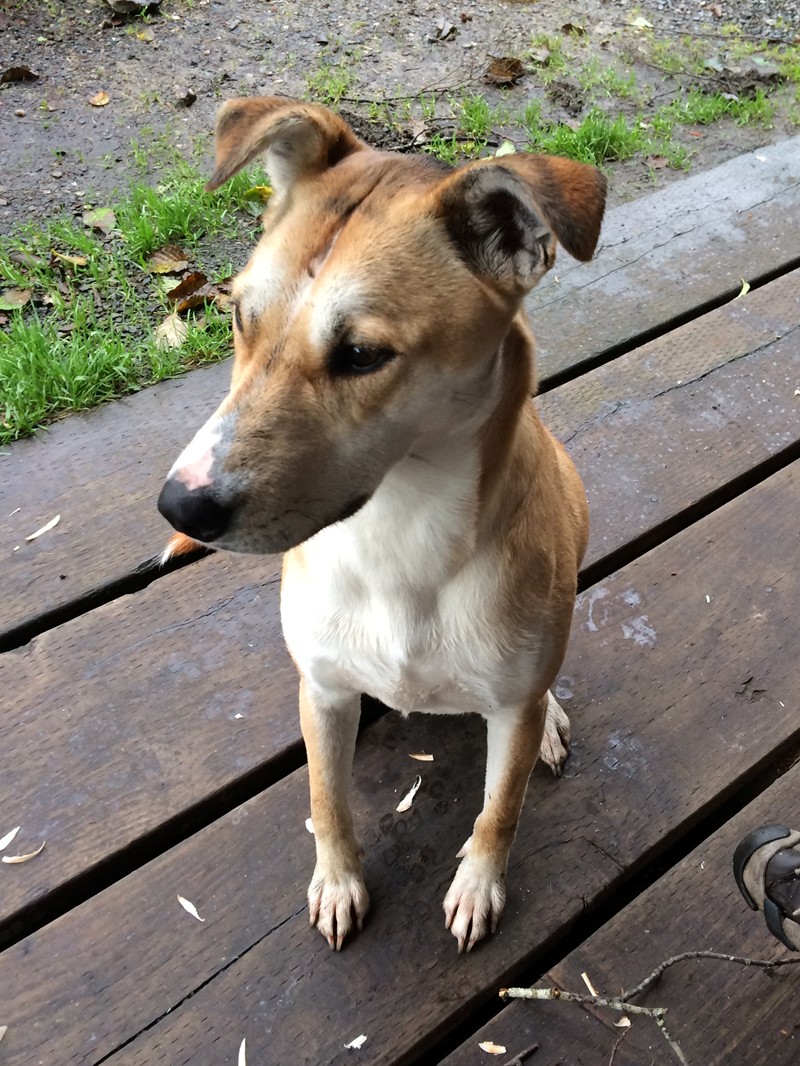 My dog turned brindle |
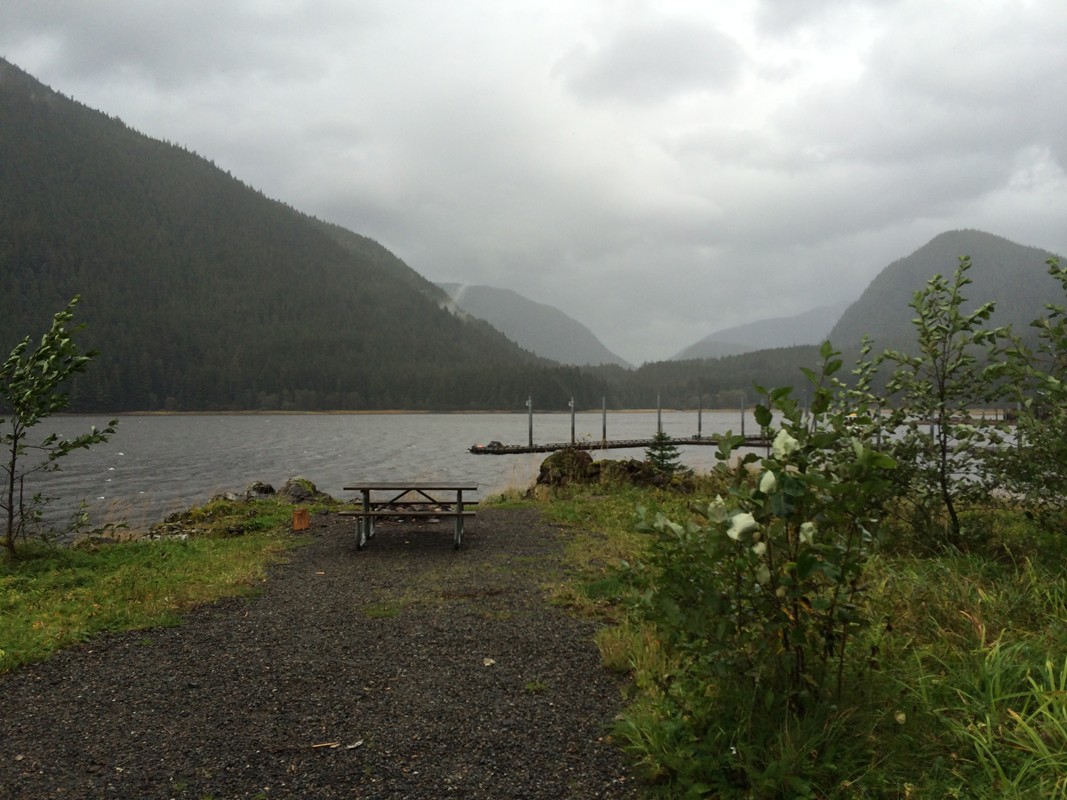 This does not capture the intensity of the storm! |
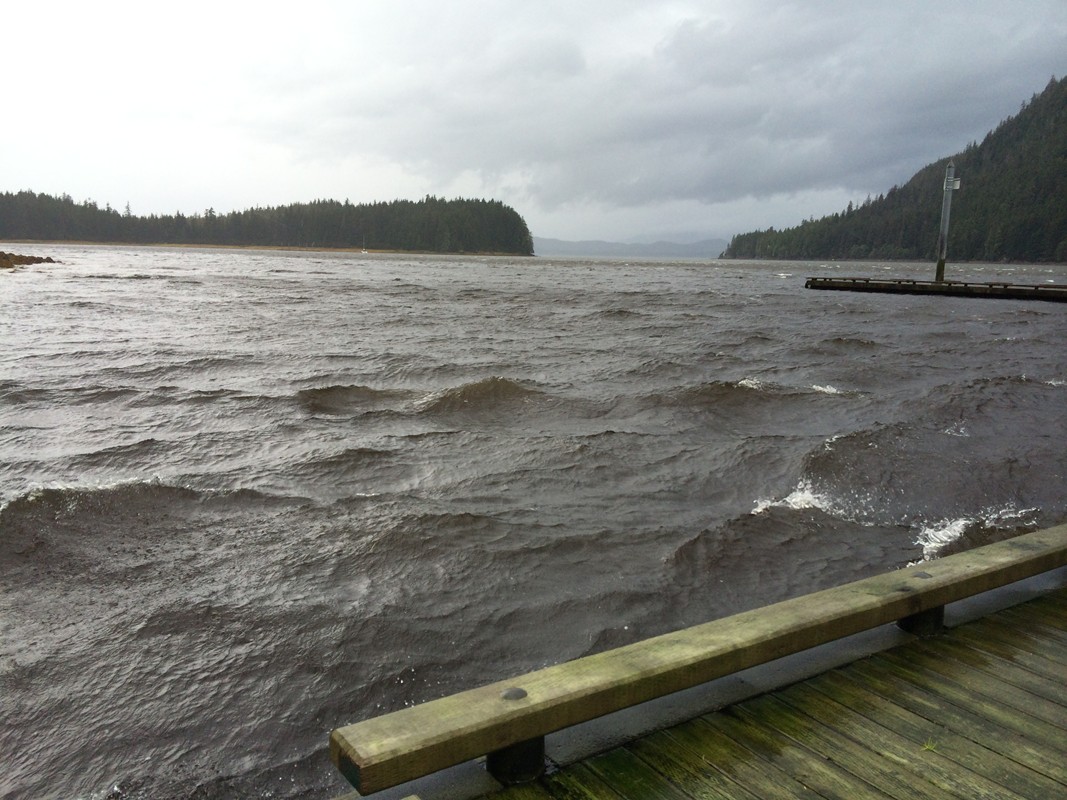 Storm churned harbor |
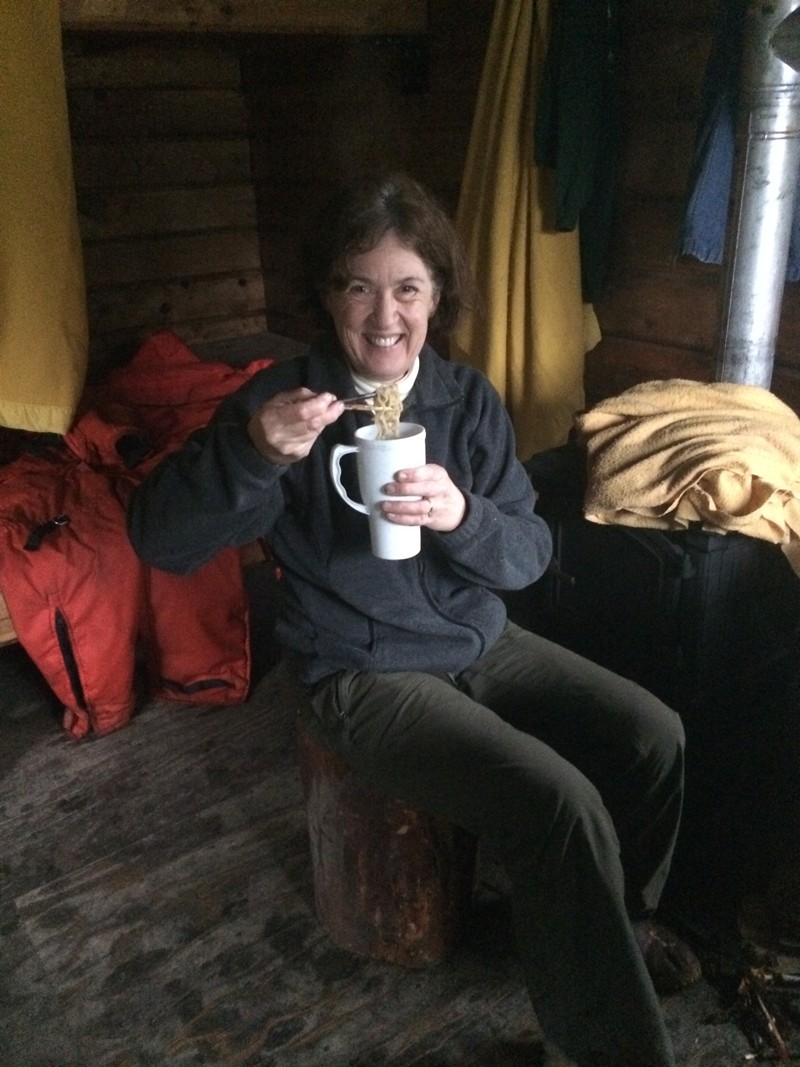 Ramen! |
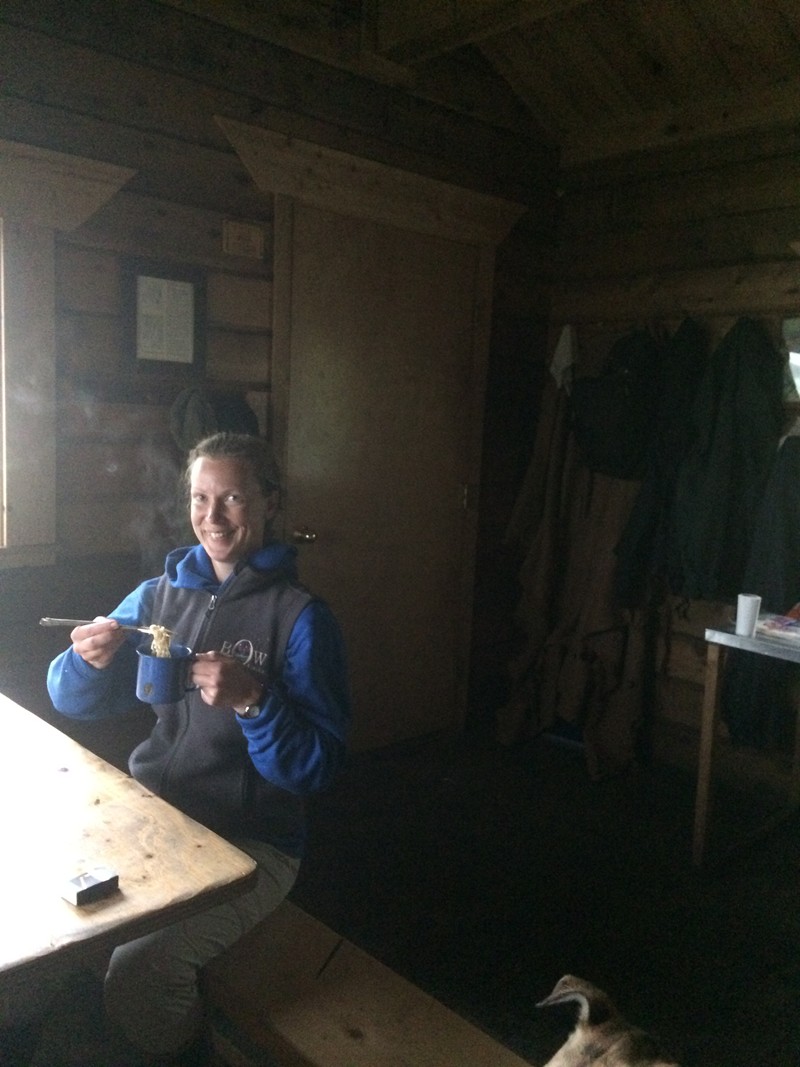 Ramen! |
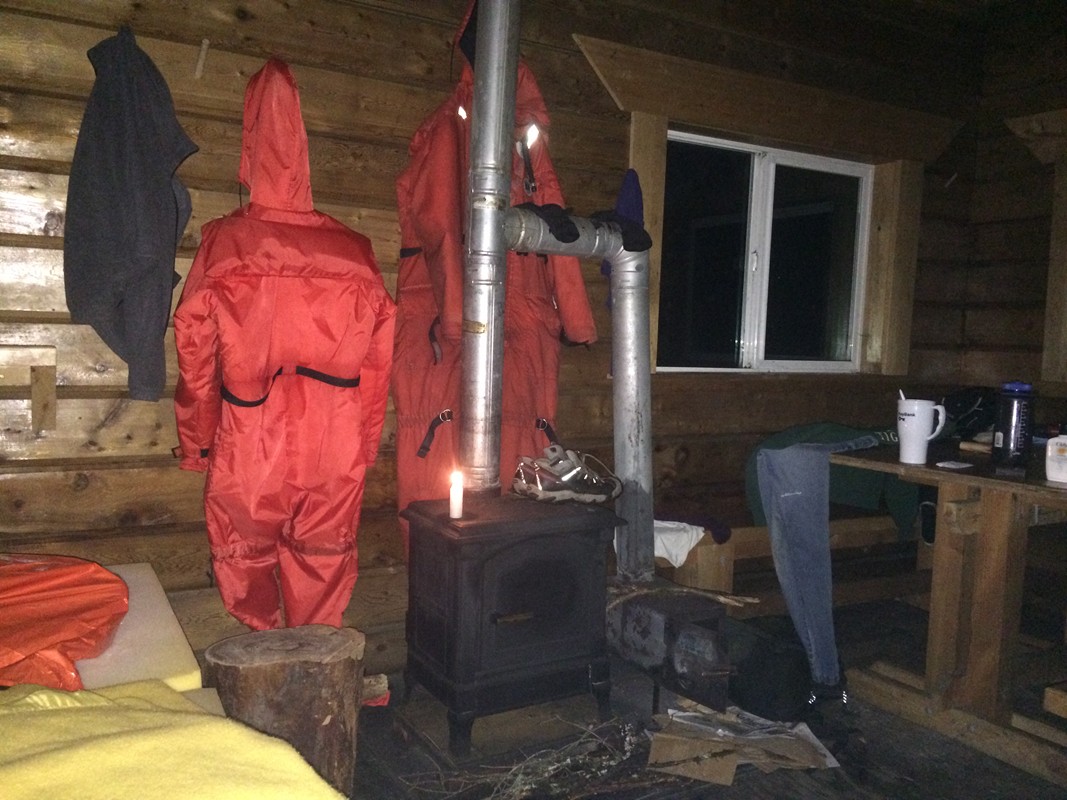 Our gear trying to dry |
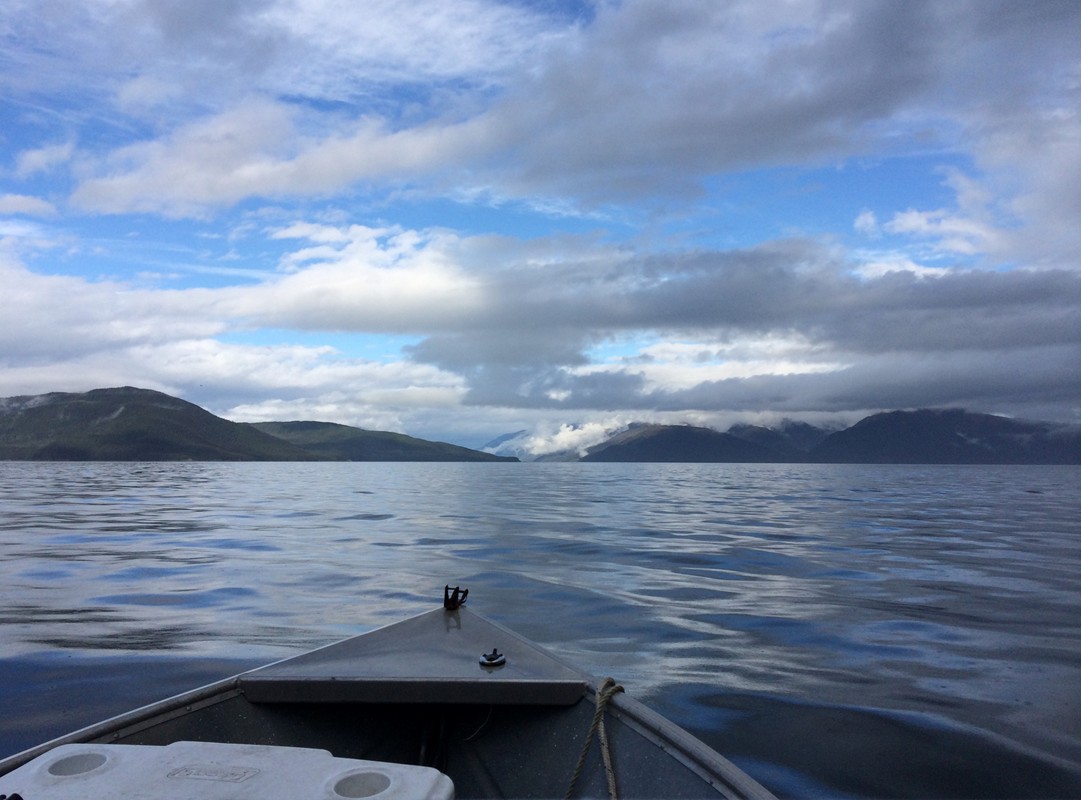 A beautiful ride home across the inlet |