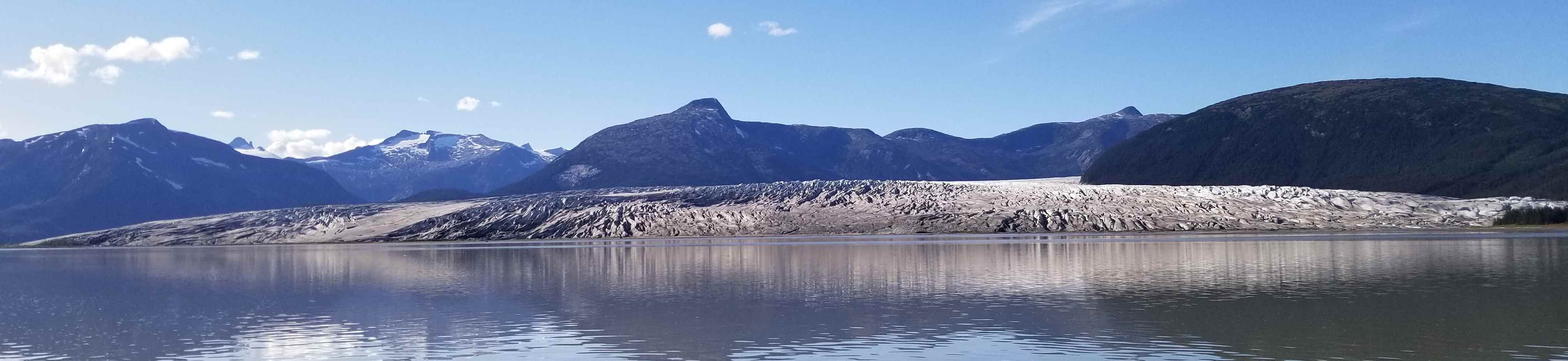
Taku Glacier
Photo Album
It's almost
7:30. The wood I just put on the fire is flaming brightly,
reflecting in the window pane to my right which is otherwise showing a
foggy,
rainy evening just beginning to dim on this early fall day. I am
pretty comfortable, but my head is still reeling with the trip up here,
and the sense of relief at being here, and being warm, is still
powerful. It was not a pleasant ride, but at least it didn't start in
the rain! The expedition began when I stopped by my parents' place to
drop off some raven food and pick up a battery for the 4-wheeler.
Thinking that I really needed a better way to get Cailey (and possibly
my gear) on and off the boat, I asked about a 2x12 laying nearby and it
was offered, but it was long and wet and dirty and I quickly accepted
my mom's offer to take it to the harbor in the truck. Ezra was hung up
with work, so I headed down alone and loaded two carts while my mom
walked the board to the boathouse. Then we each pushed a cart down and
nearly had the boat loaded when Ezra arrived to see me off. Although my
departure was early enough in the day that I didn't have to work
anxiously all day waiting for the tide, I was still extremely stressed
out. Maybe it was concern about running the river, maybe it was
thinking about dealing
with unloading when I got there, I don't know, but I blew up at Cailey
on the way down and was just barely keeping it together as I found a
place for the board on the Ronquil and dealt with the pile of slipping,
awkward metal fence posts I was taking along. But at least it was dry
in the boat house! I
do love boat house life. I was also really grateful that I'd done most
of the prep work for this trip weeks ago before I headed down to
Snettisham for a week, so all I had to do were the basics of food and
clothes, raingear, etc. All the cameras, signage, propane fittings,
tarps, staple gun, etc. were packed. At 10:00 I'd gotten gas and
dropped it off at the boat to help ease pressure later while my mother
kindly bought some supplies for me since Ezra and I are meant to be
quarantining after I got sick last weekend (test results pending).
Anyway, off I went, about half an hour after my original hoped for
departure, but still two and a half hours before the tide. There was a
chop coming down the channel, a little bumpy but not enough to shake us
up, slow us down, or cause Cailey to stand up. But at the end of the
channel as I was angling toward Salisbury, the seas suddenly picked up,
coming from Admiralty rather than straight up the channel. And quickly
they built, steep, tight, 2-foot seas that slammed us mercilessly, over
and over, with no escape. I
had to turn and run into them and they beat us up no matter how slow we
were going, dropping us into the trough over and over again after
raising us up on jumbly, sharp peaks. Oh, it was awful, bone jarring
stuff, and if I'd had to face it for much longer I'd have relented I
think and turned around. But
I knew it would change once we got around Salisbury, which we did
eventually. There the seas widened a bit and we were able to pick up
a little speed as we rode in the trough most of the time, sliding
around on 2-3 footers coming all the way up Stephen's Passage at us. It
was better, less slamming, but we were rolling around quite a bit. I
looked with great longing at Bishop in the distance. As the seas
continued
to build, I eventually had to turn and face some of them, which took us
wider around Bishop than usual, which was probably just as well. As we
neared it and the seas turned to travel with us, it actually became
rather fun, and the Ronquil was absolutely rocking those seas (i.e.,
taking them beautifully). Up and
down and around, it was totally at ease, handling them with perfection.
We paused briefly while I used the bucket and I moved the tarps that
had fallen onto Cailey's bed, then took off again while the rolling two
and
increasingly three foot seas carried us toward Cooper. And, oh what a
beautiful thing it is when you come around Cooper and the seas
inexplicably die. We raced for Jaw Point on a leveling sea. It was
flat calm beyond there, but the rain starting falling and the inlet was
misted over and I had the dreaded river ahead of me. For years I never
touched bottom, but I haven't had a trip recently without hitting at
least once and I hate to do that at speed. So as I passed Davidson
Creek and the flats beyond I started debating when to slow down,
knowing I was still five or six miles from the cabin. I turned the
fathometer on when we approached the Forest Service cabin and
alternated going slow enough for it to read and picking up speed
without quite getting on step. Most of the water there was 5-8 feet
deep and
I don't know if that was going over a sandbar or a channel. When I was
safely past, the depth dropped to 13 feet and I got back up on step
past Taku Point and around the corner. Then the next trial--where is
the main river channel people are taking before turning over toward the
slough? I tried the same spot I used last time, just past the big
avalanche chute, but in what direction to point? When the river is
miles wide, there are a lot of options. I wanted the depth sounder to
show me the channel, but to go back and forth to find it would take too
much time. It was mostly around eight or nine feet, which was great,
but
when should I turn to the slough? It was so misty I couldn't even make
it out and
had to guess by the mist-shrouded trees to the north of it. I think I
may have missed the turn, as all of a sudden there were what appeared
to be sandbars in the way. Indeed I touched bottom as I passed over
them several times and moved at half speed until I got close to shore.
Such a relief to turn upriver then with confidence!
By then I was quite cold and Cailey had been shivering for some time.
I'd tucked her in under a blanket when it started raining but, despite
the calm seas, she wouldn't settle down but wanted to be sniffing or
sitting on the back bench or alert to what I was up to, since I was
very alert and
sometime standing up myself. I started to turn into the landing I've
been using this year and nosed in between the two logs as usual, but
the water was so high there was much too much distance between the
inner log and the shore which was held off by a submerged log.
Instead, I surveyed the
possibilities farther downriver and the best place I found was the old
landing site which had a layer of roots and moss laying over a more
gradual
slope than most places which had sheer sand cliffs. On the upriver
side, the bottoms of a couple of leaning trees (one cut off) made a
convenient place to
step off and scramble up; the downriver side also had steps, but
was steeper and required me to step off the boat almost at water level,
while the other side was a step up off the bow. Cailey gracefully got
off first. I tied the bow to a tree and unloaded everything; it was
work, but so much easier than it has been the last two times. At the
very least, I wasn't fighting alders batting at my head the entire
time! Then
I tied the stern line off and anchored, which worked beautifully after
I gave it just a little more line so the stern came into the little
bite below the trees close enough that I could climb off. I did have to
reposition the board (which we didn't use) so it didn't get caught in
the alders downriver and hold me off.
Cailey danced with joy when I finally came ashore and I was doing a
little dance myself. I'd made it!!
And I found the cabin in perfect condition, also a relief. I made two
trips up with gear, leaving some things down there under a tarp
temporarily. It didn't look like anyone had been inside. Still
seriously frazzled by the
seas
and the river and the cold, I unpacked everything, started a fire (or
tried to) and sat down at 4:00 with thanks and a glass of wine. I sat
there for about half an hour before I decided to see what I might have
for dinner. I'd brought very little for food, remembering that there
were quite a few dinners left here and not wanting to carry any extra
weight. The mac and cheese sounded good, but boiling pasta on the
fireplace seemed unlikely, so I decided to try for propane before
dinner. Weeks ago I'd bought fittings to reconnect the copper tubing
once
I cut
off the leaky area (thanks Harri's Plumbing!) and borrowed the flare
and cutting tools from my parents. I hoped it would be a simple task,
but encountered a familiar issue I'd encountered most recently when
installing the same tubing for my
diesel heater at Snettisham: the old tubing was bent and not very
flexible. You have to put the flare nuts on the tube before you flare
the
end of it, as the nut then slides over the trumpet-shaped tube, which
fits nicely inside and screws into a fitting. This requires the nut to
slide a few inches down the tubing and, because the nut just barely
fits
over the tubing, it has to be straight for those two inches. Any curve
in the tubing, any kink to the opening, and the nut won't go on. It
slid right onto the end where the propane tank was, but the other was a
battle. I think I cut three sections off, several inches at a time, and
a few shorter pieces, before I finally landed on a section that was
straight enough. Through a few trials and errors, I figured out how to
use the flaring tool again and got both ends flared nicely. I wrapped
the threads of the connector in hose tape and screwed in the tank end
nut. I'd cut enough tubing off the other end that it was sticking
straight
into the air, so I had to very carefully bend it until it met the
connector straight on, which worked once I scooted the tank back a
little bit. I tightened them up with the wrench, turned the gas on, and
dumped soapy water over it that I'd made in a plastic salt shaker I
found inside. No leaks. In fact, it looked quite tidy. Would it work?
I stopped by the outhouse and put all the tools away before I tried it.
With only a little hesitation, the pilots on the stove top lit up and
the oven pilot lit enthusiastically. I had propane again! Hallelujah.
That is civilized living! I washed up and put some soup on to heat (not
pasta after all) during which I temporarily adopted the comforter I
used last time and formally covered it in my comforter cover, making
the bed. It's too long, so the bottom of the comforter is doubled up
inside the cover. And at
last I sat in the quiet of the warming cabin and ate my soup and roll,
chasing that with some stale oreos and chocolate, a little reading, and
an episode of The 100. I think a good night's sleep will dissipate the
shellshock of the afternoon; I can start the day with tea and hot
oatmeal and decide what of the many activities I might do, looking at
two and a half days ahead.
---------------------------------------------
It's dark, 8:30, and I'm reeling from a different kind of exhaustion! I
managed to sleep past 8:00, but didn't get up right away, allowing
myself
a leisurely morning. After a hot (civilized!) breakfast of peanut
butter, oatmeal, and Russian tea, I suited up and headed down to the
fallen tree at the landing. After fueling and lubricating my chainsaw,
I limbed
and bucked as much of the top of the tree as I could before it got too
high. It
didn't yield as much as I'd hoped to get--most of the wood is still on
the
tree--but hopefully it'll come down this winter. To help with that, I
made a partial cut in three of the four branches that look most to be
supporting its weight. Then I moved to Fox Hole and started digging the
sand away from the edge of
the siding, grateful to see that the ground hadn't reached
it on the front side. I heated up enough for that task to work in a
t-shirt, but paused in the middle to take Cailey back to the cabin so
she didn't have to sit around in the chill, during which I grabbed the
staple gun and staples to replace the tarp. I finished the excavation,
digging out 4-6" from the two sides except where confronted with large
roots. Then I raised up the tarp and stapled it as high as it wanted to
go, wrapping it around the sides and placing plywood against it and
boards along the bottom to help keep it in place. On the way back I
excavated around the outhouse as much as I could as well. After that I
opened up Alder and took the plywood off the 4-wheeler section,
fetching screws for the propane tank and, later, the two-wheel cart
kit. I'd found a metal strap screwed by one end to the wall at the
propane tank, which must have one supported a 100 pound tank at one
time, so I
unscrewed that and screwed one end to a new place to fit the 20 pound
tanks. I left that task unfinished, needing a hammer.
By that time it was noon, so I broke for a hot quesadilla before
suiting up--this time in waders--to head to the canoe. In my backpack I
had cameras, extra batteries, extra SD cards, my leatherman, SPOT, a
hammer, some scraps of plywood, and the no hunting signs. In my arms I
carried all the green metal fence posts. The meadow was quiet, the
slough still and beautiful. It had rained hard on and off all night,
but had stopped in the morning and held off, mercifully, for most of
this trip. Before I launched the canoe, I attached four no hunting
signs to sign posts to get ready, immediately walking to the nearby
property line to post the first just next to the slough, then moving to
the other side of the
island via canoe to post the second. As I paddled away, several birds
were
tittering along the shore and I caught a flash of yellow; in binoculars
I had wonderful looks at a couple of yellowthroats! Better looks than I
had of the males during breeding season. I could see from a distance
that the beaver lodge at the entrance to the slough that drains the
avalanche had seen a lot of activity. We pulled in and encountered a
dam
a short distance up. Since there just happened to be a
bare patch on the bank across the side slough from the lodge, I set up
a camera there on a fence post. I don't know if it will
pick up movement that far away, but it was too good an opportunity to
pass up. We then paddled to the opposite end
of the property, made a conservative guess based on the location of the
corner marker at the mountain, and posted a sign there facing upstream.
A group of teal
paddled out of the beaver lodge slough but disappeared as soon as I
started pounding. I used a couple scraps of plywood to help spread the
weight and
protect the zip ties holding the sign in place while I pounded the post
in, but it still thwacked
pretty good. From there we went for
a longer paddle on the absolutely still water, passing another
obviously active beaver lodge just shy of the entrance to the slough
that leads to the lodge under the willows. Yellowthroat Island was home
to more accommodating yellowthroats. Around Big Bend, three goldeneyes
paddled in the foreground, the teal group in the distance, all of which
soon
disappeared.
We'd
been
underway for about an hour and a half then, so I decided to do a bit
more exploring. It
was, as always, tough walking through the sweet gale and ferns, more
flooded than usual, and I was starting to wear out, but decided to stop
by the property line on the way back to put up more signs there since
we were passing
right by. We headed in at the sign I'd already planted. I was about to
place one in the meadow just inside of the fringe of brush along the
main slough,
but could then get a better look at the trees along the river and
thought I was well inside the line. I walked north to the edge of a
tributary slough where I could see the mountain and cottonwood both and
placed a sign at my best guess of the boundary in a place where people
across the slough would have a clear view. No sense
in them crossing that slough for no reason anyway. I then walked up
the slough a
ways, which was partially bordered by meadow and partially by willow
clumps, and stumbled onto a Forest Service
boundary marker right at the edge. Bingo, my guess was correct. I left
another sign there, then continued down the slough, skirting around a
dense clump of willows. In the meadow on the other side I could see
another boundary marker on the opposite side of the slough, the one
that I'd
stumbled onto during the last trip. I pounded in my last fence post
there (the signs were back in the boat) to revisit the next day.
My legs were getting pretty worn out pushing through the
wet
brush, so I was looking forward to reaching the canoe again, only to
remember that I'd left my SPOT on the boundary marker to mark it.
Oops, back we went, and then back to the slough. I emerged closer to
the side slough than I'd come in and was pleased to see the 2x2 that
held the original no hunting sign at an angle, flooded with water. It
was a bit north of where I'd put the new one and was clearly closer to
the
actual border, so I pulled up the other sign and replaced it in that
area.
Back on the water, Cailey curled up on the wet carpet in the bow and
licked her wet fur as
we closed the distance to the haul out. I had two posts left and
attached two signs to them when we got back to the landing, placing one
in the large meadow between the
slough and the fringe of willow and the other in the smaller meadow
between the willows and the timber. I was relieved to be free of fence
posts
and
heading
home, and Cailey echoed my enthusiasm, ecstatically running ahead to
the
cabin. It was 5:30, so
we'd been wandering around and paddling for five hours. A good
afternoon after a good morning's work! I hastily dried Cailey, lit a
fire, and made chili for dinner, finding it hard to fill my hungry
stomach. During the tramp, I'd seen a falcon or
the like
fly over, a number of sparrows
darting away, a couple of snipe which I startled, jays, ravens, eagles,
and thrushes.
-------------------------------------------
I'm now two days ahead, half an hour before I'm thinking about
departing. Last night I was a mix of exhausted and upset and so allowed
myself to get lost in entertainment rather than type a trip report.
It was another good day of work in the morning and tramping adventure
in the afternoon. Despite restlessness and getting to sleep late (close
to midnight), I woke up early and, while I was making a half-hearted
effort
to drift back to sleep, Cailey and I both heard a scampering sound on
the cabin somewhere and she leaped up. I was already awake, so I got up
too, surprised to find it was only 6:45. The day was young and I
decided to work before breakfast, heading down to Fox Hole with a pair
of clippers to finishing excavating around the siding. Clipping the
roots that had headed under the building (and the outhouse) and then
scraping out more sand was laborious work and I was soon overheating,
but it was quickly done. Cailey was anxious for us to return to the
cabin and not at all pleased when I started clipping the trail along
the river where it was overgrown with alders and devil's club--the one
area around the cabin I had neglected this summer. But my boat was down
there and I'd been repeatedly irritated at the clinging vegetation I
had to push through, so I set to work. Only a little more, I kept
telling Cailey, but I am unstoppable when I start clipping. I have no
self control. Cut a few branches there, pull some young alders there,
what about that cranberry, that devil's club, where did that alder come
from? But, the results are good and once again I am pleased at what
little effort it is taking to get the trails back into shape around
here; frequent maintenance is the key.
I eventually did have breakfast and gave in and lit a fire to stave off
the chill and perhaps clear the fog off the windows. And (why not!)
perhaps try to put together the 2-wheel cart kit that I'd drug up the
path from Alder, taunting me on the porch. I'd made the same
attempt a couple of years ago, only to find that the board for the
bottom of the cart was curled up on the sides and couldn't be used. I'd
brought it back to town thinking that my mother could use it to make a
replacement, which she did, even putting a coat of preservative on
it that made it beautiful. The main complication was that the
instructions had at one point apparently gotten very wet and were in
tatters. When I first carefully unfolded them it wasn't even clear that
they were all there, though I eventually found my way through all the
directions. Some words and portions of pictures were torn away or
otherwise unreadable, and I was surprised to be able to understand
them with a bit of careful study and filling in the blanks.
And it appeared that all the parts were there, the hardware inventory
perfectly matching the contents.
And
so I turned the living room into a little workshop and put the cart
fully together in about an hour and 40 minutes using a screwdriver, a
wrench, some WD-40, and my cordless drill to drill the required holes
in the new plywood bottom. Other than some confusion over how to attach
the metal tube stand, which may or may not have been more intelligible
with untattered instructions, it went very smoothly. Quite pleased, I
wheeled it out the door, cleaned out the living room, and had a
quesadilla for lunch. At ten to 1:00, Cailey and I headed out on
another adventure, this time on foot. The day had been mostly overcast
with little rain, so I was in rain gear and xtratufs this time, with
three cameras, one no hunting sign, and zip ties in my pack. My goal
was to attach the sign to the fence post I'd left empty the day before
on the northern end of the property line and then seek out a glacial
erratic for a possible camera location. The first was easily
accomplished, after which I made a detour to the next sign in line
thinking that I'd move the sign on that post to the USFS boundary
marker post just next to it to free up the fence for a camera.
Unfortunately, I cut the zip ties holding the sign on before I realized
that the shorter post and its lower holes would make the sign too low
to see clearly through the sweet gale, so I moved it back.
When I had
first approached the property line slough, I keyed in on a flurry
of bird activity on the other side. A thrush-sized bird was
aggressively chasing other birds that approached its shrub. It was
solid brown on the back with a pale yellow, heavily streaked breast and
a yellow eye line. It was very striking and unfamiliar. It chased off
both Lincoln's sparrows and the first of the
white-crowned/golden-crowned sparrows of the day. It looked like
neither, but was not having them around. As one point I think I saw a
second individual. I've since looked for them and they are spitting
images of northern waterthrushes. They match perfectly. Wow, a new
species!
Overall,
I think Cailey was enjoying this trek much more. Everything was
considerably drier, we were walking through more open country
(including the trail) more slowly, and it wasn't raining, the sun even
peeking out
through the clouds every now and again and threatening to overheat me
in my rain gear. I stumbled across an area I
called
"pretty meadow" for its brilliant patches of yellow goldenrod and
purple asters and burgundy fireweed leaves that were, together,
achingly beautiful. The bit of sunshine was warming us up and the
delectable scents of a Taku fall were on the air, for some reason
heightened in the stand of trees despite there being little vegetation
beneath. I inhaled deeply--hints of nagoonberries and sweet gale, and
whatever else is in that heady mix of Taku scents. I was thoroughly
enjoying the walk.
But as much as I wanted to explore more, my other mission
was to find an erratic and we were clearly running out of areas with
low vegetation, so we turned back to the boundary and crossed the
slough. I quickly found my first erratic on the other side, a few paces
away from widely spaced spruces. There were some bird droppings and
maybe those of a mammal on it and the vegetation wasn't too high. It
was a strong contender, although I'd have preferred a more isolated
rock without the trees that might look to be better perches. This area
is quite beautiful--a strawberry/nagoonberry/iris patch of high ground
with widely spaced spruces isolated by a band of trees
and brush. There were a surprising number of ripe nagoonberries and
even a few delicious little strawberries. Among them were more
sparrows--none in breeding colors, so I couldn't quite decide if they
were golden-crowned or white-crowned, but there were at least a dozen
of them migrating through. One had a bright red berry in its mouth.
I walked on until a wide, deep slough forced me back to the road where
I checked out the state of the typical nagoonberry patches as I walked.
I was surprised to find so many, most of them more or less ripe, and
thought I might try to pick some on the way back. I
headed out
into the meadow again a little farther on but was again cut off by a
deep slough. I retreated to the road, then left it to cross a shallow
slough down toward
the cottonwood grove and plunged into dense timber and alders just on
the other side up a steep slope. When we emerged, we were north of the
rock I had in mind and overlooking a low, brushy meadow with a very
black head in the middle of it. A black bear was in the bushes, with
just his head above them, looking and sniffing in our direction. I've
never seen a bear like that, "swimming" in the brush! I watched him for
quite a while and, realizing that he couldn't see us, hunched down and
tried to sneak around the corner and out of sight without bothering
him. We nearly made it, but he eventually stood up to look in our
direction and when we made the inevitable sound of pushing through
brush, he ran to the cover the woods, though not in a panic.
For
ourselves, we were once again separated from our goal by a deep, wide
slough, on the other side of which was a stand of cottonwoods.
Somewhere over the meadow I heard a red-tailed hawk call twice. We
retreated the way we'd come and headed back, picking a few nagoons as
we walked.
We were back at the cabin at 4:10. I took a picture of my soaking wet
pants, wondering what my rain pants were for! After I changed I decided
to try out the 2-wheel cart before I got too comfortable, hauling the
rounds I'd cut downriver in two loads, a tarp on the bottom to protect
the plywood. It worked beautifully. I had a large glass of wine on the
porch with a book and binoculars in the sunshine coming from across the
glacier. Oh, what a pleasure to sit in a t-shirt in the sun! And the
birds clearly felt it too. Thrushes chirruped and darted in the trees,
chickadees and golden-crowned kinglets and ruby-crowned kinglets passed
by, an explosion of life that had been largely silent in the rain and
mist and wet, wet world. Squirrels were harvesting spruce cones,
filling the air with the clattering of the fallen. In the evening, I
took the cover off the water barrel and filled three and a half white
jugs full of water as well as adding some to the wash water jug. I
dumped the rest of the water and stashed the whole system in the
downstairs bedroom.
At some point that evening I was reminded of
Bruno
II, and glanced over to look at him on the wall. And he wasn't there.
My mind scrambled for an explanation. Did my parents take it to town to
refurbish? Impossible. No, Bruno II, the roughly 45 year old bear rug,
had been stolen. I later checked and found that the lynx rug and the
wolf skin were also gone. So much for the thieves not taking anything
of real
value. This was what so upset me that I permitted myself to drown my
heartache in entertainment that night, though I did manage to work on a
few
other tasks after dinner. I
got back to the 4-wheeler, removing the rest of the bolts holding the
rack on using a socket wrench (1/2"). I swapped out the batteries and
the dash lights turned on when I turned the key! Success! Well,
partially. It was in first gear, which is often how it's left, but it
needed to be in neutral to start. I pushed the down shift button and
nothing happened. Nothing happened for either shifter button or
anything else I tried. I later looked up the trouble shooting section
of the manual which mostly suggested turning the engine off and then on
again. But at the bottom was a note about trying to shift with a dead
or low battery (the solution is to charge the battery...) which
suggested that there was just enough of a charge to turn the lights on,
but not enough to do anything else. But at least we know that the
battery was indeed dead. I took both back to town to charge.
------------------------------------------
This
morning I was again up early. After
a quick
glance outside, I curled up back in bed a few minutes before facing the
chilly morning. It looked misty over toward the glacier, but with what
might have been blue sky above, but it was cold, the sun hours from
peeking over the mountain at us, and everything was covered with heavy
dew. Following yesterday's pattern, I headed straight out to do some
chores before breakfast, starting with hauling the rounds I'd cut
upriver back to the porch. The cart is wonderful, if hard going over
roots. I'd hoped to make it in two trips, but on the second trip, the
final round (a huge piece I'd cut from the remainder of the log Rich
and I had bucked up last summer) fell off pretty quickly and I tossed
three other rounds off as well. It made both final trips easier, but I
was breathing pretty hard throughout. The whole thing took about 30
minutes I think, maybe less. From there I headed down to Alder and
picked up and swept up all the glass I could find outside and in on the
floor and left it there in a cigar box. I cleaned up the back porch,
and then bopped around cleaning and packing inside while a cheery fire
took the chill off. The windows were fogged over, which I'm not sure is
normal. Perhaps it has to do with the water on the floor upstairs, or
maybe the dampness of the summer has crept in here as well.
Finally,
around 9:30, I had a breakfast of oatmeal and toast from one of my buns
and sipped a delectable cup of Russian tea (then another half a cup!)
while I finished a book and caught the cabin log up to date. At 11:00 I
was getting hungry, but had one last expedition to do upriver before
lunch and
final packing. The sun was by then shining from a broad blue
sky and I enjoyed the cool of the forest and the dew on the blueberry
leaves as relief from the heat (still wearing a hoody). In the forest
just north of the cabin I heard a somewhat tentative song that took me
a moment to recognize: fox sparrow. He sang sweetly a couple of times
as I walked by.