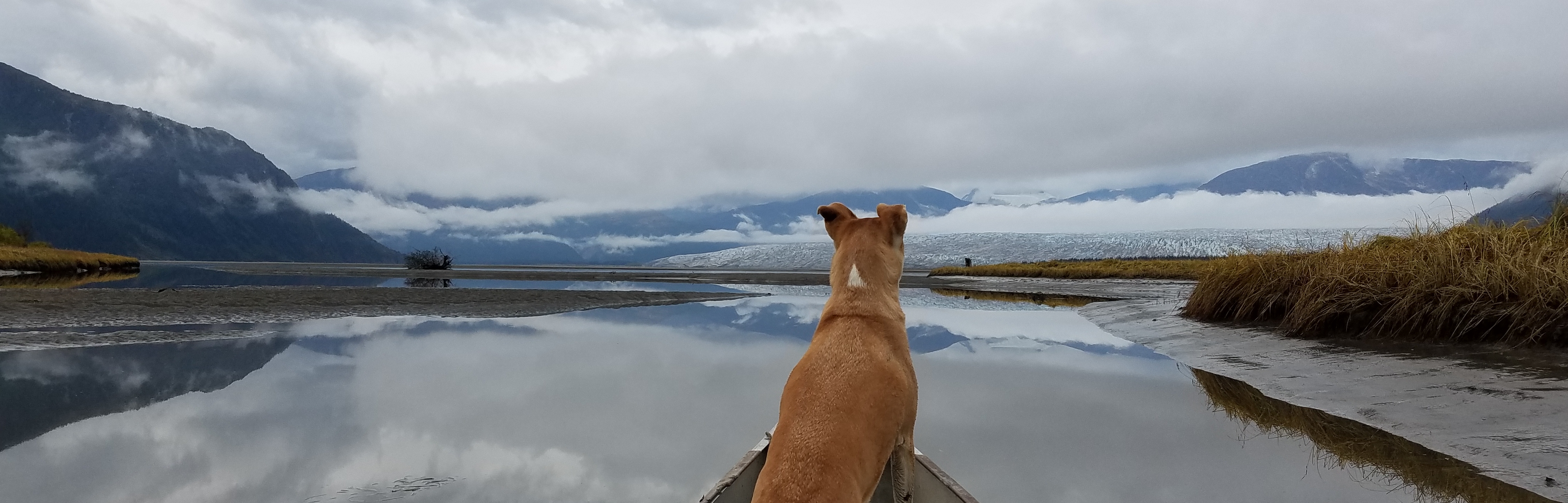
Canoeing the slough at low water
Photo Album
Taku
2018 - 4: SPOT Works!
September 23-24
It's a pretty long ride from Snettisham and I
admit to being somewhat relieved to pass Cooper Point and be back into
familiar territory, not to mention that the seas died down readily
there.
The visibility was very poor though, and I could hardly make out
anything beyond Jaw. The valleys were hazy in the thick mist, but
eventually I could verify that I was passing Davidson Creek and then
the grassy bank leading to the Forest Service cabin. I couldn't see the
glacier at all. Suddenly, just off the Forest Service cabin, BAM, the
boat shuddered.
We had gone aground at speed. Terrifying. Thank goodness the engine
appeared unharmed; I raised it up and puttered father off shore. I
really was closer in than usual, and I know that the river is low, or
at least it was before I left, and the Whiting is. Finally I saw the
glacier, but everything was still pretty foggy and obscured. The water
along the lower end of the meadow was about four feet lower than the
last time I was there so I was moving slower and more cautiously.
Somewhat short of the last waterfall we ran aground again and,
this time, raising the engine didn't get us very far. I stopped it and
raised it out of the water, and the hull was hard aground, our wake
washing over shallows well ahead of us. Uh oh. I tried pushing with a
pole, to no avail. It was 1:15, 15 minutes past high tide in Juneau, 15
minutes before high tide at Taku Point. What if I was stuck? As I was
looking at the tides inside, both on my phone and in a tide book, the
boat started floating and actually drifting upriver. I got out of the
cabin, as did
Cailey, to help us along poling. After several minutes it seemed like
the water was getting deep enough for the engine and a couple of boats
were coming downriver, so I dropped the engine and slowly started up
the bank again as the two boats peeled away from shore downriver of the
slough and continued a hundred yards out or so. They clearly know about
those shoals, but I am too chicken to try to imitate them tomorrow--if
I get stuck out there, I'll have nothing to go on. Maybe if I follow
someone closely; still, they are mostly jets and probably not carrying
the gear that I am. Along that shore, we also
passed a boat moored up along the grass.
I was very much relieved to make it across the slough mouth, also
slowly, and noticed a huge spruce tree with root wad aground in the
middle of its mouth, father in than the sandbar that crosses it. The
water really was low, the
clay bank exposed about 18 inches. It made pulling up to the landing
easy, although we drifted back out too quickly for me to get out and I
had to motor back in a second time. I had everything pretty well
packed, so grabbed two totes (one packed from town with only Taku
things, the other packed from Snettisham), plus my backpack and the
little buddy heater in case it would benefit from being dried out
sooner rather than later. Oh, and the signs. This time I tied the bow
to a tree and threw the anchor off the stern, which was a little
awkward since the river still wanted to run backward so it was running
under the boat at that point. Nevertheless, it seemed to sit nicely
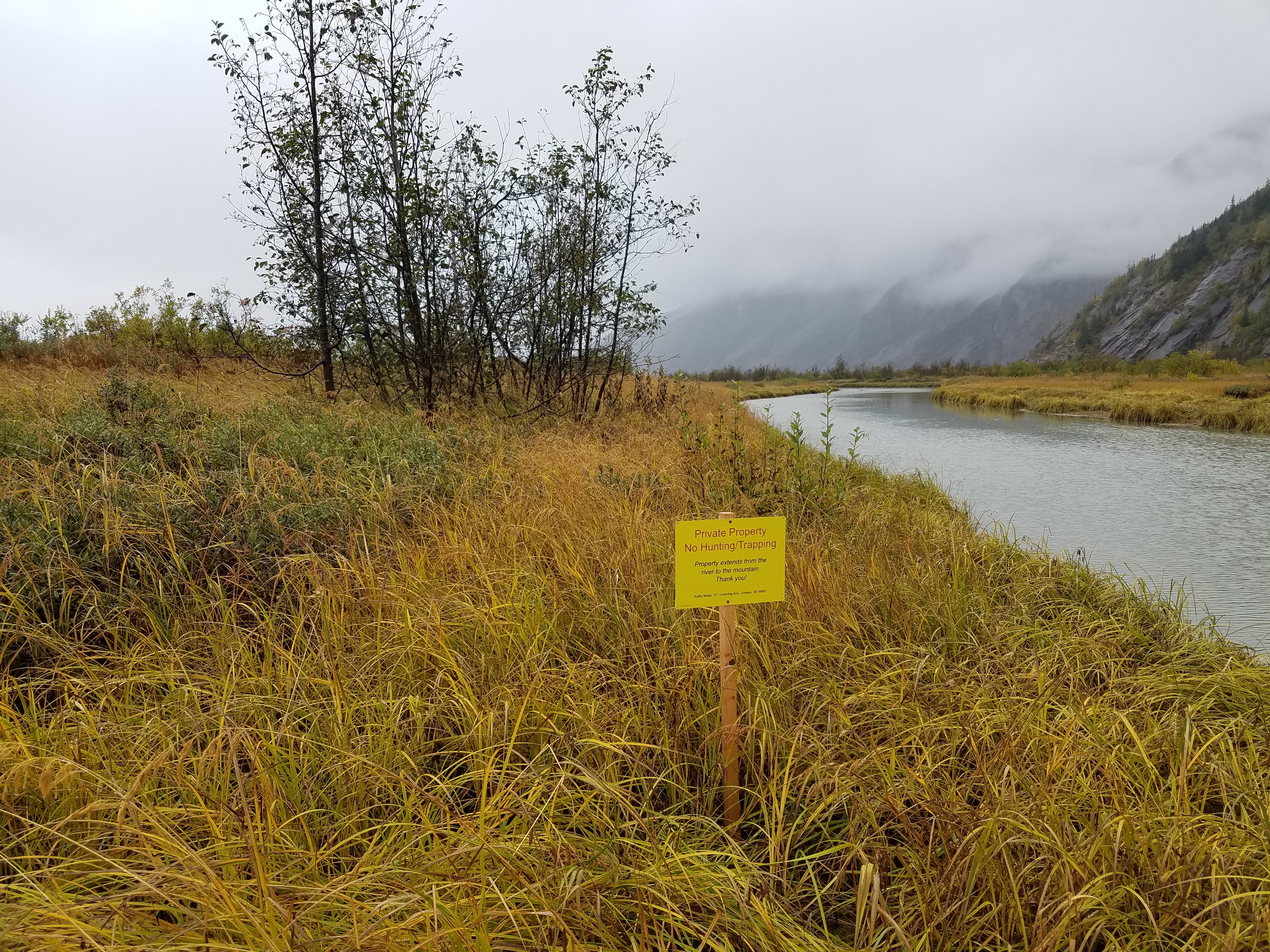
just off the sheer clay bank. I left some signs there for the downriver
property line and carried everything else to the cabin, dropping the
signs somewhat short as they became difficult to carry. After opening
up the building, I first lit a fire to start warming the place up,
which both Cailey and I needed. As soon as I could light the pilots on
the stove I put on some hot water, pleased that I'd left the jugs full
from the last time I was here (the whole place really looked quite
nice). I changed into dry clothes, unpacked the food, and was soon
slurping mediocre instant teriyaki noodles in front of the fire with a
last minute beer I'd grabbed from the cooler. Then I made myself sit
down for 15 minutes to rest before heading out on our afternoon
adventure.
My plan was to put the signage up on the downriver border and the stake
for the motion sensor camera in the meadow this afternoon, then do the
upriver border tomorrow on the way to the canoe. I grabbed a hammer
from the shed and took off, starting to enjoy the beautiful fall Taku
day. It was raining and I was suited up, but the rain wasn't as hard as
it was this
morning. Getting soaked was inevitable one way or another. I also
brought along my staple gun and secured the tarp over the side of Fox
Hole where I'd pulled it
off this spring to measure the siding. Then I nailed a no hunting sign
to the side of the building, finding no suitable trees nearby. I
thought that I'd be able to follow my old trail along the border to the
meadow, but after the first three or four pieces of blue survey tape, I
never found another. I more or less recognized, or thought I did, the
path and the clumps of trees it went through at the edge of the meadow,
but I was also unable to find the boundary post in the middle of the
meadow where I intended to post the sign. So first I went to the edge
of the slough, scaring up a group of beautiful blue-winged teal, and
put a sign there at my best conservative guess of the boundary. Then I
backtracked and
posted another in the middle of the open meadow bordering the slough,
again being somewhat conservative I think in the property line. I was
surprised to find that I posted the sign only a short distance from the
canoe which I could see through the sedge.
On the way back I picked up SD cards and considered my options. The
whole task had taken less than an hour, it was only 3:10, and I had a
lot of energy left for some reason, despite closing up Snettisham that
morning and making the long boat ride here. Although I'm sure Cailey
would have preferred to
stay at the cabin, I instead rounded up the rest of the signs and the
bike and, dropping SPOT off closer to the river for another try at an
OK
message, headed upriver. I didn't get very far on the bike, as it was
just not working to ride it with the three sings/posts on board along
with the hammer. I abandoned it by the cabin and we walked the rest of
the way, enjoying the easy trail. The first sign was easy, placed near
the No Vehicles Please sign, which was falling down. I propped the
latter on
a tree, unable to make much headway driving it into the ground (it's
not very pointed anymore and the top is too rotten to pound it very
hard anyway). From there I followed the slough toward the river, again
hoping to run into the sign post I knew was nearby. I never did, but
tried to keep my bearings between the cottonwood and the marker on the
mountain. It was trickier to pick a spot for the midway post, as there
are numerous breaks in the clusters of alders and willows that a hunter
might walk through from upriver. Which was the biggest/most
tantalizing/most likely to be used? I made an assessment, choosing what
seemed like the biggest and the one closer to the slough. Then I posted
another at the slough, again conservatively I think, and this time
managed to watch a cluster of peaceful ducks upstream preen and paddle
and rest before I disturbed them with my pounding. There was also a
sparrow or similar bird out there, a handful of which tittered or flew
away here or there on my walk, though it was overall pretty quiet. Not
eager to retrace my path through the thick sweet gale and brush back
the way I'd come, I instead walked along the slough and then angled
over behind the cabin, tickled to see the white back of the sign
in the middle of the meadow at the other side. Poor Cailey was soaked
and exhausted, her enthusiasm for bounding through sedge exhausted;
instead she followed close on my heels, annoying me by bumping me and
connecting with my heels. I can't imagine what it would be like to push
through that if it was over my head though, so I understand her tactic,
if wish she'd give us just a little more space.
The cabin was nice and warm and cozy when we got back and I set to work
changing and settling in. Oh that felt nice, with a lot of my work
done! Two hummingbirds, to my great surprise, had been tussling over
the dregs of the front feeder (the other was rancid and full of bugs),
so eventually I decided to go ahead and leave one up for them and
cleaned it and filled it with fresh nectar. It's hard to tell seeing
them mostly against the white sky, but I haven't seen any orange yet;
surely they aren't Anna's? But isn't it really late for rufous? Are
they migrating and hanging around this feeder, or are they stragglers?
Well, either way, it won't hurt to leave the feeder up for the winter
if it comes to that, and anyone who finds it will (hopefully) benefit.
I rewarded myself with a tiny bottle of wine.
I ate chili for dinner out of the pan, watched a Salvation, and then
set to work on this (checking on the boat in the middle). Now I think
I'll make some jiffy pop popcorn and watch something else. It was
pretty much dark at 7:30. Somehow I am unnerved by that, despite having
a whole day of daylight tomorrow. I plan to get underway about 1:00,
which would put me on the shoals about the same time I was on them
today, though the tide is half an hour later. Maximum flexibility! The
tide at Taku Point is at 2:00 according to my phone, 1:30 in Juneau, so
hopefully it won't be long before I'll get over them. I will surely
breathe a sigh of relief when I do.
I slept on the couch with Cailey, making her get up fairly quickly and
reposition to the bottom of the couch as she overheated, squeezed
between me and the back of the couch, sort of half panting/wheezing. At
7:00, she smelled a bear (presumably) and bolted out of bed to stare
out the window and bark. I was less enthusiastic about rising and,
after
seeing that there was no bear in sight, laid back down. But not for
long. The bear evidently reemerged from the trees, as I saw the waving
bushes when Cailey set to barking again after about 20 minutes. And so
I was up and quickly set about with chores, starting with changing the
propane tank (the pilots were out) and then filling the drinking water
tubs. Full for
most of the summer, I'd been using water out of the white jugs Mike had
brought up last summer for the large family gathering. By this time,
only one of six jugs had a little water in it, so I carried them all
back to the barrel and filled them each about 4/5 full by dipping with
the pitcher inside while another jug was getting partially filled by
leaning under the spout. It took a little less than half an hour and
they were all full, one inside and the others on the porch with their
caps loose. I brought in the porch swing and did a handful of other
tasks, put away everything in the shed and locked it, ate breakfast,
and
read for about 45 minutes until just before 10:00 when I set out for my
final close up adventure--bringing the canoe around to the landing. On
the way I set up the motion sensor camera on the back porch, grabbed
the one off the tree at the start of the trail, turned on the one at
the trail junction (after resetting the date), and set the other up.
Cailey eagerly jumped in the canoe when I
turned it over and I had to chase her out before dragging it down to
the water. This time it was low tide (two hours into a rising tide) and
the low water in the river was dramatically evident. On either side of
the slough were wide bands of mud below the edge of the sedge and I had
to drag the canoe over that as well, which I don't think I've done
before. The middle of the channel was only a few inches deep and we
were barely floating, poling along. It was still pretty early and I
knew that canoeing on the river would be easier the closer we got to
high tide, so I took my time and paddled upriver to go around the other
side of the island. The channel through the middle of the island was
mud and one of
the three rocks in the slough was fully exposed on the bank, the others
mostly exposed. I thought I might be able to see the entrance to the
beaver house at such low water, but it was not apparent, but it was
clear that
the mountain side was the main channel, as it was still a few feet deep
in
the middle. I'd startled a skittish flock of blue-winged teal
downstream when I'd first arrived, despite my best efforts, and saw
several large shorebirds fly by and land in the mud. They were large
enough that I wondered if they were plovers. Another flock flew by,
some with white stripes down their exposed backs, and these landed on a
mud island in the middle of the channel just below the island I'd
passed. I could see a straight line in the mud just off the tip of it
which I suspected was from the keel of the boat and wondered if I
should have put the no hunting sign on the other side of the island,
since it looked like people who knew the channel might take the
opposite side where I now knew the channel was. Well, not this time
anyway.
Amazingly, this little flock of shorebirds on the mud island were not
skittish and I was slowly able to drift toward them and eventually
paddle near them to reach the opposite bank again, where it was clear
the deeper channel would be (it didn't look like I'd be even able to
float along the other side). There were several smaller shorebirds with
short beaks and the white band on their backs when they spread their
wings and a more contrasting gray back and pale belly, the feathers on
the back standing out individually. The other three birds were much
larger with less contrast between the back and the belly. Most
interestingly, they had long beaks that looked slightly upturned and
they were using them magnificently to probe deep into the mud.
Dowitchers? I think I've seen the other ones before, identified them,
but I need to look them up again.
Shorebirds and ducks were not the only ones that had been using the
slough. With about half the slough bottom exposed in brown muck on
either side and around islands in the middle, the tracks of those that
had crossed the slough were exposed everywhere. Is there always that
much activity, I wonder? Just before we reached the
mouth of the slough I saw a bird on the shore and heard an unfamiliar,
slightly melodic, corvid-like call and quickly took a guess as to its
creator: rusty blackbird! Sure enough, there were three on the mud,
reminding me of the time my mother and I had seen one behind the cabin,
also on fall close up. This supports my idea that this is a migration
corridor, not having seen them in the summer yet.
The entrance to the slough was entirely cut off from the upriver corner
all the way to the downriver channel, leaving only a narrow flow along
the
shoreline. The sand on the bar was probably 8" or more above the edge
of the water
in a near vertical slope. There was as narrow channel of river water
cutting through it next to the huge beached spruce tree on the
downriver corner. I turned into this shallow channel to minimize my
time in the river and briefly got out to walk around on the sandbar and
glass downriver where I'd be trying to pass in a few hours. I could
see a large sandbar all along the shoreline where I'd gone aground,
extending well out into the river. I couldn't get enough of a vantage
to see where I'd need to go once leaving the meadow's shore (how far
into the river to go and whether I needed to weave or go straight), but
it was clear that the sandbar I'd gone aground on wasn't just a shallow
spot caused by a stump or something, it was a real sandbar and was
probably as high out of the water then as the one I was standing on.
Pondering what to do, we got back into the canoe and shoved our way
into the river where, to my relief, I discovered that paddling,
especially along the shoreline, was not difficult and we made decent
time. It was only when I had to leave the shore and paddle out around
fallen trees that I felt like I had to work harder at it; three hours
before high tide, I think the tide was already having an effect on the
river at such a low water level. On the way I passed a red-necked grebe
paddling around on the calm river. It was low overcast, clouds hugging
the mountains a couple hundred feet up, but dry without promise of
rain, a lovely morning to be out. After just under half an hour from
entering the river, we pulled up along the Kathy M and I started
walking the canoe up the stairs. I was surprised by how easy it was to
grab the line right at the bow and simply walk up with it, but once I
reached the forest, I lost power, as the bow needed to come up beyond
my ability to reach and pull before I could lever it down horizontal. I
wound up tying the line to an alder to prevent it from sliding back
and then hauled it up from the top from its side. Soon I
had it in its cuddy between trees and propped up on pieces of lumber
and branches.
Back at the cabin, I heated water for lunch (instant peanut sauce
noodles for energy) and washed the dishes, including the second
hummingbird feeder, cleaned the cabin and packed up, turning on the
motion sensor camera on the back porch as I circled the cabin.
Encumbered with my backpack, two grocery bags of food, linens, and
other items, the little buddy heater (which was working perfectly, to
my surprise and relief), and the empty propane tank, I tromped down to
the boat, loaded up, put ten gallons of gas in, pulled the anchor,
started up, and we kicked off the landing. It was, once again,
precisely 1:00 as I had planned. The tide was supposed to be at 2:00,
so I didn't expect to be able to float all the way down immediately.
However, I figured that leaving early gave me a lot of flexibility. If
I went aground, as I expected I might, then I was quite likely to
float off with the tide and then I'd be farther downriver and closer to
escaping through the rest of the shallows. There were still two beers
floating in slush to drink while I waited to drift off.
When I passed the slough, I could see that the sandbar along the bank
was disappearing but still exposed in its highest parts, so I decided
to try following the other boats offshore, where I might actually make
it through without that sandbar even fully submerging. I was idling and
everything was going alright, splitting the distance between sandbars
to
either side of me. Ahead, pretty much crossing the channel I was in,
except perhaps right along the sandbar I was trying to avoid, I could
see a small change in the water, about a five foot wide ripple. It
looked to me like a shallow bar, a narrow riffle, though it seemed
awfully long and skinny. Well, no matter, I thought, I'd float off it
shortly if I went aground, and I didn't want to try to avoid it by
getting into even shallower water so close to where I could see the
sandbar. And so we
touched bottom; I raised the engine, and we touched again. But it
looked to be such a narrow bar, I thought maybe with a little power I
could just motor across. So, with the engine raised enough that it was
not above the sand but still enough in the water to provide power, I
gave it a little gas. And went harder aground. I'd have to wait for the
tide. So, I shut down and raised the engine and started poling. Since
the pole (a 2x2) sinks into the sand, it was unclear how long it took
to start actually moving the boat and not just burying the pole, but in
less than a minute I'd say we were inching across the shallows and into
water that was deep enough to lower the engine again. I was fairly
confident, now that we were just about half an hour from the high tide,
that I was unlikeley to hit bottom again past that point. I lowered the
engine. It did not
start. Uh oh! I tried again. I gave it a little choke. It chugged and
chugged and chugged and did not start. I tried again. Nope! Now I was
in a predicament, in the middle of the river at the mercy of the
currents--the reason I was uneasy about leaving the meadow shore in the
first place. When the tide had lifted me off the bar the day before, it
had
floated me Upriver, not down. Would my kicker even start? It seemed the
next step. I pulled the choke, opened the vent, set the tiller to
start, and opened the gas lever (which was backwards from what I
thought it should be, making me wonder if that's why I hadn't been able
to start it earlier this summer) and, to my great surprise, she
started up after a dozen or so pulls. Whew! Now, where to go? If I
went back upriver to the cabin, it seemed likely that I would be stuck
there for at least 24 hours, even if I was able to trouble shoot the
engine. With the water so low, there seemed to be a pretty narrow
window for escape. Alternately, I could try to escape the river
and...well, take it from there. I had to make a fast decision and I
decided to go south, out of the river. At first it was actually fairly
pleasant. The morning was still fine, I was warm enough, and I seemed
to be making pretty good time. Maybe I could even kicker all the way to
Juneau! When I got to the cliff face I drifted for a while and filled
the gas tank, then continued on my way, enjoying the burgundy colors on
the cliff face I was slowly slipping past. The kicker didn't want to
stay centered on the boat, so I did put some strain on my
shoulders keeping it from rotating, and any time I stepped away for
even a moment, the boat turned wildly and it took way too much time and
effort to straighten it out again. Just before passing the rock island
around Taku Point, a boat from upriver passed me by; they were staring
at me from some distance and...I waved and let them go on. I wasn't
panicked and really wasn't sure what I'd ask them to do if I flagged
them down. I certainly
didn't feel like having people I didn't know on the boat, so feeling a
little guilty about passing up that opportunity, I watched them
disappear. It was the only other boat I saw that day.
When I entered the river, I decided to send an "OK" SPOT message so
people back home could see that I was leaving the cabin, and was okay
since I was not going to be at the dock at the expected hour. Ideally,
it would tell them that something was amiss but that I was okay. About
half an hour later I sent my first "help" SPOT message. I was not
making as good a time as I thought, I was now sloshing over one foot
seas
from the southeast, promising more out in the inlet, and it was
starting to sprinkle. It didn't seem likely I'd get anywhere even near
the Gastineau Channel by the time it was dark around 7:30 and I wasn't
sure that
I wanted to cross Taku Inlet on a kicker with a southeast system of
unknown strength coming up. At that point, I had one main goal which
preoccupied me: escape the river. While I could anchor anywhere in the
river, I would quite likely wind up aground for an unknown distance
from a channel at low tide, and then if help came, could they get to
me, could I get to them, and if I left the boat, would we be able to
recover it at a tide in the near future? It seemed wise to have
options, and so I
pointed the boat as well as I could toward Scow Cove. Once I was there,
I knew I could be in a permanent channel and soon enough leave the
river at Flat Point. Oh, but that river is wide and long when you're
kickering on an eight hp motor! Off the bottom of Grizzly Bar I ran out
of gas for the first time and filled up the built in tank awkwardly,
sadly overfilling
it a bit. I think this must have saturated the carburetor or something,
as it wouldn't start at first. It took some pulling and reluctance to
get it going, but I did get it going, and we continued. I was by now
wrapped in the blue quilt from the lodge and had changed into my long
underwear top beneath hoody, vest, and rain jacket. I even tried to tie
the kicker to at cleat to make it easier to hold it in place, but
eventually gave up. I kept thinking that I might be able to steer with
the main engine down, but testing that would take time and we'd have to
reorient as we got off course from the errant kicker, so I just endured
back there, grateful for safety and all the gear on board, and for the
gift of adventuring, and waited to get to Scow Cove.
With some relief, we reached it, and I passed it by, knowing that it
was the last anchorage until Sunny Cove. It itself is so
river-intertidal
that it seemed an unwise place to stay. Since it was looking
increasingly unlikely that I'd make it to town that night, my next plan
was to go to Annex Creek and see if they could hail Juneau and let me
tie up for the night, and trouble shoot the engine a little more.
I'd already sent a second help SPOT message so people could see that I
was underway in case someone came. I was wondering when my mother would
check her email, and wishing I'd told Ezra to call my parents when he
got the message, as he was sure to do so before her. I had a surge of
uncertainty as I passed by Flat Point with the unrelenting rocky
shoreline stretching before me and Annex Creek not even in sight. There
was now no longer any chance to anchor, and no reasonable place to go
ashore. Cailey was on the bench inside lying down, clearly perplexed
and not happy about the way the day was going, and periodically stood
up to peer at me through the back window. I was getting chilly. And the
seas were a little bigger, cavitating the engine a little, though they
were not large. And so we crept down toward the next point. I did try
to start the main engine a couple of times in there, hoping that it
would just start right up without explanation. I'd drained the bottom
of the fuel filter until it was clear that gas was coming out, made
sure there wasn't a kink in the fuel hose, pumped the bulb until it was
taut, and even took off the cowling to see if anything jumped out at
me (it didn't). Most of that I did after passing over the sandbar, and
I really couldn't come up with anything else to do. Since it was making
a good effort at starting, I thought it might be fuel related, but
what?
Anyway, each of the couple times I tried to start it, it just chugged
and chugged to no effect, even seeming to peter out after a few tries
as though maybe the battery was dying (which made me more
conservative in my attempts).
To my relief, Annex Creek suddenly showed up, having been blocked from
view by a rocky promontory, mostly a relief because I was farther along
than I was afraid I was. However, there was no dock, just some pilings
and what appeared to be a crane over the top. So much for my idea of a
cozy dock to tie up to! There was a small gravel beach along the shore
there, but otherwise it was unwelcoming rock. I was hoping to make it
around the next point before the gas ran out again, but wound up
running out just past the power plant. I took off the gas cap and heard
something snap, and found it free in my hand; the attachment to the
inside of the tank had broken off and was inside. That didn't
seem like it would be a problem, but after filling it up (carefully
this time), the pull cord ticked in a new way when I pulled it and I
couldn't get it to catch, possibly not to pull smoothly enough to do
so. I
worked on that for a while, I tried the main too, then switched to the
Johnson kicker. My mom had had quite a trial getting it started this
spring, which was one reason I'd started with my own kicker. If I'd
realized it would start so nicely and was actually twice as powerful as
my
kicker, I probably would have tried it sooner! I hooked up the tank,
read the instructions for starting on the engine and it sprang to life
in about ten pulls. It was slow to translate the twists of the throttle
into actual changes in speed, but we were soon underway again and this
time I did test steering with the main engine, which worked
beautifully. Sitting inside and steering like a civilized person, dry
and warm, gave me much more courage than I'd been feeling in the rain
on the back deck. If I hadn't gotten the other kicker going, my
next idea was to try to hail Annex Creek on my handheld to see if they
could lend assistance. Although the tide was dropping, I had been
drifting upstream while working with the engines, so maybe I'd have
ended up back at Scow Cove anyway!
But we plugged on and, after a while, the shoreline at Sunny Cove
showed
up just where I thought it would be, a strange way to return (having
camped there with Chris, Katie, and Rob some years ago), but it was
nice to be
somewhere familiar. My plan was to let Cailey off to go to the
bathroom, then anchor the boat out from the shore in deeper water so
there would be more flexibility in picking it up; we'd walk around, I'd
send more messages, then get the cabin cozy for the night. When it was
time to sleep, we'd be aground on the low tide and Cailey could go to
the bathroom again. However, the delta there is so gradual that as soon
as we touched bottom I wasn't able to push us off and I really didn't
try that hard; we were still 20 yards from dry land. Instead, I slid
into the water in my waders, picked up Cailey, and carried her most of
the way to dry land. On the way up the muddy intertidal zone, I tried
to send an okay message to let them know where I'd landed, but when I
looked at the SPOT in my hand, I saw two red lights--no satellite and
batteries. Scared it would run out before I got out the needed message,
I turned it off and tried again when I was stationary sitting on a log
at the top of the beach. I managed to send a help and an okay (so they
knew I was fine) and another help (so they knew I wasn't canceling the
help). It was a lot of messages, but I didn't know what was actually
going through since I'd had trouble up the Taku sending messages this
summer. And as I sat there watching the lights flash on SPOT, a Ward
Air plane flew in low from up the river and I waved as they flew by the
boat. Although I would have been more than comfortable on the Kathy M
that
night, I did almost tear up with gratitude. My messages had worked! I
slipped my way down the beach and waded out to the boat as the plane
turned around and landed. I put out a bit more anchor line since I
wouldn't be there to monitor it and tried to set the anchor a little
bit (driving it into the mud), awkward under a couple feet of water. I
grabbed my backpack from
inside, the one item I wanted to bring with me, and
waited for the plane to come, trying to sign that the water is very
shallow in
there--there was already a shoal above the water father out from shore
than the boat. My mother had a grim look on her face when I saw her
through the windshield, but I just grinned back. They were also
worried about the tide falling and a log we could see underwater, but
my mom pointed out that the main engine was tilted down, so I turned
the plane around per Ed's (the pilot's) instruction, rushed back to
tilt that up and
also put the garbage inside the cabin so birds didn't go after it
again. I'm really embarrassed that I hadn't tilted the main up, but
since I wasn't driving with it, it just didn't occur to me--no wonder
the boat wouldn't push off! I also set the anchor better and tried to
pull the line out from around it to avoid tangling if I could. The
plane was in waste deep water, so I plunged my hands into the water
where Cailey was wading up to her belly and deposited her on a float
before climbing up myself. Getting her inside the 180 was a little
tricky and ungraceful, but it was accomplished, followed by me. Ed put
down his rain jacket so I didn't get the seat wet. And soon we were
flying over the foggy, rainy inlet and down the channel to Juneau. I
was feeling pretty good, and very happy to be home that night. My
mother set me up with chili for dinner and Ezra came over to decompress
with me. Per his request, I did not shower or change clothes
before he arrived, so I remained looking adventurous when he showed up
with flowers and chocolate popsicles.
The next morning I went to work, still rocking a little (literally) as
though I'd been on a boat much longer than part of two days. Late in
the morning I texted my mother and suggested that we could go out the
next day on the Ronquil and tow it in; she wrote back and said that,
after much discussion, she'd told my dad that we were going and asked
if that was okay. I said that was fine and we agreed on 12:30. As I got
ready to head out for lunch and while I was walking Cailey on the
flume, I texted her to ask her to bring a few things (like leaving the
harbor beers, since I had discovered that my refrigerator had fully
failed while I was gone and I had no way to chill anything), lastly
suggesting that she bring her mustang suit. She texted back to tell me
that she was already wearing it. That was puzzling! Did she think we
were leaving that day...? I called to find out and, sure enough, she
thought we were talking about that very day, and the weather was
supposed to be better than the next day ("not a whisper of wind"
according to the person
at the weather center that my dad had called). So I rushed home and
turned around, picking up my mother just half an hour late. We loaded
up the
Ronquil with everything we needed, including the three jerry jugs of
gas she'd flown out to me in case I needed them, and created a bridle
to tie a tow line to by
tying a doubled line to rings on either side of the stern. Then
we took off drinking cold beers down a calm channel. Things got a
little rockier as we approached the end of the channel and a squall
came through, definitely more than a whisper! We were in chop,
then rolling a little in seas as we crossed to Bishop. From there it
was mostly on the stern, so not too bad, and soon as were cruising
along the shoreline past Cooper. By then it was raining steadily and we
discovered that the rain had soaked through our survival suits in
places when we stopped to go to the bathroom. We approached a beach
through the mist and I commented on how
small it looked at high tide. I saw a big gray blob, though, which I
hoped was the boat. The closer we got, the less familiar it looked,
until we finally agreed it was not Sunny Cove after all--it turns out
that there is another gravel beach between Sunny and Cooper! Good to
know for future reference. My big gray blob was a huge boulder. So on
we
went until we hit the real Sunny Cove and saw, with some relief, the
boat sitting nicely at anchor. Whew!! It was calm there and we tied the
boats together and started trouble shooting. I unclipped and reclipped
the emergency stop clip (though it looked fine) while my mom looked
around the engine. There was no noise when we opened the fuel cap,
suggesting a vacuum hadn't kept fuel flowing. My mom drained the fuel
filter a little, but only a tiny bit of water came out, and she pumped
the fuel bulb. Then she started the engine. Yep, it started right up,
just as usual. Naturally I felt a mixture of relief and irritation.
Frustrating as that is, though, I know that engine well enough to know
that it really wasn't starting when I tried. If it was flooded, I gave
it plenty of time between tries to drain it out. I suppose we'll never
know what was wrong, but something was wrong. Perhaps if I hadn't been
picked up, I'd have tried it again in the morning and had it start up
right away myself.
But overall this was really good news. My mom offered to tow me back so
I could sit in the shelter of the Kathy M, but that sounded like more
work and would take longer, so we rode back in tandem. By then it was
raining fiercely and everything on my boat was soaked. As we approached
my office building on the channel it was nearly 3:00 o'clock, or time
for afternoon dog walks, and I wanted to text my friends at work to
tell them to wave at us from the boardwalk. I abandoned the idea,
though, as there was no escape from the driving rain coming down the
channel behind me. It was too wet for any kind of phone work. Once we
got to the dock, there was then all the unloading of all my gear in the
pouring rain. Just by clenching my fists, torrents of muddy water
streamed out of my gloves. I think we filled four carts with all my
sundry gear and stowed the jerry jugs, may full, in the boat house. It
was with great relief that I stashed everything to dry on the floor of
my garage (much of which is still there as I write this three weeks
later). I'm pretty sure I managed to crash pretty well that night!