
Working on Cottonwood's valve
Snettisham
2014 - 3: Water Repairs
June 5-7
Working on Cottonwood's valve
 I’d
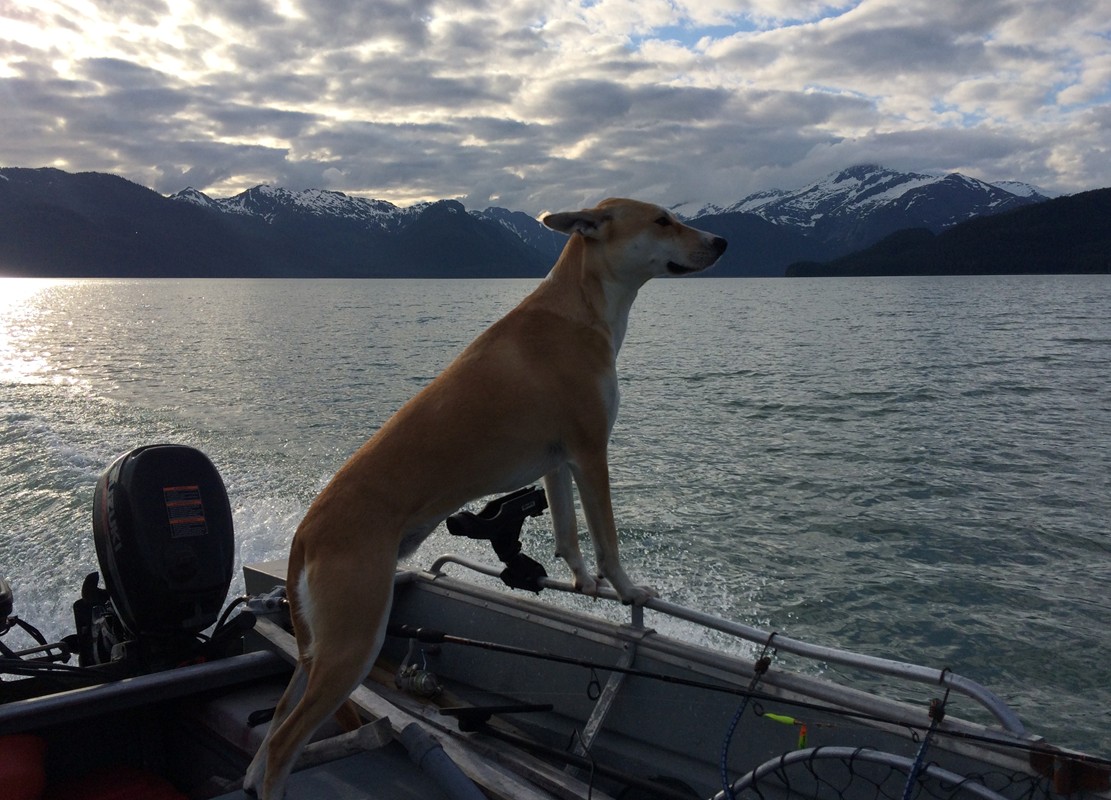
tried to come the weekend before, though nearly my entire being wanted
nothing
more than to stay in town, rest, and take care of a few things around
the house
that four weekend adventures and a wedding weekend had prevented. But
after a
long week at work, I often feel that way and would hardly go anywhere
if I
always heeded it, so I reluctantly gathered my gear and headed to the
harbor,
leaving around 1:30 Friday afternoon. By the time I got to Taku Inlet I
was
encountering unpleasant seas that got much worse after passing Arden.
The seas
weren’t big—maybe 1-2’, but their direction was inconsistent and they
were
tightly spaces so we never rested. I fought with it and fought with it,
crunching my way south while Cailey paced the boat with her tail
between her
legs, eventually choosing the back of the boat over the bed and blanket
I’d put
next to my seat, possibly because she’d discovered on her own that the
boat was
more stable back there.
I’d
tried to come the weekend before, though nearly my entire being wanted
nothing
more than to stay in town, rest, and take care of a few things around
the house
that four weekend adventures and a wedding weekend had prevented. But
after a
long week at work, I often feel that way and would hardly go anywhere
if I
always heeded it, so I reluctantly gathered my gear and headed to the
harbor,
leaving around 1:30 Friday afternoon. By the time I got to Taku Inlet I
was
encountering unpleasant seas that got much worse after passing Arden.
The seas
weren’t big—maybe 1-2’, but their direction was inconsistent and they
were
tightly spaces so we never rested. I fought with it and fought with it,
crunching my way south while Cailey paced the boat with her tail
between her
legs, eventually choosing the back of the boat over the bed and blanket
I’d put
next to my seat, possibly because she’d discovered on her own that the
boat was
more stable back there.
I considered turning around as I beat my way south, but I wasn’t willing to do that until I at least poked my head around Grave Point just in the off chance that it laid down beyond. That wasn’t typical, but it seemed worth a try at that point. On the way, a huge splash revealed a humpback close to shore north of Grave and later I saw him do what I think was a caudal-peduncle throw based on the splash, though it looked more like a half breach (maybe I just saw the tail at an odd angle). He was moving toward the middle of Stephen’s Passage when I slowly passed him. The seas picked up in that area, building to some three footers, and the scene beyond the point was one of wind whipped waves coursing up Stephen’s Passage in neat rows. It would be a dismal ride. I did something I’ve never done before; I turned and headed back to town, immediately relieved both physically from the smoother ride and emotionally. For once I think I was meant to stay in town. So after two and a half hours on the water, we sheepishly pulled into the harbor and home to light a fire.

 And
so
it had been a month with two weekends in town since I’d last been to
Snettisham. I left work at 3:00 p.m. Thursday afternoon, pushed through
all my
chores at home, sat in the woods long enough to see one of my
Swainson’s thrush
friends, and left the house at 5:00. Part of my motivation in leaving
that
evening was the glassy calm channel and the favorable forecast, having
been
shaken by just how unwilling I was to endure the seas the week before.
The ride
south was nearly perfect, the water calm or with a gentle following sea
close
to Snettisham, the clouds breaking up and allowing the sun to warm my
back. A
whale blew just south of Arden, another along the shore of Doty Cove,
and
another at the entrance to Snettisham. We passed numerous tide rips
across Taku
Inlet, one of which was inhabited by a flock of common murres. In that
same
area I saw two characteristic Dall’s porpoise splashes and later saw a
back
break the surface a few times. I didn’t get very close, but was pleased
to see
that they continue to recolonize my stretch of Stephen’s Passage.
And
so
it had been a month with two weekends in town since I’d last been to
Snettisham. I left work at 3:00 p.m. Thursday afternoon, pushed through
all my
chores at home, sat in the woods long enough to see one of my
Swainson’s thrush
friends, and left the house at 5:00. Part of my motivation in leaving
that
evening was the glassy calm channel and the favorable forecast, having
been
shaken by just how unwilling I was to endure the seas the week before.
The ride
south was nearly perfect, the water calm or with a gentle following sea
close
to Snettisham, the clouds breaking up and allowing the sun to warm my
back. A
whale blew just south of Arden, another along the shore of Doty Cove,
and
another at the entrance to Snettisham. We passed numerous tide rips
across Taku
Inlet, one of which was inhabited by a flock of common murres. In that
same
area I saw two characteristic Dall’s porpoise splashes and later saw a
back
break the surface a few times. I didn’t get very close, but was pleased
to see
that they continue to recolonize my stretch of Stephen’s Passage.
We
pulled in at 7:35, an hour and 50 minutes after leaving Juneau, at high
tide. I
quickly unloaded the little gear I had, grabbed a kayak, and went to
anchor the
boat with Cailey. The anchor didn’t catch well the first time and I
found
myself rather far out in the river, so I repositioned a little closer.
I was
chilled and, after opening up the lodge, lighting the pilots, etc., I
lit a
fire and hunkered
down with a book. It had been another long week and I felt completely
unmotivated to do work of any kind, and it was late anyway.
Hummingbirds
begging at the window compelled me to make them some food though, and I
replaced the feeders after cleaning them and letting the mixture inside
cool. Although
I’d only eaten a hunk of bread on the ride down and a leaving the
harbor
Ranier, I didn’t feel hungry for a long time, finally eating a bowl of
soup at
9:00. Not long after I fell asleep on the couch, for some reason
feeling
compelled to sleep in the lodge instead of at Hermit Thrush that night.
Cailey
curled up at my feet.
 Cailey in the spring vegetation |
 A different angle on the lodge |
 Bear fur caught in a tree |
I slept okay, although the lodge is considerably brighter than my cabin and I had to cover my eyes with a blanket after 4:00 a.m. I didn’t sleep as late as I hoped, getting up around 8:30 with no more motivation than I’d had the night before. I felt guilty for not being there in so long, the two foot high growth of vegetation over and around the path and fire pit depressing me. So one of the first things I did was clear around Nigel Cottonwood, the path along the south side of the deck, around the fire pit, around the big rhubarb, and along the top of the path, mostly with a machete and a little bit with clippers. Mostly, though, I sat on the porch or the deck or the bench with my book and listened to birds with one ear. There was a lot of song from the resident Pacific wrens, which I’d dreamt about during the night, and Townsend’s warblers. I’d been very pleased the evening before to hear the first Pacific slope flycatchers of the year, and one somewhat downriver sang often. Crows worked the water’s edge, a hermit thrush sang now and again, and hummingbirds stopped by periodically, but overall it wasn’t a very noisy chorus.
Later in the morning I managed to pull myself together enough for a walk, heading down the beach to pick up the kayak I’d stashed in the woods five weeks earlier. The tide was dropping but still pretty high and I found myself slipping on the algae covered rocks, retreating above the tide line to firmer footing on the dry rocks. The day was sunny and warm and the little rivulets felt wonderfully cool on my bare feet. I realized on the way that I’d again forgotten to bring a paddle, but I decided to trek on anyway. After all, I thought, Tlingits in this position would never have let a small thing like that stop them; they’d have improvised something that worked. With that in mind, I found two driftwood sticks, untied the kayak, and hauled it down to the water badly cutting the end of my right big toe in the process by slipping on a rock and jamming it into the one below. With the longer pole in my right hand and the shorter one in my left hand, I “poled” my way up the river. It was easy to beat the current—the poles could actually function as paddles—but it was hard to keep the boat going straight, especially with Cailey perched in the bow. I spent more effort keeping close to shore where the water was shallow enough to push than on forward momentum. Twice toward the end I gave up and let the boat turn a circle, which I don’t think actually slowed us down very much. But we eventually came even with the boat and made for it, the poles effectively paddling us over deep water and deftly alongside the boat.
I started the engine, pulled anchor, and repositioned us farther out and down the river so I could leave at the next low tide. I also refueled, then Cailey and I kayaked back to shore using the much more efficient paddle (even with a fifth of it missing). I had some lunch, read a little more, and then decided to slowly see if I could make any progress with the water system repairs. I believe it took me four trips to Harbor Seal to even begin to work on replacing the filter there. I brought over the new filter, returning for two wrenches, a screwdriver, a hack saw, and I can’t remember what else. On each of these trips I used the machete or the clippers to clear the path on the way a little more and was dedicated to using the new path from the bridge down to the trail connecting to Harbor Seal. The news at the filter wasn’t good. Because each filter is screwed to the next, and to the coupling that connects the filter to the hose, it was impossible to simply unscrew the filter head from the middle of the unit. I needed to free it from one side altogether. I tried to unscrew the coupling that connects its bushing to the plastic coupling that connects to the hose, but only one of the wrenches was large enough to fit around it and there was no unscrewing those by hand. The obvious answer was to simply to remove the hose from the coupling, but no amount of hot water and yanking would make it budget. The CPVC pipe on the other end couldn’t be freed to help with the effort because the coupling glued to the end was inside the building and wouldn’t fit through the small hole in the wall, so that limited the yanking considerably (not that I think it would have worked anyway).
So
I
decided I’d just have to cut the thing off, which is where the hack saw
came
in. This proved to be more time consuming that I thought, and more
work, so
after starting a spiral cut from the coupling down, I decided it was
time for a
break.
 I
might have been more discouraged at that point, but I’d made some
exciting
discoveries during a diversion I undertook on one of my trips back to
the
lodge. I decided to bring along a hoe and shovel so I could start
leveling the
ground on the new path downriver of the bridge and, along with them, I
brought
the metal detector. I stopped behind Mink and waved the thing around,
quickly
hitting a hot spot. Well, why not, I thought? I used the shovel to cut
out a
circle of sod which I ripped out with my hands. There underneath was a
gorgeous, ornate iron square, possibly from a stove or something of the
like.
Fantastic! The next hot spot revealed a bent piece of iron. I gave up
on the
third hot spot after a few minutes, totally delighted and amazed at how
well
the metal detector had worked so far.
I
might have been more discouraged at that point, but I’d made some
exciting
discoveries during a diversion I undertook on one of my trips back to
the
lodge. I decided to bring along a hoe and shovel so I could start
leveling the
ground on the new path downriver of the bridge and, along with them, I
brought
the metal detector. I stopped behind Mink and waved the thing around,
quickly
hitting a hot spot. Well, why not, I thought? I used the shovel to cut
out a
circle of sod which I ripped out with my hands. There underneath was a
gorgeous, ornate iron square, possibly from a stove or something of the
like.
Fantastic! The next hot spot revealed a bent piece of iron. I gave up
on the
third hot spot after a few minutes, totally delighted and amazed at how
well
the metal detector had worked so far.
After giving up temporarily on the filters, I
grabbed a diet
Dr. Pepper from the creek (I’d dropped them off earlier that morning to
chill)
and sat on the point to drink it, finding a comfy spot mostly out of
the
breeze. Cailey curled up on top of the point picturesquely. I was
starting to
relax a little (at least I was breaking in the new trail) and, after
finishing
my drink and entering in all the Alaskan birds I’ve seen into my
Sibley’s iPhone
app (which had lost that data when I switched phones), I returned to
the lodge
for my COASST walk, as it was low tide.
I started in a downriver direction again, already
overheated
by the time I turned around below the eagle tree. With my sore toe in a
band aid,
I was in socks and xtratuffs and wished I could walk barefoot on the
cool silt.
Instead I took off my shirt and went bare torsoed up the river.
Although the
mosquitoes were plentiful and viscous in the woods and, to a lesser
extent, on
the lodge porch, the brisk breeze coming in off Gilbert Bay protected
me on the
river. I walked up to the grassy point and around the outside of it,
then began
scanning the shore for an obvious entrance to what I assumed must be a
well-worn game trail inside the trees. Instead I found only cliffs. A
little
above the point was one steep spot inside the alders which, though
clearly not
used by game, I thought I could use to access the woods above. I made
it up,
but an overhang at the top trumped Cailey and I gave up on that route.
We
continued upriver, following bear tracks in the hopes that they would
lead me
to his or her route into the forest. Not far along I realized that I
didn’t
have my phone anymore, so I returned to the first steep slope and found
it on
the leaves there, thankfully.
 Cailey and I turned around and walked upriver all
the way to
the point above which a main channel of the river runs close to shore.
For one
long stretch, we walked on rocks or narrow sandy areas between rocks,
inching
our way along the shore. Eventually there were only rocks to hop along.
I never
saw an obvious way into the woods; once, when we did climb up, we found
an open
area where there was some windfall, but the slope was so steep and
brushy and
full of fallen trees that a nice game trail seemed unlikely. There was
a short
section that had obviously been well used accessing the beach down a
small
trickle of a stream—there was even a smooth patch on an
Cailey and I turned around and walked upriver all
the way to
the point above which a main channel of the river runs close to shore.
For one
long stretch, we walked on rocks or narrow sandy areas between rocks,
inching
our way along the shore. Eventually there were only rocks to hop along.
I never
saw an obvious way into the woods; once, when we did climb up, we found
an open
area where there was some windfall, but the slope was so steep and
brushy and
full of fallen trees that a nice game trail seemed unlikely. There was
a short
section that had obviously been well used accessing the beach down a
small
trickle of a stream—there was even a smooth patch on an  unlikely,
high,
slanting tree over the top of it that looked well-rubbed—but it didn’t
seem
likely that the trail extended unbroken beyond that. Perhaps there are
simply a
network of shorter game trails, and not the tidy path I am picturing
(what game
trail doesn’t disappear periodically, anyway?). Or perhaps used by
local
otters, the tracks of which I’d seen on the beach (see photo).
unlikely,
high,
slanting tree over the top of it that looked well-rubbed—but it didn’t
seem
likely that the trail extended unbroken beyond that. Perhaps there are
simply a
network of shorter game trails, and not the tidy path I am picturing
(what game
trail doesn’t disappear periodically, anyway?). Or perhaps used by
local
otters, the tracks of which I’d seen on the beach (see photo).
I headed back to the homestead and finished
failing to
replace the filter. I did get the hose off the coupling, unfortunately
cutting
into the coupling itself a little, and successfully unscrewed the
filter. With
it came the bushing connecting it to the next filter. This proved
impossible to
remove, but I did find a spare in my box of plumbing supplies. The
other
bushing came out easily enough, and I returned to the cabin to
carefully wrap
the bushings in hose tape, screw the bushing into the middle filter,
the new
filter onto that, and then the busing on the hose end into the other
side. I
put a couple of hose clamps on the black hose, returned to the lodge to
get the
screwdriver, dumped on some hot water from the kettle, shoved the hose
onto the
coupling, tightened up the hose clamps, installed the filters in the
housings
and screwed them in, and voila! I had a new filter system! Well,
almost. When I
turned on the water, the hose coupling leaked badly, must worse than a
leak
from a loose or inadequate hose clamp. It could only be the deep scrape
I’d
made from cutting off the hose.
I managed to unscrew the new filter this time
without
disassembling everything, but even with more room to maneuver and pull,
and
more hot water, the hose still wouldn’t come off the coupling again.
This time
I cut the whole thing off and soaked it in hot water back at the lodge.
This
did enable me to unscrew the brass coupling from the plastic coupling
that
attaches to the hose, but I had no spare for the latter, so I will have
to
finish it another time.
I read outside then until I got too chilled, then
lit a
little fire, heated up some soup, read some more, and then started on
this trip
report. It’s now 8:20. When I look back on the day, it seems I did a
lot, and I
am most pleased about the exploration upriver, but I did not progress
much with
the homestead! I am feeling increasingly bound by my schedule. Even
with
Fridays off this summer, I cannot spend enough time here and lead the
rest of
my life. It doesn’t matter that I enjoy the work I do down here if I
have no
energy to do it.
 Irises |
 Look at the pollen in the water |
 I start work on the filters |
 Excavationg artifacts |
 Single beauties near Mink cabin |
 Daisies on the point |
 Cailey tries to find a comfortable place... |
 ....and finally gives in |
 A steep slope we climbed |
 Wind blow upriver |
 In continue work on the filters |
 Serene evening |
I then moved to Cottonwood cabin where the process
was a bit
more complicated since there was a coupling on either side of the
valve.
Therefore, I could not unscrew the valve itself. In fact, the only way
that the
system would work is if the coupling would turn freely within the hose,
allowing both couplings to unscrew without affecting the position of
the valve
or each other. With that in mind, I unscrewed the hose clamps and slid
them
past the couplings. Amazingly, this process worked remarkably well and
I was
able to quickly free the valve, observing the badly split seam at the
bottom
that had gushed water after separating two winters ago (Cottonwood
never had
running water last summer). Putting the system back together was a bit
more
tricky, however. On one side it was simple enough to screw on the
valve, making
sure it ended up tight, but with the lever on top. But on the other
side I
needed to once again force the coupling to turn inside the hose; that
itself
wasn’t a problem, but lining up the valve with the end of the coupling
(white
with new hose tape) and keeping them perfectly lined up while screwing
in the
coupling with a wrench was more tricky (I could not turn the coupling
inside
the hose by hand). I had to pull the hose off its hook against the
cabin wall
to manipulate it, but I managed to screw the two pieces together
tightly. I concluded
the process by returning the hose clamps to their places, pouring the
remains
of the hot water on them, and tightening them up. Before I continued, I
tramped
up to the junction and turned the water back on to make sure the
connections
didn’t leak. While there I discovered that there were two new holes in
the pipe
just below the junction from naughty bear activity.
 So those were the easy ones. I still couldn’t
actually use
Cottonwood’s water system until I fixed the very leaky valve that
brought water
to it. And I also clearly needed to fix those leaks, so on the way back
to the
lodge I picked up a length of hose from the shed to wrap them in.
Before I did
anything, I hiked up to the top of the system to turn the water off at
its
source, discovering another bear bite close to the top. Back at the
lodge I
assembled hose clamps, pieces of hose, valves, wrench, screwdriver, and
hot
water, and headed up (though I’m sure I forgot at least one thing and
had to
return). I tried a two-hose clamp approach to the two leaks this time,
as some
of my previous attempts had still leaked a tiny bit. When those were
secure, I
went to work on the valve, following the same basic procedure that I’d
used on
Cottonwood. It was harder here lining up the coupling and valve on the
second
side, but amazingly it seemed to come together.
So those were the easy ones. I still couldn’t
actually use
Cottonwood’s water system until I fixed the very leaky valve that
brought water
to it. And I also clearly needed to fix those leaks, so on the way back
to the
lodge I picked up a length of hose from the shed to wrap them in.
Before I did
anything, I hiked up to the top of the system to turn the water off at
its
source, discovering another bear bite close to the top. Back at the
lodge I
assembled hose clamps, pieces of hose, valves, wrench, screwdriver, and
hot
water, and headed up (though I’m sure I forgot at least one thing and
had to
return). I tried a two-hose clamp approach to the two leaks this time,
as some
of my previous attempts had still leaked a tiny bit. When those were
secure, I
went to work on the valve, following the same basic procedure that I’d
used on
Cottonwood. It was harder here lining up the coupling and valve on the
second
side, but amazingly it seemed to come together.
Perhaps at this point I should describe the scene.
It had
started raining in the night and continued to rain on and off all
morning. The
forest was wet everywhere and I was decked out in full rain gear—rubber
fisherman’s
rain pants, rain jacket, xtratuffs, and hat. This reduced the amount of
insect
repellent that was necessary, but it was still required on the face and
hands.
After finishing at the lower junction, I headed up to the second, but
forgot
where I was going and wound up at the top again. I took that
opportunity to
work on the third leak, during which I realized that two hose clamps
may in
fact be less effective than one when covering a hole, since you want
the
pressure over the hole, not just to either side of it. So I used just
one on
that leak for the time being.
 Then I retreated back to the upper junction and
replaced
that valve, with considerably more difficulty than the others due to
the
persistent curve to the hose leading to the cabins which was very
difficult to
hold in place while manipulating the wrench. But at last it was done. I
tramped
back up through the devil’s club one more time to the water source and,
noting
that the water level was not very high, proactively raised the water
level a
bit by adding small gravel to the dam behind the barrel to reduce
seepage
through the rocks. Then I turned the water on and soon saw that my
single hose
clamp repair had been ineffective. Mostly I think it was simply placed
poorly,
as a repositioning almost stopped the leak. A second hose clamp nearby
stopped
it entirely.
Then I retreated back to the upper junction and
replaced
that valve, with considerably more difficulty than the others due to
the
persistent curve to the hose leading to the cabins which was very
difficult to
hold in place while manipulating the wrench. But at last it was done. I
tramped
back up through the devil’s club one more time to the water source and,
noting
that the water level was not very high, proactively raised the water
level a
bit by adding small gravel to the dam behind the barrel to reduce
seepage
through the rocks. Then I turned the water on and soon saw that my
single hose
clamp repair had been ineffective. Mostly I think it was simply placed
poorly,
as a repositioning almost stopped the leak. A second hose clamp nearby
stopped
it entirely.
I was pleased to see that both valves had no
leaks, but I
did have to reposition the hose clamps on one of the lower bear bite
holes to
stop it leaking. I then checked the new valves at Harbor Seal and
Cottonwood
and found them tight and cut a length of CPVC pipe to replace the
broken one in
Hermit Thrush and delivered that. It was nearly noon, but I finally had
mostly
functional water systems. I rested for a few minutes on the porch, then
retreated inside and lit a fire. I had some lunch and read by the fire
for an
hour or so, enjoying the coziness of the lodge in the rain and the
satisfaction
of a full morning’s work outside.
Although I easily could have relaxed the afternoon
away, I
decided to pack up and head out, expecting to make a few explorations
on the
way. Cailey and I left the homestead about 3:15 on a delightfully calm
sea and
scooted our way over to Doc Fushe’s cove. Right where Snettisham splits
beyond
the entrance, an immense flock of loons sat on the water and there was
a lot of
bird activity here and there throughout the entrance. I pulled up on
the sandy
beach below what we think was the workshop, anchored the boat to the
beach (on
a rising tide), and tramped up the woods to the house. I wanted to give
this
potential road to the Crystal Mine one more chance. I saw a few leads
near the
house, but nothing jumped out at me, and I was again puzzled by how
there could
be no indication of how a trail or road crossed the gullies. I had
forgotten to
look again on a map to see where the actual mine was in relation to the
cabin,
so I mistakenly headed south out toward Stephen’s Passage, winding up
below a
beautiful sheer rock face protruding from the mountain. I hiked to the
top of
that, then walked down the ridge to the ocean, thinking I’d surely pick
up the
road along there if there was one. I did quite a few cut stumps just up
from
the beach and a nice game trail. It seemed unlikely that the builder
would have
so selectively chosen logs from a narrow strip of forest when more must
have
been available closer, but I also don’t know (not that I have looked at
the map
again) why there would have been a road there (the mine is to the
north). Maybe
there was a path to the cannery!
After exploring for about an hour, I went to look
for Doc’s
grave. My parent’s said it was easy to spot on the point. Naturally,
there are
several “points” nearby, and I wasn’t sure which one they meant, but I
did
explore the next promontory on the other side of the little beach where
I’d
pulled up the boat. I did find something, though I suspect it was not a
grave.
In a hollow between trees were quite a few boards, some of them long,
and on
three trees making a triangle over the top of it were chains and/or
cables
secured about ten feet up. One of them still had a log, rotted and
broken on
the other side, held up by the chain. It looked like other logs had
fallen
entirely between the trees. It appeared that there was a tripod of logs
around
the trees over the boards. Their function remains a mystery.
The next point was the main point, far enough away
that I
opted to visit it by boat instead of walking the slippery beach. It had
always
looked attractive—a spit of rock covered in young trees. It was
certainly a
more picturesque place for a burial and I pictured him lying between
boulders,
the dirt above him covered in a mossy carpet. So I puttered over there
and
drifted to the steep rocky face, nudging into a little alcove and
stepping
easily up the rocks. As I did so, a whale passed by the outside of the
cove
among gulls and murrelets. Cailey stayed on board for an impressively
long
time, but when I’d finished exploring the point with its dense grove of
young
spruces (clearly too rocky for a grave) and entered the woods nearby,
she
appeared. The area inside the woods was all spindly dead or dying
spruces—the
area could easily have been cleared, or it could just be first growth.
There
were plenty of places for a grave, but nothing that stood out. We
returned to
the boat and I cast a handful of times into the water in the hopes of
drawing
in a dolly feeding on the little fry that I’d noticed at the edge of
the rocks,
but with no luck. Then we headed north with a practically calm ocean,
barely a ripple
pulling us up Stephen’s Passage.
By the time we got to Taku Harbor it was raining
on and off
and I’d decided against another shore excursion. But we were still a
little
early for the 6:30 going away birthday party at Sandy Beach for Sarah,
so I did
a quick circle in the harbor and then drifted at the entrance and cast
a little
more, to no effect. When I decided we’d dallied long enough, we pulled
out,
expecting the seas to continue to follow us home. After all, if you’re
coming
back in the rain and clouds, you can at least expect the seas to follow
you,
right, whatever their height? Not for the first time, I instead
encountered
smooth, low seas coming south as soon as I rounded Grave Point. They
were tight
enough to bother us and slow us down and they only got worse and worse
as we
approached Point Arden. It was slow and unhappy going the hour that it
took us
to cross Taku Inlet in the north wind and the rain. But the channel was
calm,
and we pulled up a little after seven. I’d put on dry rain gear before
leaving
Snettisham, expecting the wet tromp and wet boat ride back that we
encountered,
which meant that I was in bright yellow rain paints and my oversized
camouflage
rain coat. It was not an attractive sight and I changed clothes as soon
as the
boat was unloaded, heading straight over to Sandy Beach where I met up
with the
party. Unfortunately for the drama, no one saw me bring in the boat,
all
drenched and travel-weary, and the only ones who appreciated my efforts
were
those that I pointed it out to. Nevertheless, I was pleased with my
excursion.
Chris brought over Cailey’s dinner and we lingered at the party until
late.
 On the mountainside |
 Another view of the terrain |
 Stumps from cut trees |
 A contraption in the woods |
 Probably near Doc Fouchet's grave |
 At the point near Doc Fouchet's grave |

At Doc Fouchet's cove