
Heading home
Snettisham
2014 - 2: Nests
May 9-11
Heading home
 Since I didn’t pack or otherwise get ready earlier
in the
week, my Friday departure to Snettisham didn’t take place until 1:30
after a
morning of what seemed like endless chores to prepare. The sunny skies
we’d been
experiencing for two weeks were holding and the wind had finally
diminished
until the seas were expected to be no more than two feet (the best
possible
forecast). In fact we (Cailey and I) had a following sea all the way
down,
enough to slow us down crossing to Pt. Arden (actually in the trough
there), as
much or a little worse than we’d had the weekend before with the
exception that
the seas followed me into the port where they’d turned against us
before. I
thought that was a good sign that the north wind wasn’t quite as
powerful as it
had been. I saw one whale fluke near Sentinel Point; otherwise the
wildlife was
fairly tame.
Since I didn’t pack or otherwise get ready earlier
in the
week, my Friday departure to Snettisham didn’t take place until 1:30
after a
morning of what seemed like endless chores to prepare. The sunny skies
we’d been
experiencing for two weeks were holding and the wind had finally
diminished
until the seas were expected to be no more than two feet (the best
possible
forecast). In fact we (Cailey and I) had a following sea all the way
down,
enough to slow us down crossing to Pt. Arden (actually in the trough
there), as
much or a little worse than we’d had the weekend before with the
exception that
the seas followed me into the port where they’d turned against us
before. I
thought that was a good sign that the north wind wasn’t quite as
powerful as it
had been. I saw one whale fluke near Sentinel Point; otherwise the
wildlife was
fairly tame.
We arrived at low tide, but it was a high low
tide, so we
pulled up onto the mud flats in front of the lodge. I didn’t enjoy
hauling the
two big bags of blankets over the muck, or dragging the kayak back up,
but I
couldn’t really complain. Cailey was comfortable enough to stay on the
beach while
I anchored the boat, wading concernedly into the water, but never
approaching a
swim. At nearly three years old, perhaps she is wizening up. She did
dance like
a puppy when I came ashore, but Nigel did that too right up until his
old age.
As soon as I was settled I hung a ball of
hummingbird
nesting material supplied by the BBC in the hopes of filming
hummingbird nests
in Juneau this summer and got down to serious resting. Even with only a
four
day work week I am relentlessly exhausted by Friday, probably in part
because
of my extra-curricular historical research. Thus, with very little
guilt, I
plunked myself on the porch for some serious sitting and reading. Much
to my
surprise and delight, a hummingbird started hovering around the cotton
and
mouthing it within 20 minutes, and another did the same a little later.
That
evening I didn’t see any of them actually fly away with any cotton, but
it was
fascinating to watch. There were at least four females (and I suspect
more) and
two males coming to feed at the hanging feeders, both of which still
had nectar
from the weekend before. Other birds in the area included crows, a
robin
(possibly the partially leucistic individual I’d seen the year before),
and
yellowlegs by the water, a Townsend’s warbler singing, and my first
sight of a
pair of Wilson’s warblers at Snettisham this summer. Later I heard
varied
thrushes and hermit thrushes too.
At some point I decided to do a little preparatory work for getting the
water
system installed the next day. I needed to access the attic to find
hardware
cloth and screen for the mouth of the olive barrel, which required a
ladder, so
the first thing I did was remove the tarp from the lodge outhouse which
was
secured to a step ladder. I found the screens, brought tin snips and
giant
scissors from the shed, and cut two circles of screens in the same
pattern as
the ripped screen I’d brought down from the olive barrel the weekend
before.
That done, I ate soup for dinner and collapsed on the couch for more
reading,
immediately joined by a very tired Cailey. At 7:30 I was so sleepy I
even put
my book down for a few minutes and slept on the couch. Eventually I
gathered
sheets for the bed and made my way to Hermit Thrush, making the bed and
reading
for some time before going to bed for good.
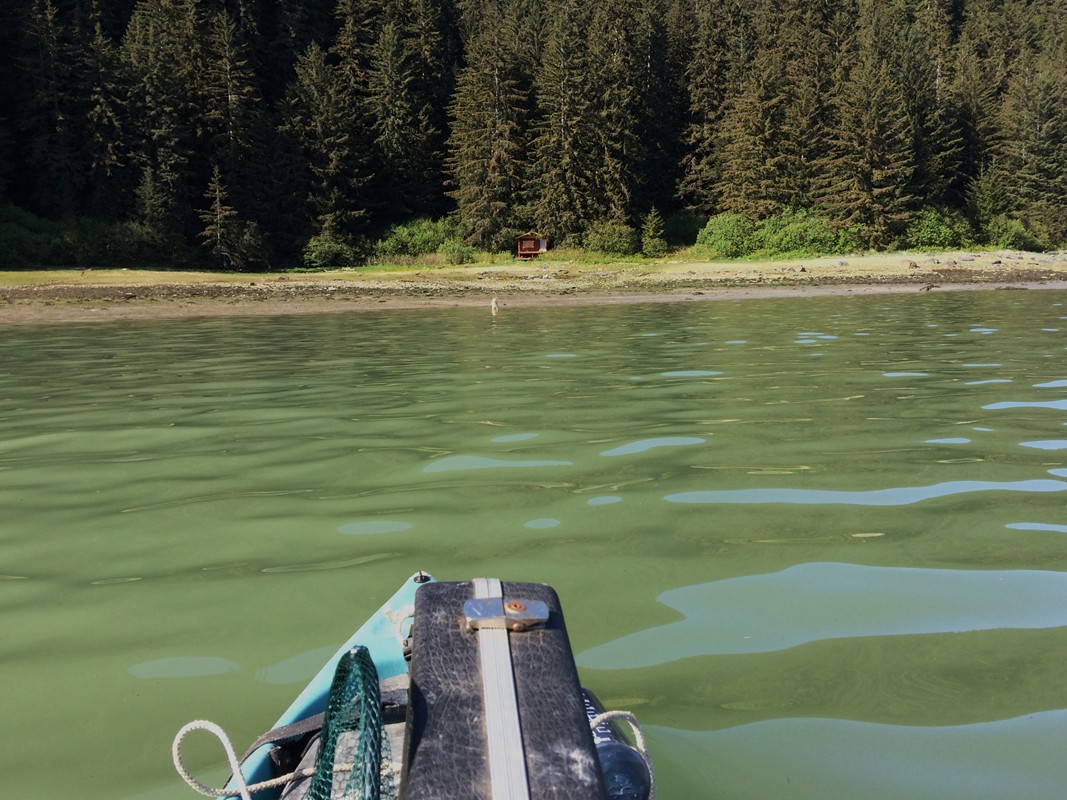 Kayaking in from the Ronquil |
 Sleepy pup |
 New screen for the olive barrel |
At 4:00 a.m. I awoke to varied thrushes and hermit
thrushes
singing, then drifted back to sleep until much later in the morning.
Cailey
joined me a little later and we both slept in. Once I got up and made
my way to
the lodge, I fed Cailey and went straight up the olive barrel with my
new
screens, rubber gloves, and hoe. As I trimmed up the screens and
secured them
between the two sections of the olive barrel’s lid (the tougher
hardware cloth
on the outside and the screen on the inside), I was really impressed by
the
simple but ingenious way I’d crafted it so many years before. It’s too
hard to
explain here, but take my word for it—it was a brilliant solution to
screening
out debris in my handy olive barrel water catchment.

 After the olive barrel was fixed up, I returned to
the creek
to further dig out its hollow. I used some larger rocks to diver more
of the
flow away and hoed and hoed until I thought I had a nice even
depression. Once
the olive barrel was in the creek, large rocks behind it secured it and
increased the level of the water and I laid a small log over the top of
it to
further help it stay in place. The last step was to redivert the rest
of the water
to that area. On the way down I fully opened the top valve, nervous to
feel
that no water was flowing through the hose, and relieved when opening
the valve
at the bottom resulted in a strong flow. I rinsed out all the housings,
inserted filters, and patted myself on the back for a job well done.
After the olive barrel was fixed up, I returned to
the creek
to further dig out its hollow. I used some larger rocks to diver more
of the
flow away and hoed and hoed until I thought I had a nice even
depression. Once
the olive barrel was in the creek, large rocks behind it secured it and
increased the level of the water and I laid a small log over the top of
it to
further help it stay in place. The last step was to redivert the rest
of the water
to that area. On the way down I fully opened the top valve, nervous to
feel
that no water was flowing through the hose, and relieved when opening
the valve
at the bottom resulted in a strong flow. I rinsed out all the housings,
inserted filters, and patted myself on the back for a job well done.
Well, almost well done. When I went inside to turn
on the
water faucet for the final test, I was alarmed to see water spurting
from the
bottom of the cold water handle, which isn’t even hooked up to water. I
turned
off the valve and pulled it off with some effort, seeing inside tiny
bits of
white pieces that had evidently broken off some part of the faucet. Not
knowing
what I was doing, but feeling that it couldn’t hurt, I used my
leatherman to
fish out all the white pieces and the pushed the lever back down. It
seemed to
fit and, lo and behold, was apparently water tight. So I did have
running
potable water after all!
Later I put together the gray water system and
spent the
rest of the morning tidying the property, sweeping all the porches and
boardwalks and raking the paths, which is no small feat. At 12:15 my
phone
alarm went off, reminding me to check the location of the sun over the
mountain
at noon. I’ve been exploring satellite internet options and was told
that the
satellite would be in the direction of the sun at 12:30 p.m. I went
back to the
porch with an angle square and measured the angle to the top of the
mountain
where the sun was, which was quite close to the due south line I’d
looked up in
Juneau. There was ample clearance above the mountain, a clear shot from
the
front porch.
I went back down the path, cutting the little bush
stumps
that threatened my tender feet on the new path to the bridge behind
Mink, and
picking up a beer in the freshet to have with my bread and cheese for
lunch.
After I ate I took a cup of Russian tea and a lawn chair down the stone
path
toward the water so I could better observe the movement of the
hummingbirds
after they left the area. I was lucky enough to see two hummingbirds
gathering
nesting materials, both of whom obviously flew away with some of it in
their
mouths. The first one zoomed upriver around the trees (and probably
around the
point) and out of sight; the other one disappeared into the
salmonberries just
a few feet away.
After that I decided to stroll down the beach to
where we’d
stashed the kayak at our previous low tide departure and kayak it back.
Barefoot as I had been all day, I meandered down the rocky beach until
I
realized under the eagle’s nest that I’d brought no paddle. Rather than
returning for one, I decided instead to take that opportunity to
explore. The
eagle’s nest and its adjacent trees are at the top of a cliff which
seemed
impassable for a dog, which is why I hadn’t scaled it earlier. The
downriver
side of its point, however, seemed manageable for both of us—steep but
with
mossy ledges and convenient handholds. Cailey was up in no time. At the
top,
the eagle tree was easy to find, the ground beneath littered with
sticks. I
found the remains of one or two eaglets—if they were different birds,
they were
in close proximity, but it seemed to me there were a lot of bones and
that the two
piles were in different stages of decay. But I didn’t find duplicates
of unique
bones, either. There were very large ones, so the bird or birds in
question
were well grown. The lower pile had a clump of flight feathers, half in
wick,
and in there I found a beak. Looking
up, the eagle nest was less impressive, and seemed to be drooping
significantly
on one end; I couldn’t tell if it was falling apart or if that was
simply the
bottom of the nest where they’d started to build it before it was
stable.
the ground beneath littered with
sticks. I
found the remains of one or two eaglets—if they were different birds,
they were
in close proximity, but it seemed to me there were a lot of bones and
that the two
piles were in different stages of decay. But I didn’t find duplicates
of unique
bones, either. There were very large ones, so the bird or birds in
question
were well grown. The lower pile had a clump of flight feathers, half in
wick,
and in there I found a beak. Looking
up, the eagle nest was less impressive, and seemed to be drooping
significantly
on one end; I couldn’t tell if it was falling apart or if that was
simply the
bottom of the nest where they’d started to build it before it was
stable.
From the eagle tree I slowly started down the game
trail
that ran along the edge of the cliff, heading back upriver. Within a
few steps
I heard loud, frantic cawing and saw a crow flush off a nest, just
above eye
level and no more than 15 or 20 feet away! She cawed and cawed, and her
mate
showed up and they both hopped around the trees protesting. Behind this
row of
trees overlooking the river was a large meadow of blueberry and
salmonberry
bushes with a few large stumps among them. I slowly worked my way up a
fallen
log until I could see down into the nest, but it was too cup shaped and
I saw
nothing inside. Nevertheless, I am nearly positive the crow I startled
was
sitting on eggs! Much as I wanted to stay, I assured the parents that I
meant
no harm and pushed my way through the rest of the brushy opening and
into the
edge of the open forest above.
The first thing I noticed was white egg shell on
the moss.
The pieces I picked up were quite large—surely they must be an eagle’s
egg! The
only explanation I could come up with was that I was below an eagle
nest, as
unlikely as that seemed since I was not far from THE eagle nest. I
looked up
from several angles and it did, in fact, look like there was a nest up
above
me. How curious! Of course I know that eagles often build multiple
nests in
their territory, but that egg….
 From there I wandered upriver onto a knoll
overlooking the
meadow and admired two Wilson’s warblers feeding in an alder, thinking
about
how I’d return to the area from the direction of the lodge above the
cliffs another
time if I could. I wandered back toward the eagle tree (now farther up
the
mountain), and took another look, increasingly convinced it was a nest.
I
wondered if there was some way I could tell if it was active!? I
studied it
again with binoculars and this time I saw a pure white hill behind the
edge of
the branches—a head! Sure enough, she moved just enough that I could
see a hint
of an eye and a beak. The mother eagle was on eggs, on this nest!
They’d
apparently moved, perhaps 100-150 feet from the original, possibly
because the
other nest was collapsing (it did indeed look like it was falling apart
when I
looked at it later from the beach). The chosen tree was shorter and at
an angle
from its neighbors and I tried to memorize its surroundings to see if I
could
find it from the beach later.
From there I wandered upriver onto a knoll
overlooking the
meadow and admired two Wilson’s warblers feeding in an alder, thinking
about
how I’d return to the area from the direction of the lodge above the
cliffs another
time if I could. I wandered back toward the eagle tree (now farther up
the
mountain), and took another look, increasingly convinced it was a nest.
I
wondered if there was some way I could tell if it was active!? I
studied it
again with binoculars and this time I saw a pure white hill behind the
edge of
the branches—a head! Sure enough, she moved just enough that I could
see a hint
of an eye and a beak. The mother eagle was on eggs, on this nest!
They’d
apparently moved, perhaps 100-150 feet from the original, possibly
because the
other nest was collapsing (it did indeed look like it was falling apart
when I
looked at it later from the beach). The chosen tree was shorter and at
an angle
from its neighbors and I tried to memorize its surroundings to see if I
could
find it from the beach later.
Heading back down, I found one more treasure—a
small clump
of gray fur or feathers below the nest. It had the look of a pellet
that had
fallen apart. On the way down I stopped to look for the
crow
nest again and while I did that I heard horrible agonizing crow sounds
from the
forest above me. I was worried for a moment that Cailey was killing a
crow
until I saw her standing calmly beside me. I think it must have been a
baby
crow begging and/or being fed, and I heard other gurgling feeding
sounds later,
which means that some eggs had already hatched. I always thought the
crows
there nested in a colony, so I had been surprised I hadn’t come across
more
crows nesting in the area already.
I carefully made my way back down the cliff and to
the
lodge. By that time the tide was low, so I watching the hummingbirds
for a few
minutes and then started my first COASST survey for the summer. This
time I
headed downriver first, as it’s the least pleasurable part of the walk,
then
turned and headed up the beach. The cool mud felt delicious on my bare
feet,
rather traumatized from walking on dry spruce twigs all morning while I
raked.
I saw a pale robin, possibly my partially leucistic friend from last
spring,
and smelled a powerful dead fish smell around the grassy point which I
failed
to find the source of. There were no obvious tracks or anything else of
particular interest.
That evening I ate more boxed soup for dinner and
continued
to read. I did try one more task, but quickly failed. In an effort to
brush my
teeth and wash my face in my cabin that night, I hooked up the filters
to
Hermit Thrush and turned on the water. Unfortunately, the water pipe
leading
inside the cabin had broken and water sprayed inside and out, soaking
the floor
before I could turn it off. That discourage further efforts for the day
and I
turned in.
 The sun at noon |
 Eaglet bones |
 Nest detritus |
 I promise there is a crow nest in there |
 The new eagle nest |
 The meadow between the eagle nests |
The next morning I decided to try putting the rest
of the
water systems together to see what other repairs I should prepare for
before my
next trip. The results were not good. One of the filters (both the
filter
housing and the head) on Harbor Seal was cracked and not water tight,
so the
whole filter will need to be replaced. Both valves connecting the main
water
line to the cabin systems leaked, as did the valve to Cottonwood and
the hose
valve at Harbor Seal. All four should be replaced, though only the two
at the
cabins are really critical. So, in the end, only Mink has a functional
water
system.
I also carried pillows and blankets to all
the cabins to get
them set up for any guests that might show up this summer, then cleaned
and
packed up. Cailey and I headed out around 12:15. Snettisham was
pleasant and
the seas were mild and smooth in Stephen’s Passage. They got larger
once we
passed Grave Point—still smooth but too closely spaced for easy
passage, so we crashed
through them—and got downright nasty choppy at Point Arden. It was with
great
relief that we put those seas behind us as we entered Gastineau Channel
and ran
with a following wind home. My early arrival meant for a calm and
relaxing
Sunday evening before heading back to work the next day.

Looking
upriver at low tide