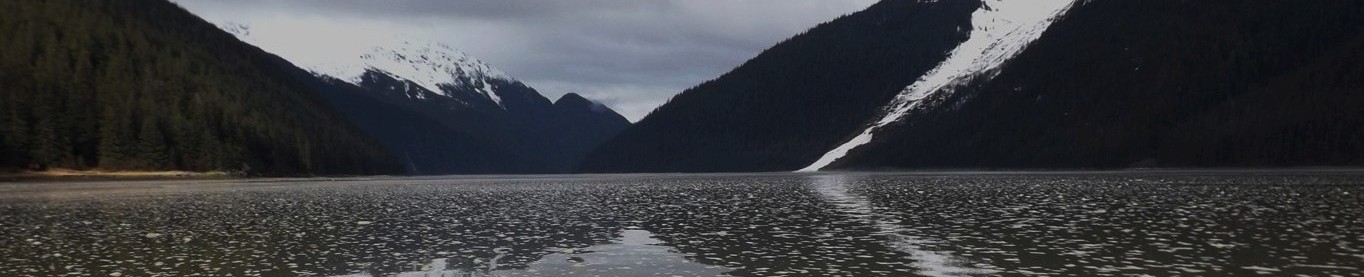
Looking upriver
Snettisham
2013 - 1: Ducks
May 5-7
Looking upriver
 The Ronquil was fit for
the water by
mid-April (having undergone bi-annual maintenance by my mechanic and a
few
repairs by me), but we never made it to the harbor that month. A
combination of
exhaustion, scheduling conflicts, and late season Taku winds combined
to keep
me town-bound to the detriment of my mental peace. Finally, I could
take it no
more; a southeasterly storm was raging when I came home from work
Friday
afternoon, but
the forecast called for diminishing winds on Sunday followed by
clearing skies,
so I arranged for a couple of days off work early the following week
to,
hopefully, open up. Sunday morning I went shopping, finished gathering
my gear,
and assessed my state of mind. I knew I'd feel better once I was down
there,
but dragging myself to the harbor was a task. Chris followed to see me
off, and
the launching was uneventful except for a sudden flurry of boat
activity that
created a frenzy in the harbor minutes after we arrived. The engine
started
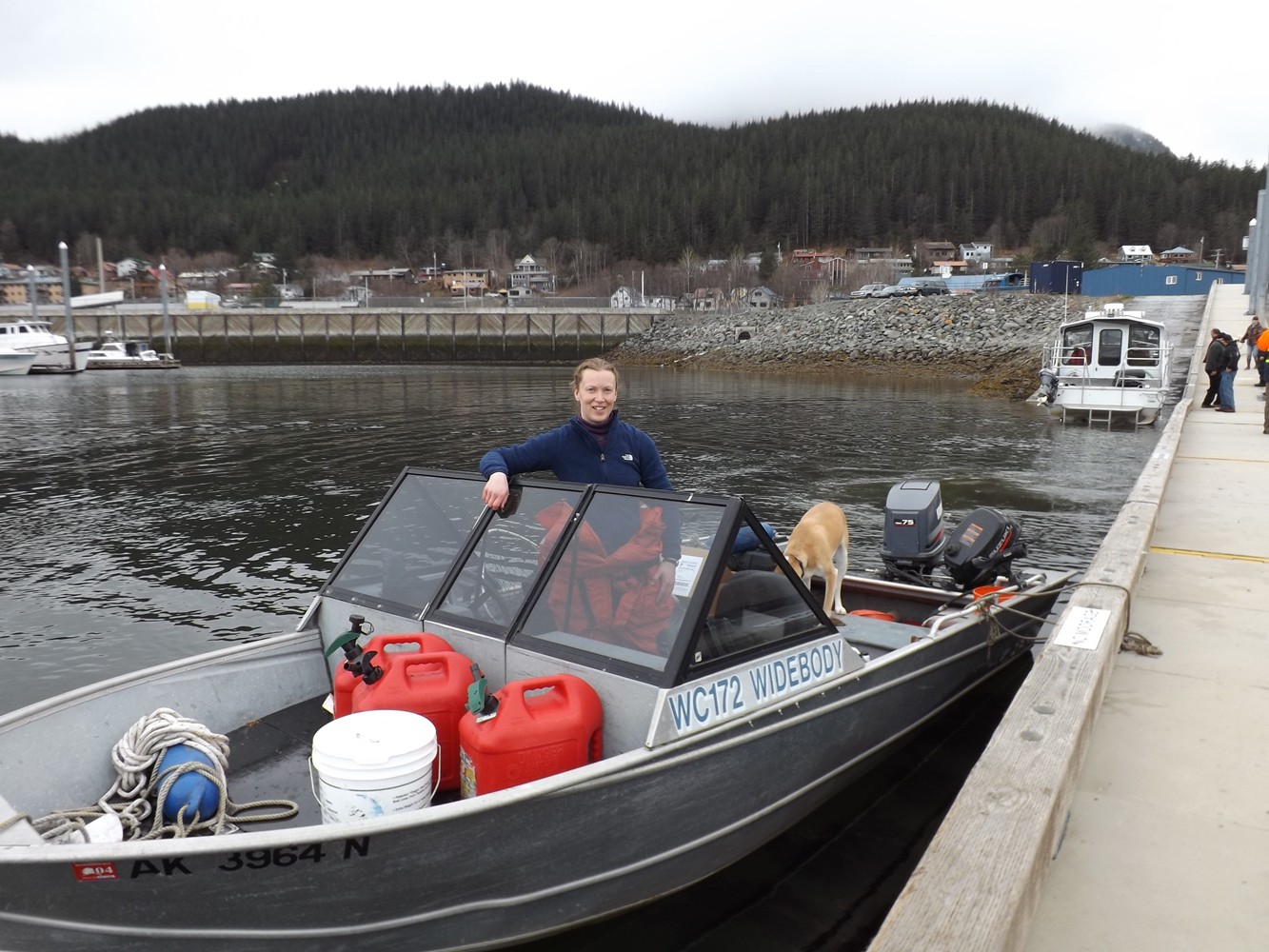
without incident, Chris took a photo of me and Cailey (who'd jumped in
the boat
at the first opportunity), and we puttered around the corner of
Mayflower
Island. I immediately felt better. We had a gentle chop down the
channel,
passed a couple of harbor porpoises, and then entered Taku Inlet for
the first
time this season. The dis-ease that had plagued me at the idea of being
on the
water again passed and I felt ridiculously peaceful. For some reason
the
uneasiness of fall, when I'm full of anxiousness at the threat of heavy
weather, had lingered into the spring and I hadn't been able to shake a
nebulous aversion to boating. All this was gone with the passing of my
first
leaving-the-harbor-beer, generously offered to the ocean and the
weather gods
as we headed down the channel. For her part, Cailey seemed delighted,
sniffing
avidly over the side of the boat. In Taku Inlet, the light seas were
already
coming down Stephen's Passage from the northwest.
The Ronquil was fit for
the water by
mid-April (having undergone bi-annual maintenance by my mechanic and a
few
repairs by me), but we never made it to the harbor that month. A
combination of
exhaustion, scheduling conflicts, and late season Taku winds combined
to keep
me town-bound to the detriment of my mental peace. Finally, I could
take it no
more; a southeasterly storm was raging when I came home from work
Friday
afternoon, but
the forecast called for diminishing winds on Sunday followed by
clearing skies,
so I arranged for a couple of days off work early the following week
to,
hopefully, open up. Sunday morning I went shopping, finished gathering
my gear,
and assessed my state of mind. I knew I'd feel better once I was down
there,
but dragging myself to the harbor was a task. Chris followed to see me
off, and
the launching was uneventful except for a sudden flurry of boat
activity that
created a frenzy in the harbor minutes after we arrived. The engine
started
without incident, Chris took a photo of me and Cailey (who'd jumped in
the boat
at the first opportunity), and we puttered around the corner of
Mayflower
Island. I immediately felt better. We had a gentle chop down the
channel,
passed a couple of harbor porpoises, and then entered Taku Inlet for
the first
time this season. The dis-ease that had plagued me at the idea of being
on the
water again passed and I felt ridiculously peaceful. For some reason
the
uneasiness of fall, when I'm full of anxiousness at the threat of heavy
weather, had lingered into the spring and I hadn't been able to shake a
nebulous aversion to boating. All this was gone with the passing of my
first
leaving-the-harbor-beer, generously offered to the ocean and the
weather gods
as we headed down the channel. For her part, Cailey seemed delighted,
sniffing
avidly over the side of the boat. In Taku Inlet, the light seas were
already
coming down Stephen's Passage from the northwest.
Just past Pt. Arden,
gazing down
Stephen's Passage to the south, I saw a black dot on the horizon which
I
assumed was a boat. But, just in case, I thought I'd better watch it
just in
case it disappeared and proved itself a whale. It disappeared! Well,
there was
no tail, but it was probably just a humpback's hump, I thought...but
maybe I'd
better watch carefully just in case it came up again like an orca. It
came up
again. And soon I could see the distinct shape of a large male orca
moving
across Taku Inlet toward Circle Point. An orca on my first trip!
Determined to
meet up with him, I gauged his location when he stopped surfacing and
headed
slowly in that direction. Several minutes later, an orca exploded from
the
water not far away off my starboard bow heading in my direction. I was
pretty sure I
hadn't reached where the orca had been, so I was surprised to see it to
my
right (and that it wasn't larger up close) but I shut down to let him
pass,
managing a pretty decent ID shot. As he went by I heard a whale blow to
the
left, but was too engaged with the orca in front of me to assess the
species.
For some time I thought there was only the single orca, but of course
it turned
out that the orca I'd photographed (AG18, I
think, born in 1985) was a different individual
from the
one I'd
originally seen, who was probably the one blowing in the distance.
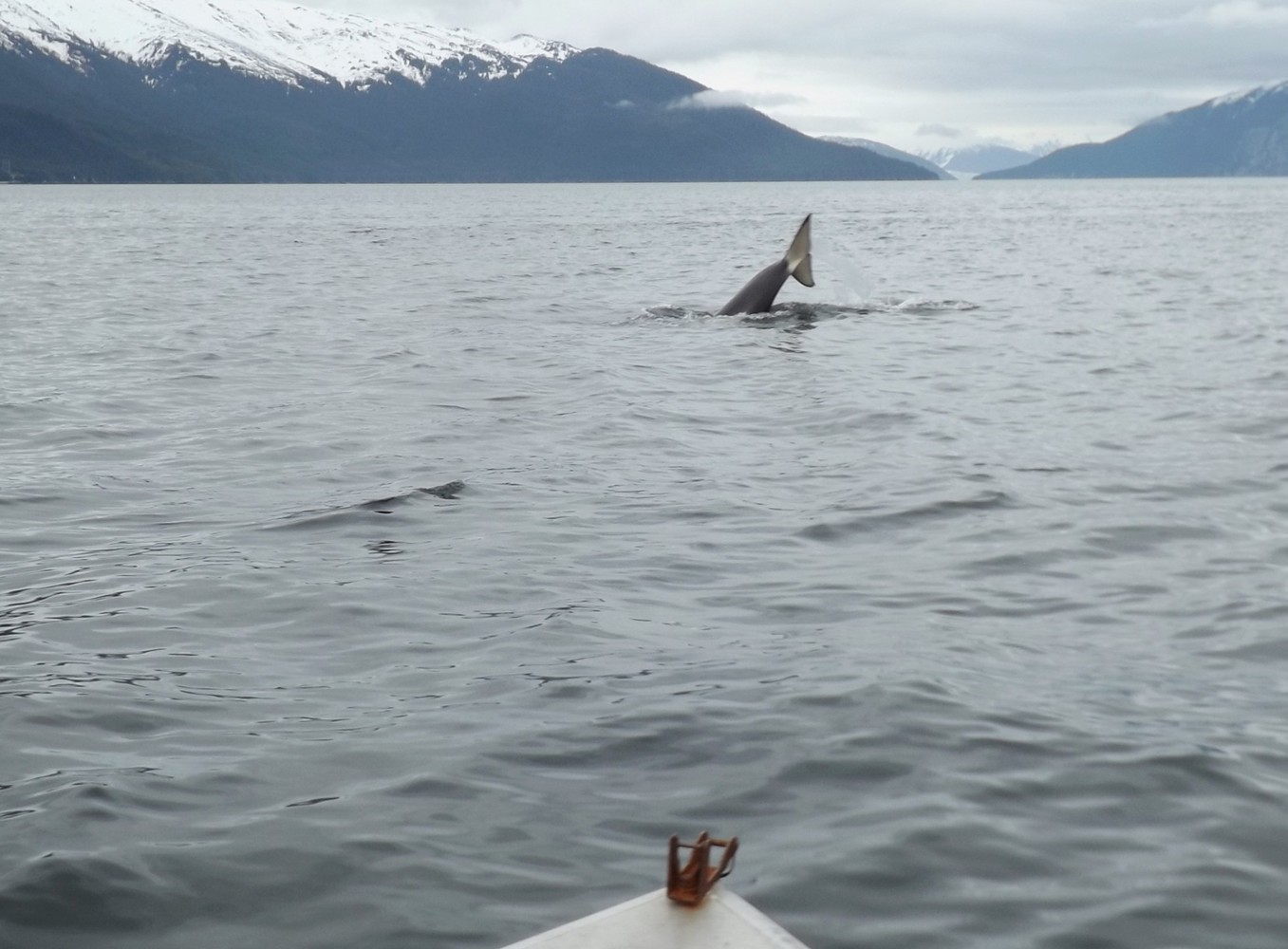 When I took off looking
for the first one again I saw
two more orcas, traveling separately, over toward the Taku; unable to
find the
large male, I went to look at them, first catching up to a juvenile.
He/she
turned around when I approached, so I shut down and drifted. The young
orca
crossed my bow and stuck his tail in the air before making several more
close
passes around the boat and disappearing. Next I saw an adult
female/juvenile
who, much to my surprise sported a very swirly (a.k.a. open) saddle
patch,
indicating that I was with a resident pod (it was possibly AG20, one of
the few AG members with a swirly open saddle patch). To that point I'd
only seen
four
individuals, all traveling separately some distance from one another,
so this
was unexpected! I photographed her and then turned back
toward
Admiralty where a large male (possibly the original) was heading for
the
channel at speed. I managed to travel alongside him for a few minutes,
awed at
the size of the dorsal fin slicing through the water and the beauty of
the
massive animal. I later tentatively identified him as AG2 (Carolus),
who was
born in 1963. That's right, he's 50 year old! I traveled alongside a 50
year
old orca. Amazing.
When I took off looking
for the first one again I saw
two more orcas, traveling separately, over toward the Taku; unable to
find the
large male, I went to look at them, first catching up to a juvenile.
He/she
turned around when I approached, so I shut down and drifted. The young
orca
crossed my bow and stuck his tail in the air before making several more
close
passes around the boat and disappearing. Next I saw an adult
female/juvenile
who, much to my surprise sported a very swirly (a.k.a. open) saddle
patch,
indicating that I was with a resident pod (it was possibly AG20, one of
the few AG members with a swirly open saddle patch). To that point I'd
only seen
four
individuals, all traveling separately some distance from one another,
so this
was unexpected! I photographed her and then turned back
toward
Admiralty where a large male (possibly the original) was heading for
the
channel at speed. I managed to travel alongside him for a few minutes,
awed at
the size of the dorsal fin slicing through the water and the beauty of
the
massive animal. I later tentatively identified him as AG2 (Carolus),
who was
born in 1963. That's right, he's 50 year old! I traveled alongside a 50
year
old orca. Amazing.
I tried to get an ID shot
of one other
individual (and failed) and saw two more spread out between me and the
Admiralty shore, but by that time I needed to turn back around and head
south
again. It was a perfect day for orcas--I'd left early in the afternoon
and had
no agenda, and the seas were easy so I could take as much time as I
wanted. All
in all, it was an unusual encounter--AG pod has a few dozen members and
even
when a resident pod is scattered, they usually still move in small
groups. All
animals I saw were alone, including the juvenile.
 So, delighted by my great
luck, we
turned and headed south (well, I was delighted--I think Cailey was
ready to get
to the homestead). The rest of the trip was uneventful--large flocks of
scoters
were the only wildlife of note. Gilbert Bay and the inlet were covered
in
clumps of pale beige foam. I wound up at the homestead at precisely low
tide
and the expanse of mud between the Ronquil and the lodge discouraged me
from
hauling all my gear. I was grateful to make it into shallow enough
water for my
xtratufs, so I contented myself with anchoring up and carrying only my
backpack
up to the lodge, figuring I'd offload everything when the tide came in.
On the
way I noticed that the eagle nest was occupied, surely one of the
adults on
eggs. The lodge appeared in fantastic shape; strong winds had evidently
swept
the deck clear of all but the biggest debris, so there was little
evidence it
had been vacated for over seven months except for the log that lay
across some
of the upper stones of the path to the beach (and behind which a shelf
of sand
had settled). The beautiful shutters my mother had installed over the
picture
window the fall before were perfectly intact; I enjoyed folding them up
and
peering inside at the immaculate interior.
So, delighted by my great
luck, we
turned and headed south (well, I was delighted--I think Cailey was
ready to get
to the homestead). The rest of the trip was uneventful--large flocks of
scoters
were the only wildlife of note. Gilbert Bay and the inlet were covered
in
clumps of pale beige foam. I wound up at the homestead at precisely low
tide
and the expanse of mud between the Ronquil and the lodge discouraged me
from
hauling all my gear. I was grateful to make it into shallow enough
water for my
xtratufs, so I contented myself with anchoring up and carrying only my
backpack
up to the lodge, figuring I'd offload everything when the tide came in.
On the
way I noticed that the eagle nest was occupied, surely one of the
adults on
eggs. The lodge appeared in fantastic shape; strong winds had evidently
swept
the deck clear of all but the biggest debris, so there was little
evidence it
had been vacated for over seven months except for the log that lay
across some
of the upper stones of the path to the beach (and behind which a shelf
of sand
had settled). The beautiful shutters my mother had installed over the
picture
window the fall before were perfectly intact; I enjoyed folding them up
and
peering inside at the immaculate interior.
But there was immediate
work to do. I
was chilled from the long boat ride, so got to work installing the
smoke stack.
I always feel like I do a haphazard job of this in the spring, but
whatever I
do seems to last all summer. It was a little tricky to do on my own, as
I had
to carry the L-shaped section of stove pipe (each section of which is
about
four feet long) up a ladder, insert it in to the hole in the wall to
meet the
section of stove pipe inside, then hold it in place (preferably plumb),
while
wrapping a metal strap around it and nailing it to the roof. It took a
few
tries, but I eventually secured it. Inside I connected the two sections
together which tweaked things enough that I had to move the sections of
stove
pipe outside again. Eventually I had it all ready and started a fire to
take
the chill off the lodge. There was no sign of rodent activity or mildew
smell,
both of which were a relief. I also had my first looks at exciting
spring
migrants on the water--a small flock of northern shovelers hung out at
the edge
of the mud along with green-winged teal and Bonaparte's gulls.
After warming up for a few
minutes, I
turned on the propane and lit the pilots on the stove, then noticed
that
Cailey
was pestering me. I realized that it was well past her dinner time (I
myself
was getting a little peckish), but I'd left the food tote in the boat
and there
wasn't much overwintered food that appealed to us. The tide was only
inching in
and the anchor was still exposed on the beach, so I strolled down,
pulled the
boat in a few more feet, and retrieved the tote. It was a good plan,
but an
exhausting trek across the mud! Nevertheless, I did this with more
patience
than usual. Lugging the tote up the beach was a slow process and I left
it at
the
bottom of the stone path to return and fetch both garbage bags of
linens, which
were only a little easier to carry (but which I needed to make the bed
that
night). With the bags I grabbed three water filter cartridges and the
filter
bags--enough to put together the drinking water system and gray water
system on
the lodge if I wanted. That left only the a few boxes on the boat to
pick up
later, all of which would fit in a kayak so I wouldn't have to bring
the whole
boat in at high tide. I fed Cailey, banked the fire, and went for a
leisurely
tour of the property, discovering first that a swamp had developed in
front of
the shed (otherwise perfectly intact), soaking the siding a foot above
the
ground and piling muck several inches deep against it. It would clearly
need
some work, but that was for another time. I continued on, opening up
each
cabin, peering inside, and making the bed in Hermit Thrush. All were in
good
shape, though I was alarmed to discover that a window on Harbor Seal
had been
left open all winter! Thankfully, the only damage appeared to be a few
extra
pine needles on the bed and some mildew on the leather arm chair. I
moved more
slowly than usual and back at the lodge I felt more relaxed than I had
in weeks,
indeed foolish that I'd ever had apprehension about the first adventure
of the
year. I made two cups of hummingbird food (having limited water) and
ate dinner
around 7:00. Disappointingly, the new 6 cup feeder I'd purchased
leaked, so I would up using the 1 cup feeder that had overwintered
there instead. At 7:30 I took Cailey for a kayak out to the boat,
retrieving the three boxes of filters and discovering that a flock of
common
mergansers and scoters had joined the myriad ducks. After dinner I read
around
the fire until the light dimmed, then headed to Hermit Thrush with
Cailey,
unfortunately causing a great blue heron feeding at the water's edge to
fly
away upriver (he returned the next evening). Having spent most of the
afternoon
outside I was still chilled and, remembering cold nights in previous
Mays, I
decided to allow myself a rare indulgence: I planned to light up my
Little Buddy
propane heater for some extra warmth.
I was to be disappointed.
Previously so
faithful, the ignition system failed. I brushed my teeth with the jug
of water
that had overwintered at the lodge and climbed into bed in wool socks
and a
turtleneck. I started reading by the light of two candles and an oil
lamp on
the table next to the bed, but wound up clutching a small candle on my
chest,
alternately hovering my hands over it to warm them. By the time I was
ready for
sleep, I was thoroughly cold and spent much of the night getting warm.
Cailey
took some dissuading before she stopped her efforts to sleep on the bed
and
finally curled up on her dog bed nearby.
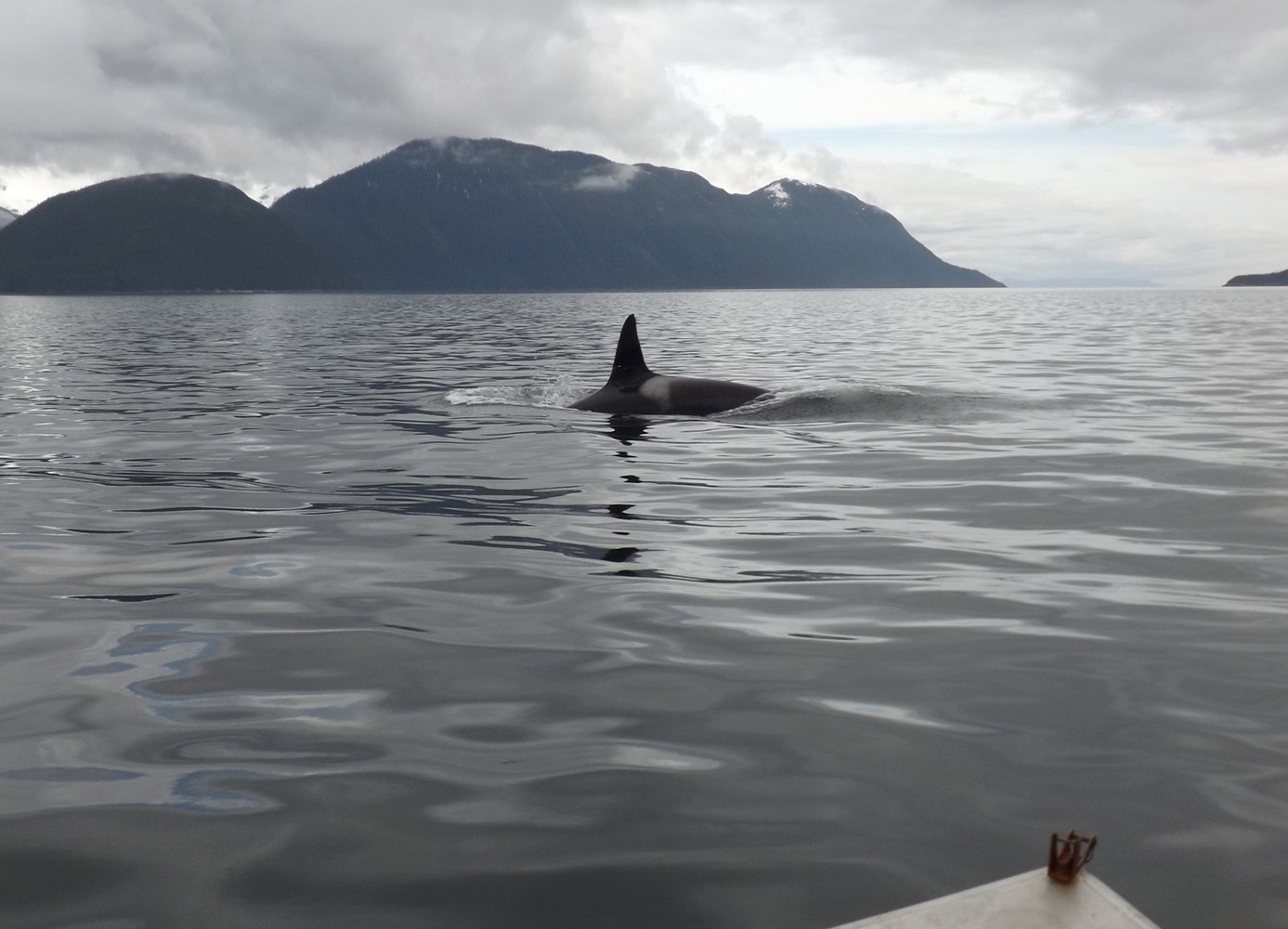 AG18? |
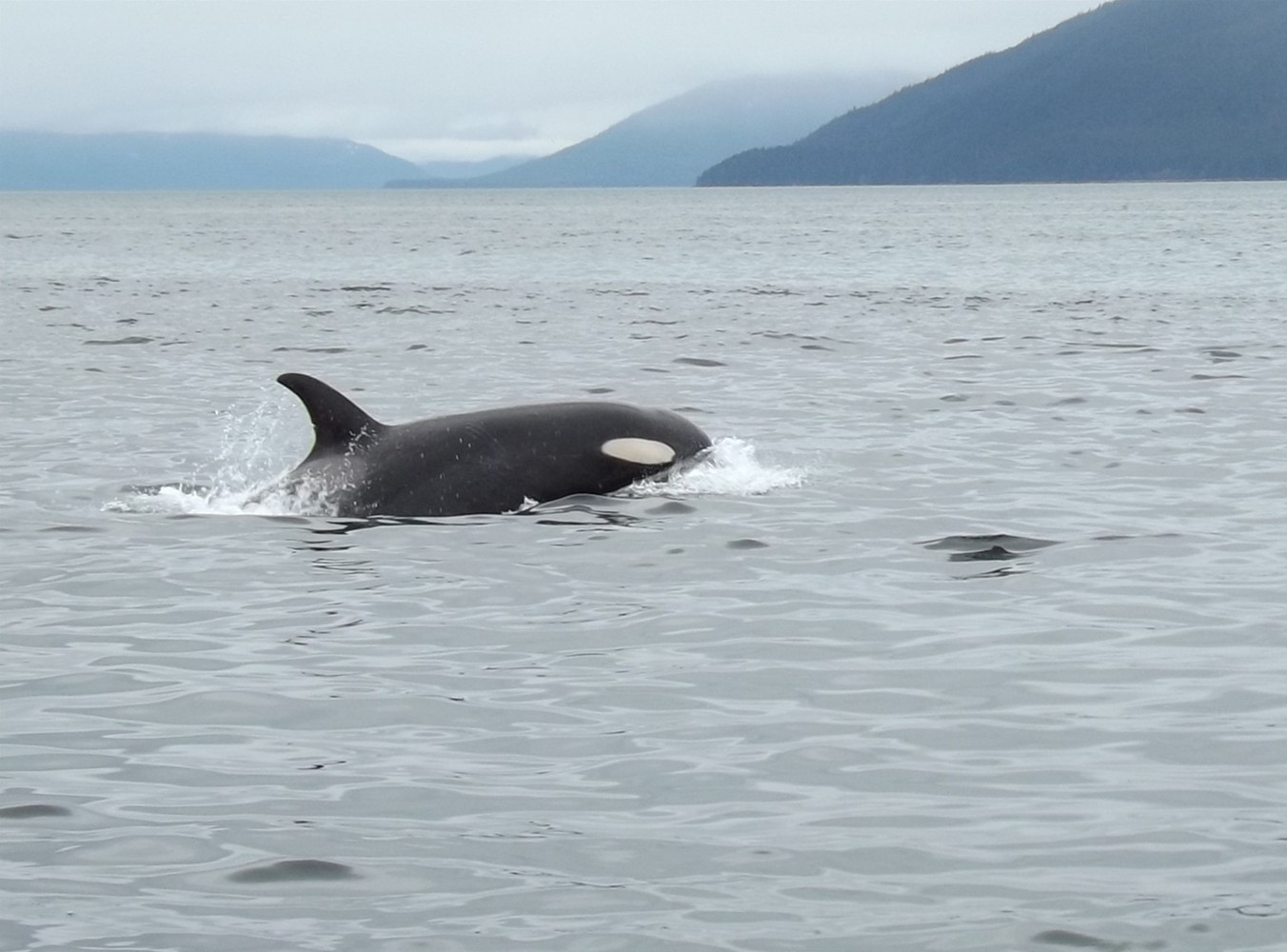 Young orca |
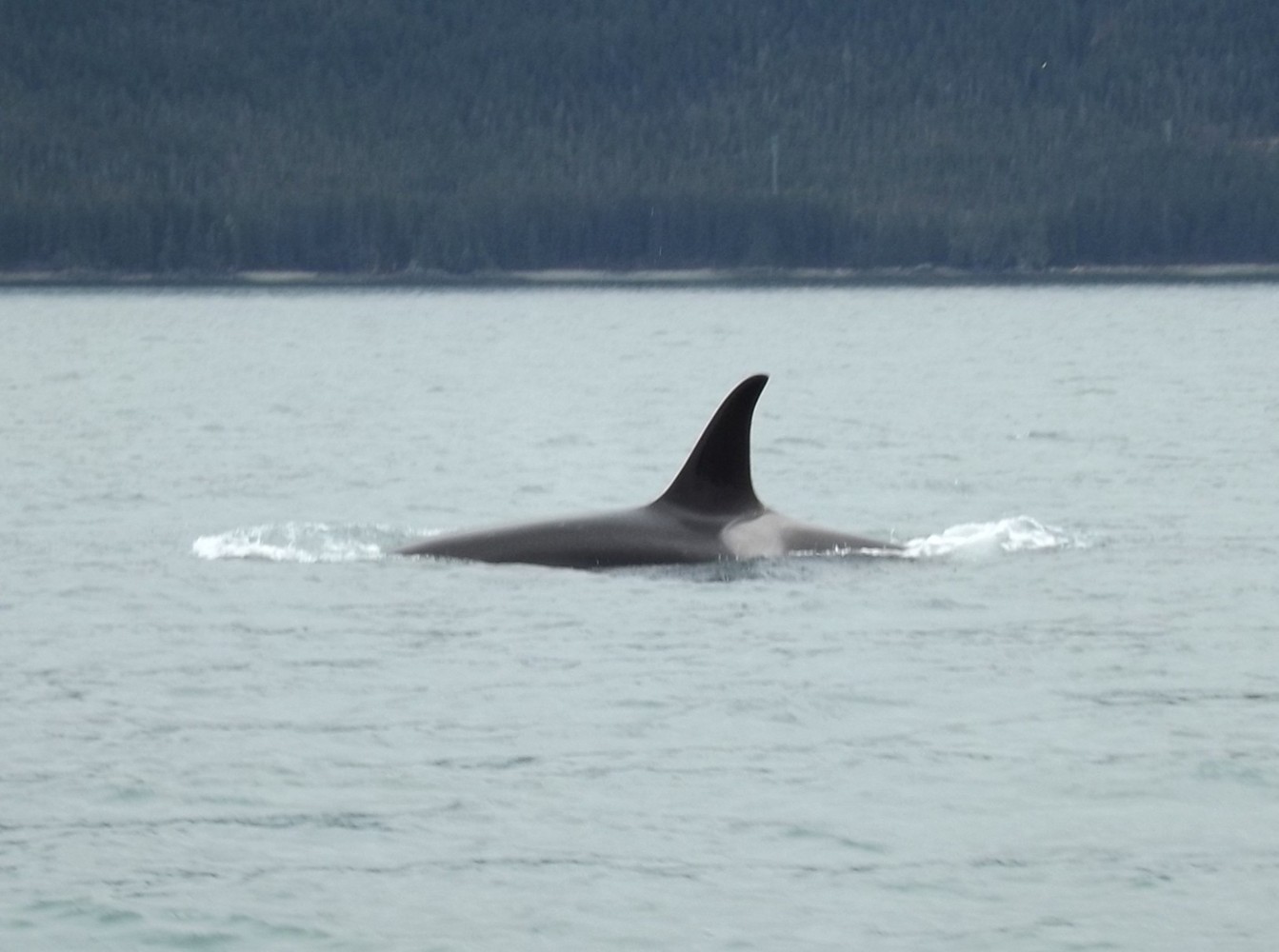 AG20? |
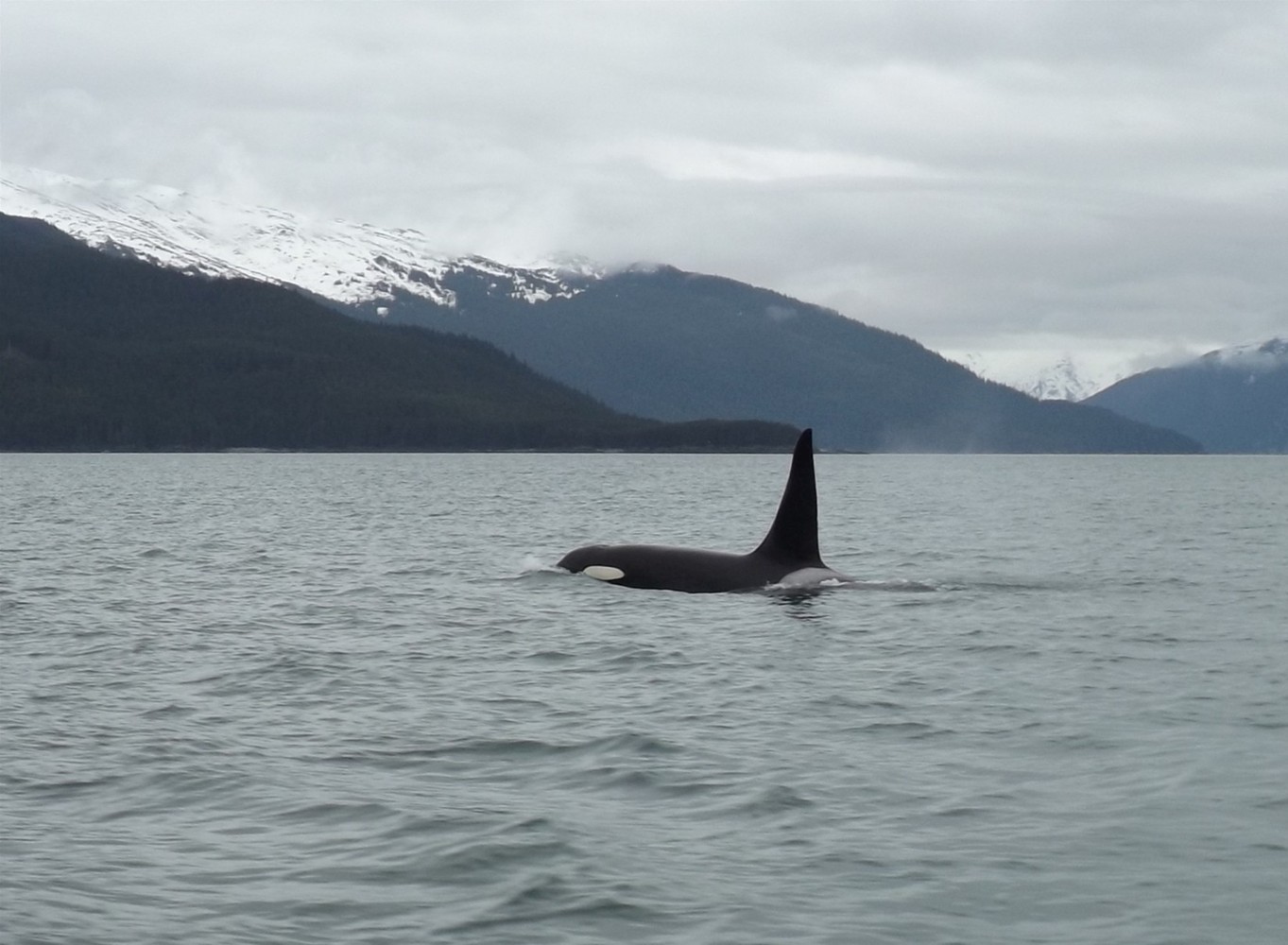 AG2? |
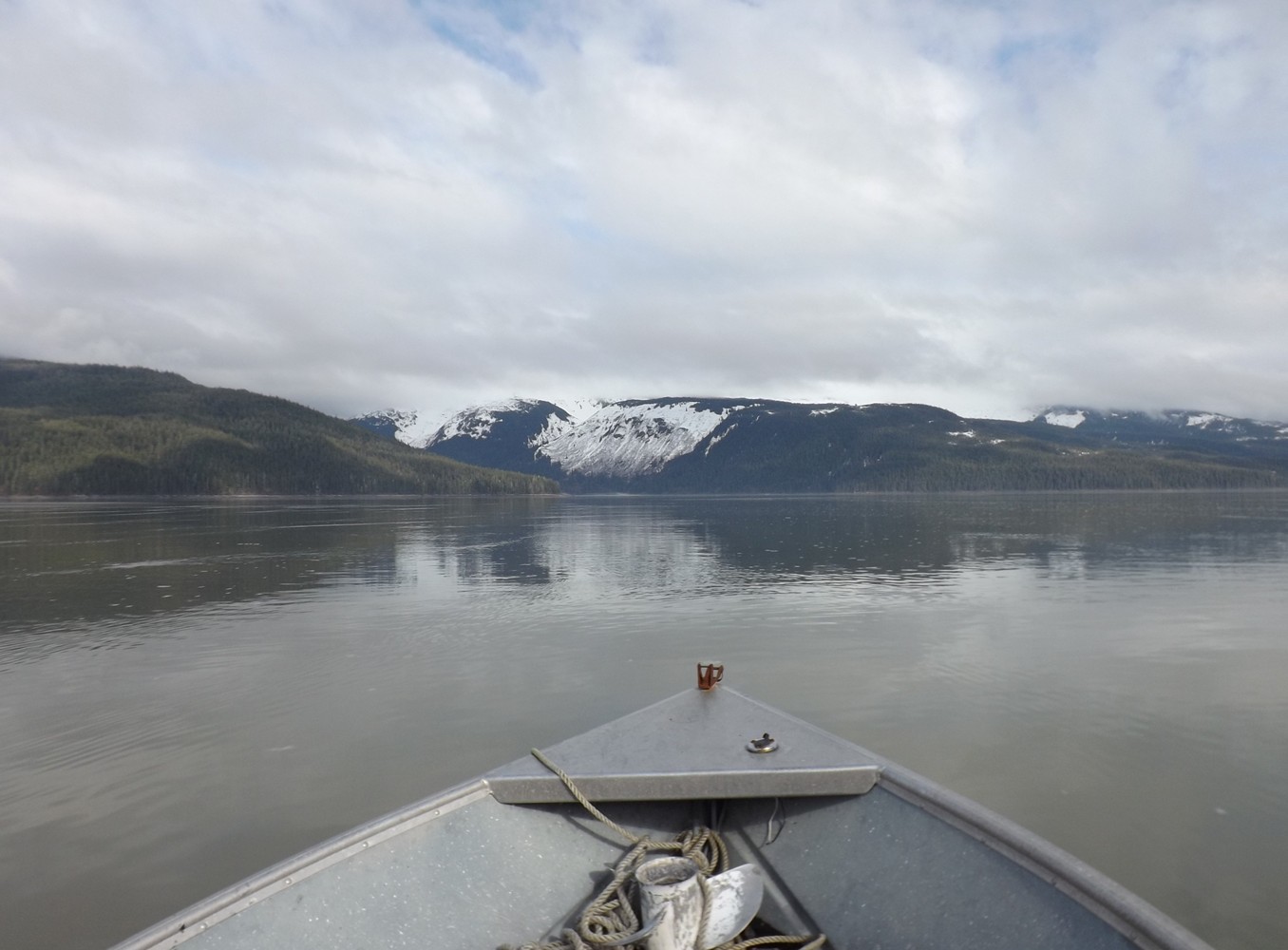 Heading toward the Whiting River |
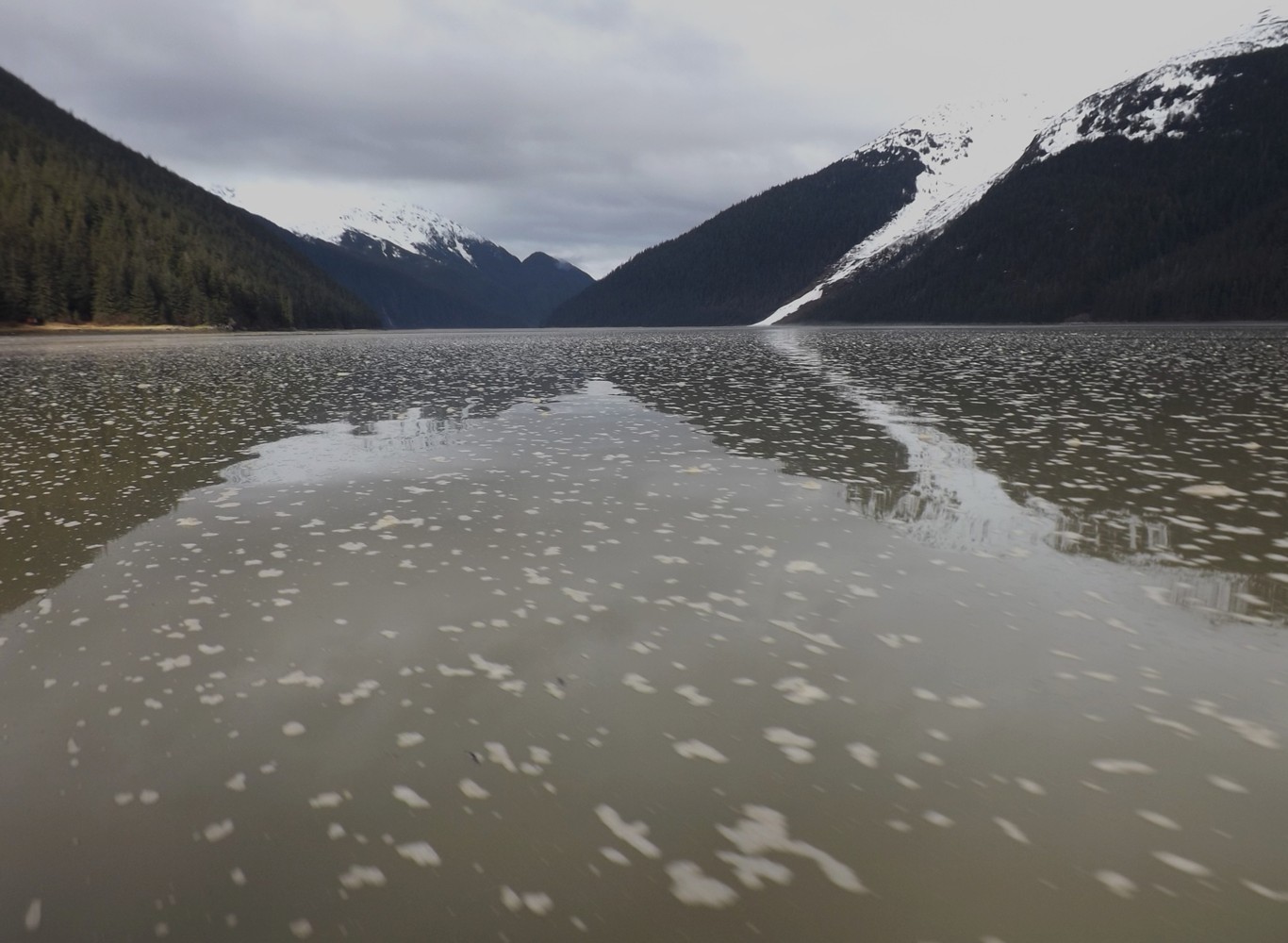 Strange foam on the river |
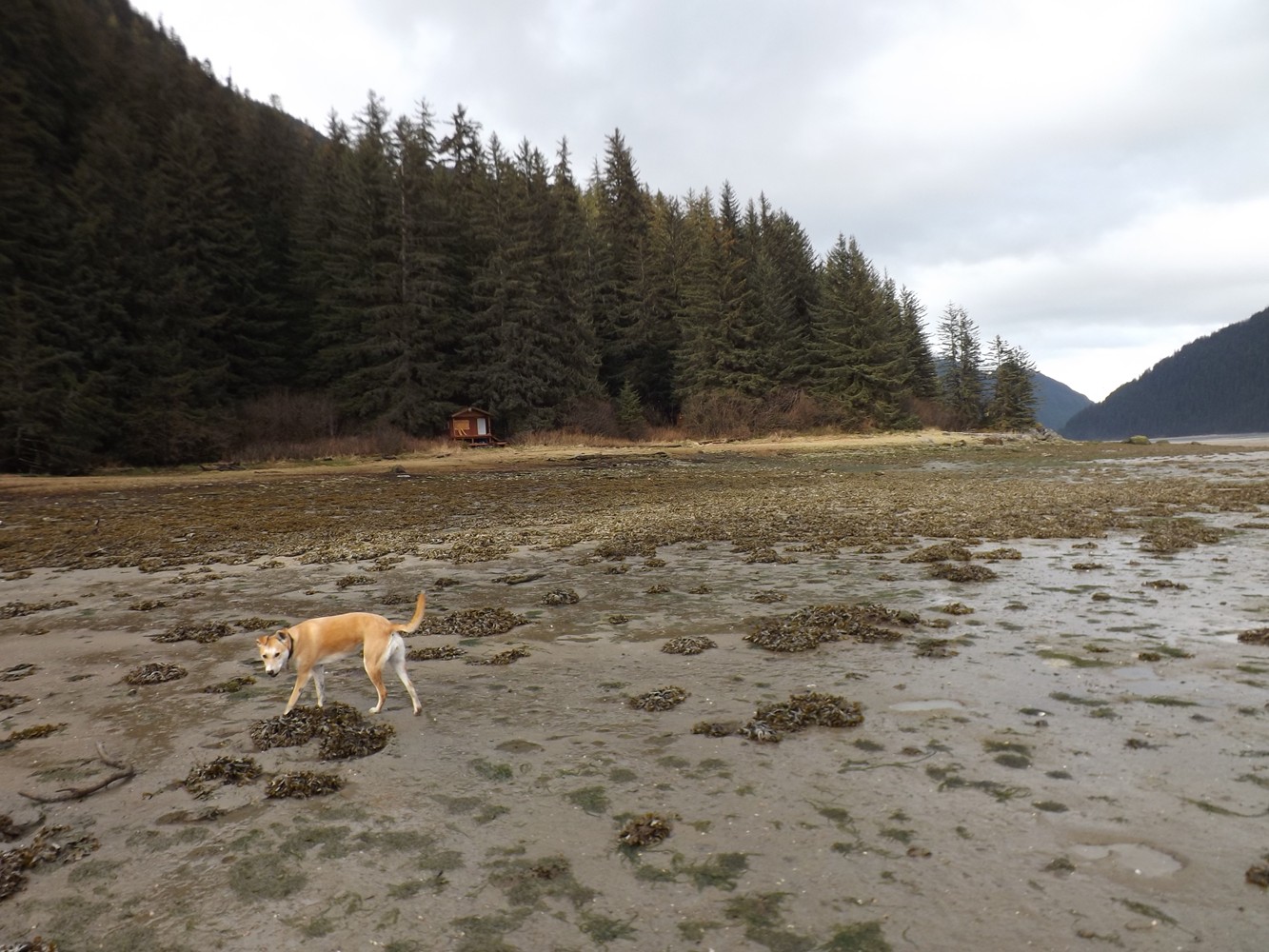 Looking up the beach on the way to the lodge |
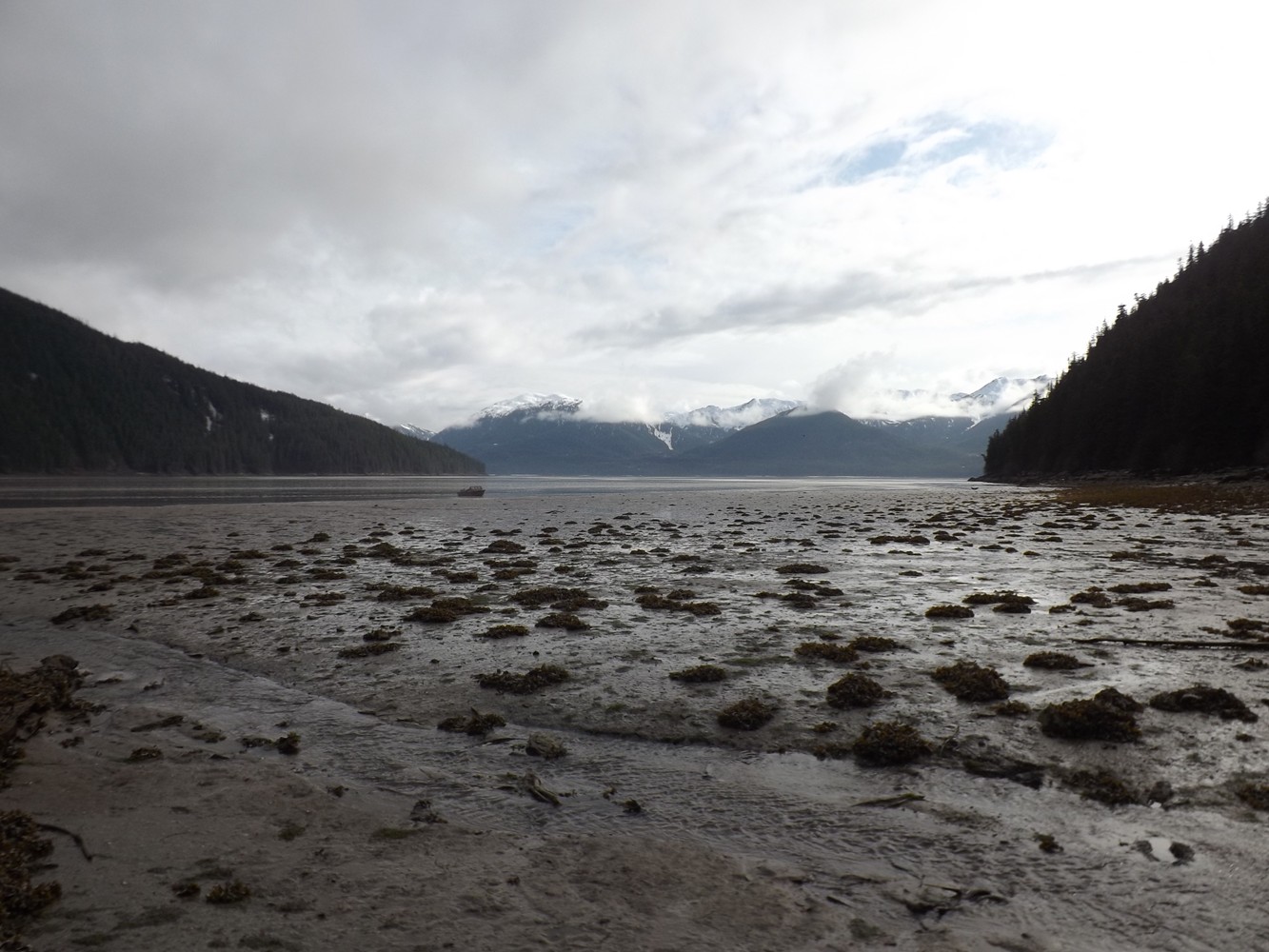 Looking back at the Ronquil as I walk to the lodge |
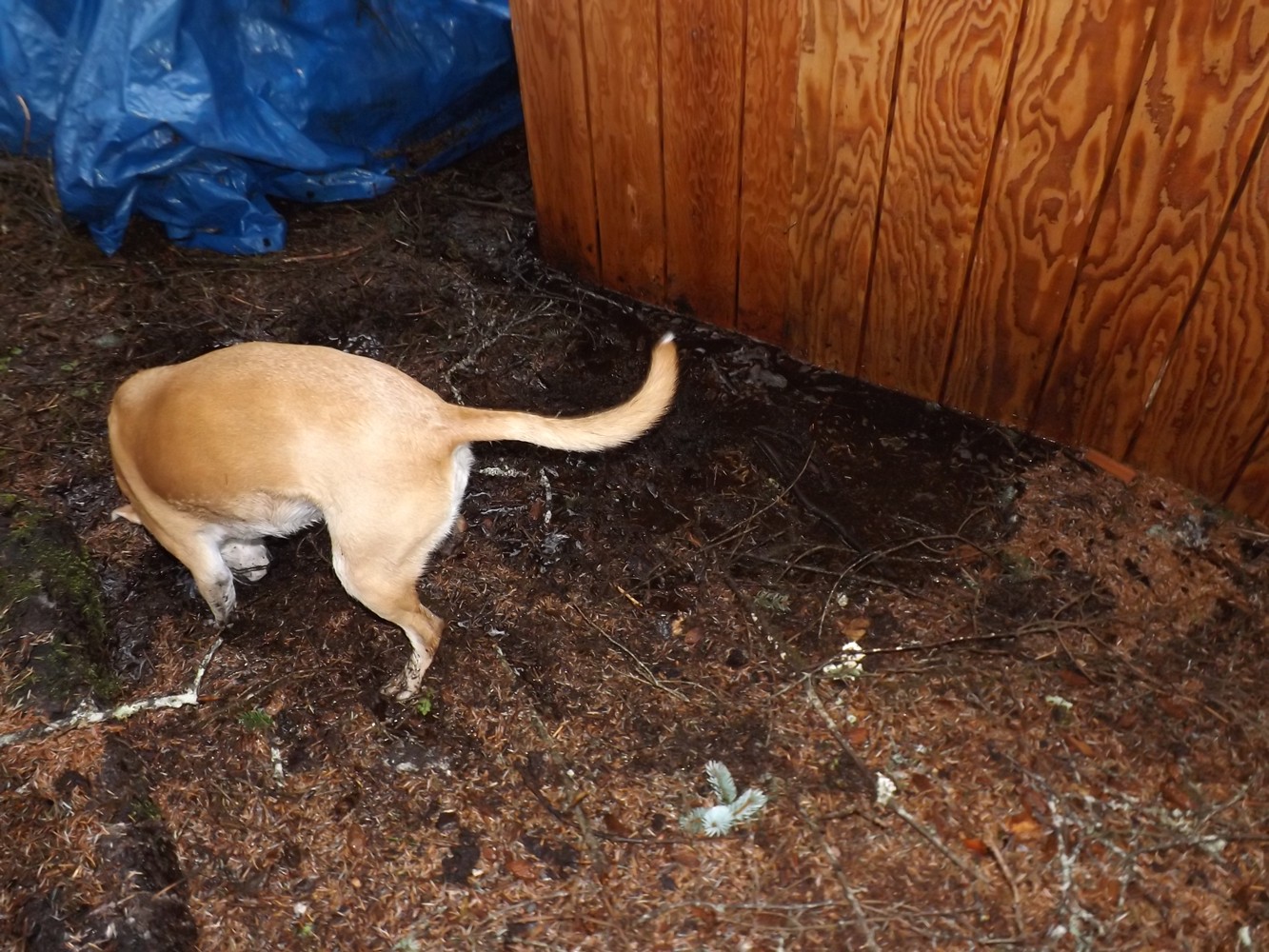 The pool built up agains the shed |
Birds haunted my sleep.
Sometime around
4:30 I was awakened--just to the point of consciousness--by a hermit
thrush's
song. Hands down the most beautiful song in the forest (in my humble
opinion),
the singer is the namesake of my the cabin I was sleeping in.
They're one of the last migrants to start singing in the spring, and
this was the
first I'd heard this year. I lay in bed listening in the half dark
until I
drifted back to sleep. Later that morning I dreamt that I was watching
white-crowned sparrows on the ground (they looked like white-crowned
sparrow-junco hybrids) while listening to golden crowned sparrow songs
(seeing both sparrows together is a
common spring occurrence, but the
latter do
most of the singing). When I woke up later, it felt vaguely like I'd
been hearing golden-crowned sparrow songs in reality, a theory
immediately
supported by singing outside--another first of the season. Of course I
hadn't been
getting around
town very much lately, but I'd been avidly listening around the house
where I
was spending significant time outside every day.
Overall, Cailey and I both
slept in impressively.
She woke up at 7:00 and jumped on the bed where her shivering kept me
awake
until I put all the covers over the top half of her and she stopped.
She stayed
under there for about 20 minutes or more before she finally stuck her
head out again.
I didn't get out of bed until after 9:30 and I actually slept most of
that
time.
 On the way to the lodge, I
heard
Townsend's warblers for the first time this year. I'm not sure I've
ever
documented first spring songs at Snettisham before, and here I had
three in one
day! The birding only got better. Right off the porch I saw a real
white-crowned sparrow, further confirmation that golden-crowned
sparrows were
about. But more of the action at that point was on or near the water.
I'm
always surprised that the mouth of the Whiting and my beach draw in as
many
migrants as they do. As I was watching the flock of northern shovelers
along
the shore, another flock flew in and landed nearby, their dramatic
and
elegant markings unmistakable--northern pintails, my favorite duck.
Along with the green-winged teals,
I had
quite a stunning menagerie of ducks moving in and out all day. Joining
them
away from shore were common goldeneyes, surf scoters, and mallards;
Bonaparte's
gulls danced in the water at the mouths of the little creeks that drain
the
homestead, mew gulls flew by, greater (?) yellowlegs snoozed and chased
each
other over the rocks and flew loops over the water screaming. Later in
the
morning at low tide I walked upriver for my first Snettisham COASST
walk of the
season, immediately rewarded with several Lincoln's sparrows
disappearing in
and out of the crevasses on the rocky point. All along the edge of the
forest they appeared until, looking closely at a new couple, I saw
savanna
sparrows instead, the classic yellow eyebrows more like yellow cheeks,
and
gorgeous.
Groups of crows kept flying past and I noticed again that they seemed
to
most often consist of five individuals, both in flight and on the
beach. There
were a surprising number of crows in the area.
On the way to the lodge, I
heard
Townsend's warblers for the first time this year. I'm not sure I've
ever
documented first spring songs at Snettisham before, and here I had
three in one
day! The birding only got better. Right off the porch I saw a real
white-crowned sparrow, further confirmation that golden-crowned
sparrows were
about. But more of the action at that point was on or near the water.
I'm
always surprised that the mouth of the Whiting and my beach draw in as
many
migrants as they do. As I was watching the flock of northern shovelers
along
the shore, another flock flew in and landed nearby, their dramatic
and
elegant markings unmistakable--northern pintails, my favorite duck.
Along with the green-winged teals,
I had
quite a stunning menagerie of ducks moving in and out all day. Joining
them
away from shore were common goldeneyes, surf scoters, and mallards;
Bonaparte's
gulls danced in the water at the mouths of the little creeks that drain
the
homestead, mew gulls flew by, greater (?) yellowlegs snoozed and chased
each
other over the rocks and flew loops over the water screaming. Later in
the
morning at low tide I walked upriver for my first Snettisham COASST
walk of the
season, immediately rewarded with several Lincoln's sparrows
disappearing in
and out of the crevasses on the rocky point. All along the edge of the
forest they appeared until, looking closely at a new couple, I saw
savanna
sparrows instead, the classic yellow eyebrows more like yellow cheeks,
and
gorgeous.
Groups of crows kept flying past and I noticed again that they seemed
to
most often consist of five individuals, both in flight and on the
beach. There
were a surprising number of crows in the area.
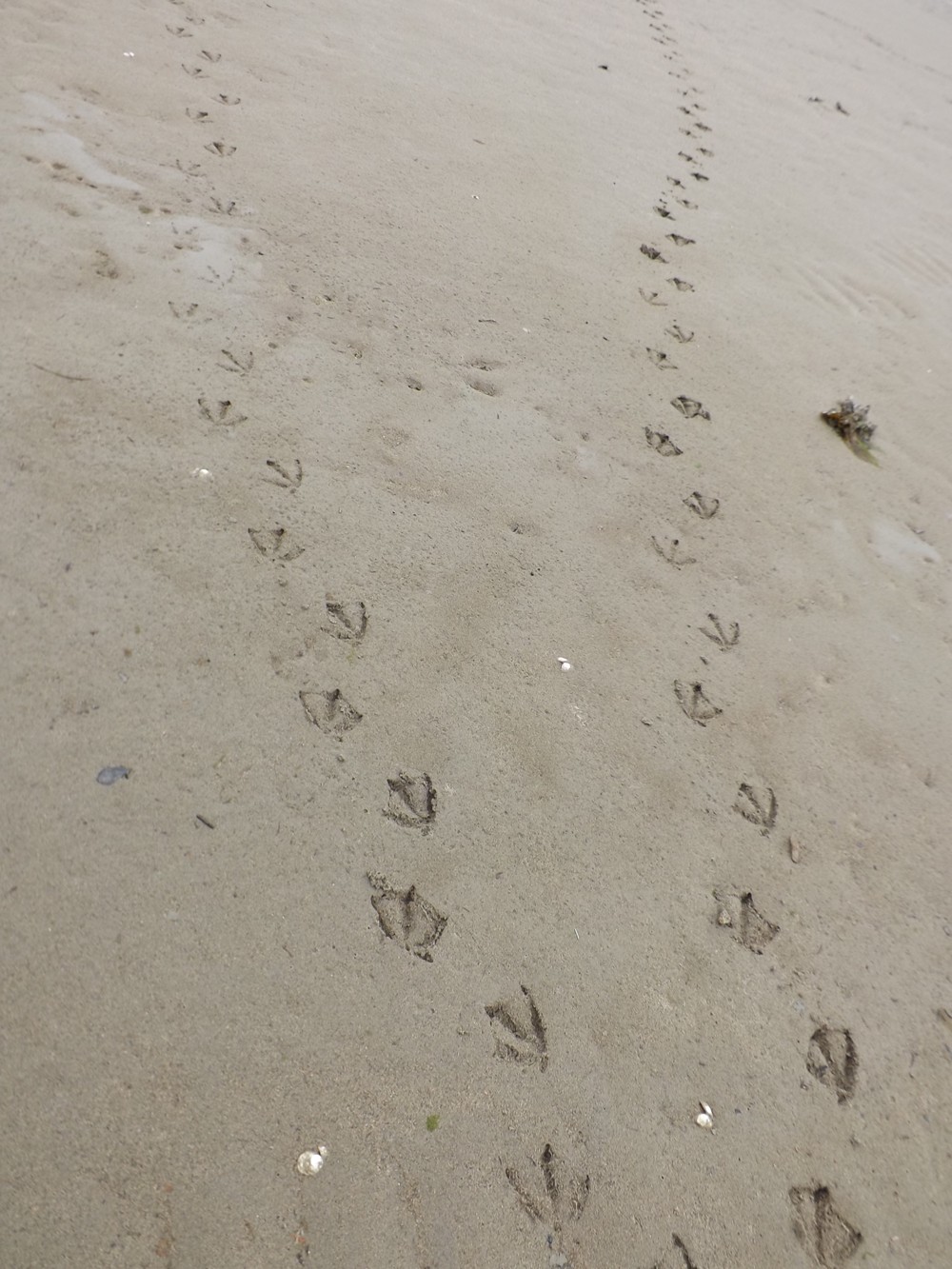
The walking was so easy
and the day so
pleasant (overcast) that I walked past the grassy turnaround point and
continued upriver. The sandbars I walked on were covered in
bird
tracks--mostly corvid and gull--that made interesting patterns in the
sand. I
moved so leisurely that the walk took substantially longer than usual,
but I
was delightfully relaxed. Closer to the lodge, more pintails and teals
were in
the shallows, surprisingly unmoved by Cailey's interest. When I got
back to the
lodge, I encountered a golden-crowned sparrow on the ground near the
path to
the cabins. I felt like I was in the Sparrow Club that morning!
 But I'm actually getting
ahead of
myself. The first thing I did after grabbing a handful of bread and a
piece of
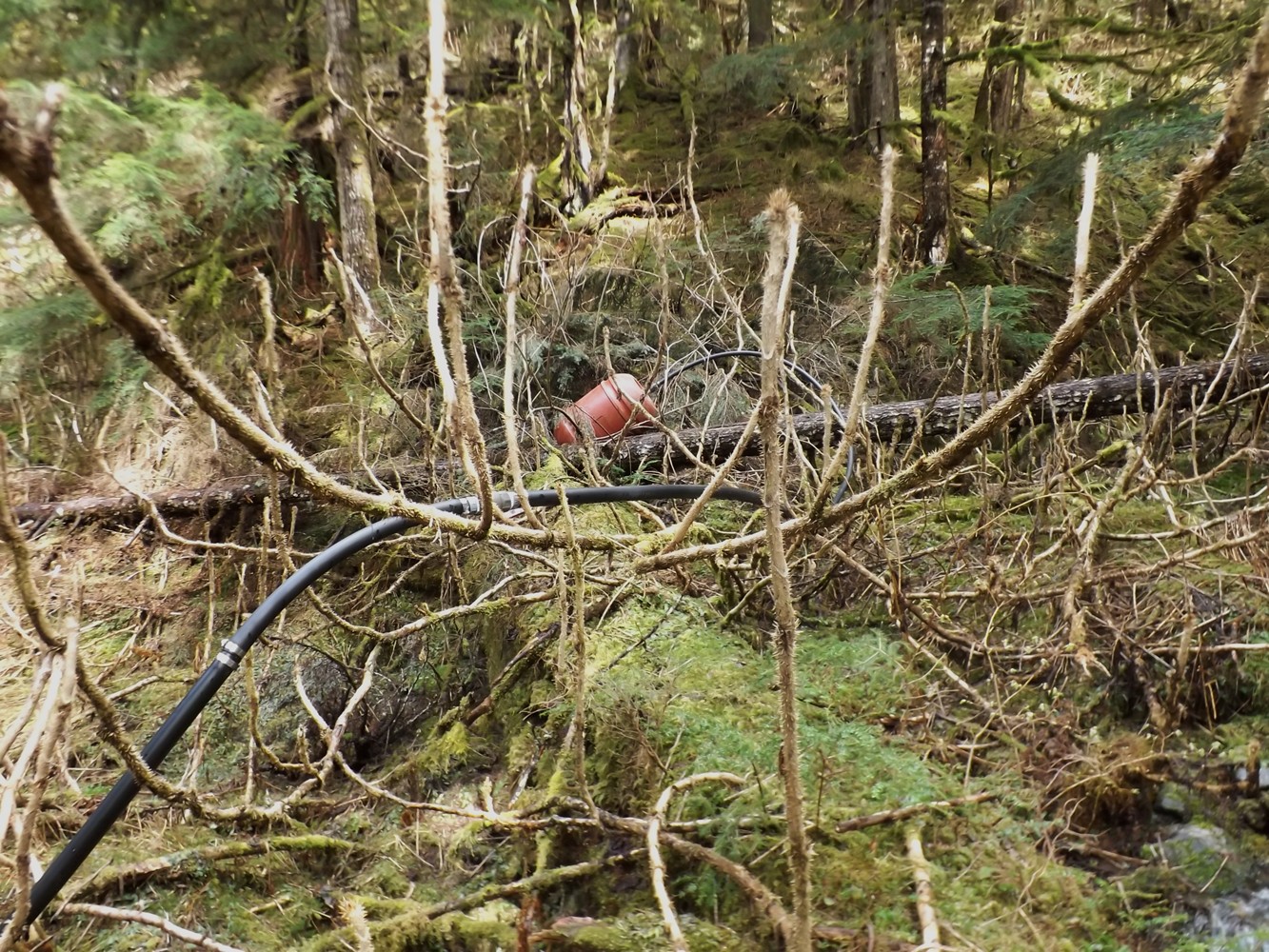
fruit for breakfast was work on the water system. Cailey and I hiked up
the
subtle trail to the creek, surprised to find the olive barrel far to
the left
of the stream on a fallen tree with the attached hose making wide loops
in that
air. I don't know exactly where it was last fall, since I hadn't
removed it
from the creek myself, but I'm sure it wasn't there and there was
evidence of
high water events. The stream itself had changed dramatically, the
small
waterfall below which the olive barrel has rested in its hollow since
it was
first installed many years ago was mostly washed out and the hollow no
longer an
option
(or, rather, no longer there). I'd have to find a new place for the
barrel to
sit. The best option seemed to be just below the next waterfall down,
right
near the
log that the hose used to rest on before it plunged into the forest
below on
the way to the lodge. I started to hollow out the space and was getting
enthusiastic about it when I decided that it would be a good idea to
have the olive
barrel nearby to help me choose the proper place, size of the hollow,
etc. I
crawled my way over the branches and devil's club to the olive barrel,
unscrewed the top, and removed the two rocks inside that help weigh it
down in
the creek. Then I laboriously drug and manhandled the barrel between
all the
hemlock branches and hollows and over to the creek. And that's when I
realized
that my new spot would not work. In order to flow, the hose coming out
of the
bottom of the olive barrel needs a constant downhill slope. A permanent
log
crossed the creek below the hollow I'd chosen under which the barrel
would not
fit, so
the hose would have to go over it (an immediate upward climb), which
would not produce flow. So, a
new
plan. I wound up using a hoe to scoop out a hollow just above the
waterfall
instead. Before I placed the barrel, I rinsed off the screens in the
lid and
rinsed out the fine silt that had built up in the bottom of the barrel
(a
surprising amount). After setting it in place, I piled rocks behind to
stabilize it. Because the barrel was about 20 feet downstream of where
it was
originally, I had to manhandle the extra hose down the hill so it
didn't loop
up above the level of the creek where it enters the barrel and halt the
flow.
Many fox sparrows scratched at the mountainside while I worked.
But I'm actually getting
ahead of
myself. The first thing I did after grabbing a handful of bread and a
piece of
fruit for breakfast was work on the water system. Cailey and I hiked up
the
subtle trail to the creek, surprised to find the olive barrel far to
the left
of the stream on a fallen tree with the attached hose making wide loops
in that
air. I don't know exactly where it was last fall, since I hadn't
removed it
from the creek myself, but I'm sure it wasn't there and there was
evidence of
high water events. The stream itself had changed dramatically, the
small
waterfall below which the olive barrel has rested in its hollow since
it was
first installed many years ago was mostly washed out and the hollow no
longer an
option
(or, rather, no longer there). I'd have to find a new place for the
barrel to
sit. The best option seemed to be just below the next waterfall down,
right
near the
log that the hose used to rest on before it plunged into the forest
below on
the way to the lodge. I started to hollow out the space and was getting
enthusiastic about it when I decided that it would be a good idea to
have the olive
barrel nearby to help me choose the proper place, size of the hollow,
etc. I
crawled my way over the branches and devil's club to the olive barrel,
unscrewed the top, and removed the two rocks inside that help weigh it
down in
the creek. Then I laboriously drug and manhandled the barrel between
all the
hemlock branches and hollows and over to the creek. And that's when I
realized
that my new spot would not work. In order to flow, the hose coming out
of the
bottom of the olive barrel needs a constant downhill slope. A permanent
log
crossed the creek below the hollow I'd chosen under which the barrel
would not
fit, so
the hose would have to go over it (an immediate upward climb), which
would not produce flow. So, a
new
plan. I wound up using a hoe to scoop out a hollow just above the
waterfall
instead. Before I placed the barrel, I rinsed off the screens in the
lid and
rinsed out the fine silt that had built up in the bottom of the barrel
(a
surprising amount). After setting it in place, I piled rocks behind to
stabilize it. Because the barrel was about 20 feet downstream of where
it was
originally, I had to manhandle the extra hose down the hill so it
didn't loop
up above the level of the creek where it enters the barrel and halt the
flow.
Many fox sparrows scratched at the mountainside while I worked.
Back at the lodge, it was
apparent that
the water was flowing, as it was pouring out in two places at
force--the hose
junction just above the lodge that feeds the garden hose (when hooked
up) and
the first of the three water filters. Both were not good news; the
valve on the
former was closed, but the coupling attaching the valve to the hose had
shot
off with the pressure. That was reparable. Worse news was the water
filter,
whose cracks had finally failed. water was spraying everywhere. I
trekked
back to the top and turned the valve off there, then returned to
trouble
shoot. The
only filter fix I could think of at that moment was using the
replacement
filter I'd requested to replace the wrong kind of filter that I'd been
sent
several years ago when I was hooking up potable water to the cabins.
Because
I'd have to take the whole filter system for my cabin apart in order to
change
the filter (since the lids are semi-permanently connected to the water
line), I
hadn't yet used it. But the filter was in the attic. And to the get to
the
attic I needed a step ladder. And the step ladder I needed was tied to
the line
that held the tarp to the lodge outhouse. So first I had to untie the
tarp,
gently pull the tarp off the outhouse, wrap it up, bring the stepladder
inside,
and fetch the filter from the attic. It didn't
fit. By
that time I was pretty hungry, so I grabbed a snack and went out on the
porch
to rest a little. While there I had an inspiration--I had 11 functional
filters
on the cabins; would one of them possibly fit the filter head still on
the
lodge filter system? It was actually a bit of a long shot, as they were
purchased at different times and most were much smaller and of a
different
design. I took the broken filter to all the cabins and found only one
possibility--the last in line at Cottonwood. I removed it and tried to
replace
it with the broken filter from the lodge; it was not a perfect fit, but
enough
of a potential that I decided to give it a try.
I wasn't able to screw the
substitute
filter in all the way onto the lodge system, but suspected it might
make a seal, so I decided
to give
it a try. To turn the water back on, though, I needed the valve at the
hose
port to function, so in the meantime I'd heated most of the rest of the
overwintered
water (one gallon), soaked the end of the hose at the junction in it,
fit the
coupling with the valve attached into the hose, and tightened up the
hose
clamp. When everything was ready, I tramped back to the water source,
turned
the valve on, and rushed back to the lodge to view the results.
Amazingly, the
new filter housing worked and I had running water again. After
installing
the new filters cartridges in the housings, I also had running potable
water.
To complete the system, though, I needed to put together the gray water
system
so the drain would work. I chose two 100 micron filter bags from the
box I
brought down, dug out a couple of zip ties, and headed back to the
"bear
proof box." I cut off the rigid rim of the bags, cut holes around the
mesh
rim to "sew" in the zip ties, and cinched them onto the inlet hose
and the outlet hose at the bottom of the barrel. It slid right onto the
pipe
leading to the drainage area, so I closed up the top of the barrel,
stuck the
outhouse tarp
inside, and sealed up the box. It was actually a little more of a
hassle than
that sounds, as I had to go back for a leatherman, etc., but it went
together
pretty smoothly. Then I tightened up the drain pipes below the sink and
was
done.
 Unfortunately, I found a
dead fox
sparrow under one of the windows while working; the bird appeared to be
in
rigor so probably had died since I'd been there (and taken the
newspapers off
the windows). No doubt the ultraviolet decals on the window (which I
attribute
to the almost total lack of window casualties for the last two years)
had
faded. So my next task was set: I had new decals, but would need to
wash the
windows before putting them up. Of course I couldn't find the window
squeegee
(which must be why I have two in Juneau), so had to be satisfied with a
pillow
case to rub with and a towel to dry. I washed all the windows on the
lodge,
dried them as well as I could, then went back to the screen-less
windows on the
two sides of the lodge and swapped out the hummingbird-shaped decals
with new
leaf-shaped decals. I tidied up a little inside, stowing the filters
and a few
other items in the attic before closing it up, then attempting
(unsuccessfully)
to fix the leaks in the hummingbird feeders (the only sealant I found
was a
rubber repair kit, which was certainly toxic and too dry to use
anyway). After
that I took a long break with hot chocolate and snacks, enjoying the
bird life
from the porch, after which I went for the COAAST walk described above.
Unfortunately, I found a
dead fox
sparrow under one of the windows while working; the bird appeared to be
in
rigor so probably had died since I'd been there (and taken the
newspapers off
the windows). No doubt the ultraviolet decals on the window (which I
attribute
to the almost total lack of window casualties for the last two years)
had
faded. So my next task was set: I had new decals, but would need to
wash the
windows before putting them up. Of course I couldn't find the window
squeegee
(which must be why I have two in Juneau), so had to be satisfied with a
pillow
case to rub with and a towel to dry. I washed all the windows on the
lodge,
dried them as well as I could, then went back to the screen-less
windows on the
two sides of the lodge and swapped out the hummingbird-shaped decals
with new
leaf-shaped decals. I tidied up a little inside, stowing the filters
and a few
other items in the attic before closing it up, then attempting
(unsuccessfully)
to fix the leaks in the hummingbird feeders (the only sealant I found
was a
rubber repair kit, which was certainly toxic and too dry to use
anyway). After
that I took a long break with hot chocolate and snacks, enjoying the
bird life
from the porch, after which I went for the COAAST walk described above.
After my leisurely break
and bird
watching, I brought filters to all the cabins (except Cottonwood),
installed
them, and tested the water systems (all functioned well, though two of
the
valves sprung leaks over the winter which I suspect will have to be
replaced).
I also made the rounds with fresh bottom sheets for the beds and
pillowcases
for the pillows and swept the cabins, their porches, and the outhouses.
Before
dinner, I spent half an hour a little ways down the beach on a log at
the edge
of the alders with a view both into the forest and across the beach.
Birds
included ruby-crowned kinglets in the bushes around me and varied
thrushes and
fox sparrows scratching at the base of the cliffs inside the forest and
along
the steep slopes below.
The day had been overcast
and not
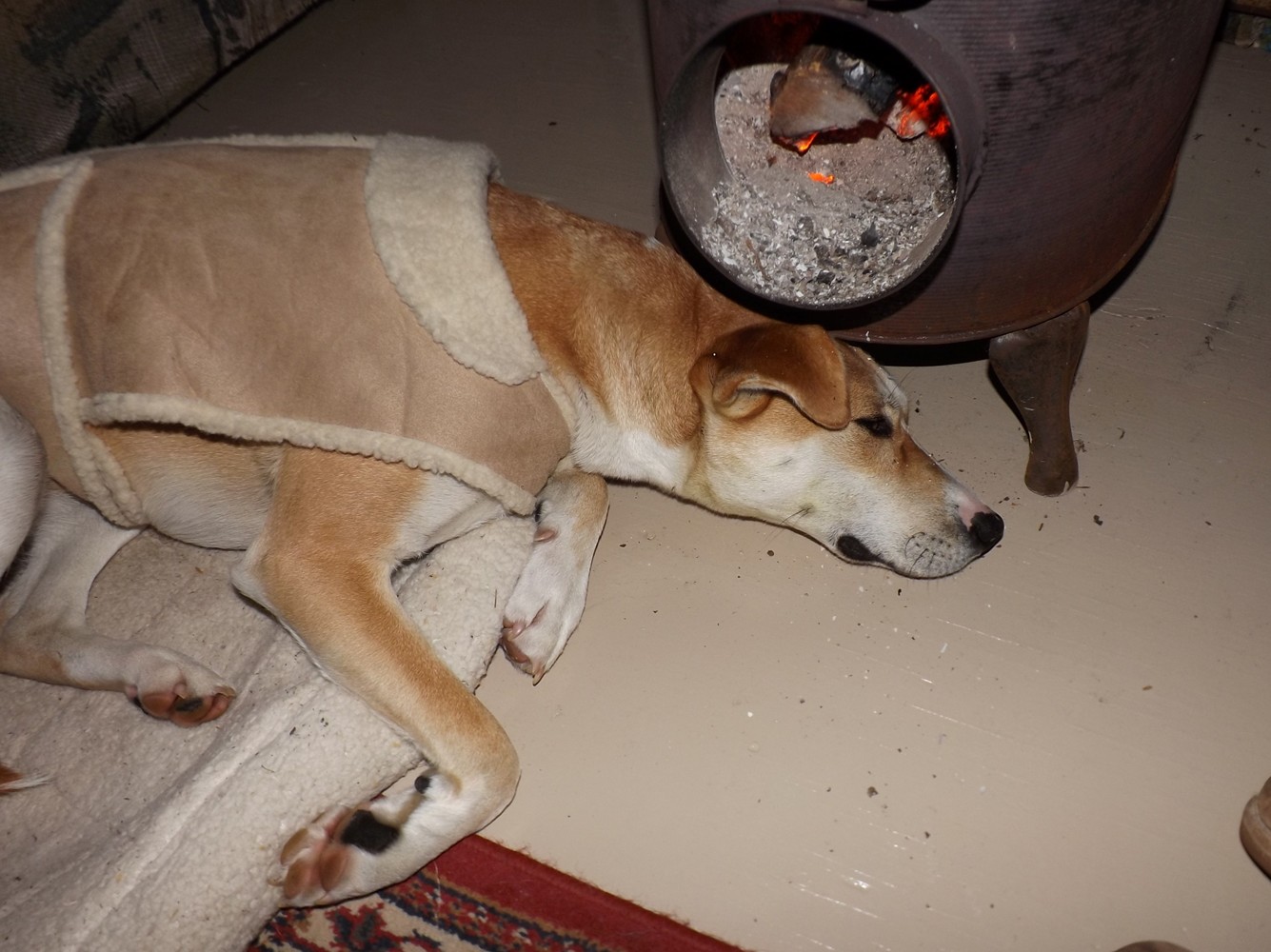
especially warm, so I was chilled by dinner. So was Cailey. I stoked
the fire
still smoldering from earlier and read around it for some time and put
Cailey's
fleece jacket on her. I ate my chili outside, but Cailey was so cold by
that
time that she was shivering, so I put her back inside. When I came back
in
later she was laying half out of her bed with her head and neck leaning
against
the wood stove! We stayed a little longer, then retired to Hermit
Thrush where
I continued reading from bed. Cailey, perhaps warmed by the fire and
the
jacket, never attempted to come into bed and I discovered that sleeping
with
fleece gloves on can really help me stay warm.
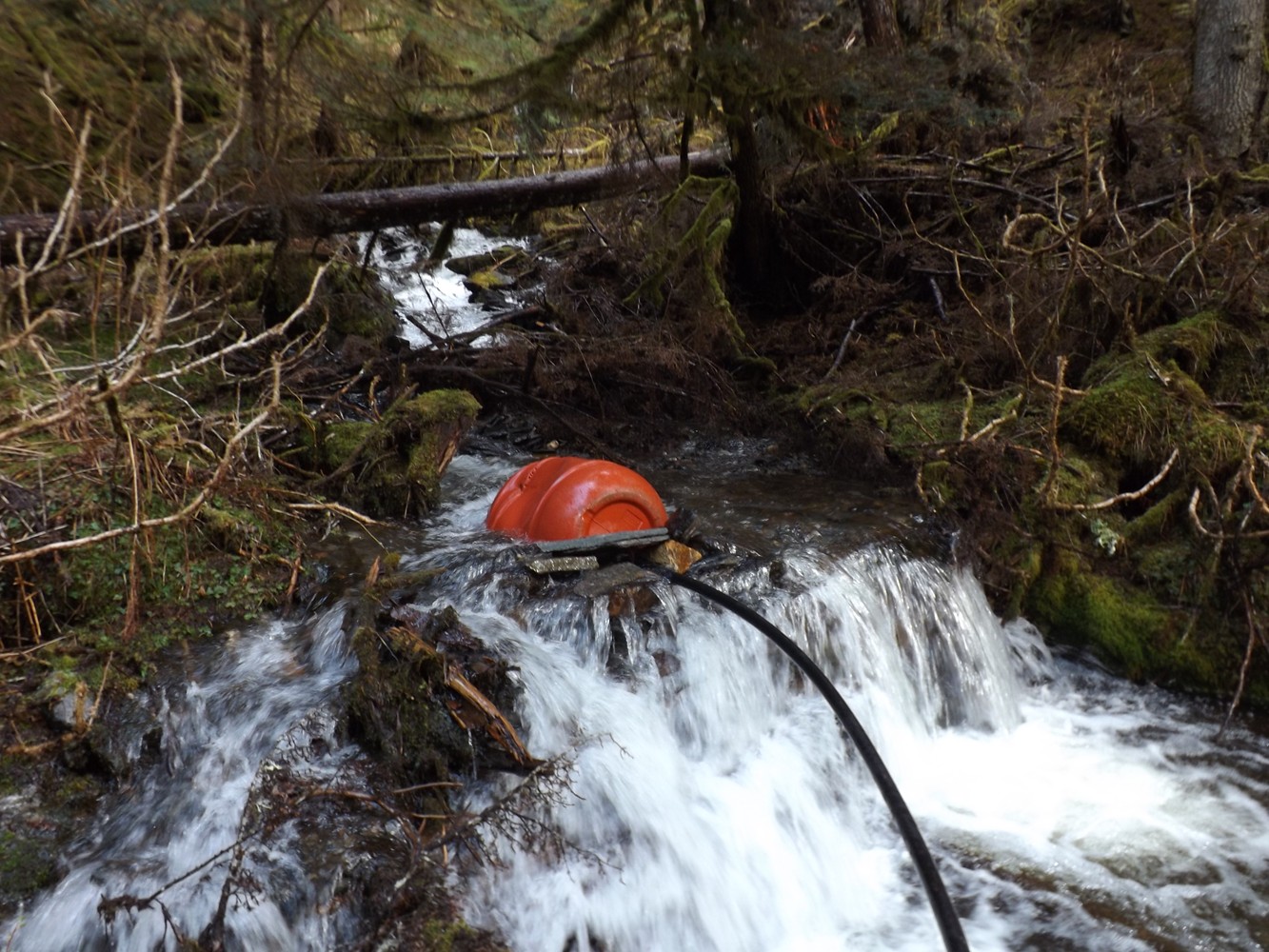 Newly placed olive barrel catchment |
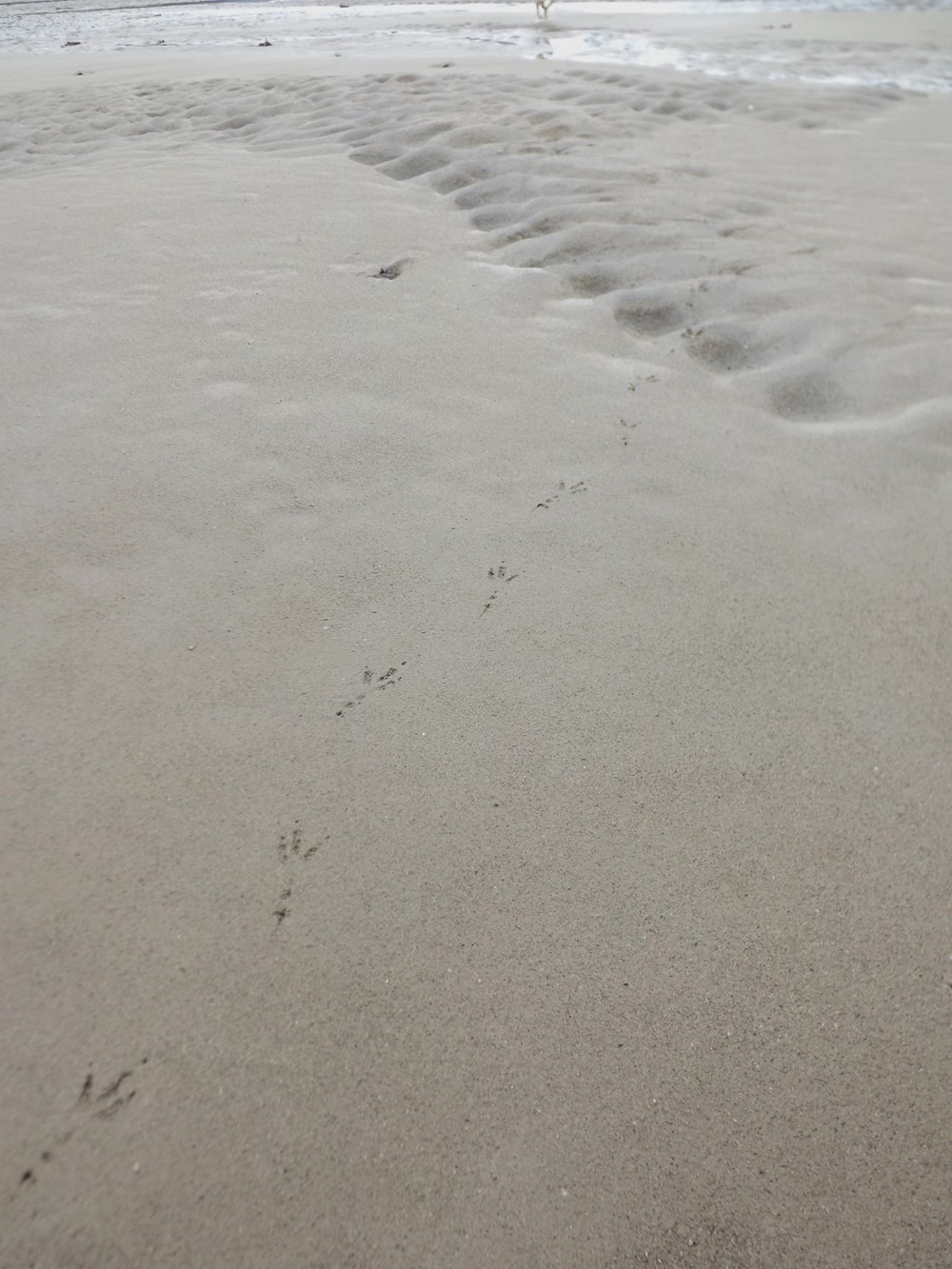 Corvid footprints |
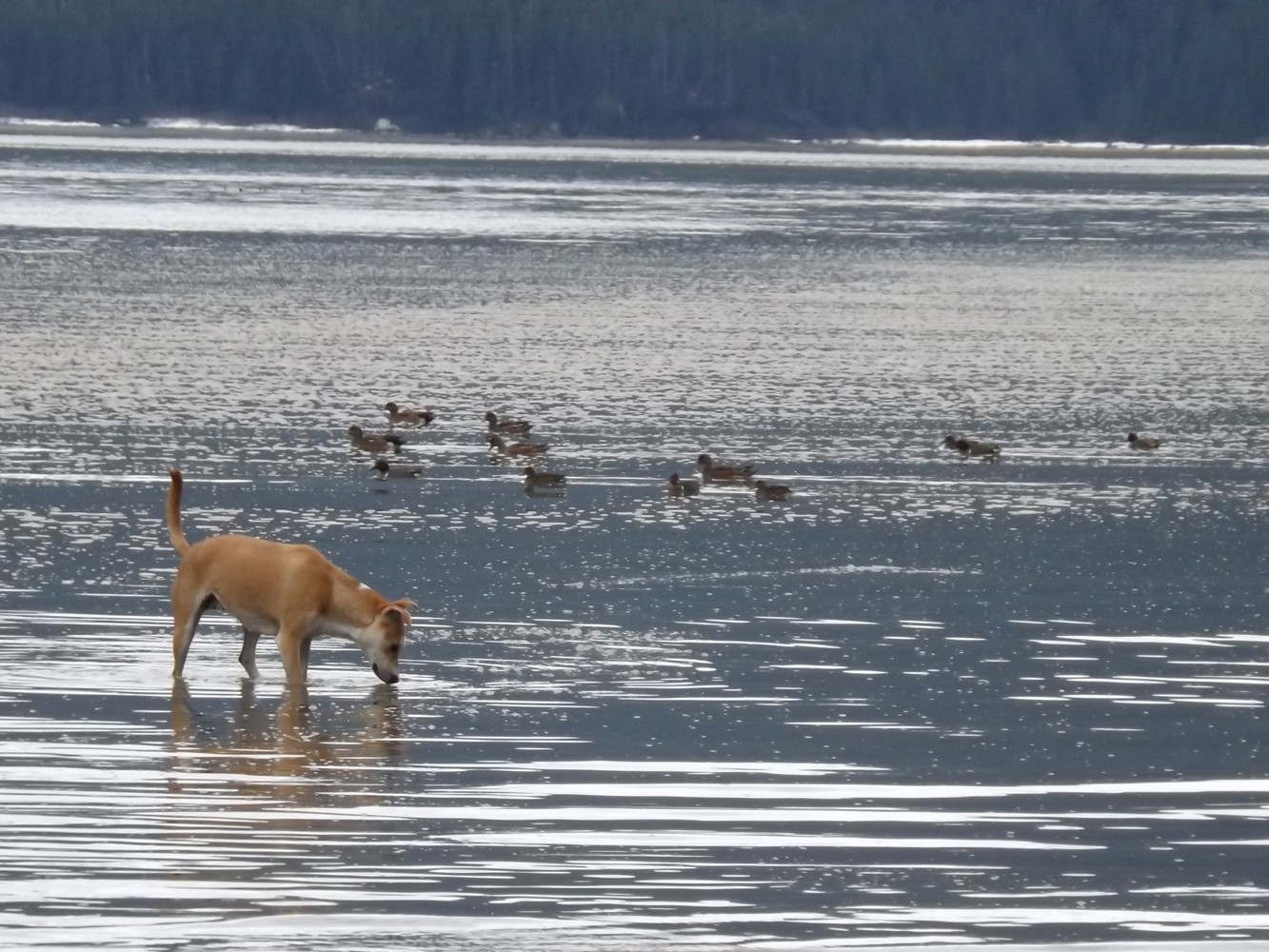 The ducks are surprisingly unperturbed by Cailey |
The next morning I slept
until almost
9:00 again. I was icy cold, so jumped on an aerobic activity just to
warm up:
raking around all the cabins and the paths. To get to the rake, though,
I first
had to get into the shed where I'd stashed all my tools last fall and
which had
a full sheet of plywood screwed over the open door. Naturally the
screws were
the funny star shaped ones, for which I have no manual screwdriver. The
drill
that screwed them in was in Juneau, but I did manage to find a very
rusty but
appropriate driver and another cordless drill that had enough battery
power left in it to
operate. I removed all but one of the screws and snuck inside to
retrieve the
rake and civilize the paths.
By the end of that I had
warmed up
nicely and so had the day. The blue sky drew me to the beach to observe
the
myriad birds and I spotted an intriguing individual farther down the
beach--it was
clearly a robin (based on behavior, shape, and other features), but it
was
colored like no robin I'd ever seen. Probably leucistic, he was pale
brown
instead of
gray on his back, and his breast was more buffy than orange. I stalked
him down
the beach, but he was not having any of it, keeping a comfortable
distance and
eventually disappearing while I was distracted
by other birds. I wound
up
sitting on a big fallen log, totally enraptured by the
activity
around me. Pintails, teal, and gulls continued to dominate the water.
On the
beach, I was first taken by a pair of tiny western sandpipers that
nearly
disappeared into the short beach grass when I took my binoculars off
them (see photo to left). Some
songbirds were making fast flights out of the trees and back and 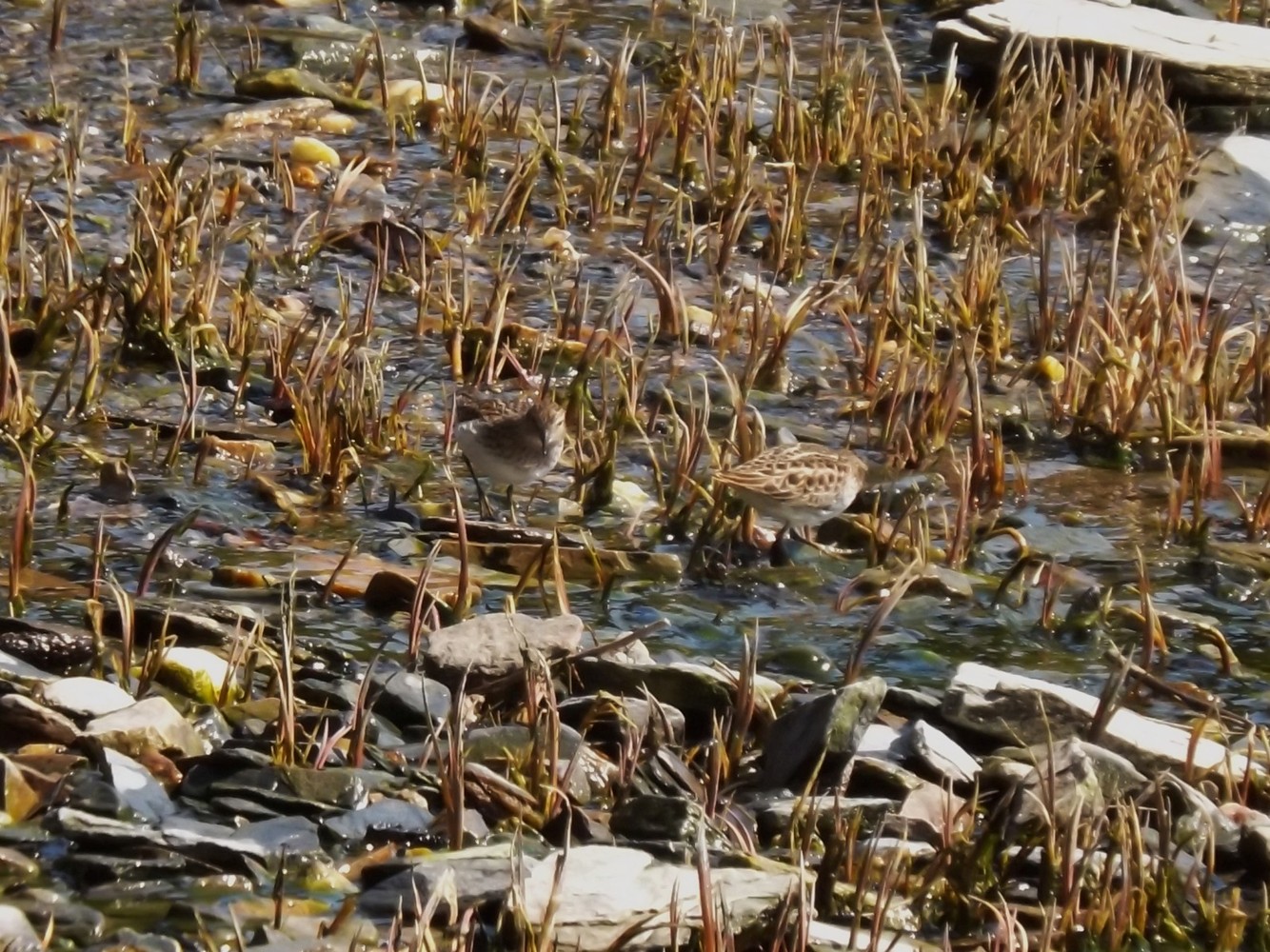 when
they
landed on the beach I was surprised to see that there were the elegant
yellow-rumped warblers. As I sat on the silvery log, a savanna sparrow
also
appeared nearby and fed around the small rocks and beach grass while I
watched,
his yellow cheek glowing whenever I focused on him. All seemed
unperturbed by
my presence and I watched them close by for some time. When I finally
headed
back to the lodge I was delighted to find the leucistic robin nearby
and
managed to snap a few more photos.
when
they
landed on the beach I was surprised to see that there were the elegant
yellow-rumped warblers. As I sat on the silvery log, a savanna sparrow
also
appeared nearby and fed around the small rocks and beach grass while I
watched,
his yellow cheek glowing whenever I focused on him. All seemed
unperturbed by
my presence and I watched them close by for some time. When I finally
headed
back to the lodge I was delighted to find the leucistic robin nearby
and
managed to snap a few more photos.
A little later I found a
place behind
the lodge that overlooks the narrow shelf of flat land between the
beach and the cliffs and watched fox sparrows scratching on the ground,
a
hermit
thrush perch nearby, a Pacific wren sing from the top of a log nearby,
and
thrushes feed along the base of the cliff. In all I was having a very
relaxing
day, but there was one more task to do before I was ready to head home.
Troubled by the black swamp pooled up in front of the shed, I wanted to
drain
it so the plywood siding wasn't in direct contact with the muck. I
retrieved
hoe and clippers from the shed and started hoeing out a channel along
the north
side of the shed. A surprising current was soon flowing through the
channel,
but it took quite a bit of additional work with hoe and clippers to
divert the
seep from the front of the shed to the new channel. In the end, I'd dug
a
trench along half the front of the front of the shed that met up with
the
channel along the side and diverted most of the flow from uphill of the
shed
directly into the side channel. The volume of black soupy muck I hoed
down that
channel was impressive, a process I repeated endlessly to maintain the
flow.
When I was done with the channel and all the collected water had
drained away,
a steady stream still flowed from the seep. Good thing I put a floor in
my
shed!
At about 2:30 I closed up
the lodge and
kayaked out to the boat with Cailey. While I added fuel to the main
tank and
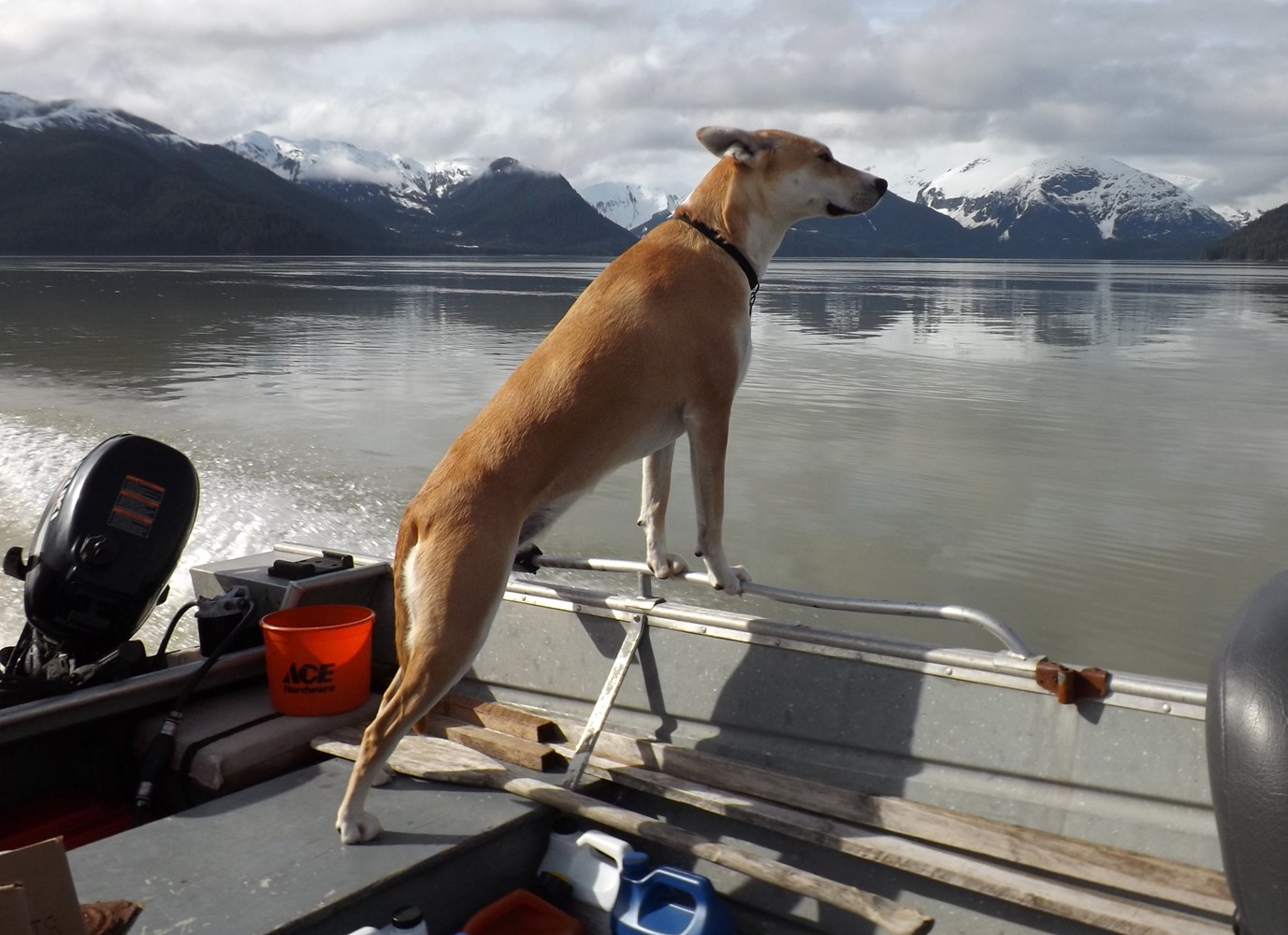
organized for the trip back, Cailey found her way onto the captain's
chair and
made herself at home. We pulled anchor, puttered into shore, and Cailey
stayed
on board while I ran the kayak up to the lodge and tossed my gear on
board.
They day was sunny, but the breeze that had risen troubled me and I was
afraid
I'd be bucking into a northwesterly all the way home. Gilbert Bay was
choppy--not a good sign--but the seas were coming into the entrance to
the port
from Stephen's Passage so I held out slim home that it was coming from
the
opposite direction outside. I cruised the north shore after passing the
sea
lion haulout at a respectful distance and headed out of the port to
disappointing seas. We ever so slowly bucked 1-2' seas all the way to
Taku
Harbor, me constantly apologizing for the banging to Cailey; it looked
like it
was going to be a long ride home. I listened to the forecast on my
handheld
which was calling for three or four footers (I don't recall); had I
known what
it was like out there, I probably would have spent the night and left
in the
morning. But once I was out there, it only made sense to continue.
In the lee of Grave
Point we stopped to rest. I imaged the worst was yet to come in Taku
Inlet, but
I was pleased to find that waters actually calmer around the corner and
the
best part of the trip turned out to be Grave Point to Point Arden. I
guess it
was more of a westerly (coming down Stephen's Passage behind Douglas)
than a
northerly (coming out of the Taku) so perhaps I was actually in the lee
of
Arden. For whatever reason, I was grateful. The going was less pleasant
crossing to Douglas and we bucked the chop all the way up the channel.
I think
the trip wound up taking three hours, the windshield squeaking like a
demon the
entire time (no doubt the result of some less than stellar repair work
I did
this spring), and I was sunburned and worn out by the time I got home.
But the homestead was
open and
I felt more relaxed and happy than I had all spring, the grim
anticipation of
the opening behind me and the joy of fabulous birding fresh in my mind.
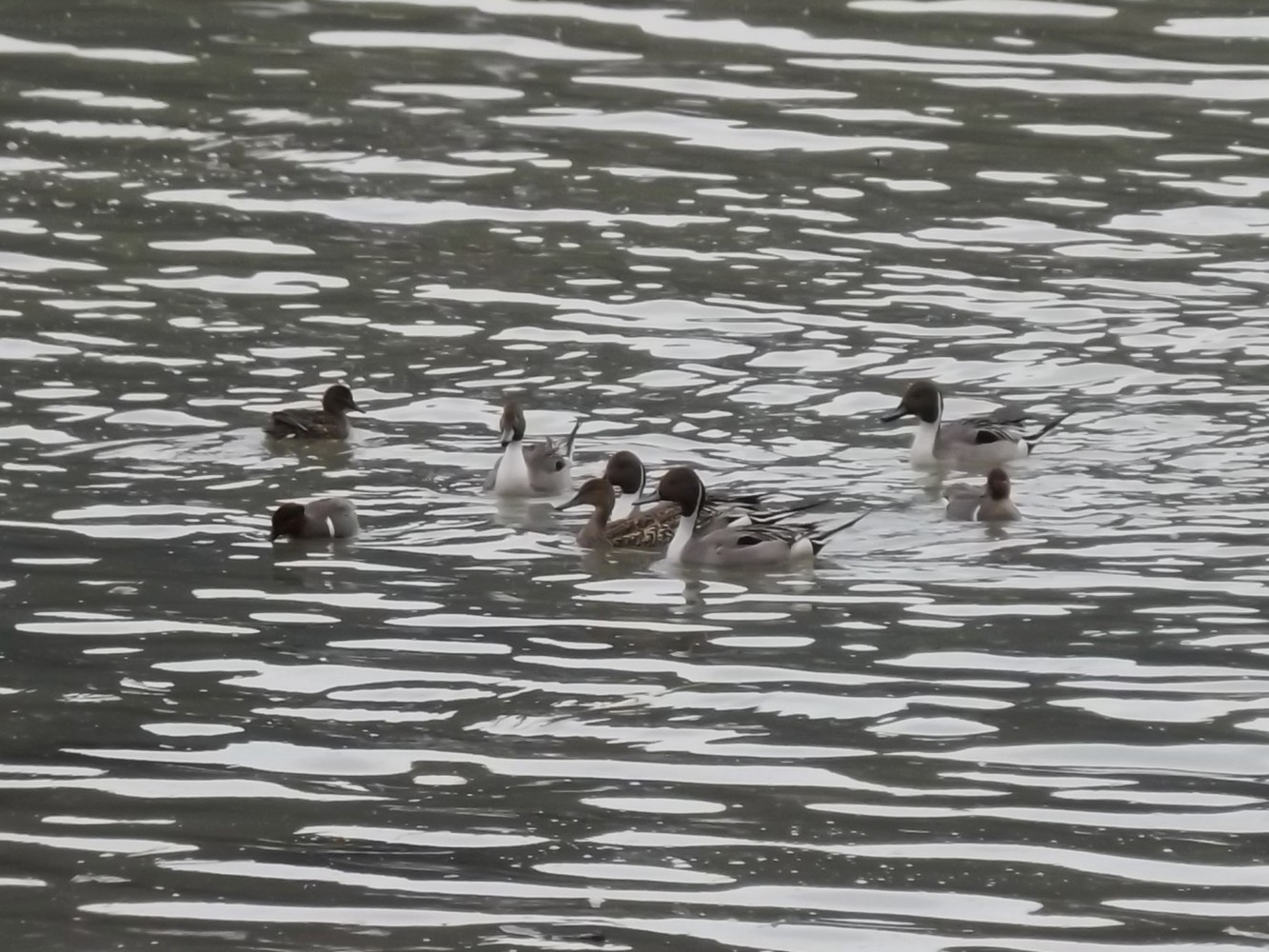 Northern pintails and green-winged teals |
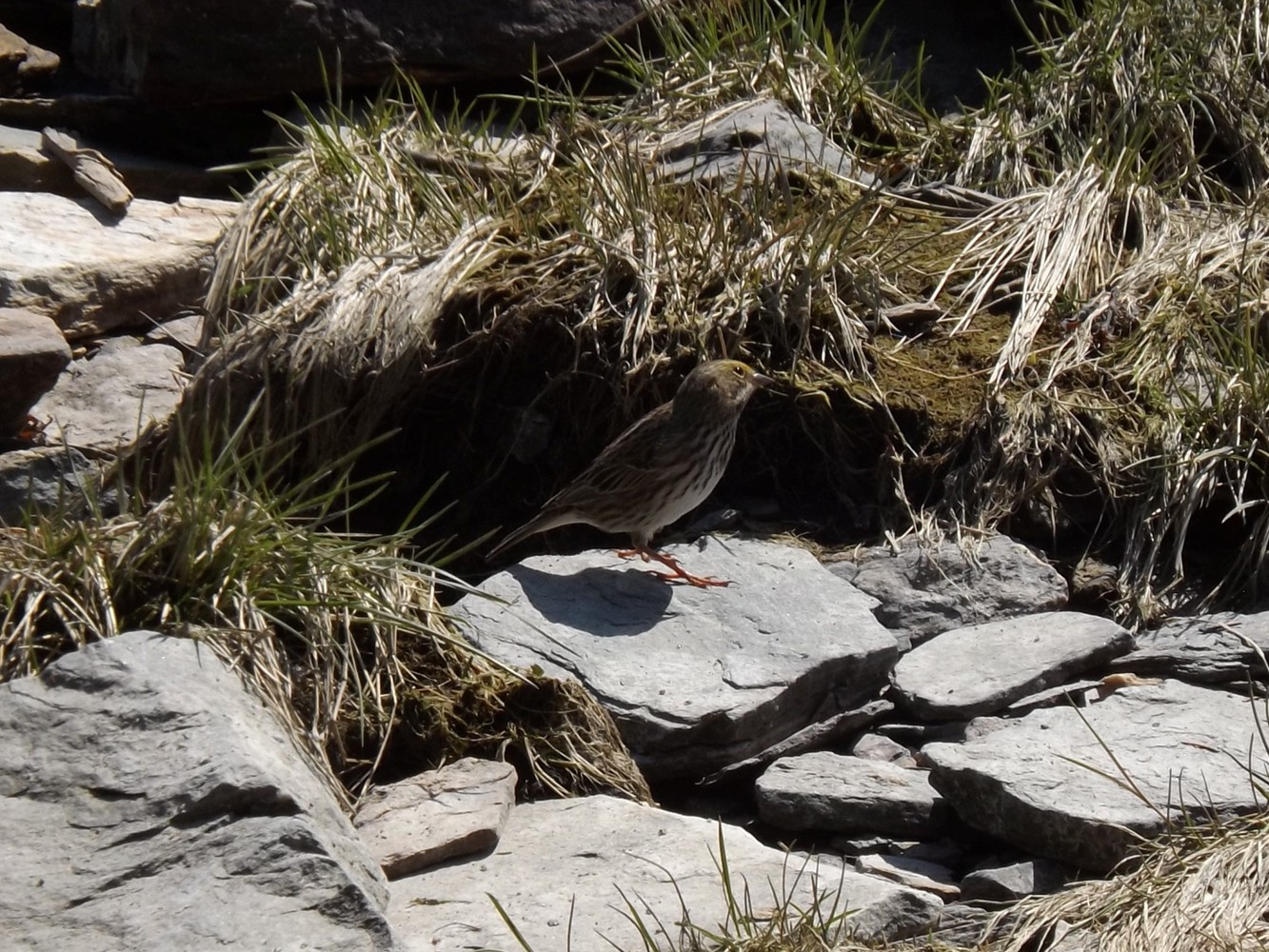 Savanna sparrow |
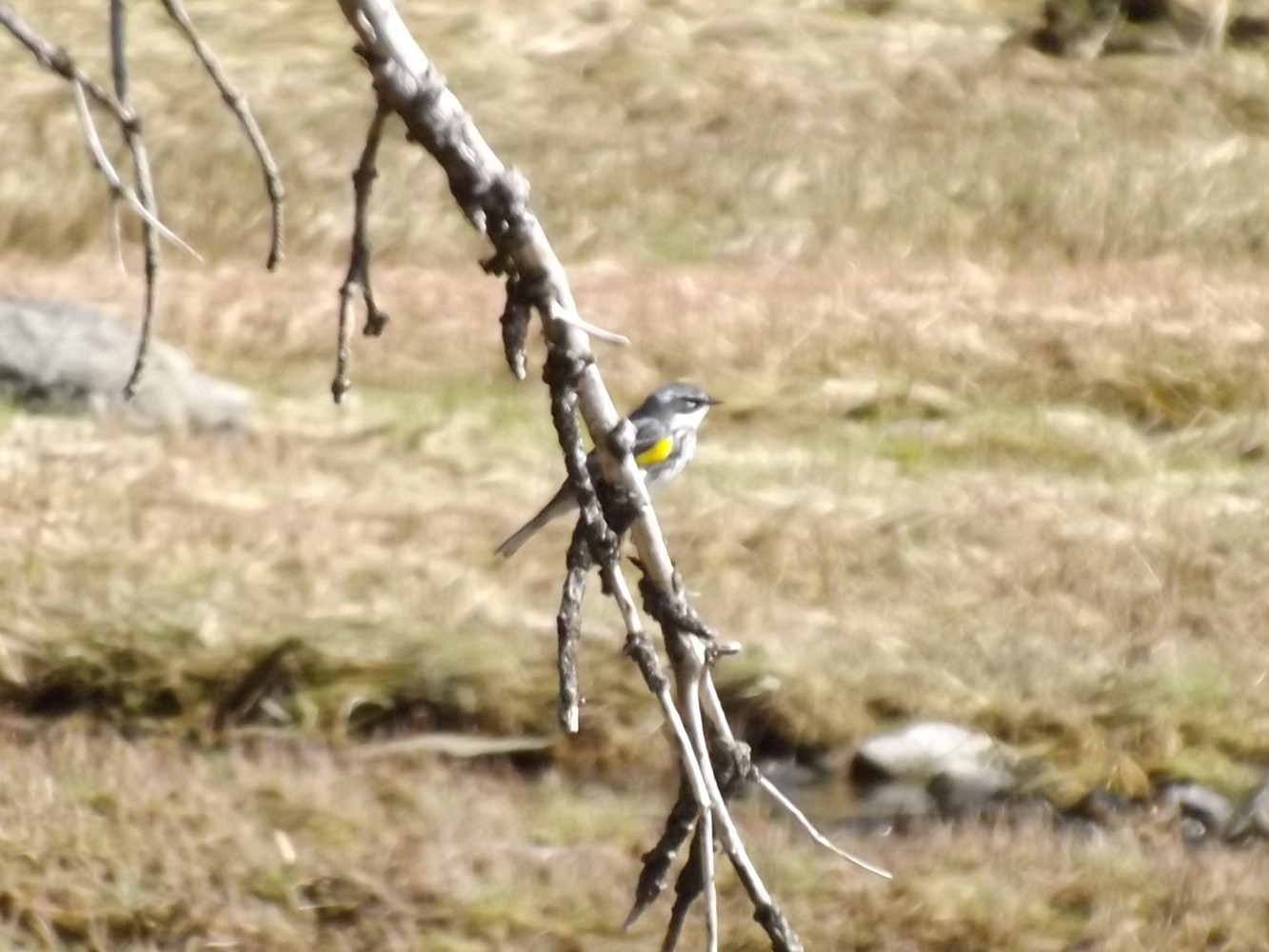 Yellow-rumped warbler |
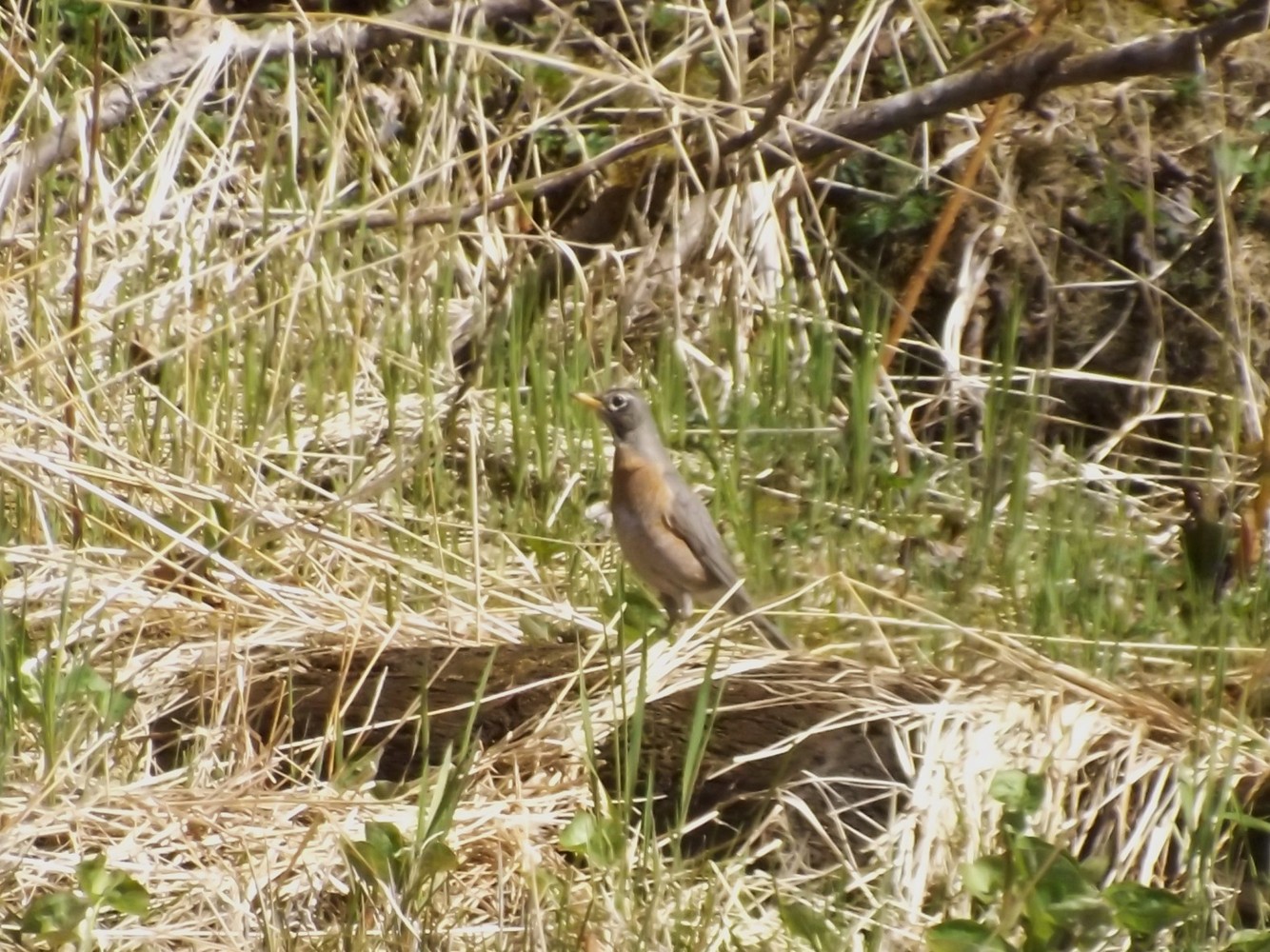 Leucistic (?) robin |
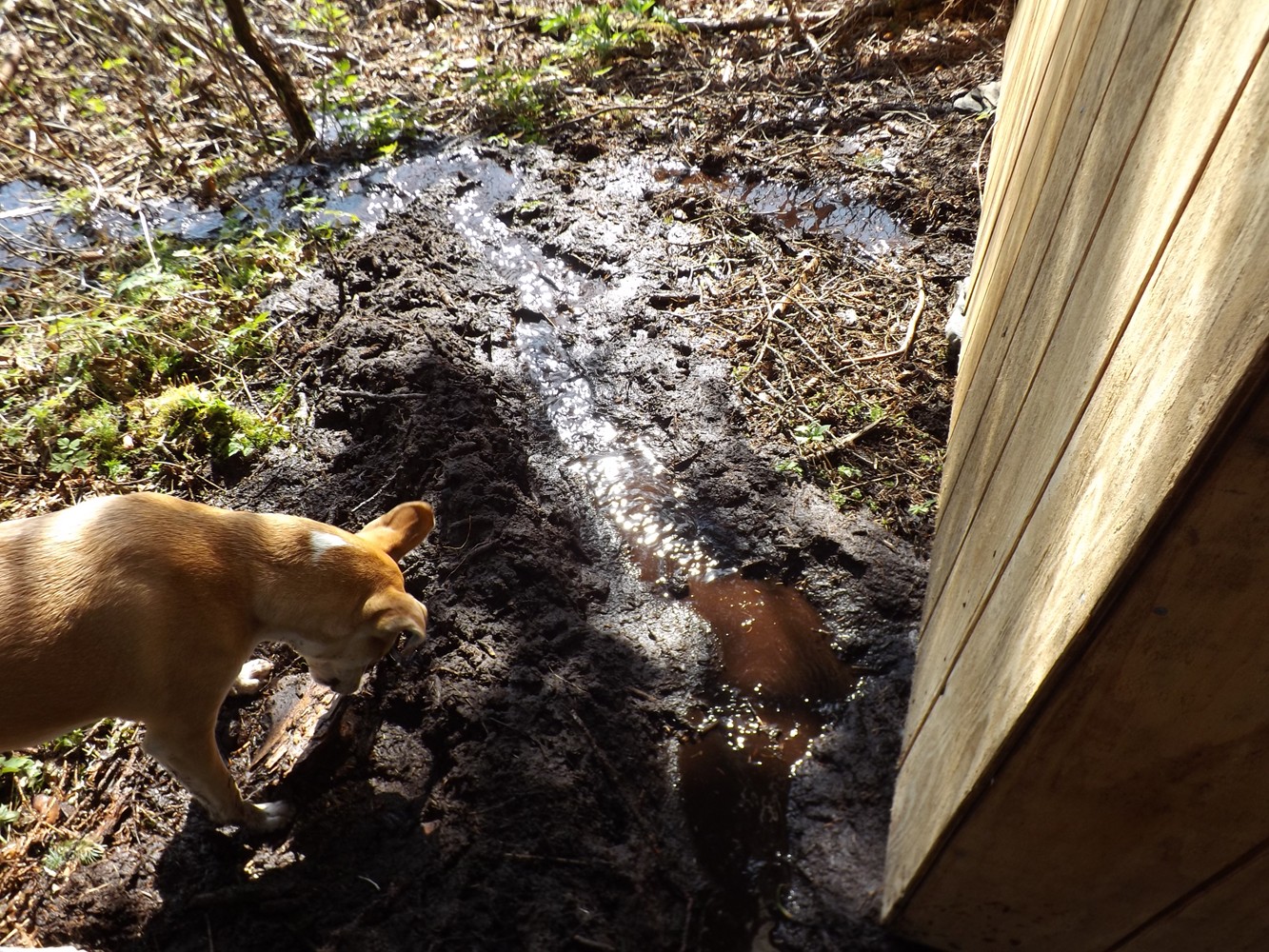 Cailey inspects the trench I dug to drain the shed |
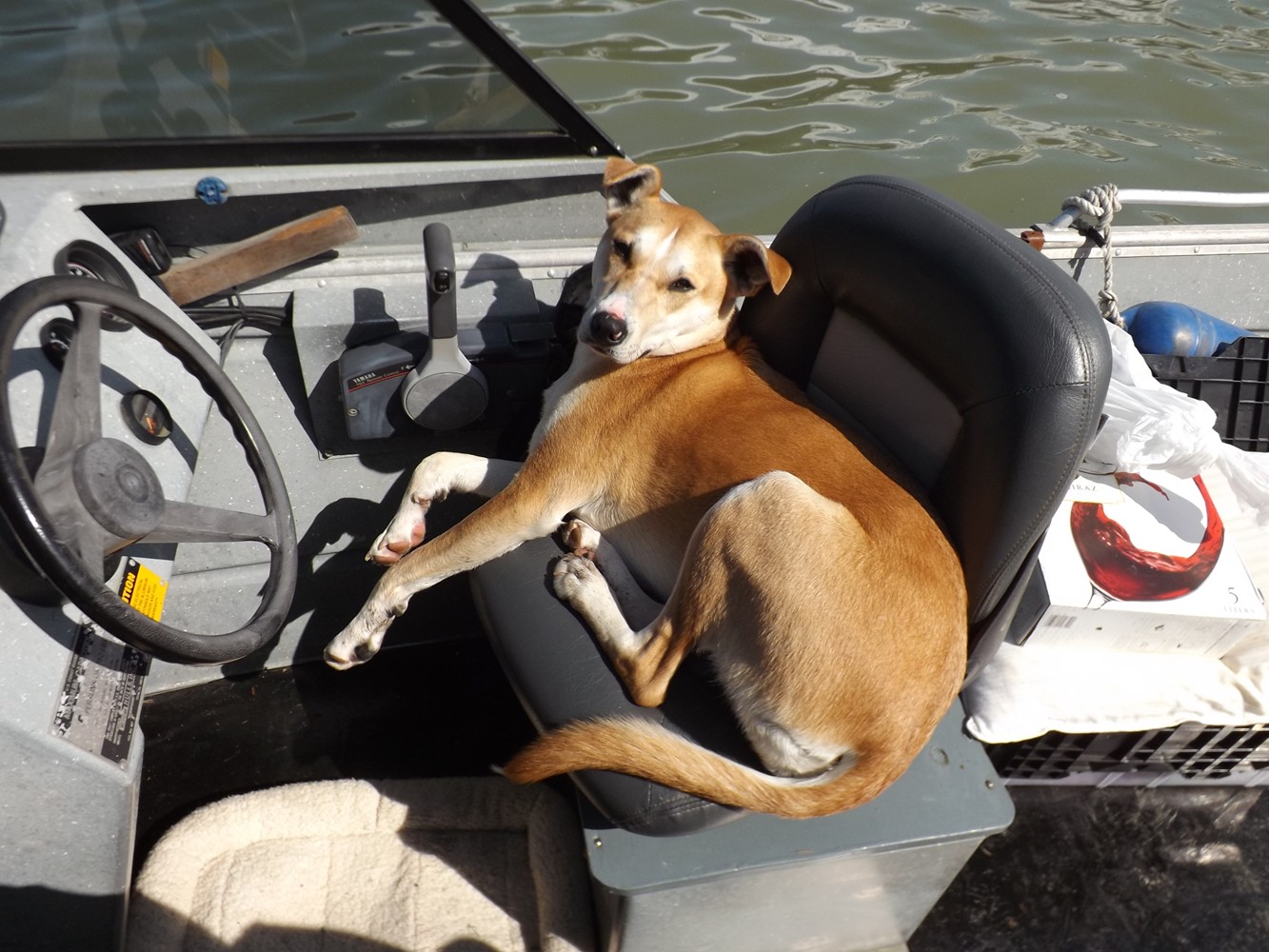 Captain Cailey |
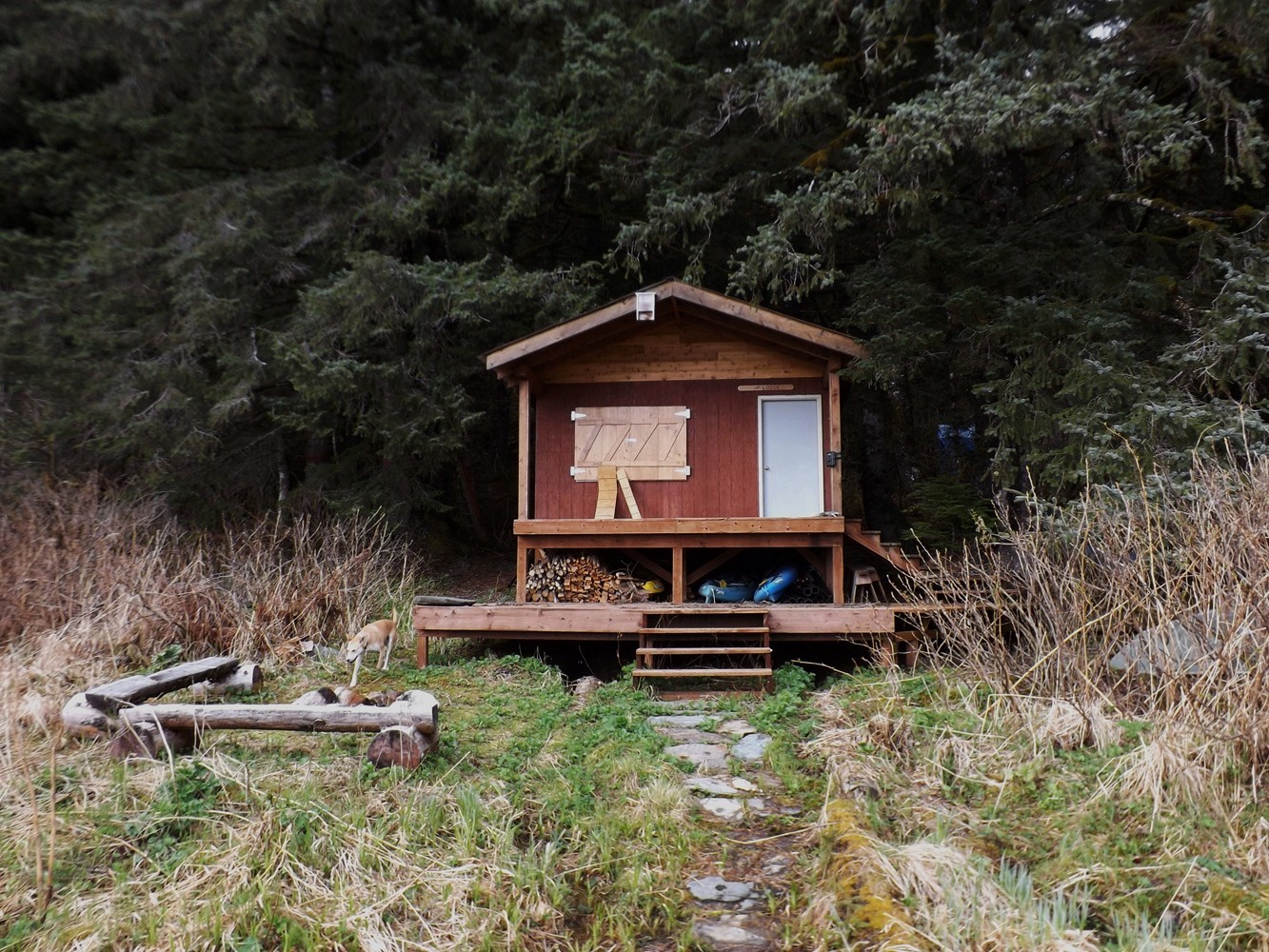
Just as I left it...