
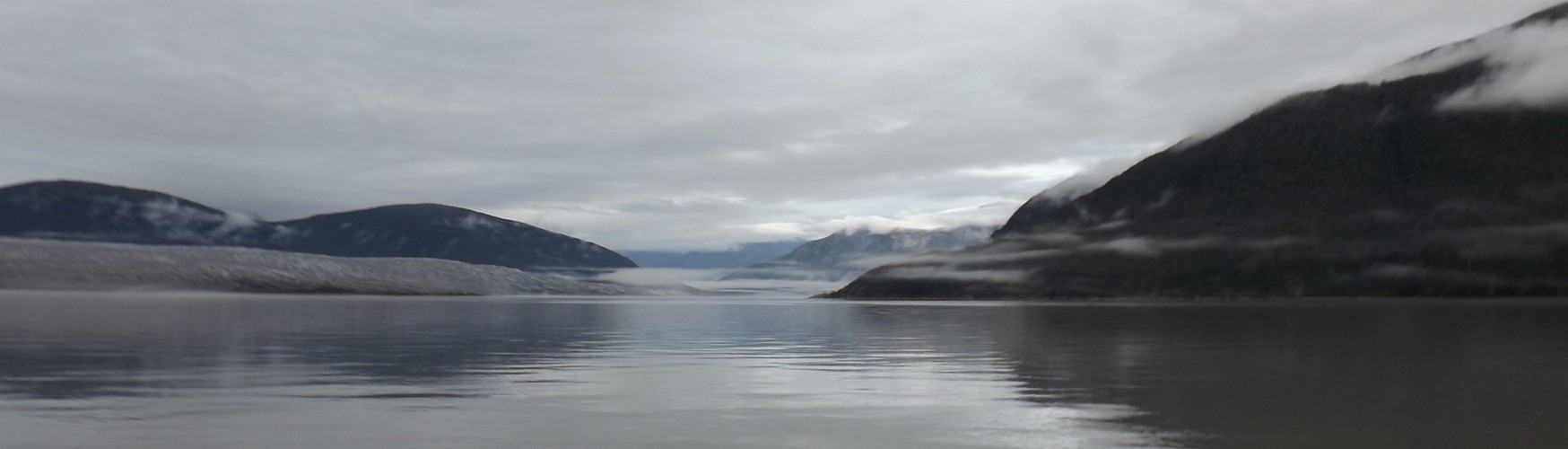
The misty river
Taku
2013 - 4: New Adventures
September 6-9
The misty river
 I’d had the weekend earmarked as a possible Taku
trip for
months; the tides were high, reasonably timed, and after witnessing the
beginnings of a spectacular nagoonberry crop in August, I was eager to
return.
Chris and I left the harbor just before 2:00 for a 2:28 tide. The day
was
overcast and called for seas to three feet from the southeast. We found
the
channel fairly calm, some light seas around Salisbury, and I came
around Bishop
fully expecting to be in the southeasterly trough before putting the
seas
behind me entirely around Cooper. Instead, we found ourselves
quartering the
seas off the bow, which was very curious. Coming around Cooper we were
suddenly
into the teeth of a vicious little northerly chop, all close and white
capped
and uncomfortable. What was a northerly doing in the middle of a
southeast
system? Well, it wasn’t the first time I’d seen that, but it was a
surprise. We
beat our way over to Jaw Point and, dreading what I’d find, passed
around it.
Against all expectations, the inlet was flat calm there. Where had that
wind
come from? It’s a constant puzzle.
I’d had the weekend earmarked as a possible Taku
trip for
months; the tides were high, reasonably timed, and after witnessing the
beginnings of a spectacular nagoonberry crop in August, I was eager to
return.
Chris and I left the harbor just before 2:00 for a 2:28 tide. The day
was
overcast and called for seas to three feet from the southeast. We found
the
channel fairly calm, some light seas around Salisbury, and I came
around Bishop
fully expecting to be in the southeasterly trough before putting the
seas
behind me entirely around Cooper. Instead, we found ourselves
quartering the
seas off the bow, which was very curious. Coming around Cooper we were
suddenly
into the teeth of a vicious little northerly chop, all close and white
capped
and uncomfortable. What was a northerly doing in the middle of a
southeast
system? Well, it wasn’t the first time I’d seen that, but it was a
surprise. We
beat our way over to Jaw Point and, dreading what I’d find, passed
around it.
Against all expectations, the inlet was flat calm there. Where had that
wind
come from? It’s a constant puzzle.
Crossing to the glacier, two dark gulls came over
to ride
the air wake over the bow. There was something different about them and
I
looked closer—they were, in fact, parasitic jaegers—a very cool and
unusual
bird for that area. The few times I’d seen them in Taku Inlet before,
I’d
usually chased them as they flew for a quick glimpse; these two came to
me,
gliding over my bow for some time, their pointed feathers protruding
from the
center of their tails, before breaking away in the middle of the inlet.
It was a
good start to the trip!
From there we enjoyed a smooth ride north with no
incident.
I tied the boat to the line that’s now holding a fallen spruce tree
to shore
(cut just two weeks before as it began its descent into the river) and
we
unloaded the boat. Chris took a load up and was back to help with
another load
by the time I was ready to leave. We traveled light, with just a light
tote and
a bag to carry along with our backpacks. We quickly opened up and
settled in;
Chris opened the shutters and lit a fire while I lit the pilots on the
stove
and the fridge. We drank cups of spiked hot chocolate and relaxed
before
tackling the only real work I had planned for the weekend. My mother
and I had
put the engine on the riverboat early in the summer, but it had never
entered
the water. I didn’t want to leave that task to my parents, so Chris and
I
gathered up the tools necessary to remove it and set to work. First we
unscrewed the four bolts securing the engine to the boat (a bit of a
pain, as the
bolts are too long for the sockets to work until the very end), then
figured
out how to put together the aluminum tripod as best we could and placed
it over
the engine. After clipping on the comealong which I found in the back
of the
shed, we raised up the engine and then slowly lowered in onto the dolly
waiting
beneath. As usual, Chris was there to point out flaws in my plans and
make
things more efficient. We dropped the engine down, tied a line around
it, and
wheeled it away to the shed where Chris had to move a sawhorse and some
other
items to make room to move it into its winter place against the wall.
We put
all the tools away and flipped the riverboat upside down.
With a little manual labor behind us, we were
ready for dinner.
We feasted on bison burgers, then curled up in bed upstairs and watched
half of
the Three Wise Men Top Gear special before falling asleep.
Rain started in the middle of the night, which
didn’t
surprise me, as a big storm was supposed to hit on Saturday. After an
exceptionally stressful week at work, I slept in until quite late
(9:30?) and
then prepared for a berry picking expedition (which mostly involved
removing
all unnecessary gear from my backpack and replacing it with empty tubs
and
suiting up in rain gear). A steady rain fell as Cailey and I trooped
upriver,
luxuriating in the open path made earlier in the summer, and began to
look for
berries in the meadows. Though the ground was covered in nagoonberries,
I soon
became discouraged as they fell apart between my fingers and I tasted
the
familiar musk of overripe nagoons. They carpeted the ground beneath my
feet,
but would I be able to take any home? Although early September is
normally the
height of nagoonberry season, the warm and sunny summer ripened them
early
(which is why I was able to pick some in mid-August). I began seeking
them in
areas where they would have ripened later, namely in the shade of trees
and
bushes. I crept my way along the river picking the few berries that
were not
overripe; many were not ripe yet, and many others were ripe enough but
not as
flavorful as they would have been in their prime. On the way I noted
some
fields of ripe crowberry bushes and some blueberries too. And then I
found
myself in a field of ripe and delicious nagoonberries just beyond the
large
cottonwood grove. I don’t know what circumstances created this single
meadow
where the majority of berries were still pickable, but I was delighted
and
quickly filled the bucket I was carrying. Having left my backpack
somewhat
downriver, I quickly returned, picked another tub around there, and
then picked
two cups of crowberries before returning to the magical meadow and
picking a
few more tubs there. Among the
nagoonberries were several patches of large amanita mushrooms, some
washed out
and orangish, others more classically red with the irregular white
spots of
fairy tales.
All the while, the rain came down steadily, but
calmly; no
wind materialized and I wondered if the storm was hitting Juneau while
it
remained calm on the river. I wound up filling every tub I’d brought
along
(about half a dozen of various sizes) in the two hours that I picked
intensively. The mist was so thick that I couldn’t see very far into
the
meadow, but I spent most of my time focused on the ground, analyzing
the
appearance of every berry before deciding whether to select it, then
assessing
its texture before making the final decision.
I made it back to the cabin a little after noon
and made
quesadillas for our lunch. We had a leisurely early afternoon, watching
the
rest of the Top Gear special, before deciding to have an adventure. My
dad has
talked for years about wanting to test the small tributaries that
connect
waterfalls with the slough behind the cabin for gold, thinking he’d
collect
buckets of sand for panning at his leisure back home. We’d planned to
go there
with the skiff this summer but hadn’t managed to get it in the water,
so Chris
and I decided to get some samples. We drug the canoe from behind the
shed to
the water and then carried the motor down after I filled it with oil
(possibly
for the second time in its life, as it uses very little). After
mounting it on
the canoe, I found myself very confused, as the propeller was clearly
facing
the right direction, but the pull chord was facing off the back of the
engine!
We drifted down to the Ronquil to pick up gas where I removed the
engine and
discovered that it rotates 180 degrees (apparently so one can put it in
reverse). I replaced it in its proper position and added fuel, but
found myself
too weak to get it going. Chris started it and pushed the choke in, but
it
immediately died. We took that opportunity to switch places and I got
the
engine started again, but it died again when I put the choke in.
 We wound up running all the way into the slough
with the
choke out. I pushed it in every now and again, hoping that the engine
had
finally warmed up, but it died every time. We finally shut it down as
we
approached the second tributary that connects to the east side of the
slough
and paddled up it. At that location, the slough is pretty close to the
mountain, so the tributary slough we paddled up didn’t go very far
before it
ended in a little channel overhung with an alders; there was a little
waterfall
and, beyond that, a dense meadow of tall ferns and grasses. Beneath our
feet,
water flowed over the vegetation and in hidden channels and there was
nowhere to
take a sample but where it ran into the slough itself. Chris jumped up
on a
large rock in the middle of the meadow and Cailey immediately followed.
We
looked around a little (I was interested to note that there were
mountain ash
shrubs full of berries there) and then returned to the canoe where I
struggled
to shovel some sandy, muddy substrate into one of the buckets for my
dad to
pan.
We wound up running all the way into the slough
with the
choke out. I pushed it in every now and again, hoping that the engine
had
finally warmed up, but it died every time. We finally shut it down as
we
approached the second tributary that connects to the east side of the
slough
and paddled up it. At that location, the slough is pretty close to the
mountain, so the tributary slough we paddled up didn’t go very far
before it
ended in a little channel overhung with an alders; there was a little
waterfall
and, beyond that, a dense meadow of tall ferns and grasses. Beneath our
feet,
water flowed over the vegetation and in hidden channels and there was
nowhere to
take a sample but where it ran into the slough itself. Chris jumped up
on a
large rock in the middle of the meadow and Cailey immediately followed.
We
looked around a little (I was interested to note that there were
mountain ash
shrubs full of berries there) and then returned to the canoe where I
struggled
to shovel some sandy, muddy substrate into one of the buckets for my
dad to
pan.
We retreated from that tributary and went farther
upstream
(via motor) until we encountered another tributary. This one connected
the
slough to the large avalanche slide and was longer and more circuitous.
Near
the end, we passed right alongside a huge rock surrounded by water;
though the
slough continued past it, the turn around the rock would have been
awkward, so
we brought the canoe to shore and got out there. In the meantime,
however,
Cailey had jumped up onto the rock and was stranded by the moat;
clearly
willing to leap or slide off that rock to follow us, I had to go back
and slide
the canoe far enough back that she could get in it, and from there to
shore,
from a low point in the rock. By the time I’d retrieved Cailey and
grabbed a
new bucket and a shovel, Chris was on another rock nearby gazing down
into the
clear, almost greenish, swimming hole at the real end of the slough.
The water
was deep and gorgeous, fed by a stream that ran down a crevasse between
two
more enormous boulders.
 The whole boulder field was amazing, and seemed to
harbor a
whole variety of plants not common elsewhere in the valley. I took
photos to
identify them later, awed by their abundance and excited to have found
what I
think may be a species of fern I’ve been wanting to find, and tickled
by the
tiny flowers blooming on these recently snow free rocks. Chris headed
for the
ice cave on the south end of the avalanche and I explored the rocks on
the
north side, searching for a place I might take samples. I wound up on
the
highest rock overlooking the whole valley, impressed to find bear scat
there,
and saw some small pools in the crevasse leading to the slough. I
hopped my way
down there and shoveled a couple inches of sand into the bucket before
heading
over to the ice cave to catch up with Chris, getting distracted on the
way by
some sandy pools created by another stream running from beneath the
snow.
The whole boulder field was amazing, and seemed to
harbor a
whole variety of plants not common elsewhere in the valley. I took
photos to
identify them later, awed by their abundance and excited to have found
what I
think may be a species of fern I’ve been wanting to find, and tickled
by the
tiny flowers blooming on these recently snow free rocks. Chris headed
for the
ice cave on the south end of the avalanche and I explored the rocks on
the
north side, searching for a place I might take samples. I wound up on
the
highest rock overlooking the whole valley, impressed to find bear scat
there,
and saw some small pools in the crevasse leading to the slough. I
hopped my way
down there and shoveled a couple inches of sand into the bucket before
heading
over to the ice cave to catch up with Chris, getting distracted on the
way by
some sandy pools created by another stream running from beneath the
snow.
The ice cave was a site to behold. Mist swept over
the
entrance to this gaping maw, dripping with melting ice, water coursing
beneath it. Inside, a faint glow appeared in the distance where a much
smaller
opening was letting in light, and this made it all the more terrifying
to stand
inside. As we played around, the visibility in the valley went from
crystal to
total obscurity and back as the mist rolled in and out. Sometimes we
could see
to the
top of the mountain where the fault began, and other times the whole
mountain
was misted over. The rain had stopped early in the afternoon and never
returned
all day but to sprinkle here and there, and the winds remained calm.
 We headed back out to the main slough and to the
next
tributary, pleased that the engine finally started running without the
choke
pulled out. It was a short-lived victory, however, as the engine soon
died and
never started again. My guess is that it was having trouble getting
fuel, but
there was little we could do. We both tried and failed to get it to go,
though
it did want to catch. Given a potential endurance test ahead of us
padding
against the river current to get back to the cabin, we decided to
forestall additional
exploration and head home. The slough was oily calm and inhabited by
quiet
ducks. At one point on the way back, we saw a large ripple in the water
ahead,
but the only thing near its point of origin was a blade of grass lying
on the
water; though it bobbed up and down, it didn’t seem significant enough
to
produce this large ripple heading in our direction, nor did it seem to
be
producing any additional ripples. Eventually we heard a splash and
turned to
see a circle on the water; we assumed beaver, but a seal head showed up
instead!
I can’t think that I’ve ever seen a seal in the slough.
We headed back out to the main slough and to the
next
tributary, pleased that the engine finally started running without the
choke
pulled out. It was a short-lived victory, however, as the engine soon
died and
never started again. My guess is that it was having trouble getting
fuel, but
there was little we could do. We both tried and failed to get it to go,
though
it did want to catch. Given a potential endurance test ahead of us
padding
against the river current to get back to the cabin, we decided to
forestall additional
exploration and head home. The slough was oily calm and inhabited by
quiet
ducks. At one point on the way back, we saw a large ripple in the water
ahead,
but the only thing near its point of origin was a blade of grass lying
on the
water; though it bobbed up and down, it didn’t seem significant enough
to
produce this large ripple heading in our direction, nor did it seem to
be
producing any additional ripples. Eventually we heard a splash and
turned to
see a circle on the water; we assumed beaver, but a seal head showed up
instead!
I can’t think that I’ve ever seen a seal in the slough.
With some trepidation, we left the serenity of the
slough
and entered the river, putting a little extra force behind our paddle
strokes.
With some surprise, we found ourselves making decent progress. I
originally
suggested that we paddle up to the first stand of spruces and then take
a break
there against the riverbank, but by the time we got there we were still
making
way and energetic, so we wound up paddling all the way to the landing
without
stopping. It took us about 20 minutes. We pulled the canoe, engine and
all, up
the stairs and into the woods. Thinking that those woods were also very
sheltered, we turned the canoe over between some dense trees and
stacked logs
under them to support the hull from winter snow.
That evening we ate bison marinara pasta and
watched Bear
Island (which my dad helped film in Glacier Bay in the 1970s with the
Alaskan).
 The Ronquil tied to the beach |
 Bison burgers for dinner |
 A wet Cailey joins me while berry picking |
 Chris and Cailey explore the first tributary |
 Cailey seems to enjoy posing |
 Digging up samples |
 Canoeing through the next tributary |
 Clear pools at the end |
 Overlooking the meadow from the big rock |
 A stream runs through a crevass |
 Looking down from the mouth of the ice cave |
 Light at the end of the tunnel |
 Parsley fern |
 Overlooking the boulder pile |
 Looking back up toward the avalanche |
And that meant that is was doubly important that
Chris make
it to Juneau on the lodge deadhead. He had a flight south on Monday
and,
knowing that we might get weathered in, we’d decided to fly him home on
the
Sunday deadhead in case the Ronquil didn’t make it through the inlet.
The
deadhead to town (when planes return from the lodge without lodge
passengers)
was at 11:30, so after a hot drink we packed a lunch and headed upriver
around
9:30. The river was brown and laced with whitecaps and the wind still
fierce,
but the sky was lightening  and
the rain had stopped but for an
occasional
shower. A rainbow arced across the river. Although we knew that wind as
well as fog could prevent the
planes
flying, we decided it was worth the risk, encouraged by the patches of
blue sky
and relative calm of the woods behind the lodge.
and
the rain had stopped but for an
occasional
shower. A rainbow arced across the river. Although we knew that wind as
well as fog could prevent the
planes
flying, we decided it was worth the risk, encouraged by the patches of
blue sky
and relative calm of the woods behind the lodge.
It’s been some years since I walked all the way to
the
lodge, so I can’t make direct comparisons with the past, but I was
surprised by
how much of what I thought would be “meadow” was grown up in alders, or
were
reduced to small grassy patches surrounded by alders and other trees.
What I
expected to be a short transition section between open meadow and
forest went
on and on and I kept analyzing the patches of open ground to see what
it used
to be—were there berries still in there, flowers?—how long ago had it
been
healthy rather that struggling to survive in the relative shade, or had
it
always been like that? When we did
finally enter the forest, I pointed out the many dead alder trees
between the
spruces and the lack of any other vegetation—a bleak landscape, and a
bleak
glimpse into the imminent future of the landscape behind us.
 I was surprised that the forest did not get
considerably
less bleak as we got closer to the lodge—having grown up there, I
remember the
trees being somewhat larger and more dramatic. The whole road was
rather
overgrown with overhanging alder branches (which suits me just fine)
and we
found the Bradley-Ogden Bridge (utilizing a culvert) in good shape. I
inspected
it and decided (just for the fun of it) that, with the slow, orangey
trickle then running
through it, it
would probably not be a barrier to juvenile fish passage.
I was surprised that the forest did not get
considerably
less bleak as we got closer to the lodge—having grown up there, I
remember the
trees being somewhat larger and more dramatic. The whole road was
rather
overgrown with overhanging alder branches (which suits me just fine)
and we
found the Bradley-Ogden Bridge (utilizing a culvert) in good shape. I
inspected
it and decided (just for the fun of it) that, with the slow, orangey
trickle then running
through it, it
would probably not be a barrier to juvenile fish passage.
We passed a rather surprised runner as we neared the lodge, then were greeted by several dogs as we left the forest, which announced our arrival to everyone there. Mike Ward came out and met us, letting us know that the sitting had just been canceled due to turbulence. We chatted with him for a bit and met some of the crew (who were curious as to where we might have come from that morning) while he confirmed that there would not be a second deadhead that day if the weather improved and gave us the marine forecast—four or five footers that day, but 2 feet or less on Monday. As we took a quick walk around the lodge, he came out and offered to hail one of the braver river residents who were intent on getting to town and would be willing to pick up Chris, but we declined.
I was, as usual, impressed with the warmth and friendliness of Mike and
the
lodge crew, but we soon headed back downriver in a rather somber mood.
I’d
counted on the deadhead to get Chris to town, as the storm was supposed
to have
largely passed by Sunday, and now we were faced with the very likely
possibility that he would miss his flight. On the walk back, my mind
worked at
any way I could fix the situation and, finally, an idea emerged. I’d
bailed the
boat that morning at about 8:30 (a few hours before low tide) and
noticed that
the river was extremely high, so high that the water was hardly lower
than it
had been when we’d arrived on a 17’ tide a few days before. What if the
water
was high enough to make an escape early in the morning? After all, the
river at
low tide was higher that it sometimes is when we leave at high tide. I
threw
the idea out to Chris and we agreed to give it a try, getting up early
and
leaving around 7:30.
Just as we started to enter the patches of
meadows, I was
startled to find myself about 20 feet from a plump black bear eating
berries
off the side of the road. I think the act of sucking in my breath
alerted him
to our presence and he turned and bounded off into the bushes. Cailey
pursued
silently, as she’s done with every bear she’s met outside, and came
back quickly.
When we reached the lodge we had our picnic lunch
in the
cabin (including some hooligan we’d smoked the week before) and relaxed
for a
while. Then, despite the urge for a nap, I went back upriver with
Cailey to
harvest. I picked a tub of sweet gale leaves (mostly before the trail
upriver,
and a little along the way), then picked almost a full tub of
nagoonberries in
the diminishing meadows above that are on our property, then headed
back to the
meadow where I’d had the most luck the day before. We’d paused there on
our
walk that morning to look at the amanita mushrooms and found several
more
patches with half a dozen mushrooms each—I mused whether they were the
fruits
of one fungus. I struggled a bit to fill my tubs there, having picked
through
many of the ripe berries already, but eventually filled all but the one
saved
for blueberries and the one saved for cranberries. The former I filled
up,
partly in that same meadow and partly at various bushes on the way back
and,
after two hours, headed back downriver. I dropped most of my gear on
the porch,
then headed to the boat to fuel it up and check on it. Afterwards, I
made a
quick foray downriver to check on the status of some high bush
cranberries
there that I hoped to pick but, though they were laden with beautiful
red
fruit, they were not yet ripe.That evening we ate quesadillas for
dinner, then
played gin
until bed.
 Hiking to the lodge |
 Amanita mushrooms |
 Bradley-Ogden Bridge |
In the morning I got up around 6:30 and finished
cleaning
the cabin
for our departure. We had a hot drink each a little later, then we made
the
bed, finished the dishes, packed up our perishables, closed the
shutters, shut
off the propane, etc., until we were ready to go. Sure enough, the
water was
nearly to the bottom step of the stairs and we boarded easily on the
small dock
my mother had installed on her last trip. Backing into the river was a
little
tricky, though, as a log was under the engine and we had to push our
way back
to free it; once it was free I started the engine, but it needs to warm
up for
several minutes before I can lower the choke lever and put it in gear.
In the
meantime, we were pressed up against the log pile below the landing and
it took
both of us to push us out into the current. In the meantime, the engine
died
and, afraid that I’d flooded it, I stopped trying to restart it after a
few
attempts and we began drifting downriver. Other than the stress of the
 engine
and the impending sandbars, I was delighted by the calm freshness of
the
morning, and enjoyed the quiet float down the riverbank. I held off
starting
the engine again for as long as I could stand it, but as we neared the
last
stand of spruces I gave it another go, not wanted to pass the slough
without
knowing that the engine would start. It started right up and
I’m sure
it was simply cold rather than flooded the first time (it was a chilly
morning).
engine
and the impending sandbars, I was delighted by the calm freshness of
the
morning, and enjoyed the quiet float down the riverbank. I held off
starting
the engine again for as long as I could stand it, but as we neared the
last
stand of spruces I gave it another go, not wanted to pass the slough
without
knowing that the engine would start. It started right up and
I’m sure
it was simply cold rather than flooded the first time (it was a chilly
morning).
So we cruised past the slough and down along the
meadow,
impressed by the huge volume of water coming down which
jiggled the
boat as we sped by the cliffs above Hut Point. In front of the glacier
we turned
south staying in the middle of the channel, our confidence buoyed by
the big
swirls of water rising around and in front of us. In my experience,
that’s the
trickiest section to maneuver, so I was feeling like we’d accomplished
our
mission by the time we were half way down Grizzly Bar. I knew that the
water
was deep along the mountain below Grizzly Bar, so I originally thought
I’d
cruise that shoreline, but the water was still so clearly deep (read:
swirly)
in front of us in the middle of the inlet that I stayed on course—plus,
there
was a sandbar near the shore there covered in seals (one I’d never seen
before)
and there was no obvious channel leading in that direction anyway.
 Then we hit bottom, at speed. It felt like we were
suddenly
in choppy water, the result of the engine skidding along a sandbar.
Sure
enough, I looked around and saw that the water was no longer
swirly—we’d missed
a turn in the channel about 15 feet behind us. It was actually an
interesting
experience, as I don’t think I’d ever gone aground at speed. Thankfully
the
engine tilted up and started again and we puttered to the right and met
up with
deep water again. From there we proceeded more cautiously, trying to
follow the
deep channel but not always succeeding. It was still two hours before
low tide,
so if we were to get grounded we’d have to wait two hours before the
tide even
began rising again. So it was with great relief that we sidestepped the
shallow
areas we found ourselves in before we hit bottom again and in that
cautious
manner worked our way toward deep water. By the time we passed Barrel
Point we
were back up to speed, passing porpoises and gulls on our way to Jaw
Point. I
realized that the river at flood probably has the least effect on the
big wash
below the Taku Glacier where the mouth of the river widens into myriad
channels—that would also be the area most affected by the tide. All in
all, we
were both proud and relieved to have passed the sandbars on a falling
tide. A
curious fog bank lay across the water in the inlet before we reached
Jaw Point
and strange apparitions kept appearing in the water in front of us—ice
bergs!
Chris netted a large, clear chunk and we carried on. The day was
gorgeous,
clear beyond the fog bank, and the water flat calm. We made it to the
harbor a little
after 10:00, getting home in time for Chris to do a load of laundry,
shower,
and watch the most recent episode of Breaking Bad before catching his
1:30
flight.
Then we hit bottom, at speed. It felt like we were
suddenly
in choppy water, the result of the engine skidding along a sandbar.
Sure
enough, I looked around and saw that the water was no longer
swirly—we’d missed
a turn in the channel about 15 feet behind us. It was actually an
interesting
experience, as I don’t think I’d ever gone aground at speed. Thankfully
the
engine tilted up and started again and we puttered to the right and met
up with
deep water again. From there we proceeded more cautiously, trying to
follow the
deep channel but not always succeeding. It was still two hours before
low tide,
so if we were to get grounded we’d have to wait two hours before the
tide even
began rising again. So it was with great relief that we sidestepped the
shallow
areas we found ourselves in before we hit bottom again and in that
cautious
manner worked our way toward deep water. By the time we passed Barrel
Point we
were back up to speed, passing porpoises and gulls on our way to Jaw
Point. I
realized that the river at flood probably has the least effect on the
big wash
below the Taku Glacier where the mouth of the river widens into myriad
channels—that would also be the area most affected by the tide. All in
all, we
were both proud and relieved to have passed the sandbars on a falling
tide. A
curious fog bank lay across the water in the inlet before we reached
Jaw Point
and strange apparitions kept appearing in the water in front of us—ice
bergs!
Chris netted a large, clear chunk and we carried on. The day was
gorgeous,
clear beyond the fog bank, and the water flat calm. We made it to the
harbor a little
after 10:00, getting home in time for Chris to do a load of laundry,
shower,
and watch the most recent episode of Breaking Bad before catching his
1:30
flight.
