Snettisham
2012 - 8: Officially Defunked
August 10-12
T137 and T137C
(probably) in Stephen's Passage
Chris
and I were in a mid-summer
funk. Sentimental items were breaking (or being destroyed),
precious fish had been stolen by bears, and things were generally not
going our way. This went on for several demoralizing weeks.
Then on a Tuesday we both independantly began to feel
better and hoped our funk had passed. On Friday, there was no
longer any doubt. Here's how I know. I was just
south of Point Arden on a calm sea heading to Snettisham with my dog
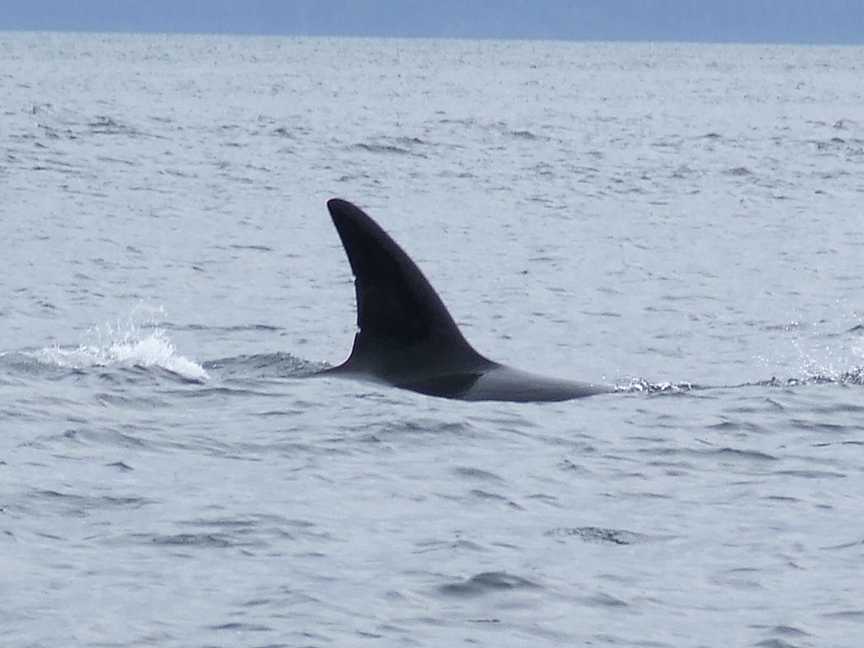
when I saw a narrow black shape
slowly disappear in the water ahead of me in the
unmistakable way that male orca dorsal fins slip into the water as they
dive. Sure enough, he blew again, heading
generally in the direction I was going, but straight for Grand
Island. I had no idea which direction he'd go from there, so I
just headed
toward him (I was still pretty far away) and hoped for another
glimpse. When I saw him again he was a little bit behind me, and
then I spotted his companions close to shore, almost camoflaged against
the dark rocks.
I knew it was going to be tricky to track them--from Point Arden they
could go to the left of Grand Island, the right of Grand Island, turn
into Doty Cove, or something inbetween, and I had nothing to go
on. So I turned
toward Doty Cove, keeping an eye out all around me in the hopes that
I'd see them again whichever decision they made. Suddenly I was
startled by the sound of a blow and turned back to see the big male
alongside the
boat! RIGHT alongside the boat, as close as he could get to it
and half way up the side. It was very startling and I was shot
through
with adrenaline. It was the first breath of his breathing cycle
and it seemed quite unlikely that I just happened to be at the exact
spot that he wanted to come up! I was also moving pretty
fast--not at speed, but faster than normal orca speed.
I slowed down and he came up in front of me, moving toward Doty Cove,
so that gave me a clue as to their movements. I pulled up
alongside him, but farther away, and snapped a few photos.
He had two nicks out of his dorsal fin that I thought would easily
identify him. When he dove I continued, slower now, toward Doty
Cove, still uncertain where they'd go. When I saw him again he
was behind me and had turned south again; I shut down to let him pass
and to listen, thinking that I
might hear the others in
the quiet. Sure enough, some distance ahead of him, I saw the
smaller group come up and sped in their direction. Before I
caught up, the adults dove, but the little calf sloshed around and did
a couple of half breaches, enough that I could see he was still orange
in his white patches (i.e., pretty young). I continued south at
orca pace; when I saw them again, they'd gone back to hugging the
Admiralty shore (after crossing the wide mouth of Doty Cove) and were
following the contour of Admiralty Island. Having taken what I
thought were good ID photos of the male already, I concentrated on the
ladies
(or lady and calves), which proved to be more difficult (there was one
small calf, its mother, and an individual that could have been an adult
female or a calf or either sex). I did
manage to match their pace pretty well, but my efforts to be polite and
not move in too close didn't yield any great ID shots. I could
see that the mother had one nice nick in her dorsal fin and that her
older companion appeared to have an unblemished fish of smaller
size. Once, the latter came up fast a couple of times out of the
breathing cycle, almost porpoising and closer than usual. I never
saw a reason and hoped
I
wasn't bothering them.
As we approached the next point, I decided I should probably leave them
and head on my way. The fading light and still air (which allowed
the blows to linger over the identifying parts of their bodies)
prevented me from taking really good ID shots, but I hoped I had
enough. They came up much closer on their last breathing cycle
and I got a much better look at their dorsal fins. As I turned
away from them toward Snettisham, I spotted the male on my
He'd been traveling a few hundred yards from the
others the whole time and I wondered if it was a hunting strategy of
just a preference. Since he was on my way, I decided to try for
one more ID shot, so I passed behind him, then tried to match
his direction on the opposite side (ID shots are always taken of the
left side of an orca). The next time he came up he was somewhat
behind me and turned in my direction. I shut down to be polite,
as he was going to pass me if he continued on in that direction.
Then I
saw his white belly underwater about 50 feet away, heading in my
direction and I knew that somthing interesting was going to
happen! When he got closer
I could see something pink underwater and knew that his penis was
extended; as he came alongside the boat, he exposed his
belly and penis to the air, right next to me (see photo to
right)! You really just need to look at the
photo. When he rolled on his side before diving, my
fingertips were inches from his magnificent flukes! I was in such
shock and had so much adrenaline running through me I was breathing
hard and my heart was pounding. I'd just nearly touched a wild,
male, transient orca! What could his gesture possibly
mean!? I have no idea! Was he curious, dominant, feeling
his oats, annoyed
that I'd hung out with his women for so long,? I looked around
for him to
come up and, but a few moments later, saw his white body again
underwater behind the engine and rushed back there, this time with my
camera on video. As soon as his great pectoral fin broke the
surface as he rolled again, though, I scrapped the video idea, as I had
a second chance to touch this amazing creature and I was not going to
miss it! I reached out with my left hand as the pectoral fin came
by and I was sure it was going to happen! Alas, just as it came
close, the orca rolled slightly back and I missed the fin by about four
inches. I don't know whether the movement was intentional or
not--I'm not sure if he could see me reaching for him or not (I hope he
could). Then he took a breath about 50 feet away heading back
south, so I figured the encounter was over. I just stood there
trying to catch my breath for a while, totally floored at what had just
happened. A male transient is not the kind of orca I would expect
to interact like that! And then I heard a blow and turned around
to find him facing me with his head above water right off the side of
the boat,
sneakily taking a peek
inside
Wow! I've had orcas spy hop before, or raise their heads above
water to look at me, but always with only one eye. This orca was
facing me like I was a trainer in Sea World and, though it happened so
fast that I didn't see his eyes, I am sure that he saw mine (check out the video).
His
eyes are clearly visible in the still clips below that I took from the
video! He sank below the water and disappeared; Cailey rushed
over and watched him go down, cocking her head dog-style as his white
eye patches loomed beneath her. Then he came up for a
breath again back on the other side of the boat heading south.
This time he continued on his way, and so did I, exhilerated beyond
description. It made my summer--one of the two most incredible
orca encounters I've ever had, the kind of thing you're very, very,
very
lucky to experience once in a lifetime. I looked at the photo and
the video several times on the way to Snettisham, that night, and all
weekend.
When I got home on Sunday I immediately searched the latest transient
orca catalog online, to no avail. The only orca I found that
matched the nicks I saw in the male's dorsal fin (the only one of the
group I had a
good enough image to identify) was a juvenile at the time the
catalog was last updated, and the fellow I saw had a big fin. I
thought it was possible that that fin had just started to sprout, which
might account for the boisterousness of the individual, but it seemed a
long shot. Plus, the young orca in the catalog was the
same orca I'd seen (with a small fin) in 2009 in Icy Strait, so
what were the chances that the transients I saw three years later would
be the same ones out of hundreds of animals? I sent the photos
and a description of the encounter to Graeme Ellis, Canadian orca
biologist and, to my delight, he (independantly) believed that I had,
in
fact, encountered the T137s again. The mother was T137,
the male was T137A, and the others probably T137B (born 2006) and,
well, T137C, who isn't even in the catalog yet! T137A is only ten
years old and just beginning adolescence, so his behavior is less
surprising. Graeme suggested that his display was an example of
"boys will be boys" (having no better idea than I did about what it
might mean), and that his interest could also have involved predatory
exploration in relation to Cailey. Given the rest of the
encounter, I suspect that's not the case, but we'll never know!
That
night I ate bread, wine, and chocolate for dinner, then went to my
cabin to read in bed. Cailey paced around the room and wouldn't settle
down until I finally acquiesced and, against my better judgement,
allowed her to snuggle up against me on top of the bed.
T137A (the male)
T137 (the mother)
T137 and T137C? (mother and calf)
T137B? (the other orca)
T137B?
T137A approaches
That white spot in the middle is his belly!
You can see his eye so clearly in this still
Cailey watches with interest as T137A sinks below the surface
The next morning I didn't have much more than puttering
in me. I
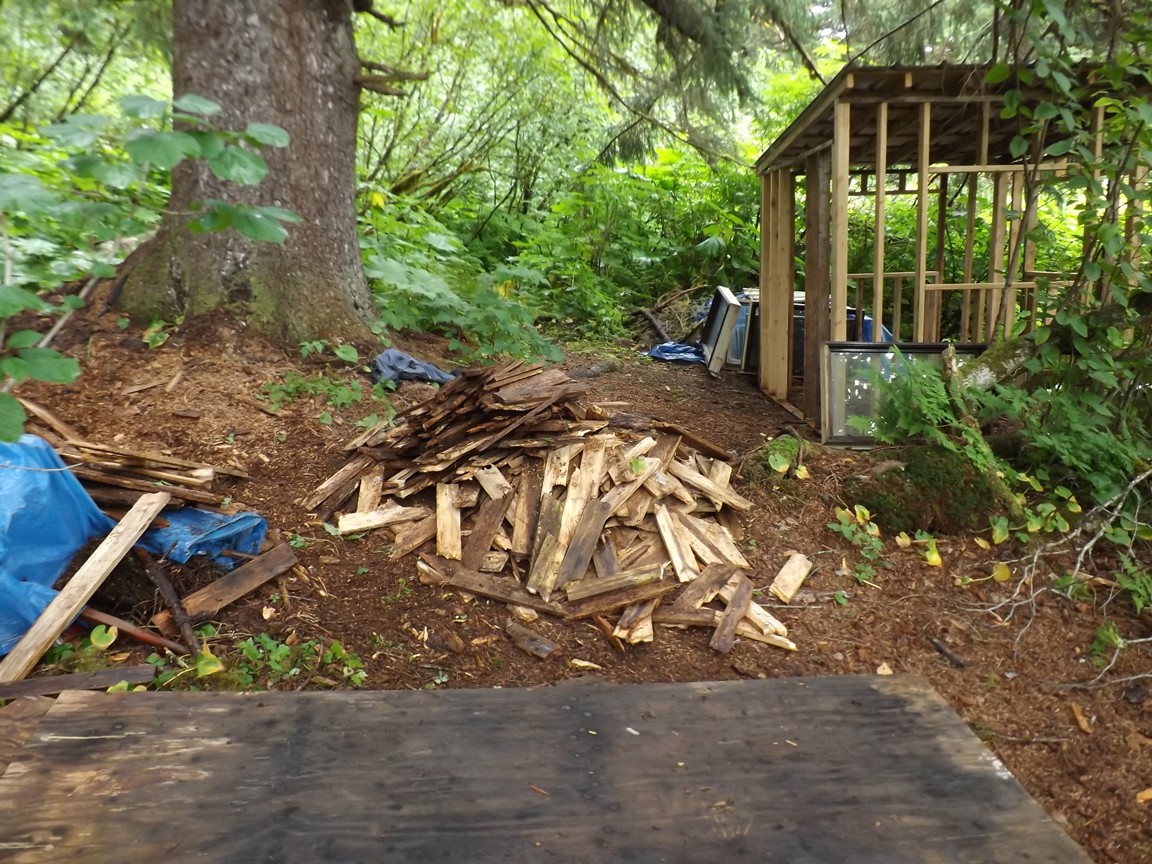
was feeling a bit down about the summer's progress; there was the shed,
framed in May, without windows or walls or floor. But before I
tackled that, I tried to fix the sink. Although it had
worked well for several years, I could not get the drain below the sink
to stay together and had finally determined that I needed to bring the
outlet pipe up a little—perhaps the building had settled. I
crawled into the bear proof box with cordless drill, and (after several
trips), hammer and chisel, and widened the hole. My hole saws
would make
too big a hole, so I drilled small holes close to each other that I
could chisel out. Long story short, after enlarging the hole a
couple of times and studying the situation inside, I finally realized
that I was just going to have to extend the pipe down from the sink
instead of raising the pipe that drained outside. Having failed
that task, I went back to the shed. I'd put off
trying to install the windows all this time, thinking that I'd need
help, and it
finally occurred to me that I should put the siding up first so the
window frame overlays the plywood. I hoped to use some of the
plywood from the murrelet camp which was stacked nearby (separate from
the rest of the lumber), but in the meantime I figured I could at least
see if the windows fit! I selected a handy window and slid it
into every opening without a problem; I'd left a little gap in the top
of each window to
make sure they fit, so when I put the window through the opening in the
back wall, I badly pinched the tip of one finger on my left hand
against the sill as the window leaned precariously back. When I
managed to pull it upright
again, the tip of my finger had been squashed and was numb. Then
the pain exploded and I had to stop working until it subsided. I
feared I might have damaged something, but the finger was back to
normal by that night.
So the next step was plywood, which was stacked behind a hodgepodge
pile of lumber thrown aside two years ago. I wasn't sure what I'd
find when I uncovered the stack and was disappointed that
the plywood was wet; and not just wet, they were also all thick
floorboards,
maybe 3/4"and not appropriate for siding. I would have to buy
new siding and bring it down, which will make the shed more attractive
anyway. The boards, however, looking in good enough shape for
the floor, so I picked through and selected two of the better ones
close to the front and laborously drug and flopped them a few feet away
onto the path. This plywood was heavy! Thick and
waterlogged, I could barely maneuver them at all. I finally
gave up and just toppled them end over end until they were off the wood
pile. Cailey immediately started gnawing on a corner and
scratching in the middle, but I shut that down before any serious
damage was done. After that arduous and unsatisfying task, I
didn't have any will or energy for continuing that project; instead, I
decided to start dealing with the mess of wood on the ground that I'd
just stumbled over. When Chris, my cousins, and I sorted through all
the old lumber two years ago, burning all the unsalvagable pieces on
the beach, we threw the rest aside to make into firewood. More
than half of the pile were 1x4s. Chris had managed to break a few
of
them into wood stove sized pieces two years ago by stomping on them,
and I thought maybe they'd be softer now and I could manage some as
well. I was motived to work on that pile of wood for three
reasons: 1) easier access to the plywood; 2) finally cleaning up the
unsightly mess of random scraps of lumber poorly covered in an ugly,
battered blue tarp; and 3) putting up firewood is deeply satisfying
work, almost on par with putting up fish for the winter. There
are lots of good, hearty homestead tasks, but I love to put up
firewood! So I uncovered part of the mess and began pulling out
old 1x4s, of which I had a bundle. As expected, they'd been
nicely seasoning (okay, rotting) under that tarp and were easy to break
by stepping on them and pulling up. I soon had a nice stack of
firewood going! As I got deeper into the pile, I started to come
across the other boards which were much bigger and impossible to
break. Thinking there wasn't too much of it, I started to put
those pieces in a stack on the deck, with the idea of cutting them up
with
a skilsaw later when I made joists for the shed floor (also on the
agenda). When I'd broken all the 1x4s, I had a huge stack, and
dumped half a dozen or more wheel barrow loads onto the deck. I
moved all the rest of the dry firewood to the back porch and created an
enormous stack of firewood in its place under the porch, about three
feet wide and all
the way to the porch above.
Then I decided I'd
better work on the floor joists. I measured the width of the shed
floor and pulled out nine 2x4s left over from the murrlet camp and
placed them on
saw horses on the deck. After I cut them I set to work cutting
the scrap lumber along with the discarded boards from the shed
construction which I hadn't put back with the rest of the protected
lumber. Some had been put aside because they were more rotten
than the others, so I figured they'd make good firewood too.
Cutting firewood with a skillsaw is easy, since I don't have to measure
or mark cuts, nor even cut them at a 90 degree angle (though that
does make things easier). I cut about half the lumber then, and
the other half later, which made another large stack of firewood under
the front porch. While I was working I was pleased to see a whale
feeding in the inlet, a phenomenon more typical (but largely absent
this year) in the spring. I enjoyed lunch on the porch watching
the whale and enjoying the day.
Broken firewood
This area is so much cleaner now
Lumber firewood
Double stack of firewood
Floor joists
Nigel cottonwood
All
day long I'd been anxious for 4:00 to arrive when I was slated to
zip over to Sweetheart Creek in the hopes of late sockeye. I was
anxious on two counts--both because fishing there is an intense
experience and because I would be leaving Cailey alone at the homestead
for the first time. I can't leave her unsupervised in the lodge
(too many things to get into or damage if she tried to follow me), but
it
finally occurred to me that she might be comfortable in Hermit
Thrush. I could easily remove most of what she might destroy, it
was as far from the sound of the boat leaving as possible, and the
noise might
be overshadowed by the nearby creek anyway. I'd done a
trial run earlier in the day, leaving her in there with lunch while I
ate lunch myself (having removed the pillows, the garbage, and a few
other things). After 45 minutes I snuck up and found her
perfectly at ease (or so it seemed), curled up on the bed. Around
3:00 I finally decided to start the venture. I brought Cailey
some food, a hoof, and a new stuffed toy and brought her into the
cabin, but I didn't close the door soon enough and Cailey zoomed out
the door with her new toy and disappeared down the hill. I
followed her down to Harbor Seal, where she reappeared, but zoomed away
again as we neared Hermit Thrush. She finally came back, sans
toy, and was unceremoniously shut inside. By that time I knew she
was exhausted from a day of playing outside and carousing with her
favorite big burl log (I'd even left her outside when I was in the
lodge to prevent her from napping), so I wasn't really worried about
damage unless she was anxious about me leaving her at the homestead
(which seems to be more serious than leaving her at home).
And then I grabbed my backback, loaded with a stringer and a bonker
that I'd cut from a 2x2 cedar strip that morning, and took off for
Sweetheart at 3:35 with the kayak resting across the rails behind
me. I
was surprised to find quite a few boats an anchor when I
arrived--surprised becuase it was a little later than the standard
season and also the weekend of the Golden North Salmon Derby. I
knew there was a chance I wouldn't have a good place to fish, but I had
no expectations; if every normal spot was taken, I'd just hike up to
the
top pool and see what happened. I gave myself two hours on the
creek,
then I
would head back to the dog.
When I got to the first big point overlooking the first waterfall, I
could see that every fishing spot was occupied. I peered down
into the crevasse overlooking the top of the lower pool and startled
the party fishing in there; they confirmed that there were sockeye
in. Looking up to my favored point, I could see a lot of gear by
the water, but the only person I saw was heading upcreek, so I thought
I'd go up there and sniff around. I found no one on the point,
but three people at the falls, one casting into the edge of the pool
above and the other dipnetting below the falls with a short net; the
creek was too loud for words, but through gestures and mouthing I
managed to ask if the point was theirs, which it was, but they
indicated that I was welcome to fish there. And so I set up
shop--a bonker and my leatherman and the stringer handy, backback
secure, net out. It was 4:05. Within the first few minutes
I caught a jack sockeye and, once I confirmed that it wasn't a little
pink, I make a quick decision
to keep it. I don't normally keep jacks, but my freezer was low
on fish and I was desperate! I figured he'd be delicous in a
pasta. Several casts later I caught another jack and, somewhat
ashamedly, kept it too. Because I had no one to guard my fish, I
kept them close in the "bleeding crevass" behind me; unfortunately,
there is nothing to tie the stringer to right there so I had to tie it
around a small stump around the corner, leaving the stringer rather
short. I was surprised to find that there were no pinks at all
where I was fishing, seeing as how it was so late in the season!
Usually at that time of year we are neck high in pinks, spending more
time releasing them from the net than actually fishing. But the
conditions were quite pleasant and the only fish I caught were
sockeyes. After a while I felt a pretty good tug when the net
spilled over the falls and into the current below and pulled in two
sockeyes at once! A little while later I brought in a
single, all normal size. The overcast day turned to rain breifly,
but I was
unconcerned. I wasn't doing nearly as well as the dig netter
across the creek, but I was feeling much better about it and the trip
had definitely been worth it. I remember when I first started
going to Sweetheart Creek that my casting was rather poor and many
times the
net hit the water like a taco; and yet, those casts seemed to yield
just as many fish as when the net fell on the water in a
perfect circle. That was definitely not the case here. It
was my well executed and well placed casts that yielded sockeye--in the
green pool at the edge of my range, or at the edge of the white water
just
to the left. After one particularly good cast, the tug that
followed when the net entered the current below the falls pulled me off
my feet and it took considerable effort to steady myself and haul it
in. Inside were FOUR sockeye!! I was
thrilled. I felt like I was playing whack-a-mole when I bonked
them,
going from one to the next and back again until they were all
quiet. Unfortunately, they were so tangled and twisted in the net
that it took a really long time to release them. When I finally
got the first two out I bled them and strung them before going back to
the others. At that point I had seven older fish and two jacks
and I'd used up so much of my stringer that my fish were half out of
the water! To keep them cool I'd have to move the stringer around
the corner where I couldn't adequately guard them and fish at the same
time, and I was not willing to give my fish up to a wandering brown
bear! That was one of several reasons I considered quitting at
that point. I also did not want to be greedy and considered
myself pretty blessed to get four fish in one cast; plus Cailey was
back at the homestead and I was anxious to make sure she was
alright. Also, fish are heavy and I wasn't sure how many I could
carry out! When one of the several brown bears in the area was
chased off by the group in the crevasse downstream and disappeared, my
decision
was made; he may well have been heading upriver and, by the time I
realized
he was around, I'd be powerless to keep him off my fish if they were
around the corner. So, after chatting a few minutes with the guy
who relinquished the point to me, I rather awkwardly slid my catch into
the
yellow dry bag I'd packed along in the bucket, put everything else
hastily away, and headed out. I really should have taken more
time to set up my gear better. As it was, the dry bag backpack,
which is quite large, drooped so low that the fish bumped against my
rear end; I wore my regular backpack over that, but the straps were too
tight over the dry bag straps and cut into my shoulders
uncomfortably. I was so heavy and off balance that I couldn't
stand up one of the logs I wanted to walk on and instead had to slide
over the top of it.
So it was an uncomfortable (though triumphant) walk back.
Normally I'd stop at the
creek below the lower pool where the water moves fast in order to clean
the fish before hauling them over the peninsula to the kayak, but the
idea of putting everything down, getting the fish out of the bag (and
then back in) only to walk for two minutes to the other side was
unappealing, so I decided to just cut through the woods and go straight
out. This turned out to be a poor idea. The trails through
the woods were rough, tangly and muddy and awkward, and they felt
a lot longer than the trail along the creek. It would have taken
less time and effort, I think, to follow the normal, well-trodden and
familiar route. By the time I reached the trail across the
peninsula, I was tired and aching and moving very, very slowly and was
feeling better about the number of fish I'd caught (I surely didn't
want to carry any more at that point). The tide had not come in
very far, either, so I when I reached the beach I had a very long haul
down the beach to the water; I wasn't sure it was any easier putting
the fish in the kayak and pulling them! Then followed the
unpleasant task of
cleaning all my fish in the shallow water, bending down uncomfortably
among the noseeums. I was realizing that my tactic was
flawed--not only had the "shortcut" I'd taken been worse than the
normal path, and probably not any shorter, but I'd wound up with
uncleaned fish at a very awkward and innappropriate place for
cleaning. The reason we're supposed to clean fish in fast moving
water is to get the guts flowing away rather than sticking around shore
to attract bears. So here I was on a very gradual intertidal
beach cleaning my fish. I didn't want to leave scraps around, so
I took the net out of the bucket and put all the fish guts in it.
When I was done I gratefully kayaked out to the boat, absolutely
thrilled at the catch I had. I loaded everything onto the boat,
dumped the guts, and started icing. Not wanting to tempt fate,
I'd only brought one bag of ice along, which turned out to be somewhat
inadequate for seven plus two fish. I wound up with two larger
fish and the two jacks without significant ice in or around them and
started considering options. By that time most of the boats had
left, leaving only one skiff with an occupant. I cruised over
there and asked if he had any extra ice. He said he didn't know,
as he hadn't been in charge of ice in his group, but that I could ask
the others who were at that point hauling gear down to the beach.
I puttered around a little in order to pull up when they were at the
shoreline and repeated my request. It turns out that I'd met the
two at the Easter campout in Sunshine Cove, and they
happily offered to give me some ice. I used more than half the bag they
gave me, thanked them, and headed on my way. I sure hope I left
them with enough ice! They said they had more than they thought
they had room for, so hopefully that's the case. They'd been
spear fishing sockeye in the lower pool and cast netting I think;
dressed in wet suits, they could cross the creek with impunity.
Very pleased with the day now that I'd caught fish, I returned to the
homestead to find Cailey resting comfortably on the bed. We had
supper, I read the rest of a portion of manuscript a friend had given
me, and called Chris in Washington to tell him about how thoroughly I'd
broken out of the funk, all the while
watching a whale lunge feeding in the inlet amonst circling gulls.
The days were still
pretty light, so I moved the double camp chair under the picture window
and read there instead of turning on the propane before going to
bed. It took me a
long time to fall asleep that night (perhaps the Russian tea I rewarded
myself with when I returned from Sweetheart Creek, the excitement of
the catch, or lingering guilt over slaughtering fish?) and I didn't
sleep particularly well, but got up with enough energy to do a couple
of small tasks before heading out.
The next morning I returned to the shed, thinking I
could at least get the joists nailed in and the
floorboards down. My dad had mentioned that when he got tired of
a shed with a dirt floor he put joists between the studs and put a
floor on top. After the shed went up, I could see that the ground
there was too moist and soft to be a good shed floor. I first
wanted to tack the joists in to make sure the 2x4s would support a
floor (spanning eight feet), so I set about putting a nail in the end
of each one. This turned out to be a ridiculously hard task,
partly because the angle was awkward on some of them (not much room to
swing), but also because the wood was puzzlingly hard. By the
time I got them secure enough to test, I was sweaty and
irritated. I did manage to scoot end-over-end the two pieces
of plywood to the shed, but discovered that they were too long for the
floor. I’d forgotten that the outside of the shed is eight feet
wide (same as the plywood), but the inside was seven inches less.
I decided to wait to cut them until I had help lifting them off the
ground (they were MUCH heavier than your normal piece of
plywood). Instead, I laid down a scrap piece of plywood and
decided the joists would support it just fine.
And
that was the end of work for the day. I wanted to head out early
to halibut fish on the way home and still get back with enough time to
process all the fish and welcome Chris back from his week in
Washington. At about 11:00, Cailey and I paddled out to the boat
and took off for another area of Snettisham. I’d heard that there
was halibut around the entrance to Mallard Cove and Fanny
Island and the underwater topography looked good. I fished up
Mallard Cove at a couple of depths from 120 feet to 50 feet with barely
a nibble, then drifted out again and moved over to the rocky islet
between Fanny Island and the shore and anchored up again, also to no
avail. At about 12:30 I finally gave up and headed out. It
had been raining steadily since before dawn and I had put Cailey’s rain
jacket on her to help keep her warm. The whole time we fished she
bopped around on the boat, often sitting toward the stern and watching
the seals around us. There were, as usual, quite a few seals
swimming around Mallard Cove, which made more sense when I anchored up
off the nearby rocky reef; unbeknownst to me, that rock is a haulout
for scores of seals, many of whom cruised by to visit us as we fished.
Thankfully,
the weather outside in Stephen’s Passage was pleasant and we made it
back to the harbor around 3:15. I headed home, showered, and
began processing my catch, noticing that this batch of sockeyes was
quite beaten
up. I cut out two fresh wounds, one of which looked like a slash
caused by a bear claw (as opposed to a seal bite); one of the wounded
fish
also had scars that had long-healed. Another fish had an old scar
on its side in the shape of a shark’s mouth—a perfect oval! I
can’t think of anything else that could have made it. Chris’s
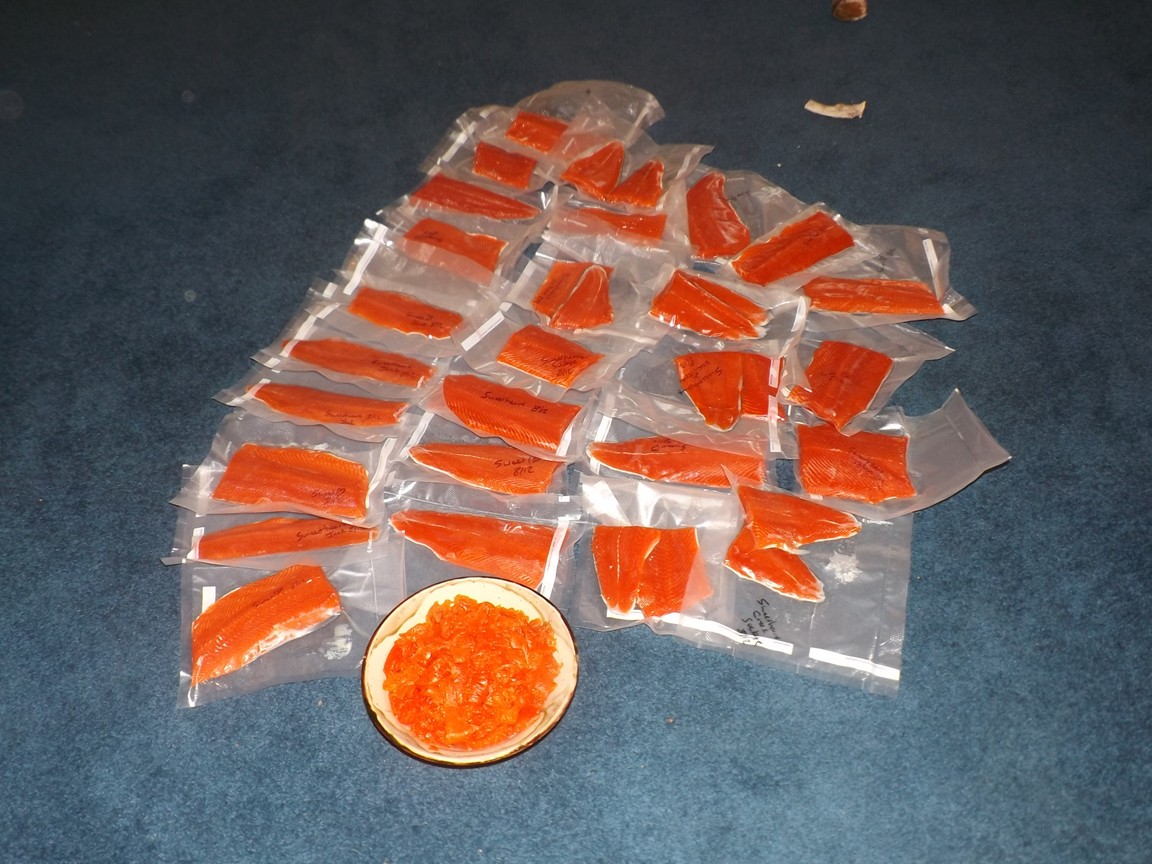
flight (which was delayed) arrived in time for him to help me vacuum
pack.

 Chris
and I were in a mid-summer
funk. Sentimental items were breaking (or being destroyed),
precious fish had been stolen by bears, and things were generally not
going our way. This went on for several demoralizing weeks.
Then on a Tuesday we both independantly began to feel
better and hoped our funk had passed. On Friday, there was no
longer any doubt. Here's how I know. I was just
south of Point Arden on a calm sea heading to Snettisham with my dog
when I saw a narrow black shape
slowly disappear in the water ahead of me in the
unmistakable way that male orca dorsal fins slip into the water as they
dive. Sure enough, he blew again, heading
generally in the direction I was going, but straight for Grand
Island. I had no idea which direction he'd go from there, so I
just headed
toward him (I was still pretty far away) and hoped for another
glimpse. When I saw him again he was a little bit behind me, and
then I spotted his companions close to shore, almost camoflaged against
the dark rocks.
I knew it was going to be tricky to track them--from Point Arden they
could go to the left of Grand Island, the right of Grand Island, turn
into Doty Cove, or something inbetween, and I had nothing to go
on. So I turned
toward Doty Cove, keeping an eye out all around me in the hopes that
I'd see them again whichever decision they made. Suddenly I was
startled by the sound of a blow and turned back to see the big male
alongside the
boat! RIGHT alongside the boat, as close as he could get to it
and half way up the side. It was very startling and I was shot
through
with adrenaline. It was the first breath of his breathing cycle
and it seemed quite unlikely that I just happened to be at the exact
spot that he wanted to come up! I was also moving pretty
fast--not at speed, but faster than normal orca speed.
Chris
and I were in a mid-summer
funk. Sentimental items were breaking (or being destroyed),
precious fish had been stolen by bears, and things were generally not
going our way. This went on for several demoralizing weeks.
Then on a Tuesday we both independantly began to feel
better and hoped our funk had passed. On Friday, there was no
longer any doubt. Here's how I know. I was just
south of Point Arden on a calm sea heading to Snettisham with my dog
when I saw a narrow black shape
slowly disappear in the water ahead of me in the
unmistakable way that male orca dorsal fins slip into the water as they
dive. Sure enough, he blew again, heading
generally in the direction I was going, but straight for Grand
Island. I had no idea which direction he'd go from there, so I
just headed
toward him (I was still pretty far away) and hoped for another
glimpse. When I saw him again he was a little bit behind me, and
then I spotted his companions close to shore, almost camoflaged against
the dark rocks.
I knew it was going to be tricky to track them--from Point Arden they
could go to the left of Grand Island, the right of Grand Island, turn
into Doty Cove, or something inbetween, and I had nothing to go
on. So I turned
toward Doty Cove, keeping an eye out all around me in the hopes that
I'd see them again whichever decision they made. Suddenly I was
startled by the sound of a blow and turned back to see the big male
alongside the
boat! RIGHT alongside the boat, as close as he could get to it
and half way up the side. It was very startling and I was shot
through
with adrenaline. It was the first breath of his breathing cycle
and it seemed quite unlikely that I just happened to be at the exact
spot that he wanted to come up! I was also moving pretty
fast--not at speed, but faster than normal orca speed.  closer
I could see something pink underwater and knew that his penis was
extended; as he came alongside the boat, he exposed his
belly and penis to the air, right next to me (see photo to
right)! You really just need to look at the
photo. When he rolled on his side before diving, my
fingertips were inches from his magnificent flukes! I was in such
shock and had so much adrenaline running through me I was breathing
hard and my heart was pounding. I'd just nearly touched a wild,
male, transient orca! What could his gesture possibly
mean!? I have no idea! Was he curious, dominant, feeling
his oats, annoyed
that I'd hung out with his women for so long,? I looked around
for him to
come up and, but a few moments later, saw his white body again
underwater behind the engine and rushed back there, this time with my
camera on video. As soon as his great pectoral fin broke the
surface as he rolled again, though, I scrapped the video idea, as I had
a second chance to touch this amazing creature and I was not going to
miss it! I reached out with my left hand as the pectoral fin came
by and I was sure it was going to happen! Alas, just as it came
close, the orca rolled slightly back and I missed the fin by about four
inches. I don't know whether the movement was intentional or
not--I'm not sure if he could see me reaching for him or not (I hope he
could). Then he took a breath about 50 feet away heading back
south, so I figured the encounter was over. I just stood there
trying to catch my breath for a while, totally floored at what had just
happened. A male transient is not the kind of orca I would expect
to interact like that! And then I heard a blow and turned around
to find him facing me with his head above water right off the side of
the boat,
sneakily taking a peek
inside
Wow! I've had orcas spy hop before, or raise their heads above
water to look at me, but always with only one eye. This orca was
facing me like I was a trainer in Sea World and, though it happened so
fast that I didn't see his eyes, I am sure that he saw mine (check out the video).
His
eyes are clearly visible in the still clips below that I took from the
video! He sank below the water and disappeared; Cailey rushed
over and watched him go down, cocking her head dog-style as his white
eye patches loomed beneath her. Then he came up for a
breath again back on the other side of the boat heading south.
This time he continued on his way, and so did I, exhilerated beyond
description. It made my summer--one of the two most incredible
orca encounters I've ever had, the kind of thing you're very, very,
very
lucky to experience once in a lifetime. I looked at the photo and
the video several times on the way to Snettisham, that night, and all
weekend.
closer
I could see something pink underwater and knew that his penis was
extended; as he came alongside the boat, he exposed his
belly and penis to the air, right next to me (see photo to
right)! You really just need to look at the
photo. When he rolled on his side before diving, my
fingertips were inches from his magnificent flukes! I was in such
shock and had so much adrenaline running through me I was breathing
hard and my heart was pounding. I'd just nearly touched a wild,
male, transient orca! What could his gesture possibly
mean!? I have no idea! Was he curious, dominant, feeling
his oats, annoyed
that I'd hung out with his women for so long,? I looked around
for him to
come up and, but a few moments later, saw his white body again
underwater behind the engine and rushed back there, this time with my
camera on video. As soon as his great pectoral fin broke the
surface as he rolled again, though, I scrapped the video idea, as I had
a second chance to touch this amazing creature and I was not going to
miss it! I reached out with my left hand as the pectoral fin came
by and I was sure it was going to happen! Alas, just as it came
close, the orca rolled slightly back and I missed the fin by about four
inches. I don't know whether the movement was intentional or
not--I'm not sure if he could see me reaching for him or not (I hope he
could). Then he took a breath about 50 feet away heading back
south, so I figured the encounter was over. I just stood there
trying to catch my breath for a while, totally floored at what had just
happened. A male transient is not the kind of orca I would expect
to interact like that! And then I heard a blow and turned around
to find him facing me with his head above water right off the side of
the boat,
sneakily taking a peek
inside
Wow! I've had orcas spy hop before, or raise their heads above
water to look at me, but always with only one eye. This orca was
facing me like I was a trainer in Sea World and, though it happened so
fast that I didn't see his eyes, I am sure that he saw mine (check out the video).
His
eyes are clearly visible in the still clips below that I took from the
video! He sank below the water and disappeared; Cailey rushed
over and watched him go down, cocking her head dog-style as his white
eye patches loomed beneath her. Then he came up for a
breath again back on the other side of the boat heading south.
This time he continued on his way, and so did I, exhilerated beyond
description. It made my summer--one of the two most incredible
orca encounters I've ever had, the kind of thing you're very, very,
very
lucky to experience once in a lifetime. I looked at the photo and
the video several times on the way to Snettisham, that night, and all
weekend. 






 beach.
I puttered around a little in order to pull up when they were at the
shoreline and repeated my request. It turns out that I'd met the
two at the Easter campout in Sunshine Cove, and they
happily offered to give me some ice. I used more than half the bag they
gave me, thanked them, and headed on my way. I sure hope I left
them with enough ice! They said they had more than they thought
they had room for, so hopefully that's the case. They'd been
spear fishing sockeye in the lower pool and cast netting I think;
dressed in wet suits, they could cross the creek with impunity.
beach.
I puttered around a little in order to pull up when they were at the
shoreline and repeated my request. It turns out that I'd met the
two at the Easter campout in Sunshine Cove, and they
happily offered to give me some ice. I used more than half the bag they
gave me, thanked them, and headed on my way. I sure hope I left
them with enough ice! They said they had more than they thought
they had room for, so hopefully that's the case. They'd been
spear fishing sockeye in the lower pool and cast netting I think;
dressed in wet suits, they could cross the creek with impunity.