September 24-25

Looking up Speel Arm from Dipper Creek
Snettisham
2011 - 9: Handling and Manhandling the Riverboat
September 24-25
Looking up Speel Arm from Dipper Creek
Closeup. It's a bittersweet time. Since Labor Day weekend I'd come to terms with the end of summer and my progress (or lack thereof). I'd taken a short trip to Anchorage, been weathered out of the Taku for a second time this summer, and began catching up on chores around the house. My plan was to close up during the spring tides at the end of the month, chartering a float plane for the luxury of a more reliable (and comfortable) ride. After all, with the riverboat unplugged, an 18.5' tide would put her under the water and I needed to make sure I could get there in time. As it turned out, I was short volunteers for the really high tides (they fell on a Monday and Tuesday), so I was swayed into accepting help on the weekend before instead, relying on the strength of the volunteers to move the boat without the help of the tides. The crew consisted of Chris, Torsten, and my mother (the plane could carry a maximum of four people).
We headed out Saturday morning at 9:00 with Admiralty Air, which now operates the 206 that used to belong to Jacque (who's flying only wheel planes these days). The flight down was uneventful; I gazed at the seas curving up from the southeast and wondered what it would be like down there on the water. I think I would have made it in the Ronquil, but it was a joy to fly instead! It looked like awfully big water from the air. The landing was a little more exciting than the flight. After cruising alarmingly close to the avalanche area across the inlet from the homestead, our pilot Gary made a rather steep turn to land, and we all independently thought we were going to drag a wing in the water before he leveled out! However, he landed like a pro. We laughed about it later.
 The
riverboat was sitting right where I left it on the beach, the water
creeping up toward the stern with the rising tide. We lit a fire
inside,
had a snack and a cup of something hot to drink, then decided to
explore via
riverboat. The stern wasn't floating yet, but the four of us
managed to
swing it around and drag it into the water, not without scraping the
hull while
pivoting on a stubborn piece of shale protruding from the grass.
The
engine was cold and difficult to start; I eventually got it to run, but
it soon
died. Torsten, with considerably more force behind his pull than
me,
started it again, and off we flew on glassy water towards Gilbert Bay,
Chris
and my mom in the bow and Torsten on the action packer. There was
a boat
at anchor in Gilbert Bay, which was a surprise, and Chris saw a camera
flash as
we passed Sweetheart Creek. We also saw a buffalo at the mouth of
the
creek, which manifested into a brown bear, which we must have startled
as we
went by, as he reared back and lumbered off.
The
riverboat was sitting right where I left it on the beach, the water
creeping up toward the stern with the rising tide. We lit a fire
inside,
had a snack and a cup of something hot to drink, then decided to
explore via
riverboat. The stern wasn't floating yet, but the four of us
managed to
swing it around and drag it into the water, not without scraping the
hull while
pivoting on a stubborn piece of shale protruding from the grass.
The
engine was cold and difficult to start; I eventually got it to run, but
it soon
died. Torsten, with considerably more force behind his pull than
me,
started it again, and off we flew on glassy water towards Gilbert Bay,
Chris
and my mom in the bow and Torsten on the action packer. There was
a boat
at anchor in Gilbert Bay, which was a surprise, and Chris saw a camera
flash as
we passed Sweetheart Creek. We also saw a buffalo at the mouth of
the
creek, which manifested into a brown bear, which we must have startled
as we
went by, as he reared back and lumbered off.
It was an hour before high tide and the grassy estuary of Gilbert Bay was almost entirely flooded. We passed many flocks of ducks and other birds, especially as we neared the mouth of Gilbert Creek in the southeast corner where we startled up a flock of Canada geese. Several eagles perched in treetops and snags, a brace of mergansers rested near the shore, and kingfishers flew overhead. If was a beautiful early fall day and we soon came upon the mouth of a big, brown water creek. A shallow, rocky creek entered the bay to the left as well, but I swung around a loop to the right and entered the larger creek, getting up my nerve to move a little faster than usual despite the new terrain. The cut bank to the right revealed egg-sized round rocks and I could see that the substrate of the creek was also mostly small rocks--a welcome change from sand and silt. We took two big turns, passing what looked to be potential fishing holes, and then I ran into a gravel bar in the middle of the creek. I killed the engine as quickly as I could but, sure enough, as I showed everyone, the starter cord would not pull. I'd have to clean out the engine again.
And so we came up on shore at a little beach edged in willows,
beyond which was
a large meadow and behind that the forest. Willows overhung the
water
across the creek, trailing into the brown water. It was a lovely,
lovely
creek--reminiscent of Johnson Creek up the Taku--and I wasn't really
very
cranky about the forced stop. Chris and Torsten started fishing
downstream and I took out the long screwdriver, surprised to find that
I was
able to move the propeller through the grill at the bottom of the
foot.
Still, the cord wouldn't pull, so I sloshed buckets of water up around
the propeller
and kept turning it; it got easier and easier to turn, but still the
starter
cord wouldn't pull. So I decided to take a little break to put
together
my fishing pole and join Chris in casting a little. It started to
sprinkle as I worked. Torsten meanwhile had snagged his gear in
the
willows across the creek and was using the riverboat to access
it. That
gave me an excuse to continue fishing for a while. Pink salmon
carcasses
lay everywhere along the bank and we spotted several late spawners in
the
stream, including a friendly one that Chris and Torsten played with
later on,
tempting it with Torsten's fly. My mother took a walk while we
fished and
discovered a little lake in the meadow nearby.
 I don't know what they look is! |
 The light gets dramatic as we cross Gilbert Bay |
 Looking at the mouth of Gilbert Creek from Gilbert Bay |
 Just outside the entrance to Gilbert Creek |
 Torsten fly fishing |
 Gilbert Creek |
After a few minutes, Torsten, my mother, and I reconvened at the riverboat to go through the process of removing the foot and further cleaning out the engine to see if we could get it to turn over. There was grit in there, but the impellor spun quite freely in both directions; Torsten removed the cowling and we could see that the flywheel was clearly moving in concert with the impellor. Why then couldn't we pull the starter cord? My mother eventually came up with the right question: "Is it in neutral" she asked? Well, it wasn't! Thankfully, everyone was good humored about it and it's a lesson I doubt I'll forget. Of course I know that you can't start the engine unless it's in neutral but it was a matter of a self-fulfilling prophesy. I had hit the bottom and, expecting the worst, did not do a thorough diagnosis of why I couldn't pull the cord. I just assumed that, as before, I'd sucked up enough sand to freeze the engine.
It was past high tide by then and I was ready to head out, but the others were ready for more adventure. They wanted to explore farther up that beautiful creek! They were, in fact, exactly the kind of companions I needed to get my gumption up to run the riverboat like it's meant to be run: fast and on step, drawing very little water. I know that's the way you have to operate the riverboat if you want to make it through shallow water, but I'm a cautious person and going fast through unknown territory could mean zipping up onto a sandbar or a gravel bar--or into a log--before I have a chance to slow down. That could mean disaster. But there was really no making my way up this creek without being on step, and these three were clearly going to be supportive if anything went wrong. So I went for it. I got up on step and I ran that creek like a son of a bitch (excuse the language). I had one of those exalting experiences, gloriously zooming up the river, swinging around bends like a champ, discovering that my instincts led me to maneuver in just the way I remember my dad handling the same situations when I was a kid. What fun! Chris and my Mom in the bow helped point me away from riffles and into the deep channels and good humouredly avoided the overhanging branches we passed under (everyone, including myself, was a little surprised that I didn't get swept overboard by some of them). It was a total success. I did run into a gravel bar once as I squeezed between the bank and a downed log and turned a little too far from the deep channel on the other side. I shut down immediately, put the engine in neutral, and discovered that it still worked. Torsten, who was the only one wearing hip waders, held us in the current until I started the engine, then let go and climbed on as soon as I had way. We worked out way up a little further before a tree blocked the whole creek.
So we headed back down, which I figured wouldn't be too hard; with the current running pretty fast, I didn't think we needed to go fast--we'd just take the current down. Boy was I wrong! It was more important in terms of control to go fast headed down river than up, I think, which I discovered after hitting the bank a few times and getting us tangled into overhanging branches more than once. As we headed inexorably toward the last disaster, everyone kept looking back at me in disbelief with expressions along the lines of "Why on earth won't you turn!?" But of course I WAS turning, as tightly as I could, but with little way on I had no control. The last crash put us in a big tangle of alders and, after we extricated ourselves, I got back on step and found that I could maneuver quite adequately to avoid any further collisions. Torsten happened to be taking a video of the ride leading up to the crash, but didn't manage to capture the more elegant moments of the trip. Neither did I have time to take any photos, so most of the upcreek adventure is unrecorded. I look forward to going back and exploring father upstream; having run that section even once, I have no qualms about running it again with a lot more confidence. I just like to know what's around the corner!
But for that day, it was time to move on. We sped back out
into
Gilbert Bay, past the Whiting River, and to Pool Creek (or so we might
name
it), the first of three creeks along the shoreline around the corner
from the
homestead (facing Stephen's Passage) that are marked as cohos streams
in
Alaska's Anadromous Waters Catalog (AWC). Torsten anchored the
boat as
far out as he could walk, then we all hiked up the stream and around
the
corner, though a cluster of downed trees and to a big, beautiful
pool.
It's the kind of pool that begs to be swum in on a hot day--about 20
feet in
diameter and at least several feet deep in the middle with a shale
bottom. At the back corner of it was a  torrid
white waterfall cascading
down about 30 feet into the pool. There was no way any fish could
make it
up that, if they could make it through all the debris in the creek to
the pool
in the first place. We were only a hundred yards or so from the
ocean and
I began to doubt the accuracy of the AWC. I know cohos spawn in
some small
awfully small streams, but there really didn't appear to be any good
spawning
habitat, let alone typical rearing habitat for fry. Torsten,
Chris, and I
hiked up the slippery edge of the waterfall about two thirds of the way
up
before we could go no farther. My mother, however, chose a route
through
the woods and made it to the top, reporting that there was another pool
at the
top, then more waterfalls. In the forest near the beach we found
a coffee
can and a metal bar.
torrid
white waterfall cascading
down about 30 feet into the pool. There was no way any fish could
make it
up that, if they could make it through all the debris in the creek to
the pool
in the first place. We were only a hundred yards or so from the
ocean and
I began to doubt the accuracy of the AWC. I know cohos spawn in
some small
awfully small streams, but there really didn't appear to be any good
spawning
habitat, let alone typical rearing habitat for fry. Torsten,
Chris, and I
hiked up the slippery edge of the waterfall about two thirds of the way
up
before we could go no farther. My mother, however, chose a route
through
the woods and made it to the top, reporting that there was another pool
at the
top, then more waterfalls. In the forest near the beach we found
a coffee
can and a metal bar.
So we moved to the next creek, which I'd explored some distance last
fall. Chris and Torsten checked it out while my mother and I
stayed in
the boat and refueled. The boys reported nothing interesting and
no
fish. I saw only one more creek along the beach ahead, which I
thought
must be the third creek, but it was little more than a trickle.
Stuck in
the middle of it on the beach was a human contraption that, on closer
inspection, looked like a bunch of metal railings and netting. We
followed this creek briefly and it turned out to be the only creek that
looked
like nice spawning habitat. Its grade was moderate, its substrate
of
small pebbles. Nice spawning habitat, that is, if it was several
times as
large. It was mostly about a foot and a half wide and quite
shallow, and
was blocked at the edge of the forest by several large trees crossing
from bank
to bank. It would have needed a lot more water to allow salmon to
pass. In the woods we found another box on the
ground like the
one Rory,
Kellee, and I found at River Point last summer nailed to a
tree, which we
never could identify. It made me wonder if these boxes harkened
back to
Snettisham's earlier days (100 years ago) rather than to more recent
biologists
as I'd guessed before. As we left this tiny creek, we discovered
a nearby
stream that had been hidden from view just around the corner which was
on par
with the other two. It, too, would have been difficult for fish
and
ascended steeply through the forest at a swift pace with little area
for
rest. I don't think any of those streams have much potential for
salmon,
but I know I have a lot to learn there.
 The riverboat from the mouth of "Pool Creek" |
 My mom on the hillside next to the falls |
 The waterfall |
The view from the pool to the ocean |
 Clamboring up the side of the waterfall |
 Looking down the beach from Pool Creek |
 Mom and I on the riverboat while the boys explore (Torsten's photo) |
 Debris at the mouth of the small creek |
 The small creek |
 The small creek gaining elevation |
 The mystery box |
 The last creek |
Although we'd been gone longer than expected and I was getting a
little
hungry, we all wanted to check out Dipper Creek before we headed back,
which
required crossing the channel toward the southwest past Fanny
Island.
Dipper Creek is a much larger creek--about 20 feet wide--and was the
creek I
thought had the most potential for coho. I'd hiked up it last
summer in
the hopes of fall cohos, but had found nothing. Although we were
there
only a week later in the season than last year, we'd experienced heavy
rains
recently that I thought that might have drawn coho in (coho, so I've
read, will
spawn in "the smallest coastal streams," some of which require fall
floods to provide passage). As we crossed the port, a torrential
rain
fell, soaking us before diminishing as we approached the creek. A
stunning rainbow crossed the entrance to Speel Arm (see the photo below
and at
the
bottom of the page), double on the right side. I think we all
agreed it was
the best
rainbow we'd ever seen. Everyone went ashore but me; my mom
wandered down
the beach in search of the pot of gold and Torsten and Chris hiked up
the
creek, finding themselves fighting through the forest and winding up at
times
high above the creek (it becomes quite a canyon farther up). The
water
had been lower when I'd explored it last summer and I'd been wearing
chest
waders, so I'd  gone
straight up the middle. They had a harder time of
it! I drifted at the mouth of the creek casting avidly, but
getting no
nibbles. The current moved me out so fast that I motored back in
and
anchored for a little bit, then got increasingly hungry and decided to
cruise
around to distract my stomach while I waited for everyone to
return. I
zoomed down the beach to the next point and back, meeting my mother at
the
mouth of the creek, a Rainier can the only treasure she'd found.
Eventually Chris and Torsten came back with no observed fish and we
headed back
to the homestead. Dipper Creek is listed in the AWC as hosting
coho only,
but I know it supports a strong pink run, so I wonder if someone didn't
simply
misread
the report!
gone
straight up the middle. They had a harder time of
it! I drifted at the mouth of the creek casting avidly, but
getting no
nibbles. The current moved me out so fast that I motored back in
and
anchored for a little bit, then got increasingly hungry and decided to
cruise
around to distract my stomach while I waited for everyone to
return. I
zoomed down the beach to the next point and back, meeting my mother at
the
mouth of the creek, a Rainier can the only treasure she'd found.
Eventually Chris and Torsten came back with no observed fish and we
headed back
to the homestead. Dipper Creek is listed in the AWC as hosting
coho only,
but I know it supports a strong pink run, so I wonder if someone didn't
simply
misread
the report!
As we left we noticed the thick termination dust on the mountains up
Prospector
Creek (Mallard Cove's creek) revealed by the scattering clouds.
Another intensely vibrant rainbow greeted us in the river inlet.
This
one
appeared to have a second arc of violet underneath the normal violet
band; I
thought my eyes were playing tricks on me, but everyone else saw it and
it even
showed up in the photos. I need to do some research on that
phenomenon. This rainbow was also faintly double. We were
all
pretty hungry then, so I made quesadillas to tide us over until
dinner.
Chris built a nice fire and we were all soon relaxed on the
couch. I
desperately wanted to nap and closed my eyes for a few minutes.
But,
being the hostess, I was a little uncomfortable about going
unconscious, so I
opened my eyes again only to find that both Torsten and Chris were
already
asleep. All four of us napped to varying degrees! By the
time we
got up the light was already diminishing and I'd decided there was no
need for
work at all that day. Having already taken care of some of the
more
arduous close up tasks (outhouses, lumber, protecting Harbor Seal's
door), the
rest of the chores could be done the next day, and forestalling them
had the
added benefit of allowing us to continue to use the water system until
the next
morning. Chris grilled steaks over alder wood outside that night
while I
cooked potatoes in the oven inside along with a coffee cake for
dessert.
We feasted, then played catchphrase until late; I saw a bat pass the
window
once. Since the rainstorm on the way to Dipper Creek, the sky had
cleared
until it was cloudless, so the stars were dazzling when we went
outside.
We admired them for a few minutes (Chris and I saw a big shooting
start), then
headed off to our cabins.
 Double rainbow |
 Rocking the riverboat |
 Dipper Creek |
 Chris and Torsten (and rainbow) |
 Rainbow in the inlet (Torsten's photo) |
 Streaks grilling |
The next morning I arrived at the lodge at 9:00 and got Torsten to wade out to the floating riverboat so we could bring the anchor higher on shore (so I didn't have to kayak to it later). He set the anchor at the base of the rock path above the log and then made breakfast quesadillas for my mom and me. The weather was sunny, but chilly, and I was grateful that my mother had already warmed up the lodge with a fire. My first task (after doing the dishes) was emptying and dismantling the gray water system. This is the least pleasant close up task as it involves removing the filter bags full of the summer's accumulated rotting sludge, so I suited up in rain pants, raincoat, rubber gloves, and xtratuffs before manhandling the olive barrel out of its box and dumping the last of its contents on the ground. Then I held my breath and cut the zip ties that held the filter bags in place and tied them up in a plastic bag. It didn't take long and everything was secure for the winter.
 By
this time the sun was up, warming the cool autumn day. Chris and
Torsten had settled onto the deck in the sunshine, leaning against a
kayak, and
requested a cup of Russian tea. I made us all a cup and, when my
mom
finished thoroughly sweeping the inside of the lodge, she also joined
us.
It was extremely pleasant, and I kept doing mental inventories of the
tasks
ahead until I'd assured myself that I could just relax there until high
tide at
noon. Just before noon rolled around, I walked down to the water
to pull
the boat in and found the anchor under just enough under water that I
couldn't
reach it in xtratuffs and had to solicit Torsten's help. I hadn't
realized that a 17' tide rose so far above the log at the end of the
path. Although it wasn't quite high tide, this got everyone up
and about
and we quickly offloaded all the gear in the boat and began puzzling
over how
to proceed. In the end, it worked out almost exactly how I
imagined
it. Finding the boat too unwieldy to move with the engine intact,
we
began the process of removing it. (Torsten had brought along a
rope system
to try, but we agreed it would be best if we could move it otherwise,
especially with a time limit.) I expected the engine to be simply
clamped
on the back of the boat, but it turned out to be bolted in four
places!
That made it significantly less attractive to remove (mostly because
I'd have
to replace them next summer, which will be awkward because the engine
is
elevated a couple of inches above where it would normally settle on the
transom, so lining up the holes may be tricky). Removing the
bolts required
a socket, wrench, and screwdriver to tap them out; Torsten held the
opposite
end of the bolt with the wrench while I unscrewed it as far as I
could.
The process went pretty well and we soon had a loose engine.
Although its
tires were flat, we brought the dolly down; Torsten and Chris lifted
the engine
onto it and we tied it on, then gently pulled and pushed it up the path
and
onto the deck.
By
this time the sun was up, warming the cool autumn day. Chris and
Torsten had settled onto the deck in the sunshine, leaning against a
kayak, and
requested a cup of Russian tea. I made us all a cup and, when my
mom
finished thoroughly sweeping the inside of the lodge, she also joined
us.
It was extremely pleasant, and I kept doing mental inventories of the
tasks
ahead until I'd assured myself that I could just relax there until high
tide at
noon. Just before noon rolled around, I walked down to the water
to pull
the boat in and found the anchor under just enough under water that I
couldn't
reach it in xtratuffs and had to solicit Torsten's help. I hadn't
realized that a 17' tide rose so far above the log at the end of the
path. Although it wasn't quite high tide, this got everyone up
and about
and we quickly offloaded all the gear in the boat and began puzzling
over how
to proceed. In the end, it worked out almost exactly how I
imagined
it. Finding the boat too unwieldy to move with the engine intact,
we
began the process of removing it. (Torsten had brought along a
rope system
to try, but we agreed it would be best if we could move it otherwise,
especially with a time limit.) I expected the engine to be simply
clamped
on the back of the boat, but it turned out to be bolted in four
places!
That made it significantly less attractive to remove (mostly because
I'd have
to replace them next summer, which will be awkward because the engine
is
elevated a couple of inches above where it would normally settle on the
transom, so lining up the holes may be tricky). Removing the
bolts required
a socket, wrench, and screwdriver to tap them out; Torsten held the
opposite
end of the bolt with the wrench while I unscrewed it as far as I
could.
The process went pretty well and we soon had a loose engine.
Although its
tires were flat, we brought the dolly down; Torsten and Chris lifted
the engine
onto it and we tied it on, then gently pulled and pushed it up the path
and
onto the deck.
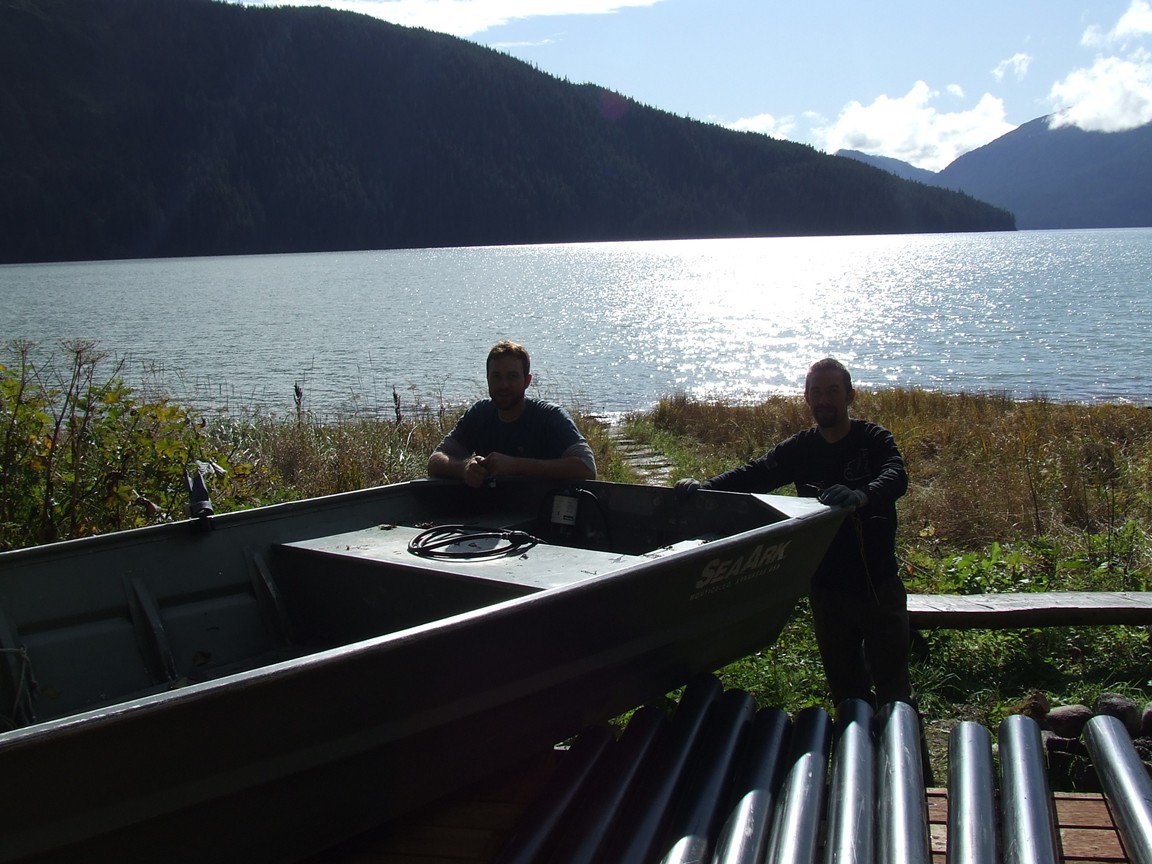
And so we moved to the boat, now considerably lighter.
Although others
were dubious, it was quite easy to scoot it over the grass with the
four of us
pulling and pushing. With my mom and me on the front and the guys at the
stern, we brought it up to the deck in about four moves. Getting
it up
the stairs onto the deck took a little extra work (and dented the edge
of the
porch where it pivoted), but soon we had it on top, and then over the
edge and
into the clear area beneath the trees where I used to stage
lumber. We
drained the gas out of the fuel filter, bungeed up the fuel hoses, and
then
tipped the boat upside down. Per my dad's instruction, I blocked
up the
gaps on the middle of the boat to prevent it from bending in the middle
from
the weight of snow where the gunwales curve up.
at the
stern, we brought it up to the deck in about four moves. Getting
it up
the stairs onto the deck took a little extra work (and dented the edge
of the
porch where it pivoted), but soon we had it on top, and then over the
edge and
into the clear area beneath the trees where I used to stage
lumber. We
drained the gas out of the fuel filter, bungeed up the fuel hoses, and
then
tipped the boat upside down. Per my dad's instruction, I blocked
up the
gaps on the middle of the boat to prevent it from bending in the middle
from
the weight of snow where the gunwales curve up.
We'd toyed with tying the dolly with attached engine to a tree for the winter and wrapping them in a tarp, but Chris suggested we try to move it inside, and I liked that idea better. Moving it up the stairs only took a couple of seconds, and we soon had it snug against the wall in the back of the lodge and secure for the winter. That primarily left winterizing the water system (which vastly expanded in size this summer). My mom and I hiked up to the olive barrel and manhandled it out of the creek, placing it in its traditional winter home high on the left bank, its hose in the bushes as much as possible to protect it from ice. Things got more complicated from there, though. I gathered up tinfoil and rubber gloves for removing the filters at each cabin, but quickly found that I couldn't unscrew the first filter housing with my hands alone, so had to return for the special tool they came with specifically for unscrewing them. This worked pretty well and I soon had the three filters at Cottonwood off and the water drained out. Although the filter housings were off, the caps for all of them remained in place (and attached to the system), so it'll be easy to put them back together in the spring. I think I'll even reuse the filters, since they got so little use this summer. While I covered the bottoms of the filter caps with tinfoil to help keep critters out, my mom removed the o-rings from the housings, greased them with vaseline, and placed them inside on paper towels for the winter. I also stuffed a ball of tinfoil in the second valve (the one for hoses) and covered it with another layer of tinfoil, leaving the system otherwise open.
We repeated the process for the other three cabins; both Mink and Harbor Seal required a little adjustment and some props to support the frail system without the housings resting on the ground. I'd already swept out Hermit Thrush a little earlier, but had left a window and the door open to air it out in the fall sun. It was a little sad locking it up for the last time this year--I would have happily stayed for much longer.
Back at the lodge, we repeated the process for the lodge filters and then I began to do some final packing, gathering up all the odds and ends that should come to town for the winter (gun, perishable foods, games, etc.), washing the last dishes, and placing some of the liquid items I want to leave behind in the sink in case they freeze and break over the winter. I also enlisted the guys to help with a few more chores and it was nice to let them handle removal of the stove pipe and covering up the hole while I worked on other tasks. My mother took down the winch system in the woods (which I'd entirely forgotten about), newspapers were taped to the windows, and soon we were almost entirely ready to go. Although we still had a couple of hours before the plane was supposed to show up, the day was so fine that I thought we may as well board up the picture window, since I didn't picture us wanting to be inside very much. The boys were putting it into place when Torsten demanded that I come look at something. Several weeks before, over Labor Day weekend, I'd leaned five 4x4 4' posts against the wall of the lodge next to the window (the posts that were cut for a rail system). Half behind one of those posts and half exposed to the sunshine (and inches away from the edge of the window that was about to be boarded up), was a bat. A bat!!!!!! A bat had roosted on my front porch and was now apparently enjoying the sunshine (bats love heat). I immediately halted all window operations and, after everyone had taken a good look and some photos, removed all the gear we'd accumulated anywhere near him and tried to give him as much quiet and room as I could. I think everyone got a little irritated at my repeated admonitions to be quiet around him, to not bang on anything, walk anywhere near him, etc! Not long after we discovered the bat he crawled back under the 4x4s, only to emerge (head first) a few posts over. He crawled a body length above them, then turned and hung upside down for a while. He moved between full exposure, half exposure, and full concealment several times over the next hour and a half.
So delighted was I by the appearance of a bat, and so dedicated to
making
his stay there as unstressful as possible, I was fully prepared to
forgo
boarding up the window altogether. However, once we'd cleared the
deck of
all our gear I very quietly rotated the board 90 degrees and, as gently
as
possible, screwed it in by hand, apparently without disturbing the
bat. Rotating the board that way
meant that
it no longer fully covers the window, but it covered about 80% of it
and meant
that I didn't need to go too near the bat to do the work. I later
asked a
bat biologist why I tend to see more bats in the fall; she confirmed
that
either or both of my hypotheses could be correct: 1) bats tend to feed
when the
light diminishes or after dark, which equates to the middle of the
night during
the summer when I'm asleep and 2) bats could be using the Whiting River
as a
fall migration corridor from the interior as the birds do (one theory
is that
bats farther north migrate into SE Alaska or other areas to
hibernate).
Although it's unlikely my bat planned to stay (they usually hibernate
in
colonies), this left experience left hopeful for more bat encounters in
the future.
 Loading the engine onto the dolly |
 The riverboat on the porch |
 The riverboat about to slide off the porch |
 Theodore the bat climbing out from under the 4x4s |
 Getting situated... |
 ...and enjoying the sun |
 Mink's water system tinfoiled and supported for the winter |
 The engine and stovepipe inside |
 Loading the plane |
After we spotted the bat we all took a lunch break, eating crackers,
cheese,
and other snack foods in lieu of making more dishes to clean. And
then,
at 4:00 on the dot, Gary returned and we started scrambling to carry
all our
gear down to the edge of the water. The tide was out a little and
falling, so Gary stopped about 30 feet from shore and we started
ferrying
everything over. We were too efficient, though, and had all our
gear and
all people on board (Torsten carrying Chris and I, who were waderless),
when
Gary discovered that the floats were hopelessly stuck in the mud.
Everyone jumped back in the water (Chris on Torsten's back) except for
me, and
they got the plane floating again. We all scrambled as hastily as
possible back on board, which caused the floats to sink back into the
mud. Gary revved the engine and, after about 25 nerve-wracking
seconds,
pulled the plane into deeper water and off we 
 went.
In the chaos, my
skill saw and jig saw were left on the beach for the winter, their gray
and
black colors camouflaged against the silt and rocks.
went.
In the chaos, my
skill saw and jig saw were left on the beach for the winter, their gray
and
black colors camouflaged against the silt and rocks.
But not straight back to town just yet. I'd told Gary on the
ride down
about my troubles getting up the Whiting and he, like everyone else,
basically
told me I just needed to go fast. See above for my thoughts about
that. Anyway, since it was a lowish tide, I asked him to fly
upriver a little
ways so I could look for channels from the air. I tried to
memorize where
the main channel is below Whiting Point as we passed it (about where I
thought
it was), then was shocked to see the section upriver a solid patchwork
of
sandbars. There was no channel. That is, there were several
channels, but none of them intersected. The sandbars were mostly
diamond
or triangular in shape (pointing upriver), one right next to another,
the watery sections between them brown with shallow water. There
did
appear to be something of a channel along the east bank and Gary
pointed that
out to me just before we passed over a sandbar that closed it off right
to the
shoreline. A channel appeared to run along the opposite shore,
too, but
with no clear path to reach it. It was amazing and
baffling. We all
shook our heads at each other. Beyond this perilous section
(which is
perhaps half a mile long), we could see the very channelized structure
of the
rest of the river ahead, which looked tantalizing beautiful. More
termination dust graced the mountains in that direction. Chris's
suggestion seemed the best: go up at
high tide and camp in order to catch the high tide back down the next
day. I'm
hopeful that I can make it through there with the help of tide, but
then I'd be
trapped on the other side for 12 or 24 hours. What I need is
another
group of very supportive people to help me through it next summer!
 Do you think that channel along the bank is passable? |
 There's the channel I need to get to |
 What it's all about: that glorious river beyond the sandbars |
 A windblown ridge |
 Crossing the ridge beyond Dipper Creek |
 Sun streaking through the rain in Gastineau Channel |
From there we turned back toward Gilbert
Bay, passing over the wind blows
we'd seen from the river which looked even more dramatic from the
air.
From there we flew up over Dipper Creek, spotting a lake that may be
its
source, and then over a ridge and back into Stephen's Passage.
There
was enough turbulence going over the ridge to turn my stomach and I
felt
varying degrees of queasiness for the rest of the trip. I think I
wouldn't have enjoyed being on the water that day. Flying over
Taku
Inlet, Chris and Torsten saw a whale breach from above. Then, as
we left
the sunny weather behind and entered the rain showered gloom of
Gastineau
Channel, they also saw a circular rainbow from above. And then we
were on
the pond. Gary drove us to the front of the airport
and dropped us off and Chris drove us all home. And so we had
pizza and embraced the impending winter.

