Island camping. Boat camping. These are things I've
dreamed
of doing for years and years, ever since I started working on boats
around Juneau in
1998. I've passed by all these islands with fine beaches many
times, but never landed. Benjamin, Aaron, Gull Islands. On
Friday, June 5, I had to stay in town
for a gig, so decided this might be the weekend. The fine
summer
sunny weather that had landed on Juneau the previous Sunday held all
week and looked
to stay all weekend. It was fantastically
beautiful, but breezy. I figured the water might be too choppy
for
leisurely whale watching, but I hoped to find a leeward area somewhere
to hang out before staking out a beach. Chris and I packed up,
bought some picnic food, trailered the Ronquil from Douglas Harbor (the
wind made it a bit tricky), then launched at Amalga Harbor about 2:00
pm. Favorite Channel was flat calm and gorgeous and as soon as I
mentioned to Chris that he should keep an eye our for whales, a cow and
calf came up nearby. We stopped and watched them for a bit as
they seemed to head south, then we started up again on the way to North
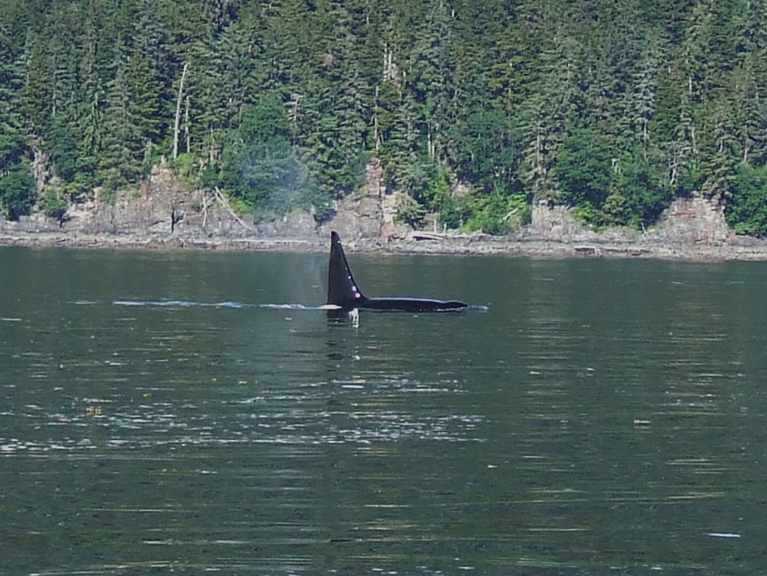
Pass. Half way to Shelter Island, a big black fin rose in the
water to the north. Orcas again!! We then saw them
spread out from the shore of Shelter Island as far as we could see
north, way up into Lynn Canal.
The
large bull
that caught our eye passed by without
offering any good ID photo opportunities and, since it seemed like the
majority of the pod was still traveling in our direction and because we
were alone on the water in terms of boats, we shut down and dropped the
hydrophone we'd borrowed from my mother. We immediately heard
clicks, then
intermittent moans, groans, squeaks, and zips from the pod--it was
pretty amazing.
After about five minutes the frequency and volume picked up until we
heard an almost continuous, clear stream of orca sounds and soon we
heard them blowing above water as well. A large male and two
females/young males were heading straight for the boat from the
west. The two smaller orcas came up about 40 feet
away and one of
them broke while she surfaced to head straight for us (see photo to
left). She
surfaced again,
heading away, about 20 feet off the starboard bow and
met back up with her companion (see photo to right). Pretty
cool. This seemed
like a good sign and more orcas were coming, so we put away the
hydrophone and started leisurely traveling back toward the mainland,
which seem to be where this widely scattered pod was headed.
I've never seen an orca pod so spread out. As we traveled
alongside them I struggled to get ID shots (as well as scenic shots) to
identify the pod. When the female buzzed the boat I saw that she
had an ever-so-slightly open saddle patch, so I knew they were
residents. I hoped that the several large males we could see in
the distance would help identify them, but none of the photos were
particularly helpful in the end. All in all, we saw at least six
large males and at least 18 other individuals (which suggests there
were many more). When we reached the mainland one small orca
breached a few times on the glassy water and splashed around afterwards
for quite a while. Another farther south spyhopped high above the
surface (showing his pectoral fins every time) three times in a
row. Orcas kept coming from the north, seeming to coalesce a bit
as time went on. My best guess is that the male that buzzed the
boat was one of the AG boys (see first three photos below) and that the
female that broke away to come
close was AG5. But, these are guesses. I've included a
number of photos here in case anyone wants to take a shot at
identifying them (the second row of photos are all of different
males). Given that there were so many large males, if
AG pod was involved, it was likely a superpod, as AG has only three
large males, all brothers, and the whole pod is not very large.
Of course, the most recent resident ID book I have is a decade old, so
things may well have changed.
At Aaron
Island we let the rest of the orcas pass and saw the
humpback calf again, somewhat overshadowed by the excitement of the
killer whales. I'd originally thought of camping on Bird Island,
but it was already occupied. Aaron was my second choice, so we
cruised around there and found it deserted. But, it was still
pretty early in the afternoon and we thought we'd continue exploring
other options. We zoomed north to Little Island, the last in a
trio of islands starting with Lincoln Island to the south. Little
Island is just that--a grassy nub that descends into a sprawling rocky
reef to the north, east, and west, and a pleasant gravel beach to the
south where sea lions haul out in the fall. Although this looked
like an adventurous place to camp, we decided it would be too windy and
exposed, especially with the brisk breeze coming up Lynn Canal and the
two foot seas it generated. On the east side of the islands the
water
was still pretty calm. We cruised back south along Ralston Island
to a bite we'd noticed earlier. A wide gravel beach edged in
grassy meadow sat inside a sheltered cove and appeared to be in the lee
of the wind and exposed to late sun. As we idled our way between
the reefs we could see the ripples on the water disappear closer to
shore, and felt the change immediately as we passed over the
line. Dead calm and sunny. We came up on the ostrich-egg
sized rocky beach and hauled our gear up onto gentler sand higher
up. We explored a bit, climbing a rocky outcrop to the east
overgrown with blooming blue lupine and yellow cinquefoil with
sweeping views of Herbert Glacier and the surrounding mountains.
Then Chris pitched his tent while I worked on the boat, now aground
with the falling tide. I wanted to make sure the boat wouldn't
drift into shore during the night at high tide and get stranded too
high on the beach, so I tied off a second anchor to a shorter line on
the stern to keep it in deeper water, trying to give it enough line for
the rising tide while keeping it short enough to prevent its drifting
too far into shore.
Finally we had a picnic sitting on camp chairs and beach blankets in
the sun. As the sun finally settled behind the mountains we built
a campfire and watched the tide rise. And rise, and rise, and
rise! The high tide line was not very clearly marked on this
beach and we started to wonder if we'd pitched the tent and built the
fire too low. Chris finally moved the fire about
fifteen feet up the beach and we soon watched the old fire turn to
steam as the water reached it. High tide was around 1:00 am and,
in the end, the water wound up about three feet from the entrance (we
were ready the whole time to pick up and move it); it looked pretty
neat from inside the tent, the mountains still slightly visible in the
distance.
The next day we loaded the boat as the tide approached it, then left
our little bite as soon as it floated. The water was nearly as
calm as the day before until we neared North Pass, so instead of whale
watching we cruised over to Poundstone Rock where sea
lions covered the bottom and two bald eagles sat on top, one of them
flapping around with and eating a large fish. Then we passed by
Sentinel Island and checked out the lighthouse and the pigeon
guillemots on the rocks. Finally, we headed back toward Amalga,
drifting around on the water for a while enjoying the day before we
headed inside to trailer the boat.

 looked
to stay all weekend. It was fantastically
beautiful, but breezy. I figured the water might be too choppy
for
leisurely whale watching, but I hoped to find a leeward area somewhere
to hang out before staking out a beach. Chris and I packed up,
bought some picnic food, trailered the Ronquil from Douglas Harbor (the
wind made it a bit tricky), then launched at Amalga Harbor about 2:00
pm. Favorite Channel was flat calm and gorgeous and as soon as I
mentioned to Chris that he should keep an eye our for whales, a cow and
calf came up nearby. We stopped and watched them for a bit as
they seemed to head south, then we started up again on the way to North
Pass. Half way to Shelter Island, a big black fin rose in the
water to the north. Orcas again!! We then saw them
spread out from the shore of Shelter Island as far as we could see
north, way up into Lynn Canal.
looked
to stay all weekend. It was fantastically
beautiful, but breezy. I figured the water might be too choppy
for
leisurely whale watching, but I hoped to find a leeward area somewhere
to hang out before staking out a beach. Chris and I packed up,
bought some picnic food, trailered the Ronquil from Douglas Harbor (the
wind made it a bit tricky), then launched at Amalga Harbor about 2:00
pm. Favorite Channel was flat calm and gorgeous and as soon as I
mentioned to Chris that he should keep an eye our for whales, a cow and
calf came up nearby. We stopped and watched them for a bit as
they seemed to head south, then we started up again on the way to North
Pass. Half way to Shelter Island, a big black fin rose in the
water to the north. Orcas again!! We then saw them
spread out from the shore of Shelter Island as far as we could see
north, way up into Lynn Canal.  feet
away and one of
them broke while she surfaced to head straight for us (see photo to
left). She
surfaced again,
heading away, about 20 feet off the starboard bow and
met back up with her companion (see photo to right). Pretty
cool. This seemed
like a good sign and more orcas were coming, so we put away the
hydrophone and started leisurely traveling back toward the mainland,
which seem to be where this widely scattered pod was headed.
I've never seen an orca pod so spread out. As we traveled
alongside them I struggled to get ID shots (as well as scenic shots) to
identify the pod. When the female buzzed the boat I saw that she
had an ever-so-slightly open saddle patch, so I knew they were
residents. I hoped that the several large males we could see in
the distance would help identify them, but none of the photos were
particularly helpful in the end. All in all, we saw at least six
large males and at least 18 other individuals (which suggests there
were many more). When we reached the mainland one small orca
breached a few times on the glassy water and splashed around afterwards
for quite a while. Another farther south spyhopped high above the
surface (showing his pectoral fins every time) three times in a
row. Orcas kept coming from the north, seeming to coalesce a bit
as time went on. My best guess is that the male that buzzed the
boat was one of the AG boys (see first three photos below) and that the
female that broke away to come
close was AG5. But, these are guesses. I've included a
number of photos here in case anyone wants to take a shot at
identifying them (the second row of photos are all of different
males). Given that there were so many large males, if
AG pod was involved, it was likely a superpod, as AG has only three
large males, all brothers, and the whole pod is not very large.
Of course, the most recent resident ID book I have is a decade old, so
things may well have changed.
feet
away and one of
them broke while she surfaced to head straight for us (see photo to
left). She
surfaced again,
heading away, about 20 feet off the starboard bow and
met back up with her companion (see photo to right). Pretty
cool. This seemed
like a good sign and more orcas were coming, so we put away the
hydrophone and started leisurely traveling back toward the mainland,
which seem to be where this widely scattered pod was headed.
I've never seen an orca pod so spread out. As we traveled
alongside them I struggled to get ID shots (as well as scenic shots) to
identify the pod. When the female buzzed the boat I saw that she
had an ever-so-slightly open saddle patch, so I knew they were
residents. I hoped that the several large males we could see in
the distance would help identify them, but none of the photos were
particularly helpful in the end. All in all, we saw at least six
large males and at least 18 other individuals (which suggests there
were many more). When we reached the mainland one small orca
breached a few times on the glassy water and splashed around afterwards
for quite a while. Another farther south spyhopped high above the
surface (showing his pectoral fins every time) three times in a
row. Orcas kept coming from the north, seeming to coalesce a bit
as time went on. My best guess is that the male that buzzed the
boat was one of the AG boys (see first three photos below) and that the
female that broke away to come
close was AG5. But, these are guesses. I've included a
number of photos here in case anyone wants to take a shot at
identifying them (the second row of photos are all of different
males). Given that there were so many large males, if
AG pod was involved, it was likely a superpod, as AG has only three
large males, all brothers, and the whole pod is not very large.
Of course, the most recent resident ID book I have is a decade old, so
things may well have changed.