July 23-25

The Adolphus herd
Icy
Strait
July 23-25
The Adolphus herd
 Icy
Strait. Point
Adolphus. These are magical places of huge, friendly whale pods,
exotic birds, frolicking sea otters, and the sweet, heady scent of
millions of
smelt. Point Adolphus is one of the happiest places on earth, and
I hadn't been there in eight years. During the summers of 2000
and 2001 I traveled to Icy Strait two or three days a week, three hours
a day of which I spent watching wildlife with independent travelers on
the
Auk Nu. My crew and I had consistently amazing wildlife
encounters there; I think I traveled the
Juneau-Gustavus-Point Adolphus-Gustavus-Juneau route about 75 times
those two years and
dreamed od coming back some day on my own. Eight years later I
finally found myself in a position to go and was determined to do
it. My July was
pretty booked up, so I put aside the only weekend still available in
the
hopes that the weather would cooperate. My friend Dru agreed to
accompany
Chris and I on his own boat.
Icy
Strait. Point
Adolphus. These are magical places of huge, friendly whale pods,
exotic birds, frolicking sea otters, and the sweet, heady scent of
millions of
smelt. Point Adolphus is one of the happiest places on earth, and
I hadn't been there in eight years. During the summers of 2000
and 2001 I traveled to Icy Strait two or three days a week, three hours
a day of which I spent watching wildlife with independent travelers on
the
Auk Nu. My crew and I had consistently amazing wildlife
encounters there; I think I traveled the
Juneau-Gustavus-Point Adolphus-Gustavus-Juneau route about 75 times
those two years and
dreamed od coming back some day on my own. Eight years later I
finally found myself in a position to go and was determined to do
it. My July was
pretty booked up, so I put aside the only weekend still available in
the
hopes that the weather would cooperate. My friend Dru agreed to
accompany
Chris and I on his own boat.
Gustavus is about twice as far away
from Juneau as my homestead. I filled my on-board gas tanks (15
gallons) and brought
along an extra 20 gallons in jerry jugs and packed up food and camping
gear in the days before we left. Chris and I needed to be back in
town by Saturday night, so
we wound up leaving Thursday morning with the intent to camp out for
two
nights--one on Lemesurier Island in Icy Strait and one at the
Couverdens. It was going to be a bit of an adventure--Lynn Canal
and Icy Strait can be big water and I'd never camped at either of these
places and didn't know what to expect. The forecast Wednesday
night called for south winds and seas two feet or less in Stephen's
Passage and up to
three or four feet in Lynn Canal and Icy Strait.
Dru was going to launch from Auke Bay, we were going to launch from
North Douglas, and planned to meet up near Shelter Island
around 10:00am. I got up and finished
packing in the morning and hitched up the trailer and Chris and I
took
off on time at 9:00 am. Unfortunately, that was right around low
tide, which was -4.5', or just about as low as it
gets. When I pulled the boat around to the launch ramp at Douglas
Harbor, the water
level was below the end of the concrete ramp, revealing a relatively
hard bottom below a three inch drop from the end of the concrete
run.
I was not thrilled with the idea of pulling the boat up over that lip
and was a bit worried about pulling it off. But, adventures
awaited, so
we
decided to give it a shot. At that moment, the morning's
drizzle turned into a truly torrential downpour which neither of us
was really prepared for. I backed the trailer down and we
managed to arrange the boat after repositioning the trailer once.
I was pretty worried about getting it over the hump and put Trucky into
low 4 wheel drive. It made it up on the second try. The
rain had soaked the driver's seat (I had the window down while on the
ramp), so I wound up with wet pants and Chris was wet
from being out in the drenching rain. It had been raining for
days, and the
boat was full of water up to the front seats. I still hadn't
fixed the bilge pump system and had put off bailing it out knowing
that it could drain while it was trailored. We took the
plug out, tied it down, and headed for the North Douglas boat
ramp. During the drive I thought the boat looked a little funny
and was simultaneously discouraged by watching a crack in my windshield
migrate
from the bottom middle over toward the driver side until it stopped
right in the middle of my main field of vision. When we pulled
into
the launch ramp and got out to prepare the boat for launching, we saw
that the bow of the boat was unusually low and the front of the trailer
inexplicably close to the ground. We found out later that the
wooden supports for the hull had broken, but I still don't know why the
trailer was so close to the ground. We'd intended to load the
boat there, but decided we'd better get that boat in the water before
the trailer collapsed entirely beneath it. I backed it down,
and only then realized that the boat had failed to drain out during the
drive. The opening was, of course, plugged with debris. So
I stopped just short of the water, got in the boat, and leaned over the
back to stick my fingers in the hole; I cleaned out quite a few rocks
and twigs and Chris helped bail with the bucket. All of this put
us a bit behind schedule, and I called Dru to let him know. He
was already out near Shelter and heading toward Admiralty to escape the
swells.
I had to clean out the drain hole a
couple of times and the draining took so long that I also had to pull
the
boat up a few feet to avoid the rising tide.
Eventually we were able to slowly load the boat, put the plug back in,
and launch at the very tail end of the dock. I pulled up and
parked the trailer on the bank below the highway and decided to use the
portapotty one last time. As I was pulling my pants back up I
heard a clunk and a
plop and knew instantly what had happened: my cell phone had slipped
from my back pocket and died a watery
death. Although I didn't voice this in fear of jinxing myself, I
secretly hoped that this sacrifice might help with wildlife
encounters. It certainly beat my normal offering of a splash of
beer or whiskey in the ocean.
So we weren't off to a particularly
auspicious start and I was a little bummed about my trailer and my cell
phone, but we headed out toward Shelter Island on the
lookout for whales with beers in hand. The day before there had
been two groups of
bubble net lunge feeding humpback whales in that area and I hoped to
encounter them on the way north. They'd been hanging around for
days, so I was relatively optimistic and kept an eye out for groups of
whale watching
boats. With wheel houses much farther off the water and a network
of observers, commercial whale watching boats tend to spot things
before I do. I saw an Allen Marine boat heading south along the
Admiralty shore, which seemed suspicious, but it dropped out of sight
before I spotted anything interesting and I was already late for the
rendezvous with Dru. We slid through some swells from the south
as we crossed over to Admiralty, but the seas diminished by the time we
hooked up with Dru. We touched base, checked the hand held
radios, made a communication plan, and headed north. At Faust
Rock we stopped to check out the
sea lions on the buoy and I glassed North Pass. Three Allen
Marine boats and several other boats were parked in there and at least
three other whale watching boats had left that area heading
south. I thought that was a good sign, so
Chris and I headed up there in the Ronquil
while Dru stayed behind to
troll near Point Retreat. Ten minutes later we slowed down in the
pass and watched for a while, but saw nothing but a pair of whales and
a single whale near the boats a little farther north. We turned
and headed on our way, seeing some dramatic light displays over
Admiralty. Dru was reeling in a salmon when we arrived, but it
turned out to be a pink.
 From
there we headed south along
the shore of Admiralty Island about half way to Funter Bay, then
crossed Lynn
Canal (I was still hoping to catch any lunge feeders that might have
ducked behind Admiralty). The weather was cooperating and it was
a fairly smooth
crossing and not rainy. On the Chilkat side we turned south again
and suddenly
came up on glassy smooth three foot swells around Point Howard, widely
enough spaced that they were comfortable and even a little bit
fun. The farther south we
headed, though, the worse the seas became until we were plowing through
three
and four footers with chop. Dru's C-Dory was handling it better
and he took the lead; we got a bit beaten up and took a few sloshes of
green water over the bow (see photo to right of the Little Bitty behind
a swell). We cut between two islands and finally saw
Rocky Island in the distance, near where we would turn into Icy Strait
and hopefully put the swells behind us.
From
there we headed south along
the shore of Admiralty Island about half way to Funter Bay, then
crossed Lynn
Canal (I was still hoping to catch any lunge feeders that might have
ducked behind Admiralty). The weather was cooperating and it was
a fairly smooth
crossing and not rainy. On the Chilkat side we turned south again
and suddenly
came up on glassy smooth three foot swells around Point Howard, widely
enough spaced that they were comfortable and even a little bit
fun. The farther south we
headed, though, the worse the seas became until we were plowing through
three
and four footers with chop. Dru's C-Dory was handling it better
and he took the lead; we got a bit beaten up and took a few sloshes of
green water over the bow (see photo to right of the Little Bitty behind
a swell). We cut between two islands and finally saw
Rocky Island in the distance, near where we would turn into Icy Strait
and hopefully put the swells behind us.
Chris impressively managed
to nap a little in the passenger seat while we continued to bang and
slide our way south. In the distance I saw an occasional whale
blow as I gritted my teeth from the pounding. Among the islands,
the height of the swells diminished
somewhat, but were spaced tightly enough to slow us down. As we
pulled a little closer to Icy Strait, I began to see, periodically,
what
I thought was
a clump of whale blows, maybe four or five together. I didn't
dare let my hopes up when I saw a white splash in the distance among
the swells, but a few minutes later I saw it, the unmistakable
silhouette of a
group of bubblenetters lunging above the surface. We were still
at least half a mile away, so I didn't disturb Chris, who woke up on
his own
after a particularly unpleasant bump. We passed Pt. Couverden
and I called Dru on the handheld to let him know
that we were going to hang out for a bit with the whales. I
needed to have the engine in gear to keep the bow pointed into the
waves (which were 2-3 footers there) but we slowed to an idle.
Suddenly, about 100 feet away,
the water turned light green and pectoral fins broke the surface
moments before an enormous black head shot high above the water,
followed by a less dramatic lunge next to him. It was incredible,
and quite an introduction to bubblenetting for Chris. Welcome to
Icy Strait.
 We
stayed in that area for
about half an hour, mostly in the company of a Canadian sailboat, and
watched the whales lunge about three out of four dives. We did
shut down a few times to listen for vocalizations through the
hydrophone, but heard nothing. It was a little tricky whale
watching among the waves! Eventually, the whales began
heading farther into Lynn Canal and we turned and met up with Dru who'd
been fishing and had several strikes already. The seas were
mercifully behind us and somewhat diminished as we turned and cruised
along Home Shore. As we turned around a point and faced
Excursion Inlet I stopped in some calm water close to the
mouth of a creek and filled up my 10 gallon gas tank, then we headed on
past the Porpoise Islands and into Icy Passage. Only
a few miles out of Gustavus the wind suddenly shifted and we ran into
some brutal chop that was aggravating and slowed us down
considerably. Again the Little
Bitty was able to handle the chop
better and pulled ahead of us. Soon the chop turned into tight
2-3 foot swells, rain came, and we lost Dru altogether. I hailed
him on the radio and he said he was already at the dock, which soon
materialized in front of
us. It was about 5:00 pm and the charter boats were coming in, so
we
were worried that we wouldn't find a place at the small dock to tie up
while
we refueled. Thankfully, the rush was over and a few spots
opened up after a couple of minutes; the only major activity on the
dock was passengers boarding inflatable tenders
back to a Cruise West ship anchored in the channel nearby. Chris
and I pulled in on the left,
Dru
on the right. Chris stayed behind to watch the gear while Dru and
I
carried as many jerry jugs as we could handle up the ramp and down the
veeeeeery long wooden dock, stepping into the pedestrian passing zones
when trucks drove by. I felt a little funny trudging by the
steady
stream of leisurely, well-dressed tourists while wearing my baggy
fisherman's bib rain pants, xtratuffs, rain jacket, and hat (all
soaking
wet).
I confess I felt a bit smug, too; Juneau to Gustavus is a significant
journey in a small, open boat.
We
stayed in that area for
about half an hour, mostly in the company of a Canadian sailboat, and
watched the whales lunge about three out of four dives. We did
shut down a few times to listen for vocalizations through the
hydrophone, but heard nothing. It was a little tricky whale
watching among the waves! Eventually, the whales began
heading farther into Lynn Canal and we turned and met up with Dru who'd
been fishing and had several strikes already. The seas were
mercifully behind us and somewhat diminished as we turned and cruised
along Home Shore. As we turned around a point and faced
Excursion Inlet I stopped in some calm water close to the
mouth of a creek and filled up my 10 gallon gas tank, then we headed on
past the Porpoise Islands and into Icy Passage. Only
a few miles out of Gustavus the wind suddenly shifted and we ran into
some brutal chop that was aggravating and slowed us down
considerably. Again the Little
Bitty was able to handle the chop
better and pulled ahead of us. Soon the chop turned into tight
2-3 foot swells, rain came, and we lost Dru altogether. I hailed
him on the radio and he said he was already at the dock, which soon
materialized in front of
us. It was about 5:00 pm and the charter boats were coming in, so
we
were worried that we wouldn't find a place at the small dock to tie up
while
we refueled. Thankfully, the rush was over and a few spots
opened up after a couple of minutes; the only major activity on the
dock was passengers boarding inflatable tenders
back to a Cruise West ship anchored in the channel nearby. Chris
and I pulled in on the left,
Dru
on the right. Chris stayed behind to watch the gear while Dru and
I
carried as many jerry jugs as we could handle up the ramp and down the
veeeeeery long wooden dock, stepping into the pedestrian passing zones
when trucks drove by. I felt a little funny trudging by the
steady
stream of leisurely, well-dressed tourists while wearing my baggy
fisherman's bib rain pants, xtratuffs, rain jacket, and hat (all
soaking
wet).
I confess I felt a bit smug, too; Juneau to Gustavus is a significant
journey in a small, open boat.
At the end of the dock, Dru's friend had parked a yellow pickup for us
to use to refuel. We drove straight down the road to the gas
station with
its
archaic 50s style pumps and struggled to get the credit card to
work.
Dru wound up holding the handle on the gas nozzle up the entire time
while I filled our seven jerry jugs of various sizes. We fueled
as
quickly as possible as I still had some traveling to do and was anxious
to get underway; Dru was spending the night in town with his
friend. On our
way
back we stopped briefly at the mercantile where I bought a soda for
Chris and Dru accidentally met up with his friend. I admit I
could
have been friendlier, as I was losing steam and eager to get back to
the dock.
It had
been a very long day, we still had a significant ride to Lemesurier
Island, and I didn't know whether the brutal chop we'd encountered
approaching the dock would hold. I admit that I considered
finding a
place to camp nearby on Pleasant Island to avoid the crossing.
Dru and I left the mercantile and drove down the long dock to the ramp
(this time making the tourists step aside
for us), then lugged the jerry jugs down to our boats. Chris
drove
the truck back to dry land while I followed Dru out to the mooring area
nearby to pick him up after he anchored. His anchor didn't catch
the
first time and he had to let out a bit more line. I took him back
to
the
dock, completely exhausted, and picked up Chris. As we puttered
away
from the dock, I asked Chris what he wanted to do. As always, he
had
the right answer. "Is that your favorite island in the world
over there?" he asked, gesturing toward Lemesurier. "Yes" I
answered
meekly. "Then let's camp there!" He'd picked up a second
wind while
at the dock which helped rally my flagging spirits.
So off we went toward Lemesurier Island. Lemesurier is my
favorite
island in the world, but I hadn't yet set foot on it. I couldn't
even remember
exactly why I liked it so much, but we almost always cruised by its
northern shore and sometimes circumnavigated it before we visited Point
Adolphus on Icy Strait wildlife trips. It left a dramatic
impression
and I used to tell my crew that if I could own only one island in the
world, it would be Lemesurier. As we headed west, I was relieved
to
find Icy Strait flat calm, but visibility dropped and soon
Lemesurier was entirely out of sight. It was the first time that
I've
really put my boat's compass to good use. About half way across
the
entrance to Glacier Bay, a corner of the island came into view, then
gradually the rest of it emerged from the mist.
Just as
we entered North Passage between Lemesurier and the mainland we passed
over an area of boiling, turbid ocean, huge circular upwellings that
jostled us as we passed. And
then there it was--the long gravel beach where we used to watch deer.
 It had been eight years since I'd seen this beach, and I
didn't
know what to expect in terms of camping! Also, although the wind
that
day had so far been mostly from the south, I wasn't sure that a breeze
might not wend itself around the islands or a north wind kick up and
grind my boat against the beach all night (it wasn't particularly
sheltered). The chart showed
evenly
spaced rocks all along the beach but I didn't remember seeing a
continuous
reef there and the chart is not large enough to include much detail, so
I
hoped we'd find a spot suitable for the boat. Everyone I talked
to
suggested camping on the south side of the island and seemed puzzled
when I suggested the north side, but I was
determined to try this beach, knowing that conditions could force us
well beyond it in search of a more adequate or sheltered cove for the
night.
It had been eight years since I'd seen this beach, and I
didn't
know what to expect in terms of camping! Also, although the wind
that
day had so far been mostly from the south, I wasn't sure that a breeze
might not wend itself around the islands or a north wind kick up and
grind my boat against the beach all night (it wasn't particularly
sheltered). The chart showed
evenly
spaced rocks all along the beach but I didn't remember seeing a
continuous
reef there and the chart is not large enough to include much detail, so
I
hoped we'd find a spot suitable for the boat. Everyone I talked
to
suggested camping on the south side of the island and seemed puzzled
when I suggested the north side, but I was
determined to try this beach, knowing that conditions could force us
well beyond it in search of a more adequate or sheltered cove for the
night.
It was calm when we arrived and scoped it out. Looking up the
rugged valley in the middle of the cove (which is somewhat reminiscent
of picturesque mountains in Chinese paintings) I began to remember why
I liked this
island so much. I looked for deer but found
none. We were facing some dramatically high tides and wanted to
make sure we didn't get flooded that
night, so we looked for a place with room to camp off the beach.
At
the westernmost corner of the cove we found a beautiful pebble/sand
beach free of rocks on the approach with a smooth, steep slope up from
the water and a
border of grass at the edge of the forest. A big rocky point
swept out
from the west side of it and a large kelp bed grew along the east side
of it inhabited by several sea otters. As we pulled up to the
beach I
was stunned by the clarity of the water, beyond anything in the Juneau
area. I could see 20 or 30 feet down with
complete
clarity. We unloaded the boat, hauled our gear to the top of
the
beach, and anchored it, throwing a second anchor off the stern to help
keep the boat in deep water during the tide. It was drizzling and
the
noseeums were pestering us and I admit that I began to wonder if I was
crazy to go out on a camping trip in the rain like this.
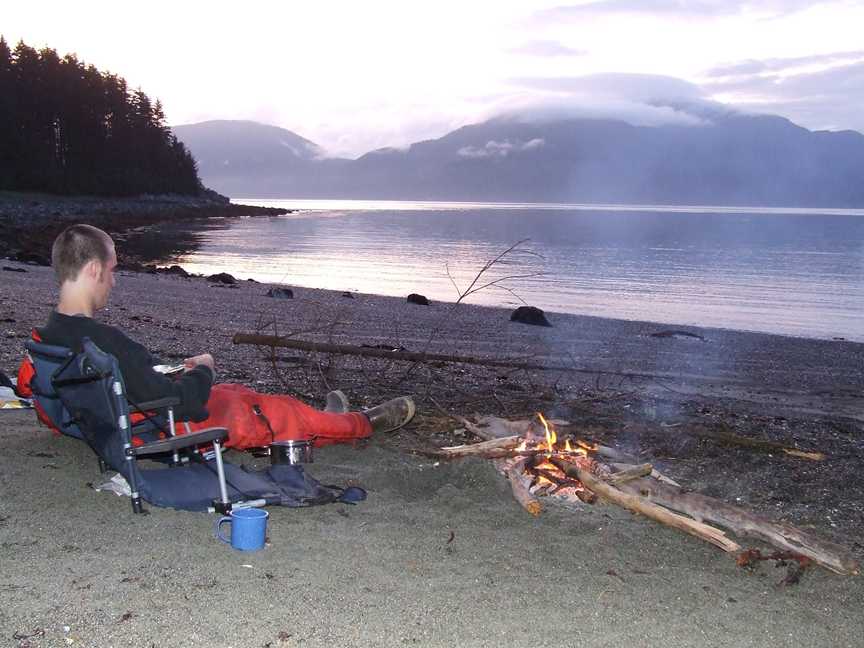 But, we put on bug dope and set about getting camp in
order. We
saw
seaweed pushed up against the edge of the grass at the top of the
beach, so decided that camping on the sand was out of the
question.
Chris pitched the tent in the grass and I got ready for dinner and
tromped into the forest to look for firewood. The forest looked
like
second growth--no underbrush to speak of and an
endless supply of
dryish dead branches ideal for fires. I grabbed an armful,
cleared
an area on the beach of fetid, sandflea ridden seaweed, and dug a
little fire pit. Using a bit of cardboard from a cracker box we
got a
fire going immediately, poured ourselves some red wine, and sat down in
our camp chairs for a moment. I immediately cheered up.
With a little
crackling fire and a broad sweep of beach and ocean in front of me,
I felt a bit less crazy. There were no signs that other campers
had used the area.
But, we put on bug dope and set about getting camp in
order. We
saw
seaweed pushed up against the edge of the grass at the top of the
beach, so decided that camping on the sand was out of the
question.
Chris pitched the tent in the grass and I got ready for dinner and
tromped into the forest to look for firewood. The forest looked
like
second growth--no underbrush to speak of and an
endless supply of
dryish dead branches ideal for fires. I grabbed an armful,
cleared
an area on the beach of fetid, sandflea ridden seaweed, and dug a
little fire pit. Using a bit of cardboard from a cracker box we
got a
fire going immediately, poured ourselves some red wine, and sat down in
our camp chairs for a moment. I immediately cheered up.
With a little
crackling fire and a broad sweep of beach and ocean in front of me,
I felt a bit less crazy. There were no signs that other campers
had used the area.
But we were pretty hungry. We broke out Chris's new amazing
propane
camping stove (with two burners that start at the push of a button) and
I managed to slowly cook a big chunk of halibut a friend had given us
and some bisquick biscuits. The drizzle had ceased and we even
saw some
sunshine lighting up the tops of the trees above camp.
We
made a couple more trips into the woods for firewood, but mostly sat on
the beach and chatted. Once we saw a huge splash over toward
Glacier
Bay and heard the crash a ridiculously long time later. I wound
up drinking a bit too much wine.
After dark we
stumbled our way into the tent for the night and I quickly passed into
oblivion.
But not for long! I slept well and was super
comfortable all night,
but I did wake up many times. Every time I was awake and drifting
off to sleep
I heard
a continuous stream of whale blows from whales passing by and lingering
in the cove.
There were crashes that I expected were breaches, often following a
blow that sounded like a fog horn. In my sleepiness I came up
with a
theory that Hootie (as we used to call an Adolphus whale (or probably
several) that blew noisily that way) was the breacher. It was a
magical
way to
sleep.
 Point Retreat |
 Dru with a fish on, Point Retreat |
 Lunge at the Couverdens |
 Chris on the Gustavus dock |
 Lemesurier Island beach at sunset |
 Cooking supper |
 Long
about 7:00 am I also began to hear some rhythmic scraping sounds and
thought they might be caused by my boat going aground with the
falling tide. I wanted to make sure the boat was as far out as
possible so it would quickly float later that morning when the tide
began
to rise, so I put on my long underwear and xtratuffs and stepped
outside. The morning was calm and misty and wonderful.
There were
three whales in sight, two in the cove toward the right and one just
off the point to the left. The boat was, indeed, bumping gently
on the
gravel at the bottom of the beach, so I walked down, threw the anchor
farther out, and pushed it. More whales cruised by and as I was
watching to see how the boat would respond, I watched the whale at the
point remain stationary while doing some interesting antics.
He arched his back, but
never
dove deep, sometimes showing the edge of his tail or snout and
remaining very close to shore near a kelp bed. I
watched
and watched him wiggling around out there and finally couldn't bear it
any longer. It was a bit far away, but this whale was so close
to
shore I couldn't resist. It was a long
walk
and soon the sand and gravel gave way to large slippery rocks covered
in limpets and shiny seaweed. As expected, the whale began moving
away
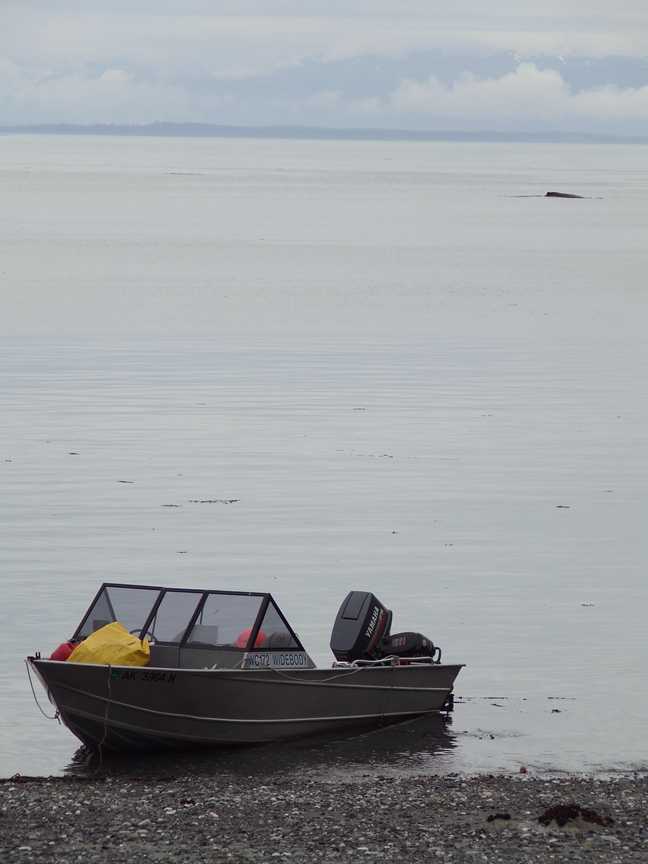
when I was still about 200 feet from the point (see photo below).
As he approached
the
pair of whales farther along the beach in the next cove, Hootie blew
dramatically, dove, and came up in a big spiral breach, immediately
followed by his companion in a smaller breach, and the crashes sounded
just like the ones we'd heard from the tent all night.
Long
about 7:00 am I also began to hear some rhythmic scraping sounds and
thought they might be caused by my boat going aground with the
falling tide. I wanted to make sure the boat was as far out as
possible so it would quickly float later that morning when the tide
began
to rise, so I put on my long underwear and xtratuffs and stepped
outside. The morning was calm and misty and wonderful.
There were
three whales in sight, two in the cove toward the right and one just
off the point to the left. The boat was, indeed, bumping gently
on the
gravel at the bottom of the beach, so I walked down, threw the anchor
farther out, and pushed it. More whales cruised by and as I was
watching to see how the boat would respond, I watched the whale at the
point remain stationary while doing some interesting antics.
He arched his back, but
never
dove deep, sometimes showing the edge of his tail or snout and
remaining very close to shore near a kelp bed. I
watched
and watched him wiggling around out there and finally couldn't bear it
any longer. It was a bit far away, but this whale was so close
to
shore I couldn't resist. It was a long
walk
and soon the sand and gravel gave way to large slippery rocks covered
in limpets and shiny seaweed. As expected, the whale began moving
away
when I was still about 200 feet from the point (see photo below).
As he approached
the
pair of whales farther along the beach in the next cove, Hootie blew
dramatically, dove, and came up in a big spiral breach, immediately
followed by his companion in a smaller breach, and the crashes sounded
just like the ones we'd heard from the tent all night.
 Entirely delighted by
Lemesurier Island and our campsite, I picked my way back over the
rocks, stopping to check out some of the myriad limpets.
I
climbed back into bed and managed to sleep a little longer. When
we got up a couple of hours later my hangover headache was gone and we
had instant oatmeal and hot chocolate and Russian tea for breakfast,
sitting in our camp chairs and watching whales pass in front of
us along. Seals and a gang of sea lions also passed by. The
boat was still
aground, but by the time we broke down
camp it was floating on the rising tide. We left the
island around noon and hung a left to check out the little rocky island
just around the point to the west. There used to be a seal
haul out there, but we didn't see any seals, so
we turned around,
passed
by
the long beach again, then turned the corner to stop in front of
the huge kelp bed along the northeastern corner of the island. A
dozen or so
otters floated around, including a mother with a
baby resting on her
chest. From there we turned and headed for Point Adolphus,
beckoning from across a glassy Icy Strait. It was overcast and
gray and very placid. The water was alive with marbled murrelets,
gulls, and black-legged kittiwakes feeding everywhere around us.
As we
cruised through one flock of gulls a dark individual caught my eye and
I told Chris to pay attention to it in case it turned out to be what I
hoped--a jaeger. Sure enough, as we got closer we saw the brown
and tan coloration and the two long, sharp tail feathers of a parasitic
jaeger. To eliminate any doubt, the jaeger began chasing a gull
in
incredible aerial acrobatics. As I explained to Chris that
jaegers harass gulls until they release their fish, this gull dropped
its prey and the jaeger picked it up from the water. It
Entirely delighted by
Lemesurier Island and our campsite, I picked my way back over the
rocks, stopping to check out some of the myriad limpets.
I
climbed back into bed and managed to sleep a little longer. When
we got up a couple of hours later my hangover headache was gone and we
had instant oatmeal and hot chocolate and Russian tea for breakfast,
sitting in our camp chairs and watching whales pass in front of
us along. Seals and a gang of sea lions also passed by. The
boat was still
aground, but by the time we broke down
camp it was floating on the rising tide. We left the
island around noon and hung a left to check out the little rocky island
just around the point to the west. There used to be a seal
haul out there, but we didn't see any seals, so
we turned around,
passed
by
the long beach again, then turned the corner to stop in front of
the huge kelp bed along the northeastern corner of the island. A
dozen or so
otters floated around, including a mother with a
baby resting on her
chest. From there we turned and headed for Point Adolphus,
beckoning from across a glassy Icy Strait. It was overcast and
gray and very placid. The water was alive with marbled murrelets,
gulls, and black-legged kittiwakes feeding everywhere around us.
As we
cruised through one flock of gulls a dark individual caught my eye and
I told Chris to pay attention to it in case it turned out to be what I
hoped--a jaeger. Sure enough, as we got closer we saw the brown
and tan coloration and the two long, sharp tail feathers of a parasitic
jaeger. To eliminate any doubt, the jaeger began chasing a gull
in
incredible aerial acrobatics. As I explained to Chris that
jaegers harass gulls until they release their fish, this gull dropped
its prey and the jaeger picked it up from the water. It
 immediately lifted up again and began chasing another gull,
this time
grabbing the disgorged fish before it reached the water. We
chased the
jaeger crazily all around, thankful for the calm water and lack
of debris (see photos below).
immediately lifted up again and began chasing another gull,
this time
grabbing the disgorged fish before it reached the water. We
chased the
jaeger crazily all around, thankful for the calm water and lack
of debris (see photos below).
From there we continued to
Point Adolphus, slowing down just west of the point. We saw one
whale farther west along the shore, but nothing else manifested
itself right away. We continued on, thinking that more whales
might be on
the other side of the point. After we got up to speed, two whales
suddenly came up, one about 100 feet to port, the other about the same
distance away off the port bow. We shut down and drifted.
The whale to port continued traveling west, but the other whale
appeared to be sleeping. It breathed regularly, and never dived
or slipped beneath the surface. Crazily, the current and whatever
movements the whale was making were bringing us inextricably
together. When we watch whales from a distance, and primarily in
silhouette, I don't think we realize how wide they are!
This
whale, heading straight for us at an alarming rate, kept his dorsal
fin above the surface and its broad back fell away on either side like
a bus....like two buses,  side by side! It was MASSIVE and I
thought it was
pretty neat to see the dorsal fin from this unusual angle as it got
closer and closer and bigger and bigger. The whale kept coming
and seemed to be deep in sleepy oblivion, unaware
that it was about to collide with us. I felt bad
about starting the engine with a whale so close, but it suddenly
didn't seem like I had any choice--I really
didn't want him to wake up by bumping into the boat!
As it happens, the whale (who
was only half asleep, of course) arched his back when only about 20
feet from the
boat, just as I was starting the engine and pulling away, and fluked
magnificently (see series of three photos below).
side by side! It was MASSIVE and I
thought it was
pretty neat to see the dorsal fin from this unusual angle as it got
closer and closer and bigger and bigger. The whale kept coming
and seemed to be deep in sleepy oblivion, unaware
that it was about to collide with us. I felt bad
about starting the engine with a whale so close, but it suddenly
didn't seem like I had any choice--I really
didn't want him to wake up by bumping into the boat!
As it happens, the whale (who
was only half asleep, of course) arched his back when only about 20
feet from the
boat, just as I was starting the engine and pulling away, and fluked
magnificently (see series of three photos below).
While
it was approaching, a
whale in the background farther east rose in a beautiful breach and
twisted in a dramatic spiral before crashing back to the ocean.
It breached twice more, but we were too distracted by the charging
whale to fully appreciate it. After the sleeping whale dove, we
also noticed a clump of blows out in the same area and decided to check
them out. We cruised past the point and a little further east in
the general area of the group, which appeared to be made up of at least
8-10
whales. This group moved in typical Adolphus
fashion, taking long series of breaths followed by short dives that
usually didn't last more than a few minutes. Their
blows lingered in the calm, as many as five plumes rising
simultaneously. A
fog horn whale was among them, letting off ridiculously loud
blows. We were careful to follow humpback whale watching
regulations and never wound up in the proper place for a close pass,
but they were mesmerizing nonetheless. After a while we wound up
back off Point Adolphus and were distracted by a whale tail lobbing
repeatedly offshore, crashing his flukes down in dramatic splashes over
and over, almost in slow motion (see photo below). While we were
watching this
whale, we started to hear loud claps like thunder and spotted a
whale slapping the water with its pectoral fins in the direction of
Lemesurier Island some distance away. There were several seconds
between the fin disappearing in the water and the sound reaching
us.
Several times he fluked and came up in half breaches.
In short, it was everything
I imagined hanging out at Point Adolphus on my own would be.
There were whales everywhere--sleeping whales,
breaching whales,
lob tailing whales, fin slapping whales, groups of whales, whales
coming
within feet of my boat (legally), harbor porpoise sounding
unpredictably
all around us, gulls and jaegers. The air
had that heady Point Adolphus smell, the water
was flat calm, and more often than not we were the only boat in
the area. It was wonderful.
After all the excitement
died down and we gave up on getting any closer to the fin
slapper/breacher (he stopped his activity while we were only thinking
of trying to get closer), we decided to have lunch while shut down and
drifting in the general vicinity of the big group. As we gazed
over
the bow of the Ronquil where
we thought the whales would come up next,
we
were startled by an explosion behind us and turned to see a solitary
whale 100 feet away or more where we hadn't realized there was
one. This whale was heading directly for the side of the boat,
water sliding off his massive gray sides as breath after breath he came
closer, enormous and unstoppable. When he was about 15 feet away
he arched his back directly broadside to the boat, his flukes flashing
just under the surface, and I called to Chris to look underwater.
I was half yelping with delight as I saw streaks of white beneath the
boat as the whale disappeared. Suddenly my
view was shattered by an enormous tail thrust up high in the air above
my head only a
few feet away as the whale adjusted course
underwater. Those flukes, which look so slender from a distance,
were thick and rubbery and impressively stout (see photo at the bottom
of the page). Somehow I managed
to snap a photo in my shock moments before those flukes slipped beneath
the surface, passing only two feet from the edge of the bow. I
was stunned and full of adrenaline. The whale then came up on
the other side of the boat about 50 feet away and I snapped a photo of
his solid black flukes (see photos of the stealth whale below).
 Whale off the point |
 From a limpet's perspective |
 Whale passing the island |
 Lemesurier Island |
 On the way to Point Adolphus (in the background) |
 Jaeger chasing a gull |
 Sleeping whale |
 Sleeping whale getting closer! |
 Sleeping whale diving |
 Pectoral fin slapping |
 Stealth whale approaching the boat |
 Stealth whale's tail |
 The Adolphus herd |
 The Adolphus herd |
 A member of the Adolphus herd |
 It
really couldn't get any
better than that. We watched the group a bit longer, then
repositioned near Point Adolphus and drifted
there for a few minutes before heading back across Icy Strait.
Dru and I had agreed that I would try to hail him on the hour starting
at noon and, if that failed, would meet up with him at the Gustavus
dock at 4:00. I'd tried calling him but never received a
response, though strangely I heard another boat trying to call
him. On our way across the strait we passed a clump of kelp
harboring an
adorable sea otter with some gulls perched on top, then I spotted four
very dark birds sitting together on the water. More
jaegers! All four of them rose into the air and I chased them
madly, snapping
photos (see photo to left). Soon we reached the dock and Dru
pulled in after
us. We reconnoitered for a few minutes, then decided to take off
for the Couverdens. Dru left the dock first, but his engine
quit on him and the current was carrying him toward the construction
barges nearby. We'd intended to fill the fuel tanks at the dock,
but quickly left in case Dru needed assistance; by the time we made it
out, he'd started the kicker and was on his way east. I followed
him out past all the moored charter boats and shut down to start
fueling. For the next few minutes we had amazing encounters with
the smallest, shyest cetacean in the area, the diminutive and adorable
harbor porpoise. These guys are tiny and shy and have a habit of
showing themselves ever so briefly once--or twice--and then
disappearing. I'd pointed them out to Chris a number of times,
but they never came up again once I mentioned them. He'd caught
some glimpses of them at Point Adolphus, but here they suddenly made up
for
all their allusiveness. At least three porpoise were zigzagging
around the boats, getting close and closer until they were surfacing
just a few feet away from us. The water was so clear that we
could see
their shapes underwater when they were within 30 feet (and the glare
was down) and we also got looks at their palef gray sides. I
followed a pair for about 15 feet underwater and was
all ready to take an amazing photo of them when they came up, but my
card turned up full
when I hit the button. Another porpoise came up moments later
right next to the motor, then dove and swam parallel to the boat just
under the surface of the water about two feet away. It was
amazing and delightful.
We could see the whole shape of this porpoise underwater, swimming
crazy
fast until it veered off toward Dru's boat and disappeared. By
this time we'd drifted pretty far back and were approaching the barges
at the dock again (a new dock is under construction), so we finished
fueling, changed the card and the batteries on my camera, and turned
into Icy Passage. In the distance I saw a black fin come
up and told Chris to pay attention because something was
different about it and I thought it might be exciting. What I had
in mind was a minke whale (which we often used to see briefly in
that area), but when it came up again another fin appeared nearby and
that one was six feet tall. Orcas.
It
really couldn't get any
better than that. We watched the group a bit longer, then
repositioned near Point Adolphus and drifted
there for a few minutes before heading back across Icy Strait.
Dru and I had agreed that I would try to hail him on the hour starting
at noon and, if that failed, would meet up with him at the Gustavus
dock at 4:00. I'd tried calling him but never received a
response, though strangely I heard another boat trying to call
him. On our way across the strait we passed a clump of kelp
harboring an
adorable sea otter with some gulls perched on top, then I spotted four
very dark birds sitting together on the water. More
jaegers! All four of them rose into the air and I chased them
madly, snapping
photos (see photo to left). Soon we reached the dock and Dru
pulled in after
us. We reconnoitered for a few minutes, then decided to take off
for the Couverdens. Dru left the dock first, but his engine
quit on him and the current was carrying him toward the construction
barges nearby. We'd intended to fill the fuel tanks at the dock,
but quickly left in case Dru needed assistance; by the time we made it
out, he'd started the kicker and was on his way east. I followed
him out past all the moored charter boats and shut down to start
fueling. For the next few minutes we had amazing encounters with
the smallest, shyest cetacean in the area, the diminutive and adorable
harbor porpoise. These guys are tiny and shy and have a habit of
showing themselves ever so briefly once--or twice--and then
disappearing. I'd pointed them out to Chris a number of times,
but they never came up again once I mentioned them. He'd caught
some glimpses of them at Point Adolphus, but here they suddenly made up
for
all their allusiveness. At least three porpoise were zigzagging
around the boats, getting close and closer until they were surfacing
just a few feet away from us. The water was so clear that we
could see
their shapes underwater when they were within 30 feet (and the glare
was down) and we also got looks at their palef gray sides. I
followed a pair for about 15 feet underwater and was
all ready to take an amazing photo of them when they came up, but my
card turned up full
when I hit the button. Another porpoise came up moments later
right next to the motor, then dove and swam parallel to the boat just
under the surface of the water about two feet away. It was
amazing and delightful.
We could see the whole shape of this porpoise underwater, swimming
crazy
fast until it veered off toward Dru's boat and disappeared. By
this time we'd drifted pretty far back and were approaching the barges
at the dock again (a new dock is under construction), so we finished
fueling, changed the card and the batteries on my camera, and turned
into Icy Passage. In the distance I saw a black fin come
up and told Chris to pay attention because something was
different about it and I thought it might be exciting. What I had
in mind was a minke whale (which we often used to see briefly in
that area), but when it came up again another fin appeared nearby and
that one was six feet tall. Orcas.
 Wow.
I quickly looked
around for more fins, for once hoping that I wouldn't see very many
more and that we'd encountered
transients. Chris and I had spent time with residents twice this
summer, but I really wanted him to see the mammal hunters too. We
saw no other fins than these two--a female and a huge male with the
straightest fin
I'd ever seen (see photo to right). They were separated when I
first saw
them, then came together as they neared us and the dock. I really
wanted to get ID photos, so we turned and traveled in their direction
for a while, not having much luck getting close enough for a decent
photo. Once they passed Pleasant Island they turned southwest
somewhat, so
I turned as well, knowing that I'd soon have to leave them to continue
in the other direction. Suddenly the female startled me with a
blow about 50 feet off the stern, now heading more to the west. I
traveled at a distance parallel to her and took a series of great ID
shots, but the male wasn't surfacing. She went through a long
breathing cycle before he finally came up about 200 feet in front of
her. I pulled up as courteously as I could and took some photos
of him before turning and leaving them to their travels. A harbor
porpoise surfaced leisurely just a few feet behind him going in the
opposite direction, which I found interesting.
Unfortunately, one of the enormous barges
from the dock was bearing down directly on the orcas as I left, but
they seemed to travel past its stern unperturbed. The male's
dorsal had a nick several inches long near the top and I was pretty
confident that we'd be able to identify him. It
couldn't have
been easier. He is T87, one of the older orcas in the area at 46
years or more, and he was traveling with
his long-time companion T88, about the same age (photos identified in
the table below). I was delighted
and couldn't imagine the day getting any better.
Wow.
I quickly looked
around for more fins, for once hoping that I wouldn't see very many
more and that we'd encountered
transients. Chris and I had spent time with residents twice this
summer, but I really wanted him to see the mammal hunters too. We
saw no other fins than these two--a female and a huge male with the
straightest fin
I'd ever seen (see photo to right). They were separated when I
first saw
them, then came together as they neared us and the dock. I really
wanted to get ID photos, so we turned and traveled in their direction
for a while, not having much luck getting close enough for a decent
photo. Once they passed Pleasant Island they turned southwest
somewhat, so
I turned as well, knowing that I'd soon have to leave them to continue
in the other direction. Suddenly the female startled me with a
blow about 50 feet off the stern, now heading more to the west. I
traveled at a distance parallel to her and took a series of great ID
shots, but the male wasn't surfacing. She went through a long
breathing cycle before he finally came up about 200 feet in front of
her. I pulled up as courteously as I could and took some photos
of him before turning and leaving them to their travels. A harbor
porpoise surfaced leisurely just a few feet behind him going in the
opposite direction, which I found interesting.
Unfortunately, one of the enormous barges
from the dock was bearing down directly on the orcas as I left, but
they seemed to travel past its stern unperturbed. The male's
dorsal had a nick several inches long near the top and I was pretty
confident that we'd be able to identify him. It
couldn't have
been easier. He is T87, one of the older orcas in the area at 46
years or more, and he was traveling with
his long-time companion T88, about the same age (photos identified in
the table below). I was delighted
and couldn't imagine the day getting any better.
We met back up with Dru
closer to Gustavus and headed back down Icy Passage. The seas
were calm and Dru and I joked silently to each other about driving
without touching our steering wheels. The trip was uneventful as
we passed Pleasant Island and the Porpoise Islands and Chris dozed for
some time. I was still trying to absorb how amazing the day had
been. Then in the distance off a point along Home Shore I saw
some splashing that looking like little breaches, but it was too far
away to
make out. As we got closer I saw another boat turn in that
direction and stop and I slowly began to make out several black fins
rising together among the splashes. We'd encountered a second pod
of orcas! We pulled up into a frenzy of activity. One
enormous animal was spy hopping high out of the water in a most
dramatic way, his white belly shining brilliantly, and once he flipped
over on his back and slapped his tail as he went down. Another
was rolling over and over at the surface, slapping his fins and making
a
terrible ruckus; the rest were sounding chaotically in all
directions, one of them wiggling as he came up. I managed to snap
photos of most of them in those first few minutes. The commotion
soon stopped, but the group continued to come up erratically, alone or
in
twos, moving in all directions, which reminded me of
resident orcas milling and hunting for fish. But, there were
only about seven orcas, including a calf, and most of them had at least
one nick in their dorsal fins, so I suspected they were
transients. They certainly weren't any
residents I was aware of. Whatever we'd stumbled on was evidently
pretty
exciting; although the surface activity soon tamed, they were making
a cacophony of sounds I'd never heard before and continued to
mill. We  dropped
the hydrophone
and listened in on a chaotic (to our ears) mix of intense orca
sounds--they were loud, continuous, and overlapping, an endless stream
of crazy orca
vocalizations.
I've never heard anything like it! We paddled over to
Dru so he could share the hydrophone, but he caught only a few seconds
before the ocean went silent again. The orcas clammed up, stopped
milling, and assumed a line formation heading west. We tried to
catch up with them one more time and some of them passed close to our
stern, but it was clear that they were seriously on their way somewhere
else and we decided to let them be. They turned away from shore
and headed
for Point Adolphus and we headed on toward Lynn Canal. These
orcas were a little more difficult to identify than the other
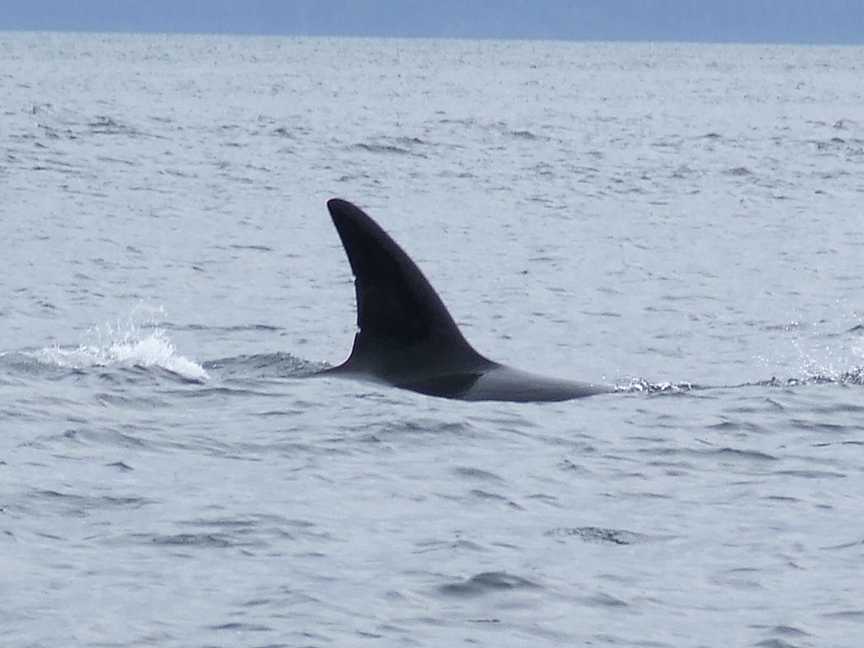
two. I'm pretty confident that one of them was T137A, born in
2002, with two distinctive nicks in his/her dorsal. I also
suspect that T137 was among them (T137A's mother), though the angle on
the dorsal fin isn't ideal for identification. But, a
seven-year-old orca is quite likely to still travel with its
mother and I found no better match for her dorsal. Among this
group was also a juvenile orca; although young
orcas are more difficult to identify that adults, it's quite possible
that this orca, the only one I saw with an unblemished dorsal fin, was
T137B, another offspring of T137, born in 2006. Two others I took
photos of had distinctive doral nicks (like the one to left and the
one traveling with a very young calf in the photo below), but I can't
identify either. Unfortunately, I was on the wrong side of the pod for
the best ID shots.
dropped
the hydrophone
and listened in on a chaotic (to our ears) mix of intense orca
sounds--they were loud, continuous, and overlapping, an endless stream
of crazy orca
vocalizations.
I've never heard anything like it! We paddled over to
Dru so he could share the hydrophone, but he caught only a few seconds
before the ocean went silent again. The orcas clammed up, stopped
milling, and assumed a line formation heading west. We tried to
catch up with them one more time and some of them passed close to our
stern, but it was clear that they were seriously on their way somewhere
else and we decided to let them be. They turned away from shore
and headed
for Point Adolphus and we headed on toward Lynn Canal. These
orcas were a little more difficult to identify than the other
two. I'm pretty confident that one of them was T137A, born in
2002, with two distinctive nicks in his/her dorsal. I also
suspect that T137 was among them (T137A's mother), though the angle on
the dorsal fin isn't ideal for identification. But, a
seven-year-old orca is quite likely to still travel with its
mother and I found no better match for her dorsal. Among this
group was also a juvenile orca; although young
orcas are more difficult to identify that adults, it's quite possible
that this orca, the only one I saw with an unblemished dorsal fin, was
T137B, another offspring of T137, born in 2006. Two others I took
photos of had distinctive doral nicks (like the one to left and the
one traveling with a very young calf in the photo below), but I can't
identify either. Unfortunately, I was on the wrong side of the pod for
the best ID shots.
 Less than an hour later we
reached Swanson Harbor and slipped between Entrance Island and Ansley
Island. Chris and I planned to camp at Entrance Island at the
recommendation of a friend, but Dru wanted to check out the dock
inside. We passed between Entrance and Couverden islands and
turned into a sheltered bay with two public docks just offshore.
There were boats tied up to both, so we pulled up to the less occupied
one. Dru didn't have a stove with him, so we decided to have
supper together on the docks. Dru made amazing creamy macaroni
and cheese and Chris and I had chips and tomato
bisque soup. After supper Chris and I returned to Entrance Island
and Dru anchored up for the night in the harbor and slept on his
boat. Entrance Island has a nice steep beach of medium sized
rocks and we were greeted by hundreds of squirting clams submerged
beneath the rocks when we stepped ashore at low tide. Again, the
water was ridiculously clear and here we could see brittle stars and
sea stars, jellyfish, and lots of other critters. Some areas of
the water were alive with tiny moon jellies. It wasn't the
softest beach for letting the boat go dry, but it looked reasonable and
was definitely out of the wind. We unloaded the gear and carried
it up to the edge of the beach grass and Chris explored the island
while I anchored the boat. I used the same system--a long anchor
line to make sure the boat didn't pull anchor and a shorter anchor off
the stern to help keep it in deeper water as the tide rose in the
middle of the night. Chris came back as I was finished, have
perused the whole island for camp sites. The island isn't very
big, and the forest on top is of a first growth variety, dense at the
edges, open and decaying in the middle. We fought through the
brush and chose a relatively flat site on the far side of the island to
pitch the tent. We packed our camping gear over there and left
the food and other unnecessary items in the grass above the boat.
Chris pitched the tent while I went about gathering fuel for a
fire. The beach facing Icy Strait had a lot of driftwood and a
narrow band of sand and large rounded rocks above an expansive black
and jagged reef. The weather had been clearing all afternoon and
the view was gorgeous as the sun set. After the exciting day we
had,
I didn't last long around the fire and soon crashed in the tent.
I was sound asleep when Chris joined me later.
Less than an hour later we
reached Swanson Harbor and slipped between Entrance Island and Ansley
Island. Chris and I planned to camp at Entrance Island at the
recommendation of a friend, but Dru wanted to check out the dock
inside. We passed between Entrance and Couverden islands and
turned into a sheltered bay with two public docks just offshore.
There were boats tied up to both, so we pulled up to the less occupied
one. Dru didn't have a stove with him, so we decided to have
supper together on the docks. Dru made amazing creamy macaroni
and cheese and Chris and I had chips and tomato
bisque soup. After supper Chris and I returned to Entrance Island
and Dru anchored up for the night in the harbor and slept on his
boat. Entrance Island has a nice steep beach of medium sized
rocks and we were greeted by hundreds of squirting clams submerged
beneath the rocks when we stepped ashore at low tide. Again, the
water was ridiculously clear and here we could see brittle stars and
sea stars, jellyfish, and lots of other critters. Some areas of
the water were alive with tiny moon jellies. It wasn't the
softest beach for letting the boat go dry, but it looked reasonable and
was definitely out of the wind. We unloaded the gear and carried
it up to the edge of the beach grass and Chris explored the island
while I anchored the boat. I used the same system--a long anchor
line to make sure the boat didn't pull anchor and a shorter anchor off
the stern to help keep it in deeper water as the tide rose in the
middle of the night. Chris came back as I was finished, have
perused the whole island for camp sites. The island isn't very
big, and the forest on top is of a first growth variety, dense at the
edges, open and decaying in the middle. We fought through the
brush and chose a relatively flat site on the far side of the island to
pitch the tent. We packed our camping gear over there and left
the food and other unnecessary items in the grass above the boat.
Chris pitched the tent while I went about gathering fuel for a
fire. The beach facing Icy Strait had a lot of driftwood and a
narrow band of sand and large rounded rocks above an expansive black
and jagged reef. The weather had been clearing all afternoon and
the view was gorgeous as the sun set. After the exciting day we
had,
I didn't last long around the fire and soon crashed in the tent.
I was sound asleep when Chris joined me later.
 Gulls and kelp in Icy Strait |
 Harbor porpoise |
 T88 |
 T87 |
 Transient 1 & 2 |
 Transient rolling |
 Transient 2 |
 Transient 1 with calf |
 T137? |
 T137A |
 T137B? |
 Entrance Island |
 Camp |
 Fire on the island |
 Reef at sunset |


 Low
tide was at 10:00 am, so we knew the boat wouldn't be
floating until noon or so. Dru had planned to get up early to
fish and agreed to pick us up at 9:00 am to fish for a few hours before
we headed back to town. I was pretty excited about it, as the
area had been crazy with jumping fish and Dru had had two on while we
were watching the lunge feeders two days before. I drained the
boat and boiled water for hot chocolate while Chris got ready and
cleaned up the tent. We had a quick, light breakfast on the beach
before Dru came by. We headed outside the harbor and Chris and
Dru tried halibut fishing nearby; Chris caught a chicken (which he
released) and we both learned more about fishing for
halibut. I was content to enjoy the morning and let them
fish. After 45 minutes or so and a few repositionings (the
current was active) we decided to switch to salmon fishing. Dru
tutored us and we managed to set the poles. Chris caught the
first pink, and I reeled in the second. It was the first salmon
I'd ever caught trolling! In all I think we caught about five
pinks before we tried for halibut again. Dru caught another
chicken before we headed back to the island to pack up. Dru
watched his boat on
the beach while Chris and I gathered our gear and loaded up. We
pooled our food for a quick picnic lunch on the side of the Ronquil before we left.
Low
tide was at 10:00 am, so we knew the boat wouldn't be
floating until noon or so. Dru had planned to get up early to
fish and agreed to pick us up at 9:00 am to fish for a few hours before
we headed back to town. I was pretty excited about it, as the
area had been crazy with jumping fish and Dru had had two on while we
were watching the lunge feeders two days before. I drained the
boat and boiled water for hot chocolate while Chris got ready and
cleaned up the tent. We had a quick, light breakfast on the beach
before Dru came by. We headed outside the harbor and Chris and
Dru tried halibut fishing nearby; Chris caught a chicken (which he
released) and we both learned more about fishing for
halibut. I was content to enjoy the morning and let them
fish. After 45 minutes or so and a few repositionings (the
current was active) we decided to switch to salmon fishing. Dru
tutored us and we managed to set the poles. Chris caught the
first pink, and I reeled in the second. It was the first salmon
I'd ever caught trolling! In all I think we caught about five
pinks before we tried for halibut again. Dru caught another
chicken before we headed back to the island to pack up. Dru
watched his boat on
the beach while Chris and I gathered our gear and loaded up. We
pooled our food for a quick picnic lunch on the side of the Ronquil before we left.
At about 1:00
pm we headed
out under a blue sky and decided to go straight across Lynn Canal to
the Admiralty shoreline. There was a bit of a chop from the north
as we crossed and I stuck behind Dru when I
could to let him break it
up for me a bit. We reached Funter Bay and turned north and there
the chop was more troubling and slowed us down a bit. I tried to
stay behind Dru, but had trouble catching up to him when I lagged
behind. About half way to Pt. Retreat I saw some tiny, quick
splashing to the left--Dall's porpoises! I'd practically
forgotten that they were a possibility. We veered over in their
direction and skirted
the edge of the pod, which were "zooming," in the hopes that they'd be
interested in riding our wakes. A pair rode the stern wake a
couple of times, but they were otherwise disinterested. I hadn't
seen DPs in a long time, and these were a first for Chris.
A little
farther north and
a couple of points away from Retreat we started to run into sport
fishing boats. Ahead of us I saw a clump of whale blows close to
shore and wondered whether we might have another group of lunge feeders
in our future. A few minutes later, about ten whales exploded out
of the water just between us and shore and I immediately shut
down. It was spectacular. They weren't coming out as high
as the ones in the group we'd seen at the Couverdens, but the sheer
number of them was impressive and the day couldn't have been better for
it. By that time the water was calm and we just drifted with the
current in the sunshine. They moved south along the shore
during their breathing cycle; we were slowly drifting in that
direction too, but they'd put some space between us by the time they
dove.
I expected
them to come up much farther away, but instead they came up
in the exact same place again, not far away. Several times they
traveled south while breathing, only to turn underwater and lunge in
the same place. Eventually they repositioned a little farther
north and
started making their way south again. When there were few other
boats around, we dropped the hydrophone just as the whales dove.
Silence. More silence. Then more silence. I was
beginning to think that the whales weren't going to lunge at all when
a shrill bellow erupted, and another, and another, wavering toward the
end in terrifying screams Then silence
again, and moments later
the whales lunged. It was spectacular. The proximity of
boat motors and other complications discouraged us from trying to
listen again, but it had been the loudest, clearest bubblenet call I'd
heard (probably because I had my own private hydrophone this
time). The whales repositioned a couple of times, and so did
we. Once Dru wound up just between us and the group and I got
some pretty good pictures of them. On many of the lunges, a whale
came up alongside the group (maybe 20-30 feet away) simultaneously, but
not lunging, then would get absorbed among the other whales. He
was pretty small, so we wondered if he was a calf
whose mother was among the bubblenetters.
At 3:00 pm it was getting
pretty crowded with boats and we decided we'd better head
in. The high tide was at 4:00 pm and Chris and I wanted to run
the
channel given that we didn't have a functional
trailer at Douglas. We talked about one of us driving the truck
back, but decided to pick it up the next day. I'd only run the
channel once before and found it a little nerve wracking (I spent some
time aground in the middle of it waiting for the
tide to rise). This time the tide was significantly higher, but
my mother had mentioned that she'd seen the channel markers from the
air earlier in the summer and noticed that they
didn't line up with the actual channel in some areas! But, it was
going to be a pretty high tide, so I wasn't concerned. We touched
base with Dru at South Shelter, then we parted ways and Chris and I
headed to town. We passed a marker that indicated that the
shallowest point in the channel was five feet, then we zoomed on our
way, passing quite a few fishing boats headed in the other direction
and one or two heading to town. I didn't realize that so many
boats still made use of the channel. Everything was pretty
flooded, but we had fun following the channel markers until we shot out
past the hatchery and into deeper water. I had to change gas
tanks there and took that opportunity to try the satellite phone to ask
my parents for a ride home from the harbor, but got no signal. We
passed Aurora and Harris Harbors slowly, then got back up to speed for
the last leg to Douglas Harbor, arriving around 5:00 pm. We
secured the boat, then Chris started packing our gear up the ramp while
I asked around for a cell phone. The first guy I asked lives on a
boat and took my inquiry as an invitation to chat a little about his
choice not to own a cell phone and the future of the harbor; the next
couple had left their cell phones at home. Finally, I disturbed a
young couple sunbathing on the back of a sailboat. The man's
first response to my question was to ask if I was with Fish & Game,
but I managed to derail further suspicions by confessing that my cell
phone had dropped into a portapotty. The woman lent me her phone
immediately and I got ahold of my parents. A few minutes later,
my mother arrived to get us and home we went, with enough time for
showers and a moment to relax on the couch before showing up to a going
away party at Auke Rec, exhausted and sunburnt and dazed from the
amazing trip. Icy Strait! It was
everything I'd imagined it could be and more!
 Towards the ends of a lunge |
 The group |
 |
 |
 |
 |
 |
 |
 Heading down Gastinuea Channel |
 Stealth whale fluking at Point Adolphus (Point Adolphus on the very left, Lemesurier Island in the distance to the left, ) |